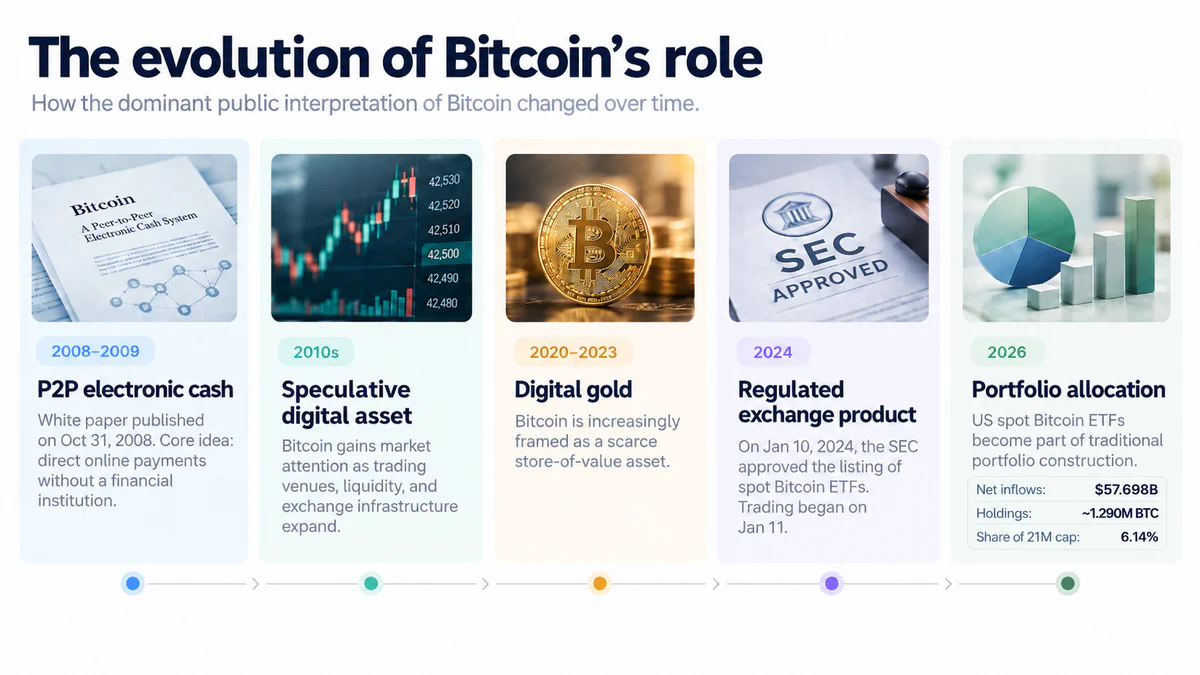
In the original white paper by Satoshi Nakamoto, Bitcoin was described not as an investment tool but as "peer-to-peer electronic cash"—a system allowing two parties to make payments directly without a financial institution between them. The proposal was not about creating a more profitable asset but about replacing trust in an intermediary with cryptographic proof.
However, as the market evolved, perceptions of Bitcoin changed. Its limited supply became a convenient basis for another narrative—the digital analogue of gold.
There will never be more than 21 million BTC in the network. The block reward is halved approximately every four years: after the 2024 halving, it will be 3.125 BTC, with the next expected in 2028. New issuance is expected to gradually decrease until around 2140.
The predictability of supply, the absence of a central issuer, and the ability to store the asset independently made the comparison to gold understandable even for the traditional financial market.
On July 5, 2023, BlackRock CEO Larry Fink articulated this idea very clearly in an interview with Fox Business:
In many ways, the role of cryptocurrency is to digitize gold.
For Bitcoin, this was a symbolic moment. A concept that had long existed primarily within the crypto market began to be used by the head of the world's largest asset management company.
However, limited supply alone does not make an asset a safe haven. Scarcity answers the question of how many units of an asset can exist. In financial research, a safe haven is typically an asset that shows zero or negative correlation with the market during periods of stress, thereby reducing portfolio losses. In this respect, Bitcoin's similarity to gold is significantly less obvious.
Bitcoin is no longer outside the traditional financial system
On January 10, 2024, the SEC approved the listing and trading of shares of several spot Bitcoin ETPs on U.S. national exchanges. Trading of approved spot Bitcoin ETP shares on U.S. national stock exchanges began on January 11, 2024. This changed the very way of accessing the asset.
Investors no longer need to open an account on a crypto exchange, create a wallet, store a seed phrase, and be responsible for private keys themselves. Exposure to BTC prices can be obtained through the same brokerage account that holds stocks and bond funds.
BlackRock directly describes its iShares Bitcoin Trust as a tool that simplifies the operational and custodial complexities of direct Bitcoin ownership.
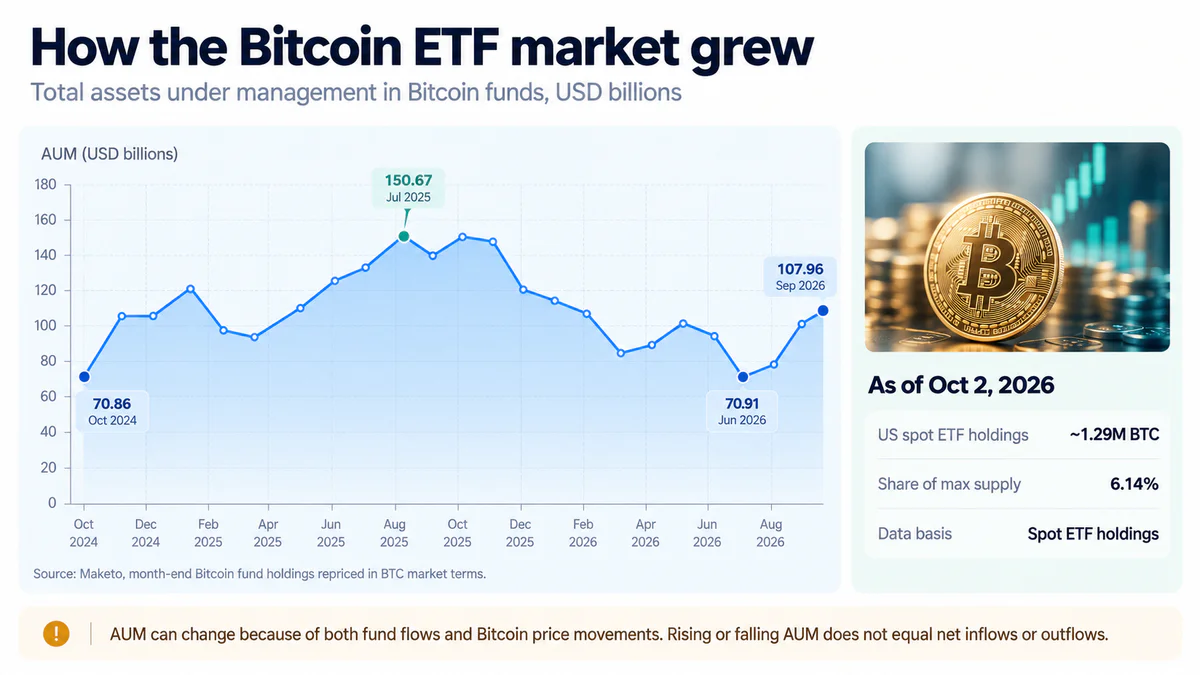
The scale of the new infrastructure is already hard to consider niche. According to Farside Investors, by October 2, 2026, the cumulative net capital inflow into U.S. spot Bitcoin ETFs since their launch reached approximately $57.7 billion.
According to Bitbo, as of the same date, 13 U.S. Bitcoin ETFs controlled about 1.29 million BTC, or approximately 6.14% of the maximum 21 million coins.
Institutionalization is also happening outside of ETFs. By the end of September 2026, Strategy controlled 847,666 BTC. At the end of the second quarter of 2026, 1,484 investment managers reported positions in iShares Bitcoin Trust totaling about $11.6 billion in their 13F filings.
Even before the fund's approval, Fink explained the motivation of the traditional financial industry as follows:
In the realm of cryptocurrencies, we strive for greater democratization [...] and to make this process significantly cheaper for investors.
Larry Fink, CEO of BlackRock. Source — Fox Business, The Claman Countdown, July 5, 2023
But at this point, a fundamental contradiction arises. Bitcoin offered to do away with the need to trust a financial intermediary. Yet one of the main factors in its mass investment accessibility today is the emergence of highly convenient financial intermediaries. However, this does not mean that ETFs change the network itself. Rather, they change the way a significant portion of capital interacts with it.
The closer Bitcoin gets to Wall Street, the more it behaves like a risky asset
If Bitcoin is digital gold, it is logical to expect that during market stress, it will at least partially perform the same function as safe-haven assets.
Historical data provides a much more complex answer.
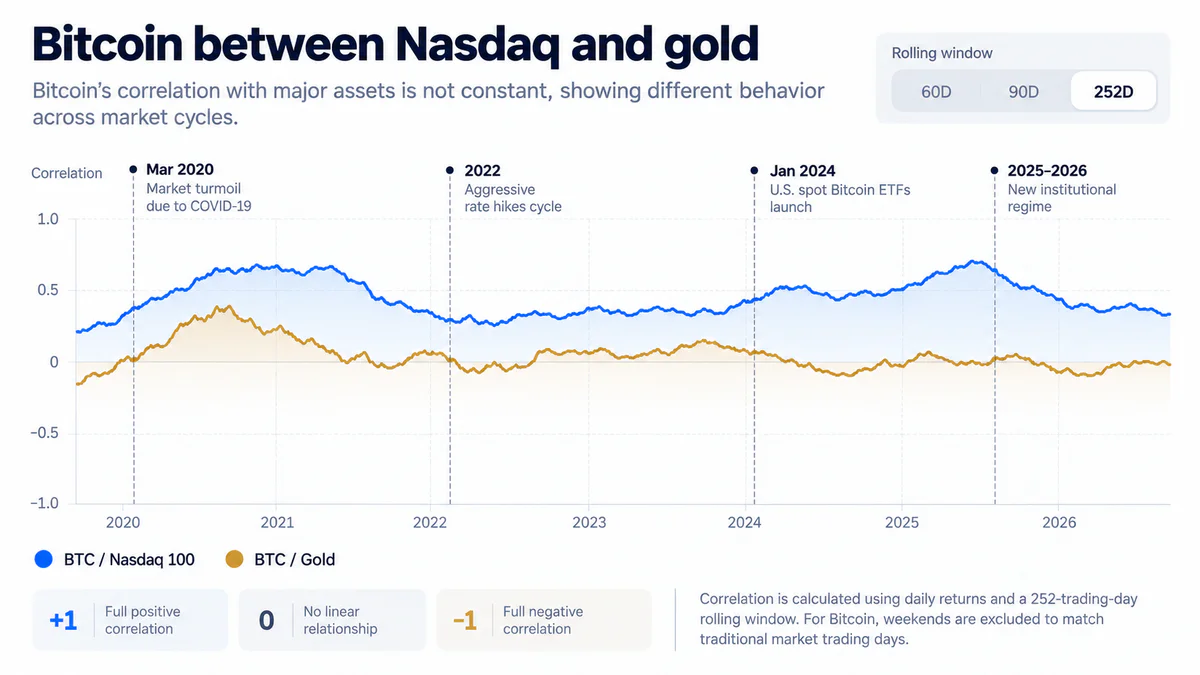
Analysis by CME Group shows that since 2020, crypto assets have maintained a positive correlation with the Nasdaq 100. It has varied over time—from about 0.1–0.2 during periods of weak connection to 0.35–0.60 in 2025 and early 2026. At the same time, the correlation with gold has been around zero since 2024. Even during the most noticeable connection period in 2020–2021, the 12-month rolling correlation with gold did not exceed approximately 0.41.
The mere fact of correlation with tech stocks does not turn Bitcoin into a Nasdaq analogue. The connection is unstable and changes with the macroeconomic regime.
A study published in Finance Research Letters in January 2026 concluded that Bitcoin's properties as a safe asset are heterogeneous. The authors found safe-haven properties during certain medium-term shocks but simultaneously recorded an increase in connectedness with other markets and a sharp decline in similarity to gold in the new market regime.
Another study from Finance Research Letters, published in September 2026 and using data up to February 2026, obtained an even stricter result. During stress on the U.S. market, Bitcoin generally moved with stocks rather than against them. The authors found no consistent protection against stock market crashes.
A similar result was obtained during the escalation of the conflict around Iran in 2026: a study by Economics Letters found no consistent safe-haven properties for Bitcoin in the observed window.
However, concluding that BTC is always an ordinary risky asset would also be a mistake. A study of informational links between Bitcoin, the S&P 500, gold, and oil, published in September 2026, shows no stable long-term connection between Bitcoin and traditional assets. Interdependence arises and disappears depending on regulatory actions, liquidity, and specific macroeconomic episodes. This instability is more important than a simple label.
During one crisis, Bitcoin may move with the stock market and react more strongly to market stress, while during another, it may show a noticeably weaker connection to stocks. Therefore, the thesis of "digital gold" cannot be tested with a single correlation over the entire historical period.
Flows into Bitcoin ETFs can vary significantly from week to week. From September 21 to 25, 2026, U.S. spot Bitcoin ETFs received about $2.39 billion in net inflows. During the following trading week from September 28 to October 2, the total inflow decreased to approximately $83 million, with funds recording a one-day outflow of $148.7 million on September 30.
For an asset increasingly included in the portfolio decisions of large investors, the state of the traditional market is becoming harder to ignore.
Institutionalization creates a Bitcoin paradox
The arrival of traditional finance has obvious advantages.
ETFs lower the technical barrier to entry. Regulated infrastructure simplifies reporting and storage. Large asset managers provide access to the asset for clients who would never work with a cryptocurrency wallet on their own.
Liquidity and market legitimacy are growing, but with them, the pricing mechanism is also changing. When Bitcoin is in a portfolio alongside stocks, bonds, and commodities, decisions about buying and selling it are made within the framework of overall risk management. A decline in risk appetite, rising bond yields, changes in rate expectations, or the need to reduce leverage can affect several asset classes simultaneously.
Bitcoin, however, does not cease to be Bitcoin.
An ETF cannot increase the issuance limit. BlackRock does not control consensus rules. A wallet owner can still send BTC to another user without the permission of a fund, bank, or broker.
Therefore, institutionalization creates not so much a new Bitcoin as two different models of interaction with the same asset.
The first is Bitcoin as a network. The user controls the keys, can make transactions, and interacts directly with the protocol.
The second is Bitcoin as a financial product. The investor buys a regulated instrument, gains price exposure, and delegates storage to other infrastructure participants.
In the first case, the key property is independence from an intermediary. In the second, it is the convenience of the intermediary. This is one of the main paradoxes of modern Bitcoin.
Bitcoin seeks a new place in the investment portfolio
Integration into traditional finance gradually changes the very question investors ask about the asset. Previously, the debate was often framed as "Bitcoin or gold." Now these instruments are increasingly seen not as mutually exclusive.
In 2024, Paul Tudor Jones, founder of Tudor Investment Corporation, explained his position as follows:
I hold long positions in gold and Bitcoin.
Paul Tudor Jones, founder of Tudor Investment Corporation. Source — CNBC Squawk Box, October 22, 2024
In the same interview, he spoke about a basket of gold, Bitcoin, commodities, and Nasdaq. In this logic, BTC does not replace the traditional safe-haven asset but takes a place alongside it.
Asset management companies come to a similar conclusion. BlackRock Investment Institute calls 1–2% a reasonable range of exposure to Bitcoin in a hypothetical 60/40 portfolio, based on the asset's contribution to overall portfolio risk. According to the company's calculations, in a classic 60/40 portfolio, a 1% share of Bitcoin provided about 2% of total risk, 2% about 5%, and at 4%, its contribution to risk increased to 14%.
In August 2026, BlackRock updated its analysis and reported that over a historical ten-year period, adding Bitcoin at a 1–2% share improved the risk-adjusted return of a traditional 60/40 portfolio. This is a retrospective result, not a forecast of future returns.
Fidelity Digital Assets reached a similar conclusion: in its ten-year modeling, adding BTC increased not only returns and volatility but also Sharpe and Sortino ratios. The most noticeable increase in risk-adjusted return metrics was observed when the share of Bitcoin in the portfolio increased from 1% to 3%.
Data from WisdomTree for the period from the end of 2013 to the end of 2025 also shows the effect of a small share of the asset. For a global 60/40 portfolio, the calculated annual return was 6.40% with a volatility of 8.76% and a Sharpe ratio of 0.52. With 1% Bitcoin in the portfolio, the figures were 7.01%, 8.83%, and 0.59, respectively; with 3%, 8.23%, 9.12%, and 0.70; with 5%, 9.44%, 9.57%, and 0.80.
Historical returns do not guarantee a repeat of these results. Moreover, Bitcoin's high volatility means that increasing its share quickly changes the risk profile of the entire portfolio.
But the very framing of the question has already changed.
To become part of a traditional portfolio, Bitcoin does not necessarily have to prove it is better than gold. It is enough for it to perform its own function—providing a source of return and risk that does not fully coincide with other asset classes.
In this case, the definition of "digital gold" becomes more of a characteristic of the asset than a complete investment model.
Does Bitcoin lose its meaning as it succeeds?
The most complex question arises not from price or correlations but from how people use Bitcoin.
The white paper began with the idea of electronic money that allows parties to make payments directly without a financial institution. Modern statistics show a completely different demand structure.
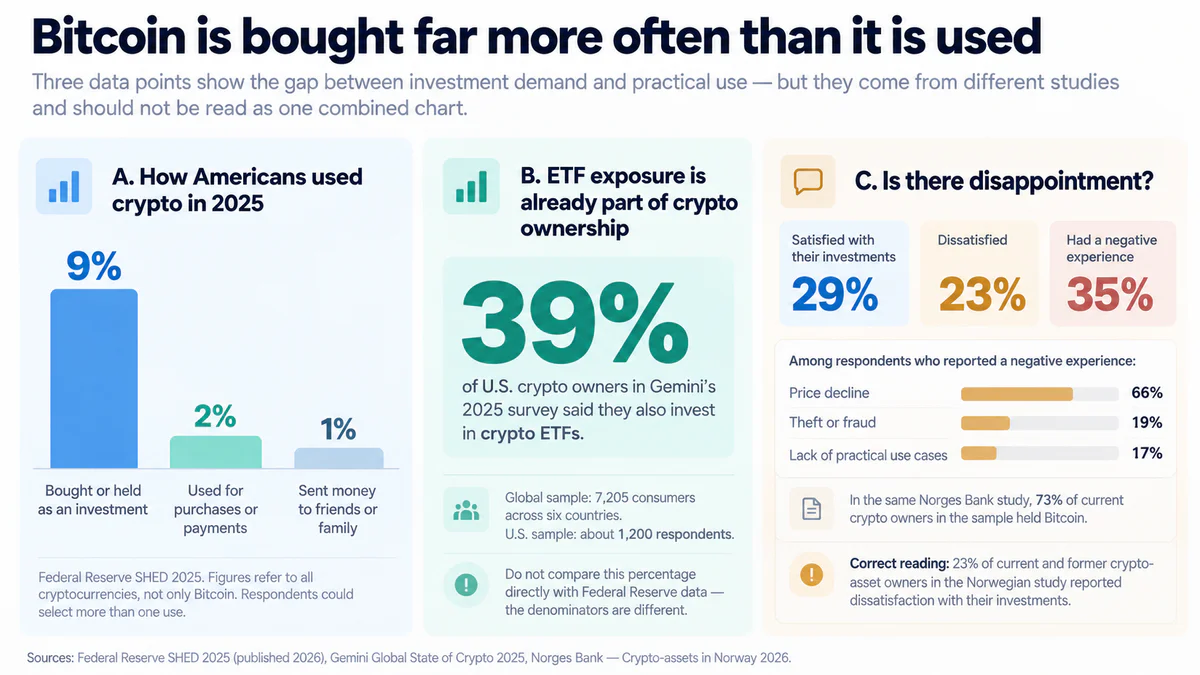
According to the Federal Reserve, in 2025, 9% of American adults bought or held cryptocurrency as an investment. It was used by 2% for purchasing goods or payments and by 1% for transferring money to friends and family. The data applies to all cryptocurrencies, not just Bitcoin, but the gap between investment and payment functions is evident.
At the same time, interest is growing in instruments that do not require interaction with the blockchain at all. In a 2025 Gemini survey, 39% of American cryptocurrency holders reported investing in cryptocurrency ETFs as well.
It turns out that "owning the economic outcome of Bitcoin" and "using Bitcoin" are already two different things.
For an ETF client, private keys are not needed. They cannot withdraw a fund share to their own address or send it to another user. The investor gains price exposure to Bitcoin, while the fund and its counterparties handle the storage of the underlying asset and other infrastructure.
This shift is what worries some early technology advocates.
Jack Dorsey, co-founder of Twitter, Block Head, and chairman of the board of Block, responding in 2025 to a question about how Bitcoin could theoretically fail, said:
I think it fails due to a loss of relevance. It just ceases to be significant to people in their daily lives.
Jack Dorsey. Source — Presidio Bitcoin, interview 21 in 21, April 2025
His argument is that one function of a store of value is not enough. Without daily payment use, Bitcoin risks becoming something people just buy and hold.
Dorsey previously spoke directly about institutionalization:
Attention is now focused on ETFs. It is distracted by players like BlackRock.
Jack Dorsey. Source — Citadel Dispatch, episode CD150, January 2025
At the same time, he emphasized that the arrival of large financial companies does not change the open nature of the Bitcoin network: using it still does not require permission from a bank, fund, or other intermediary.
Are there signs of regret among the owners themselves?
A survey by Norges Bank does not allow us to speak of widespread disappointment in Bitcoin: it covers owners of various crypto assets and assesses satisfaction with investments rather than attitudes toward Bitcoin's original idea.
The 2026 Norges Bank study shows that among current and former crypto asset owners in Norway, 29% were somewhat or very satisfied with their investments, while 23% were somewhat or very dissatisfied. 35% reported negative experiences. Among respondents with negative experiences, 66% cited a drop in value, 19% theft or fraud, and 17% a lack of opportunities to use crypto assets as a means of payment in the traditional economy. At the same time, Bitcoin remained the most common asset: 73% of current crypto asset owners held it.
This is not a survey exclusively of Bitcoin owners and not proof of disappointment for the entire audience. But the "lack of use options" indicator is important precisely in the context of the technology's original promise.
Within the market, there are effectively two definitions of success. For one camp, Bitcoin should become a usable global monetary network. For the other, it is enough for it to become a major store of capital.
The second position was most vividly articulated by Michael Saylor in July 2026:
I think the market has made it clear that the most effective use [of this asset] is as a store of value or a capital transfer network.
Michael Saylor, Executive Chairman of Strategy. Source — Strategy Q2 2026 earnings call, July 30, 2026
Notably, by the end of September 2026, Strategy controlled 847,666 BTC. For its model, Bitcoin as digital capital is not a compromise with the original idea but an independent end scenario for the asset's development.
This results in a fundamental debate. Dorsey fears that Bitcoin's success as a store of value could make everyday use of the network secondary. Saylor believes the market has already defined the store of value as the most valuable application. Both sides are talking about the same protocol.
Bitcoin's victory as an asset may be a defeat for the original idea
Bitcoin remains a scarce asset without a central issuer. The maximum supply has not changed. Users can still store keys independently and send BTC without a banking intermediary. But the economic system around it has become different.
Today, a significant portion of Bitcoin is held within the structure of exchange-traded products, and banks, funds, investment managers, and companies gain direct or indirect exposure to the asset. For millions of investors, interaction with the asset may begin and end in the interface of a regular broker.
At the same time, research does not confirm a simple model in which BTC always behaves like gold. During some shocks, it moves with risky assets, while in other regimes, the correlation weakens. Its function in the portfolio becomes independent and depends not only on limited issuance but also on global liquidity, the composition of holders, and the behavior of institutional capital.
Therefore, the main question today is no longer whether Bitcoin remains digital gold. A more interesting question is what constitutes its victory.
If the goal was to create a global scarce asset that the traditional financial system would be forced to recognize and include in portfolios, the process of institutionalization looks like confirmation of success.
If the goal was to build a widely used alternative to financial intermediaries, the picture is less clear. An investor can today gain exposure to Bitcoin without ever using the network's properties for which it was created.
Perhaps both versions will continue to exist in parallel—Bitcoin as an open monetary network and Bitcoin as institutional digital capital.
And then the question defining the next stage of its development sounds different.
When traditional finance buys Bitcoin, who ultimately changes whom—Bitcoin changes the financial system, or the financial system changes Bitcoin?
This material is prepared solely for informational purposes and does not constitute financial advice or a recommendation.
Related articles