
Why the November expiration differs from October's
The November expiration of Bitcoin options is lower in nominal contract value than October's: about $7 billion versus $10.8 billion. However, more significant changes have occurred in the structure of open positions. In October, large positions were concentrated in call options with strikes of $90,000–100,000, whereas in November, the relative share of put options has increased.
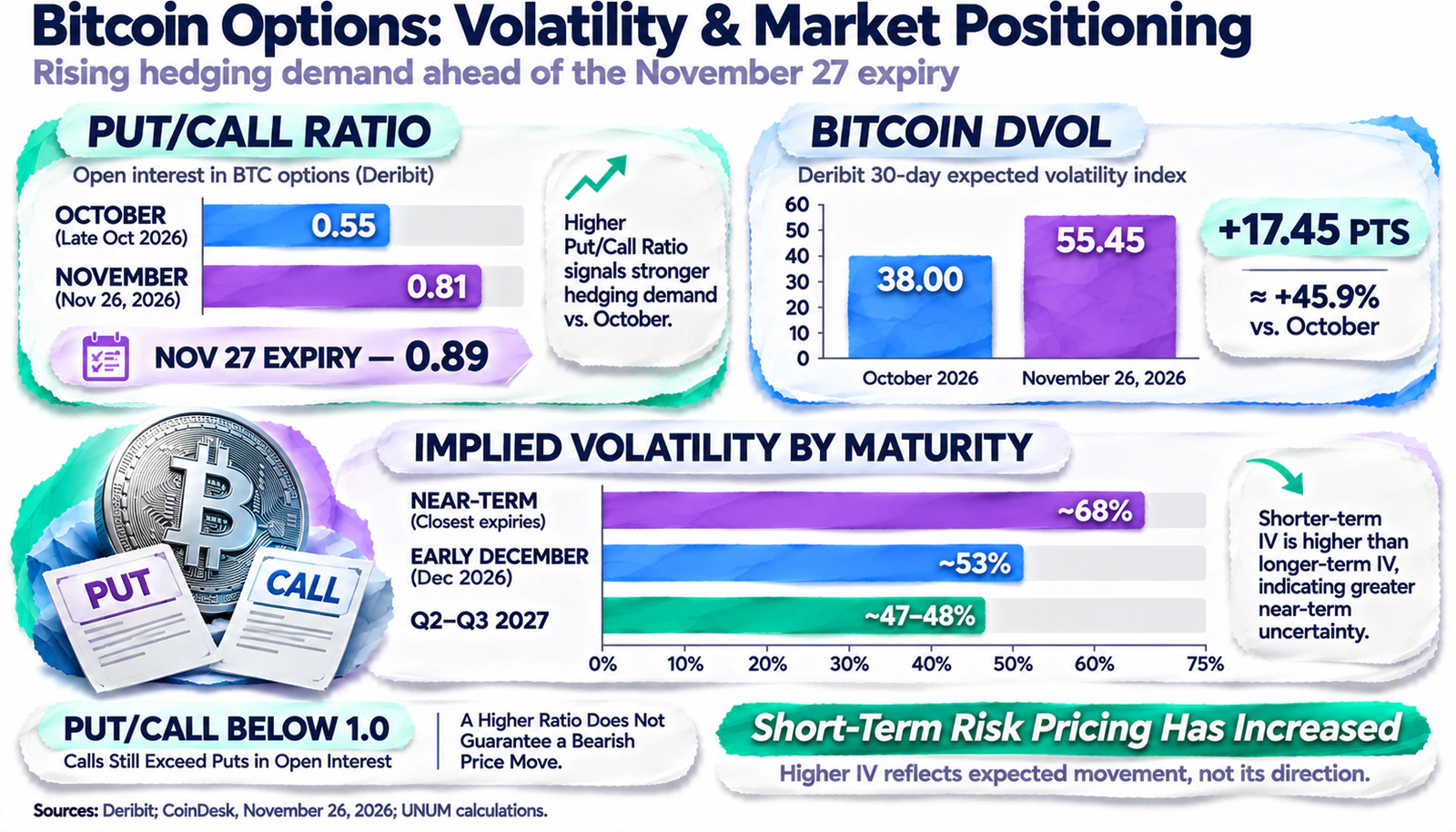
One indicator of this change is the Put/Call Ratio — the ratio of open interest in put options, which give the buyer the right to sell an asset at a set price, to call options, which give the right to buy it. At the end of October, the indicator for the entire BTC options market on Deribit was 0.55, and by November 26, it had risen to 0.81.
The ratio of open interest in BTC put and call options across all expiration dates has sharply increased to 0.81 (and for the November 27 expiration — to 0.89).
However, the ratio remains below one, so it is incorrect to speak of a quantitative predominance of put options. Its growth indicates a change in the structure of open interest but does not allow us to determine how many participants are betting on a Bitcoin decline and how many are hedging existing investments.
This restructuring of the options market continues trends that UNUM examined in the analytical review of October's results: deteriorating liquidity, reduced investor risk appetite, and growing uncertainty about the recovery of cryptocurrencies.
How options expiration affects Bitcoin's value
Expiration is the end of the term of a derivative financial instrument. At expiration, options with positive intrinsic value are exercised according to the contract terms, while others expire without payout upon execution. The result depends on the relationship between the settlement price of the underlying asset and the strike — the pre-established execution price.
Suppose an investor purchased a put option on Bitcoin with a strike of $70,000. If the settlement price of BTC at expiration is $60,000, the intrinsic value of the option is $10,000 per 1 BTC. For Deribit's inverse option, this corresponds to a payout of about 0.1667 BTC before accounting for premiums and fees.
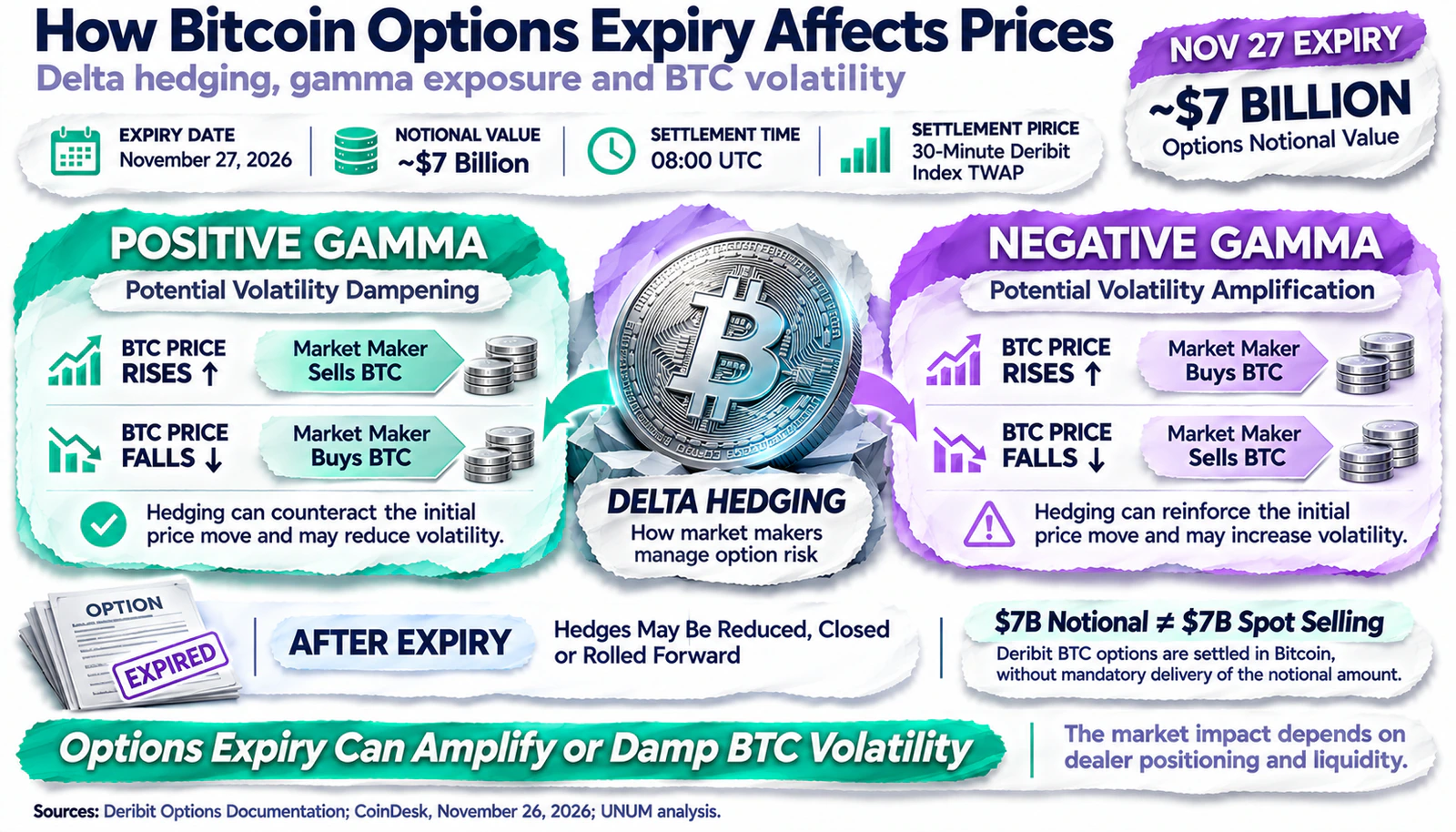
According to Deribit documentation, since August 1, 2026, inverse options with positive intrinsic value at expiration are first converted into inverse futures with the same expiration date, after which they are immediately settled in BTC. The final financial result is equivalent to direct settlement execution. Expiration occurs at 08:00 UTC, and the settlement price is determined as the time-weighted average of the Deribit index from 07:30 to 08:00 UTC.
Therefore, an expiration of $7 billion does not mean that transactions with Bitcoin of a comparable amount will automatically be made on the spot market or that investors will simultaneously withdraw such a volume of capital.
One of the key mechanisms of potential expiration impact on price is related to the adjustment of hedging positions by market makers — professional participants providing market liquidity. To reduce their portfolio's sensitivity to BTC price changes, they may open offsetting positions on the spot market or use Bitcoin futures. This approach is called delta hedging.
The nature of these operations depends on gamma exposure, reflecting the sensitivity of the option portfolio's delta to changes in the underlying asset's price.
Positive gamma. When maintaining a delta-neutral position, the market maker sells the asset when the price rises and buys when it falls, potentially dampening volatility.
Negative gamma. The market maker buys the asset when the price rises and sells when it falls, which can amplify the initial market movement.
After expiration, the need for some hedging positions disappears, although some participants open similar positions for later expiration dates. Depending on the structure of the closed hedging positions, the price sensitivity to new purchases and sales can either increase or decrease. Without reliable information about the aggregate positions of market makers, it is impossible to determine the direction of such impact in advance.
What price levels market participants are targeting
The distribution of open interest in Bitcoin options allows for an assessment of the strike prices where market participants' positions are concentrated.
In the November expiration, according to Deribit data from November 26, significant open interest in put options is concentrated at strike prices from $63,000 to $75,000. When considering all expiration dates, large positions are also found at strikes of $60,000, $58,000, $50,000, and $40,000.
The presence of such contracts does not necessarily mean that investors expect Bitcoin to fall to $40,000. For example, a large BTC holder might purchase relatively inexpensive put options with a low strike price to protect capital from an unlikely but potentially devastating market drop.
The Max Pain indicator deserves special attention — it is the calculated strike price at which the total intrinsic value of expiring options is minimal.
According to a snapshot of Deribit data published by Castle Labs on November 26, the Max Pain level was $70,000 with the BTC index at $60,559. To reach this mark, Bitcoin would need to increase by approximately 15.6%. The Max Pain estimate can change as options positions are closed and opened.
The Max Pain theory suggests that positioning and hedging features may contribute to the price approaching certain strike prices. However, this mechanism does not guarantee reaching the calculated level and does not fully account for spot demand, macroeconomic events, and participants' positions on other trading platforms. Therefore, $70,000 should be viewed as a characteristic of the current options distribution, not as a Bitcoin price forecast.
Why the market is pricing in increased risks for the coming weeks
In addition to the number of open contracts, their cost contains important information. One of the key indicators of the options market is implied volatility (IV), which reflects the scale of future price fluctuations embedded in the cost of options.
The DVOL index of the Deribit cryptocurrency exchange measures the implied volatility of Bitcoin for the next 30 days on an annualized basis. As of November 26, according to CoinDesk, the indicator reached 55.45 compared to 38 in October.
The term structure of volatility has also changed. For the nearest expiration dates, the indicator reached approximately 68%, for early December — 53%, and for contracts expiring in the second and third quarters of 2027 — 47–48%.
Such an inversion of the term structure, called backwardation, means that the annual implied volatility of short-term options is higher than that of long-term ones. This indicates an increased assessment of short-term risks but does not imply a greater absolute range of price movement over a short period. High implied volatility just before expiration may also depend on the pricing features of contracts with minimal remaining term.
To determine the relative cost of downside protection, traders use the 25-Delta Skew — the difference in implied volatility between put and call options with the same expiration date and an absolute delta value of about 0.25. The sign of the indicator depends on the order of subtraction adopted. If the implied volatility of comparable put options is higher than that of call options, the market is pricing in a higher relative cost of protection against a BTC decline.
The combined analysis of DVOL, Put/Call Ratio, and Skew helps assess market positioning, hedging costs, and investor expectations. However, even a pronounced demand for protective options does not mean that a price decline is inevitable.
How Bitcoin reacted to previous major expirations
To find out what historical data from the cryptocurrency derivatives market can provide for analyzing Bitcoin post-expiration, UNUM compared BTC dynamics after six previous monthly expirations on Deribit.
For comparison, UNUM used CoinLab data on the BTC/USDT trading pair on Binance at the time of expiration, one hour after, and one day after.
Expiration Date | In 1 hour | In 24 hours |
|---|---|---|
May 29, 2026 | +0.17% | +0.03% |
June 26, 2026 | −0.47% | +0.03% |
July 31, 2026 | −0.18% | −1.41% |
August 28, 2026 | −0.18% | −2.55% |
September 25, 2026 | +0.44% | +0.09% |
October 30, 2026 | −0.20% | −1.06% |
Source: CoinLab. Comparison and calculations by UNUM.
In three out of six cases, Bitcoin traded higher a day after expiration, but in all three cases, the increase did not exceed 0.09%. The average absolute price change was about 0.27% in the first hour and 0.86% in a day.
A broader sample from CoinLab, covering 58 expirations, also does not show a consistent directional movement: in 29 cases, Bitcoin traded higher a day later. The average absolute price change in the first hour after contract execution was 0.31% compared to 0.30% in a regular hour.
However, the absence of a consistent directional pattern does not rule out the short-term impact of derivatives on the market. Dustin Weiss, Robert Gaudiosi, Z. Ivy Zhou, and Robert Webb in the study Bitcoin option expiration, gamma exposure, and intraday price reversals, published in Finance Research Letters in 2026, identified statistically significant intraday BTC price reversals near expirations.
The most pronounced effect was observed with a high concentration of open interest at strikes close to the market price and negative aggregate gamma exposure.
The historical sample of six expirations is descriptive and does not establish a causal relationship between contract execution and BTC movement. Scientific studies, however, indicate the presence of short-term effects under certain conditions. BTC options market data helps form a forecast for Bitcoin movement but does not reliably determine the price direction several weeks ahead.
Why Cryptocurrency Market Liquidity Might Be More Important Than Expiration Size
The consequences of adjusting options and futures positions largely depend on the market's ability to absorb trading flows. The fewer the available buy and sell orders, the more significant individual large operations can impact Bitcoin's price.
An additional pressure factor remains the capital outflows from U.S. spot Bitcoin ETFs. On November 25, these funds recorded a net outflow of $453 million, and from November 1 to 25, the total net outflow was about $5.39 billion.
As noted in the UNUM investor calendar for November 23–27, the expiration coincides with a shortened trading week in the U.S. According to the NYSE calendar, on November 27, after Thanksgiving (November 26), the main stock market will close at 1:00 PM New York time. The shortened trading session may limit the activity of individual cryptocurrency market participants, but the actual state of liquidity needs to be assessed by the order book depth and trading volumes.
In the joint analysis by UNUM and Tradex for risk management in Bitcoin trading, special attention should be paid to the order book depth, spot volumes, perpetual futures funding rates (Funding Rate), and liquidation dynamics. It is the combination of these indicators that allows assessing whether the price movement is supported by real demand or primarily by position restructuring in the derivatives market.
The relationship between spot demand and derivatives was further explored in the UNUM article "Bitcoin's Growth Relies on Futures. What's Next for BTC".
Three Scenarios for Bitcoin Movement After Expiration
Considering the current positioning in the options market, increased implied volatility, and uncertainty regarding capital return, three main scenarios can be outlined for the development of events until the end of December.
Bitcoin Recovery
The completion of the November expiration may reduce the need for some hedging positions. If Bitcoin ETF outflows simultaneously weaken, spot demand recovers, and the relative cost of protective options decreases, the market will have the prerequisites for more sustainable growth.
Confirmation of this scenario will be an increase in price amid rising spot demand without signs of excessive leverage in the futures market.
Market Consolidation
Participants may close November positions and open similar positions in December contracts, maintaining a cautious approach to risk. In the absence of significant capital inflows or outflows, Bitcoin may continue to move within a limited range.
Consolidation will be indicated by price stabilization within a certain range, a decrease in short-term implied volatility, and the absence of a pronounced demand and supply imbalance.
Continuation of the Crypto Market Correction
If demand for protective options persists, Bitcoin ETF outflows continue, and market liquidity remains constrained, the closing of November contracts will not eliminate the main causes of pressure on BTC.
In this case, further price decline may be accompanied by forced liquidations of long futures positions. The combination of these factors was examined in detail in UNUM's analysis on why Bitcoin's decline cannot be explained solely by ETF outflows.
Key Indicators to Monitor After November 27
After the expiration, investors' attention will gradually shift to the December options market. To assess the further direction of Bitcoin, several groups of indicators should be monitored:
Put/Call Ratio and Open Interest. These will show how the structure of positions changes after the closing of November contracts and the opening of contracts with later expiration dates.
DVOL and 25-Delta Skew. These will help determine changes in expected volatility and the relative cost of downside protection.
Distribution of December Strikes. This will allow identifying new zones of concentration for options positions.
Spot Volumes and Market Depth. These will help assess the sustainability of demand and the market's ability to absorb large trades.
Funding Rate and Futures Open Interest. These will help assess the relative demand for long and short positions and the change in the volume of active contracts. Additional data, including liquidation statistics, are needed to assess leverage risks.
Bitcoin ETF Flows. These will show the dynamics of capital movement through U.S. spot exchange-traded funds.
A particularly important event will be the quarterly expiration on December 25, 2026, on Deribit. The redistribution of open interest in favor of December contracts will allow assessing whether current market participants' concerns persist after the completion of November settlements.
Can Expiration Be a Turning Point for Bitcoin
The November options expiration of $7 billion can change the hedging structure and become a catalyst for short-term price movements. However, historical data does not confirm the existence of a stable pattern that would allow predicting Bitcoin's direction solely based on the completion of options contracts.
For a sustainable reversal, demand recovery, liquidity improvement, and capital flow stabilization are required. These conditions, rather than the nominal expiration volume, will determine Bitcoin's further prospects.