On October 21, 2026, the Office of the Comptroller of the Currency (OCC) published the final rules for implementing the GENIUS Act. The document sets federal requirements for the issuance of payment stablecoins, the composition of reserve assets, token redemption, risk management, and oversight of issuers. The new regulation will take effect on January 18, 2027.
For the cryptocurrency market, this means a gradual shift from fragmented requirements to a more defined federal control system. Issuers of payment stablecoins subject to the GENIUS Act will need to comply with established standards of financial stability and transparency. Simultaneously, the regulation opens new opportunities for banks and financial organizations that view digital dollars as a tool for international settlements and payments.
The US Secretary of the Treasury called the adoption of the law an important milestone in the development of the American financial system:
The GENIUS Act marks a turning point in American finance, further solidifying the United States' position as the global capital of cryptocurrency.
However, the significance of the GENIUS Act extends beyond cryptocurrency regulation. Stablecoins serve as one of the primary sources of liquidity in cryptocurrency markets, are used for cross-border transfers, and allow financial companies to create blockchain-based payment services. Therefore, the new rules could impact not only issuers of USDT and USDC but also the competition between traditional banks and cryptocurrency platforms.
What is the GENIUS Act and why is the US changing stablecoin regulation
The GENIUS Act, or Guiding and Establishing National Innovation for U.S. Stablecoins Act, is a federal law on stablecoins that forms the regulatory framework for the issuance and circulation of payment digital dollars in the US. It was passed on July 18, 2025, after which American regulators began developing subordinate rules.
Stablecoins are digital tokens whose value is pegged to a specific asset, most often the US dollar. Unlike Bitcoin and other cryptocurrencies with floating rates, payment dollar stablecoins are intended to maintain a relatively stable value, usually around one dollar per token.
However, the stability of the rate depends on the reliability of reserves, the possibility of redemption, and trust in the issuer. Even if a company claims full backing of issued tokens, it is important for holders to understand what assets are included in the reserves, how quickly they can be converted into cash, and who controls the fulfillment of obligations.
These questions are central to the new American legislation. The GENIUS Act defines the range of organizations allowed to issue payment stablecoins in the US and sets general requirements for their activities. The OCC, in turn, has developed detailed rules for companies under its jurisdiction.
The OCC's draft rules were presented on February 25, 2026, and the final version was published on October 21 after considering comments and suggestions from financial market participants. Previously, UNUM reported on the US Treasury Department's development of requirements for stablecoin issuers.
Importantly, the published document does not complete the entire process of regulating digital assets. Separate requirements related to the Bank Secrecy Act, anti-money laundering (AML), and compliance with the Office of Foreign Assets Control (OFAC) sanctions will be developed additionally in coordination with the US Treasury Department.
Customer identification procedures (Know Your Customer, KYC) are also significant for compliance with applicable financial legislation requirements, but the specific obligations of organizations will depend on the nature of their activities and subsequent regulatory decisions.
What requirements does the GENIUS Act set for issuers
The main task of the new rules is to ensure that issuers' obligations correspond to actual reserve assets and to reduce the risk that a company will not be able to timely redeem issued tokens.
In the final OCC document, several areas of regulation are highlighted:
Reserve backing. The GENIUS Act requires full backing of payment stablecoins with permitted liquid assets at a ratio of at least 1:1. These include cash, certain short-term U.S. government securities, and other legally provided instruments.
Token redemption. Issuers are required to comply with the requirements for exchanging stablecoins for the underlying currency and maintain sufficient liquidity to fulfill redemption requests.
Risk management. Companies must manage financial, operational, and technological risks and ensure the resilience of their operations.
Reporting and oversight. Regulated issuers must disclose prescribed information about their financial condition and reserves, undergo established audits, and engage with regulators.
Asset custody. New provisions affect custodial operations and requirements for organizations responsible for safeguarding the relevant assets.
One of the most significant provisions is the mandatory reserve backing of payment stablecoins. The law restricts the use of reserves to a specified list of permitted assets and operations, preventing their free placement in high-risk instruments.
Reserve backing of stablecoins becomes one of the main mechanisms for reducing risks for digital dollar holders. However, even having assets that fully cover the issuer's obligations does not guarantee absolute financial security.
Short-term government securities and bank deposits can create liquidity risks if mismanaged, especially if a large number of holders simultaneously request token redemption. This is why the American regulator focuses not only on the composition of reserves but also on internal control systems.
OCC Chief Jonathan Gould emphasized that the agency aims to combine the development of digital payments with financial stability requirements: “We are creating a clear and practical regulatory framework for innovations in payment stablecoins, providing for strict standards of reserve backing, redemption, and risk management.”
For the largest issuers, the new requirements mean the need to confirm the reliability of existing mechanisms, while smaller companies will have to consider additional costs for internal control, audit, reporting, and compliance with regulatory requirements.
Who can issue stablecoins after the law comes into effect
The GENIUS Act introduces a system for admitting payment stablecoin issuers, where the ability to issue tokens depends on obtaining the appropriate permission and compliance with federal or state legal requirements.
Rules from the OCC apply to certain banking organizations and their subsidiaries, non-bank companies with federal qualified issuer status, certain state-supervised issuers, and foreign organizations within the established jurisdiction.
Differences between categories have practical significance. Banks already have experience meeting supervisory requirements and interacting with regulators, but issuing payment stablecoins will require compliance with additional special rules. For non-bank crypto companies, obtaining permission may involve substantial investments in infrastructure, personnel, and internal control systems.
Licensing stablecoin issuers should ensure access to the U.S. market for organizations that meet established requirements. Meanwhile, banking supervision and financial stability control become important factors in the development of blockchain-based payment products.
Special attention is given to the transition period. According to OCC clarifications from October 21, from January 18, 2027, payment stablecoin issuers in the U.S. must comply with the GENIUS Act, including requirements for obtaining the necessary permission, considering prescribed exceptions and transition mechanisms.
The law generally prohibits the issuance of payment stablecoins in the U.S. by organizations without the appropriate status. Restrictions are also provided for digital asset service providers on offering and selling tokens whose issuers do not meet established requirements. Violations may result in supervisory measures and other legal consequences, including criminal liability in relevant cases.
Meanwhile, the OCC provides for the possibility of temporary exemption from certain requirements for applicants meeting established conditions. Such exemption is not granted automatically, and the decision depends on specific circumstances and applicable procedures.
The regulator also announced that it will separately notify about the start of accepting and reviewing applications for licensing and related requests.
In the long term, federal regulation can enhance institutional clients' trust in digital dollars, but at the same time, it creates additional barriers for new entrants. Companies that can not only issue in-demand tokens but also maintain an effective system for compliance with financial requirements may gain a competitive advantage.
Why the ban on stablecoin yield has become a contentious issue
One of the most discussed provisions of the GENIUS Act was the prohibition on issuers from paying interest or other yield to holders of payment stablecoins solely for owning, using, or storing such tokens.
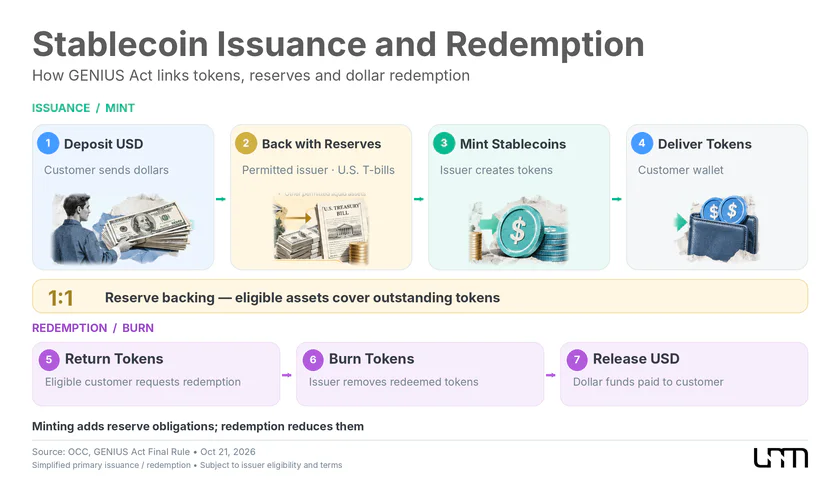
When stablecoins are initially issued, the issuer receives funds from an authorized client, issues the corresponding number of tokens, and places reserve assets in permitted instruments. If part of the reserves is invested in short-term U.S. Treasury bills, the company receives interest income, but the law limits the ability to directly pass it on to payment stablecoin holders as a reward for owning the tokens.
Cryptocurrency exchanges' business models differ in this regard. Platforms can offer users their own reward programs, funded through commercial agreements and not necessarily representing direct interest payments from the issuer.
This is where the conflict between the interests of the banking sector and the cryptocurrency industry arises.
In the initial draft of the rules, the OCC considered a presumption of violation of the yield ban for certain schemes of interaction between issuers and related intermediaries. In the final version, the regulator abandoned such a presumption, retaining the possibility of individual assessment of agreements and taking action when circumvention of the law is detected.
This is particularly important for Coinbase. The exchange collaborates with Circle and uses USDC as one of the key settlement assets in its ecosystem. The ability to offer users rewards for holding or using stablecoins helps platforms compete for client funds.
At the same time, the yield on USDC for cryptocurrency platform clients will depend on permissible reward mechanisms and the conditions of specific programs. The OCC's refusal of a general presumption of violation does not mean that any intermediary payments automatically comply with the GENIUS Act.
The banking sector views the situation from another perspective. If users can receive more attractive rewards on cryptocurrency platforms, some funds may potentially move from traditional deposits to digital assets. This could affect banks' cost of capital and their lending capabilities.
Thus, yield regulation becomes a matter not only of consumer protection but also of the distribution of financial resources between banking organizations and cryptocurrency companies.
How the new rules will affect Tether, Circle, and Coinbase
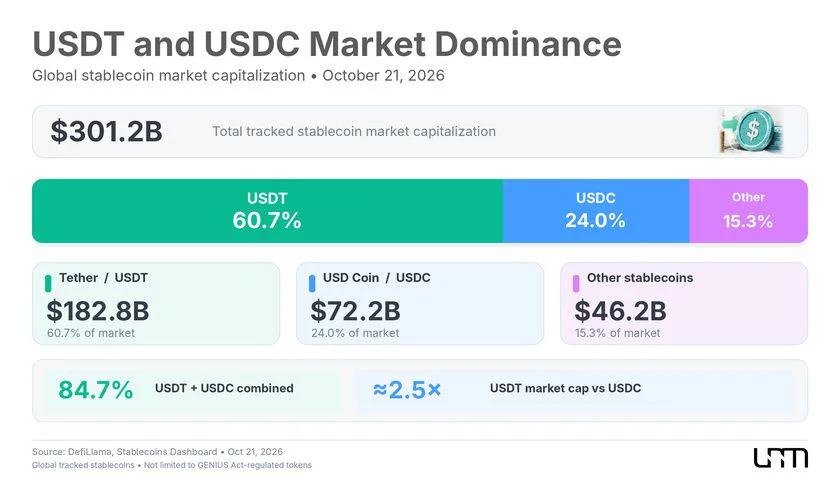
The most noticeable consequences of the GENIUS Act may manifest in the market of the two largest dollar stablecoins — USDT and USDC.
This distribution shows how heavily the industry relies on a few major issuers. Even relatively small changes in their operating conditions can impact the liquidity of cryptocurrency exchanges and the digital payments infrastructure.
Company | Market Position | Potential Implications of GENIUS Act |
|---|---|---|
Tether (USDT) | Largest dollar stablecoin | Requirements for foreign issuers and conditions for accessing the US market may impact the company's strategy |
Circle (USDC) | One of the largest dollar stablecoin issuers | New standards may enhance institutional client trust but require ongoing compliance costs |
Coinbase | Major cryptocurrency exchange and Circle partner | The application of yield prohibition will determine the potential for further development of reward programs |
Banking Groups | Participants in the traditional payment system | Federal rules may facilitate the development of proprietary products based on payment stablecoins, subject to special requirements |
New Issuers | Companies without comparable infrastructure | Costs of licensing, risk management, and reporting may increase the cost of market entry |
For Tether, the GENIUS Act's requirements for foreign issuers, including the conditions for their payment stablecoins to circulate in the US market, are significant. The company maintains a substantial advantage in USDT circulation volume, but the scale of the business alone does not exempt it from applicable regulatory requirements.
Circle, on the other hand, can leverage the development of regulated infrastructure as a competitive advantage. The company already publishes information about USDC reserves, and a significant portion of the backing assets is tied to short-term US Treasury instruments and reverse repo operations.
According to Circle's transparency information on reserves, the company discloses the volume of USDC in circulation and the composition of assets backing the issued tokens. Reserves include bank funds, short-term US Treasury obligations, and permitted operations with government securities. This data allows market participants to assess the alignment of reserve value with the issuer's obligations.
However, reserve stability is only one factor in competition. The spread of USDT and USDC also depends on integration with payment services, support from trading platforms, liquidity depth, and user trust.
Therefore, expecting an immediate redistribution of market shares following the GENIUS Act's enactment would be premature. A more likely scenario is a gradual change in the competitive environment, where regulatory status becomes more important for banks, payment companies, and institutional clients.
Why Stablecoin Regulation Matters for the US Government Debt Market
The impact of the GENIUS Act is not limited to cryptocurrencies, as dollar stablecoin reserves are closely tied to the US money market.
When an issuer receives dollars in exchange for new tokens, it places reserve funds in permitted financial instruments. Short-term US Treasury bills (T-bills) and operations with government securities help maintain reserve liquidity while earning interest income.
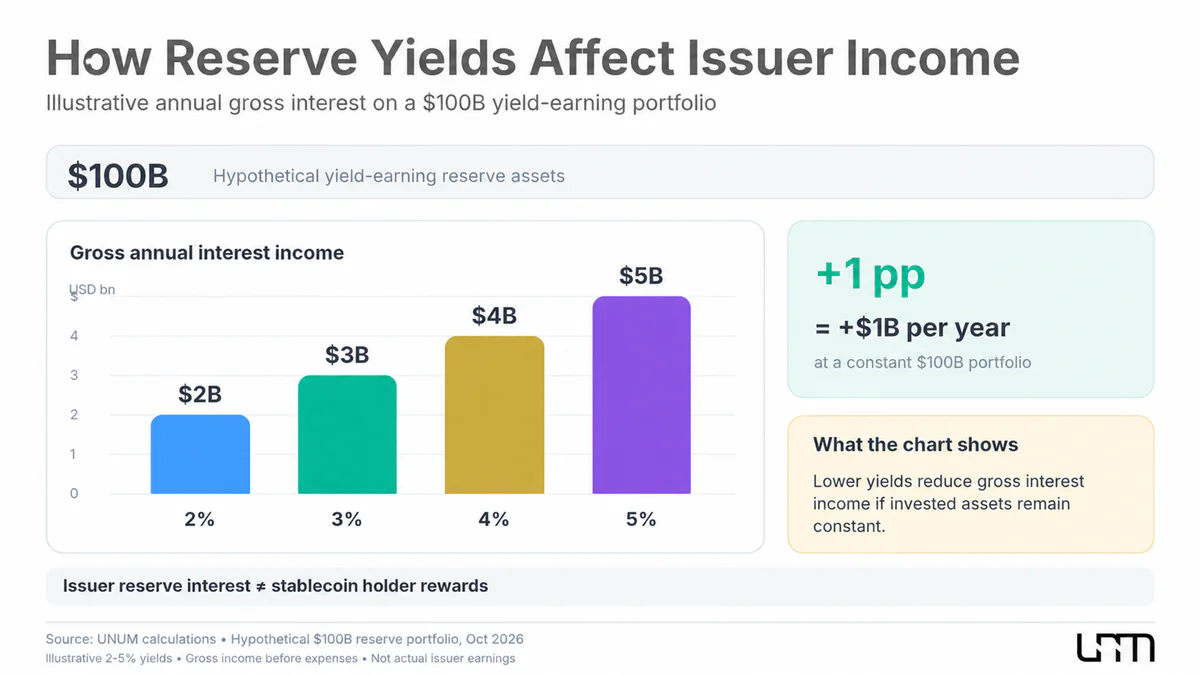
For issuers, this income is an important part of the business model. For example, a portfolio of permitted income-generating assets worth $100 billion with an average annual yield of 4% could theoretically generate about $4 billion in gross interest income per year. This is a hypothetical calculation that does not account for operating expenses, reserve structure, and market rate changes.
As a result, issuer profitability depends not only on the number of tokens issued but also on the monetary policy of the US Federal Reserve. Lower interest rates can reduce the yield on reserve assets, while an increase in stablecoin supply can partially offset this effect by increasing reserve volumes.
For US government debt, the expansion of the digital dollar market means potential additional demand for short-term Treasury instruments. However, its actual impact depends on the sources of funds flowing into stablecoins. If users transfer capital from other money market instruments, the overall additional demand may be significantly less than the growth of issuer reserves.
Thus, the GENIUS Act establishes a connection between the development of digital payments, the regulation of crypto companies, and the traditional financial system of the United States. The more stablecoins are used in settlements, the more significant the role of their reserves in the money market can become.
How GENIUS Act differs from European MiCA
Stablecoins in the U.S. are getting a separate regulatory system, but the American market was not the first to have special requirements for issuers. The European Union already applies the Markets in Crypto-Assets (MiCA) regulation, which governs the issuance of certain categories of crypto assets and the activities of cryptocurrency service providers.
Both systems provide requirements for issuers, reserves, token redemption, and information disclosure. However, there are important differences between them.
The American GENIUS Act is primarily focused on payment stablecoins and establishes a special regulatory system for their issuers. The European MiCA covers a broader range of crypto assets and services, highlighting, in particular, e-money tokens and asset-referenced tokens.
The regulation of yield is particularly different. Article 50 MiCA prohibits interest payments on e-money tokens not only to issuers but also to cryptocurrency service providers. The definition of interest includes some economically equivalent third-party rewards.
The American model also prohibits issuers from paying yield for holding payment stablecoins, but the final OCC rules do not establish an automatic ban for all intermediary reward programs. Specific agreements will be evaluated based on their content and legal requirements.
Licensing mechanisms also differ. The European system provides unified regulatory standards applied through national competent authorities, while the American system considers the distribution of powers between federal regulators and individual state authorities.
In Asia, the situation is even more diverse. Singapore and Hong Kong are developing their own stablecoin regulatory regimes, focusing on reserve backing, redemption, and licensing. Therefore, companies operating in the international market have to consider several different legal systems.
Previously, UNUM provided an in-depth analysis of how MiCA changes the European cryptocurrency market, and also reported on the increase in the number of banks in the MiCA registry.
The presence of several regulated markets creates additional opportunities for institutional use of stablecoins but also increases the requirements for international issuers. Companies that can meet the standards of different jurisdictions will gain advantages in expanding global payment services.
What GENIUS Act will change for USDT and USDC holders
For regular users, the main significance of the new regulation is related to the reliability of reserves, the ability to exchange tokens for dollars, and the rules of operation of cryptocurrency platforms.
Federal requirements should increase the transparency of regulated issuers' activities, but they do not turn stablecoins into a completely risk-free financial instrument. The value of a digital token still depends on the issuer's ability to fulfill its obligations, as well as the conditions for the asset's circulation on specific trading platforms.
It is important to consider several circumstances.
Redemption and sale of the token are different operations. The right to redeem a stablecoin from the issuer may depend on the client's status and service conditions, whereas the market price on a cryptocurrency exchange is formed based on supply and demand.
Reserve backing does not replace deposit insurance. The presence of reserve assets does not mean that stablecoin holders automatically receive insurance protection from the Federal Deposit Insurance Corporation (FDIC), provided for certain bank deposits.
Reward programs may change. Possible changes in the yield of USDC and other payment stablecoins will depend on platform policies, the structure of commercial agreements, and the practice of applying American rules.
Requirements depend on the nature of the activity. The mere entry into force of the GENIUS Act does not mean an automatic ban on holding USDT or USDC, but the issuance and offering of tokens in the U.S. market must comply with applicable regulatory requirements.
For users who regularly conduct transactions in stablecoins, the most significant evaluation criteria will remain the transparency of reserves, liquidity, stability of the dollar peg, and the availability of redemption mechanisms.
Even a regulated payment stablecoin retains certain risks associated with the operations of the issuer, banking counterparties, cryptocurrency platforms, and technological infrastructure.
When the new rules will take effect and what happens next
January 18, 2027, will be a key date for the regulation of payment stablecoins in the United States. This is when the GENIUS Act and the final rules published by the OCC will come into force.
However, the commencement of the regulatory framework does not mean that all issues will be resolved simultaneously. Regulators will need to implement licensing procedures, review issuer applications, and establish practices for applying the new requirements.
Future rules on anti-money laundering and sanctions control, as well as decisions regarding permissible user reward models, will have particular significance.
For the largest crypto companies, the coming months will be a period of preparation for new working conditions. Issuers will need to verify the compliance of reserves and internal procedures with regulatory requirements, while cryptocurrency platforms will need to assess potential impacts on commercial products.
The new cryptocurrency regulation in the US is gradually turning the issuance of payment stablecoins into an independent segment of financial activity with established requirements for admission, reserving, and oversight. This could increase trust in digital dollars and accelerate their use beyond cryptocurrency exchanges.
At the same time, the GENIUS Act does not eliminate competition between Tether, Circle, Coinbase, and the banking sector. On the contrary, it creates a new regulatory framework for this competition, where not only the scale of issuance and token liquidity will matter, but also the ability of companies to meet financial requirements, maintain reliable reserves, and offer users in-demand payment products.