The financial market has become global, and significant events can occur at any time of the day. A central bank decision, an economic report, or corporate news can be released after the exchange closes, while investors increasingly expect the opportunity to react to them immediately, regardless of the time zone.
This is facilitated by the development of online brokers and mobile trading platforms. If exchanges used to resemble stores with fixed working hours, the digital economy is gradually forming a different standard – constant access to financial assets.
As early as 2010, former Nasdaq CEO Bob Greifeld spoke about the possibility of transitioning to round-the-clock trading. At the same time, he pointed out the main limitation of such a model – insufficient activity outside the main session: “There is rarely volume unless there is important news on a specific stock.” Greifeld considered the activation of the pre-market as one of the signs of the market's readiness for further expansion of trading hours.
The question arises, when will round-the-clock trading become the new standard for financial markets and what will it take to achieve this?
Cryptocurrencies Have Shown a Market Model Without Closing
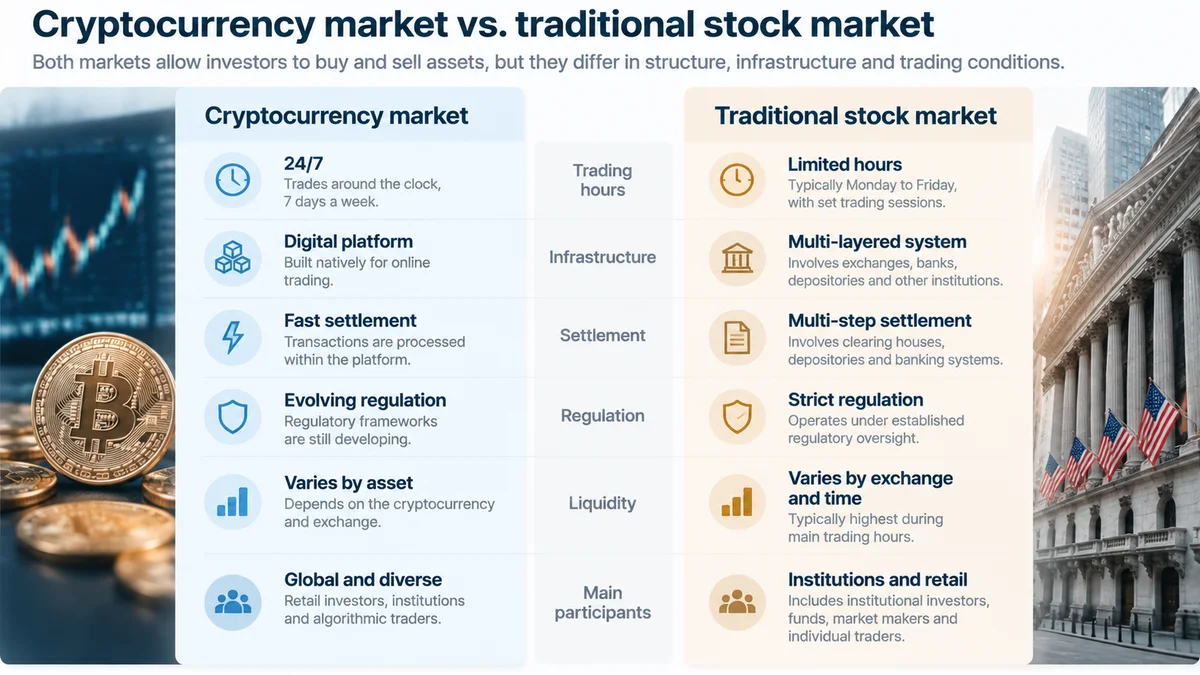
The main example of a continuous financial market has become the cryptocurrency market. Bitcoin, Ethereum, and other digital assets are traded 24 hours a day, seven days a week, and are not dependent on the usual schedule of exchange sessions. This format has gradually changed investor expectations: if an asset is constantly available, market participants begin to perceive the ability to buy or sell it at any moment as a natural part of the digital economy.
However, directly transferring this experience to the stock and other markets is impossible. Cryptocurrency platforms were initially created as digital infrastructure and do not depend on many elements of the traditional financial system. Stock trading, on the other hand, is connected with a whole chain of processes: confirmation of ownership rights, settlements between participants, the work of depositories, and compliance with regulatory requirements. Therefore, transitioning to a 24/7 exchange model will require not just a change in trading schedules but a more extensive restructuring of the infrastructure.
Tokenization Could Become the Basis of the Next Generation Market
One of the directions that could bring the financial market closer to a 24/7 model is asset tokenization. Major financial companies are considering blockchain not only as a technology for cryptocurrencies but also as a potential infrastructure for traditional financial instruments.
ARK Invest founder and CEO Cathie Wood associates tokenization with deeper changes in the market structure. “Tokenization can fundamentally change how investors access and participate in private and public financial markets,” she stated on September 24, 2026, when ARK Invest announced the transition of its ARK Venture Fund to blockchain infrastructure.
Tokenization involves creating a digital representation of a traditional financial instrument. In this form, stocks, bonds, funds, and other assets can be traded. Potentially, this allows the use of blockchain infrastructure for faster operations and virtually continuous access to digital assets.
However, the technology itself does not solve all problems. A full-fledged 24/7 market requires not only digital tools but also clear regulatory rules, investor protection, sufficient liquidity, and compatibility of various trading platforms. Otherwise, round-the-clock availability of an asset does not necessarily mean a full and efficient market.
How Traditional Markets Experiment with 24/7 Trading
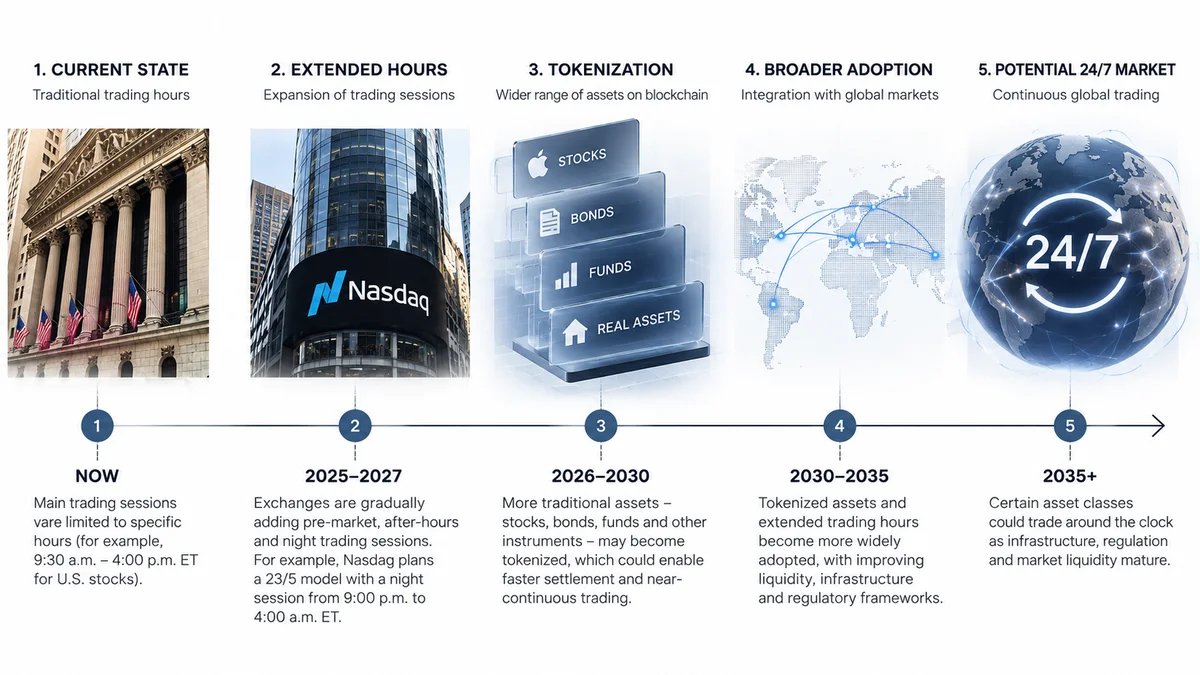
Major exchange operators are already moving from discussion to practical implementation of extended trading hours. Nasdaq received approval to launch a 23/5 mode starting December 6, 2026, adding a night session from 9:00 PM to 4:00 AM Eastern Time. Cboe also received SEC approval to launch 23/5 trading of U.S. stocks on EDGX in December. NYSE Arca is preparing a similar mode with an hour break for technical and settlement operations.
The topic has already gone beyond individual exchange initiatives. In September 2026, the SEC held a special roundtable on preparing the U.S. market for 24-hour trading. The regulator separately discussed infrastructure resilience, market data continuity, cybersecurity, clearing, and liquidity during night hours.
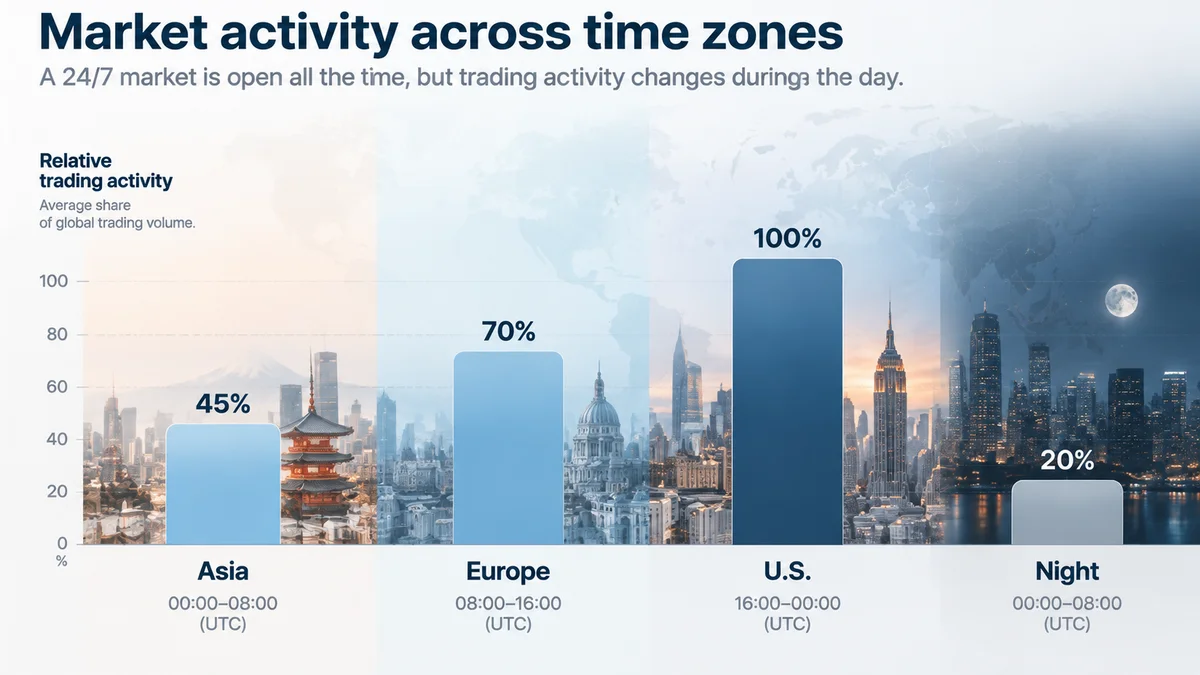
Interest in this is primarily related to the globalization of markets: investors from Asia, Europe, and the U.S. work in different time zones and may face situations where important information appears after their local exchange closes.
Therefore, many platforms are considering gradually increasing working hours instead of immediately transitioning to a 24/7 model. This approach allows assessing the real demand for trading in additional hours and understanding whether there are enough participants to form full liquidity.
At the same time, simply opening an exchange for a longer period does not guarantee active trading. If there are few buyers and sellers in the market at night, an investor may face lower volumes, a wider bid-ask spread, and sharper price movements. Therefore, when extending trading hours, not only the duration of the exchange's operation is important but also the quality of the market during each of these periods.
SEC Commissioner Hester Peirce noted in September 2026 that trading during extended hours still accounted for less than 1% of the total volume for NMS stocks and was heavily concentrated in a small number of securities.
Will Round-the-Clock Trading Become the New Standard?
A full-fledged 24/7 mode has not yet become the standard, but the movement towards it has already moved from the discussion stage to the practical phase. Initially, financial markets are likely to continue expanding trading hours and developing night sessions, while individual digital and tokenized assets will gradually transition to the new mode.
The key condition will be not the technical ability to work around the clock, but the readiness of the entire market infrastructure. This requires sufficient market depth and liquidity, reliable settlements, clear regulatory rules, and investor protection. Therefore, the transition to a 24/7 model will depend on how quickly these elements can adapt to the new trading regime.
As a result, the round-the-clock market is likely to form gradually, starting with individual assets and extended trading sessions, rather than through an immediate abandonment of the traditional exchange schedule.
Related articles