
How Meta's Financial Metrics Changed in Q3
The financial report published on October 21 for Meta's Q3 2026 showed mixed trends in the company's financial metrics. Meta Platforms' revenue grew by 26% compared to the same period last year; however, operating expenses increased significantly faster—by 68%. As a result, the operating margin halved from 40% to 20%.
Despite the decline in operating profit, Meta's net profit increased by 264% to $9.86 billion. This result is explained not only by the company's current activities but also by the comparison with the previous year. In Q3 2025, the effective tax rate reached 87%, partly due to a one-time tax charge related to changes in U.S. legislation. In the reporting period, it was 24%.
The main financial results of Meta are presented in the table.
Metric | Q3 2025 | Q3 2026 | Change |
|---|---|---|---|
Revenue | $51.24 billion | $64.60 billion | +26% |
Operating Expenses | $30.71 billion | $51.61 billion | +68% |
Operating Profit | $20.54 billion | $12.99 billion | −37% |
Operating Margin | 40% | 20% | −20 pp |
Net Profit | $2.71 billion | $9.86 billion | +264% |
Earnings Per Share (EPS) | $1.05 | $3.83 | +265% |
Source: Meta's Q3 2026 financial report
The difference between operating and net profit is crucial for assessing a company's financial health. The former shows how much the business earns after deducting operating expenses but before accounting for taxes and other non-operating results. The latter includes additional financial factors, including tax burden.
Therefore, the 264% increase in net profit does not indicate a comparable improvement in business efficiency. To assess the quality of Meta's profit, it is necessary to separate the results of core activities from one-time legal expenses that significantly impacted the quarterly report.
Why Meta's Operating Profit Fell by 37%
The main reason for the reduction in operating profit was expenses related to settling legal claims in the U.S. In August 2026, Meta announced an agreement with 52 state attorneys general and other jurisdictions regarding litigation related to the impact of social media on teenagers' mental health.
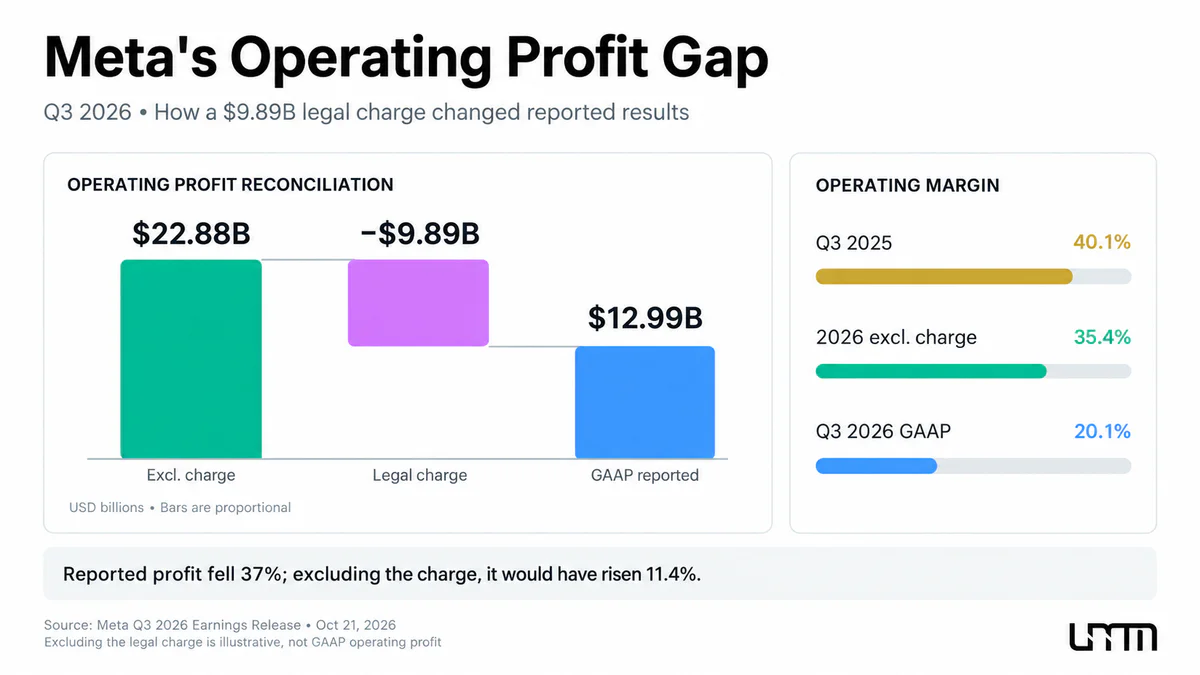
Under the agreement, the company may pay up to $18.59 billion, with the final amount of obligations depending on the terms provided by the agreements. Of this amount, Meta recognized an accrual of $9.89 billion in Q3 2026 expenses. This should not be equated with the actual cash payment of the entire amount during the quarter.
Excluding this one-time factor, the financial results would look different. According to Meta's official report, operating profit would have increased from $12.99 billion to $22.88 billion, exceeding last year's figure by approximately 11.4%.
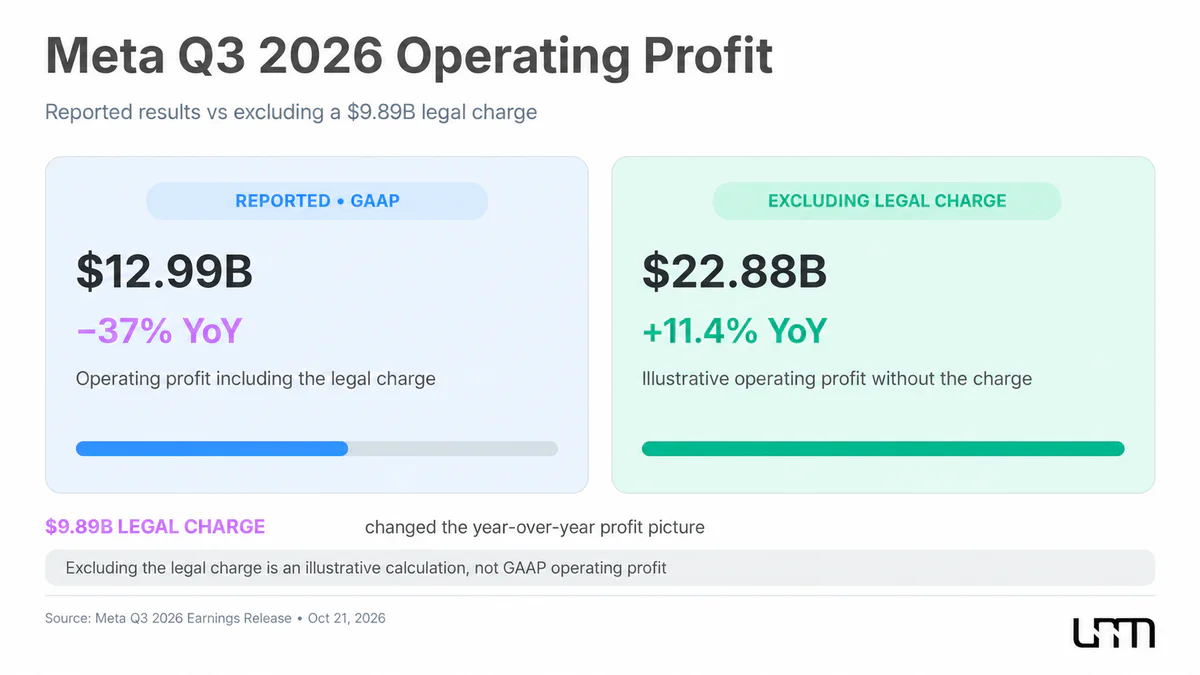
Without this charge, the adjusted operating margin would have been about 35.4% instead of 20%. This significantly changes the interpretation of the results: the core business remains profitable, and operating profit, after excluding a specific one-time expense, shows growth.
However, even the adjusted profitability would be below last year's level of 40%. This indicates pressure from other expenses, including costs for research, product development, and technological infrastructure.
The one-time nature of the charge does not make it insignificant for shareholders. Legal obligations require financial resources and can affect future cash flows, even if they do not reflect the company's day-to-day operational efficiency.
Advertising Business Remains Meta's Main Growth Driver
Despite increased expenses, Meta's main revenue source continues to show steady growth. In the third quarter of 2026, advertising revenue reached $63.06 billion compared to $50.08 billion a year earlier. Thus, advertising accounted for about 97.6% of the company's total quarterly revenue.
The growth in advertising revenue was supported by both an increase in the volume of impressions and higher placement costs. According to Meta's report, the number of ad impressions in the Family of Apps increased by 10%, and the average price per ad rose by 14%.
The scale of the user audience remains an important factor. The average number of people using at least one Meta app daily reached 3.64 billion in September 2026, up 3% year-over-year. The Family of Apps ecosystem includes Facebook, Instagram, WhatsApp, Messenger, and other company services.
Advertising revenue grew significantly faster than the audience, driven by an increase in the number of ad impressions and a rise in the average ad price. This allows the company to increase revenue not only by attracting new users but also through more active monetization of the existing audience.
Artificial intelligence is becoming an important part of this model. Meta is implementing machine learning algorithms to personalize recommendations, select ads, and optimize advertising campaigns. According to the company's management, investments in AI are already contributing to increased advertising revenue through more accurate recommendations, increased user engagement, and improved monetization.
Meta's management positively assesses the results of the investment strategy and the current state of the core business:
Our investments are paying off, the core business remains strong, and we are seeing acceleration across all directions.
However, strong advertising results do not mean that all investments in artificial intelligence have already paid off. The company is developing both technologies that improve existing products and new directions, the commercial model of which is still being formed.
It is the revenues from the Family of Apps that remain the foundation for financing these projects. Another segment, Reality Labs, which deals with virtual and augmented reality technologies, generated only $443 million in revenue for the quarter with an operating loss of $4.13 billion. Its results further underscore Meta's reliance on the advertising business.
How Much Meta Spends on Artificial Intelligence
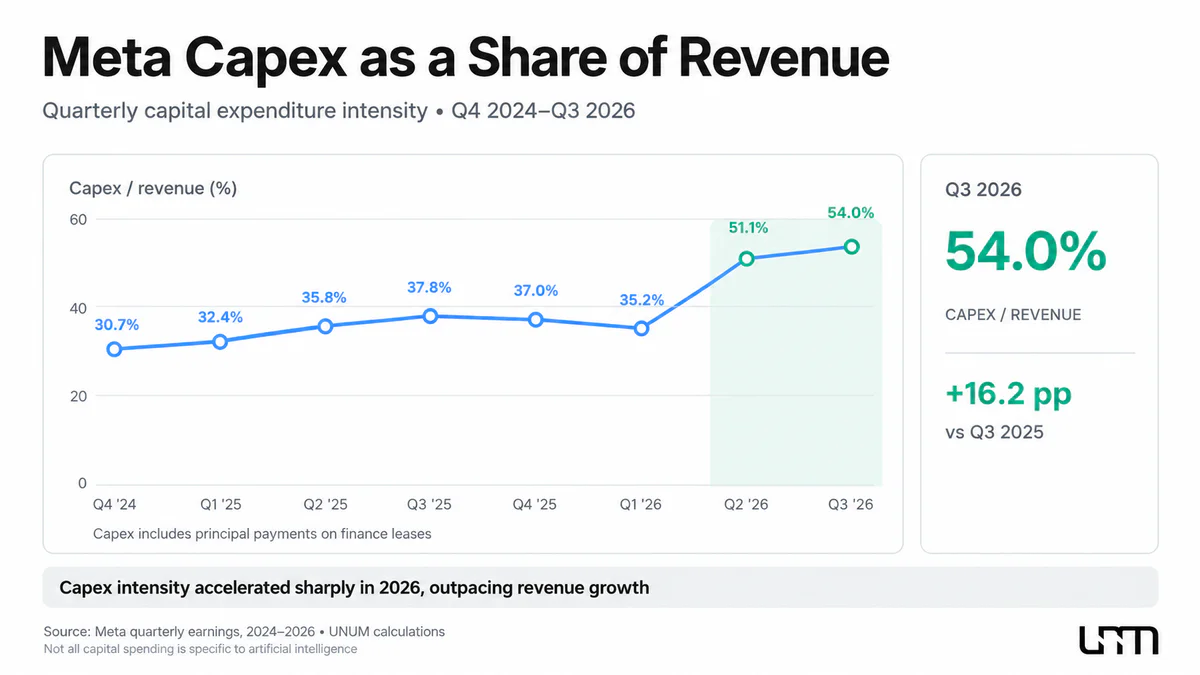
One of the most notable changes in Meta's financial results was the scale of capital investments. In the third quarter of 2026, the company's capital expenditures, including the repayment of principal obligations under finance leases, reached $34.91 billion. This is equivalent to approximately 54% of quarterly revenue.
In the third quarter of 2025, comparable capital expenditures were about $19.37 billion, or 38% of revenue. Thus, the investment burden on the business has noticeably increased.
Meta's investments in artificial intelligence involve expanding the computing infrastructure necessary for training and deploying models, as well as improving existing digital services. The company allocates significant funds for server equipment, data centers, and the development of computing capabilities.
For the first nine months of 2026, Meta's capital expenditures reached $85.82 billion compared to $50.08 billion for the same period last year. At the same time, the company revised its forecast for the entire 2026 year to $135–145 billion, whereas it previously expected $130–145 billion.
It is important to distinguish between capital and operating expenses. The acquisition of servers, construction of data centers, and other long-term infrastructure are usually not reflected in the income statement as one-time expenses in full. The cost of such assets is spread over future periods through depreciation, while cash is spent on their acquisition much earlier than the infrastructure is fully amortized.
Therefore, the investment program affects both the current cash flow and future operating expenses. New computing capacities will require additional costs for power supply, maintenance, and equipment operation.
At the same time, capital investments should not be fully equated with expenses solely on artificial intelligence. Meta's computing infrastructure simultaneously serves advertising algorithms, recommendation systems, social platforms, and new products.
The company expects that such investments will not only enhance the efficiency of existing services but also create additional revenue streams. However, the payback of infrastructure for developing advanced AI models may take longer than investments in the already operating advertising business. Meta acknowledges this risk in the forecast comments to the financial statements.
Why Meta's Free Cash Flow Became Negative
The increase in capital expenditures has already noticeably affected Meta's cash flows. In the third quarter of 2026, the company's operating activities generated a positive cash flow of $32.79 billion, but the free cash flow was negative, amounting to –$2.12 billion. A year earlier, this figure was positive, reaching $10.63 billion.
Meta's Free Cash Flow (FCF) is calculated as the cash flow from operating activities minus purchases of property and equipment and repayment of the principal amount of finance lease obligations.
The company classifies FCF as a non-GAAP measure, which supplements but does not replace financial metrics calculated under U.S. Generally Accepted Accounting Principles (GAAP). In particular, free cash flow should not automatically be considered the entire amount of funds available for any corporate expenses.
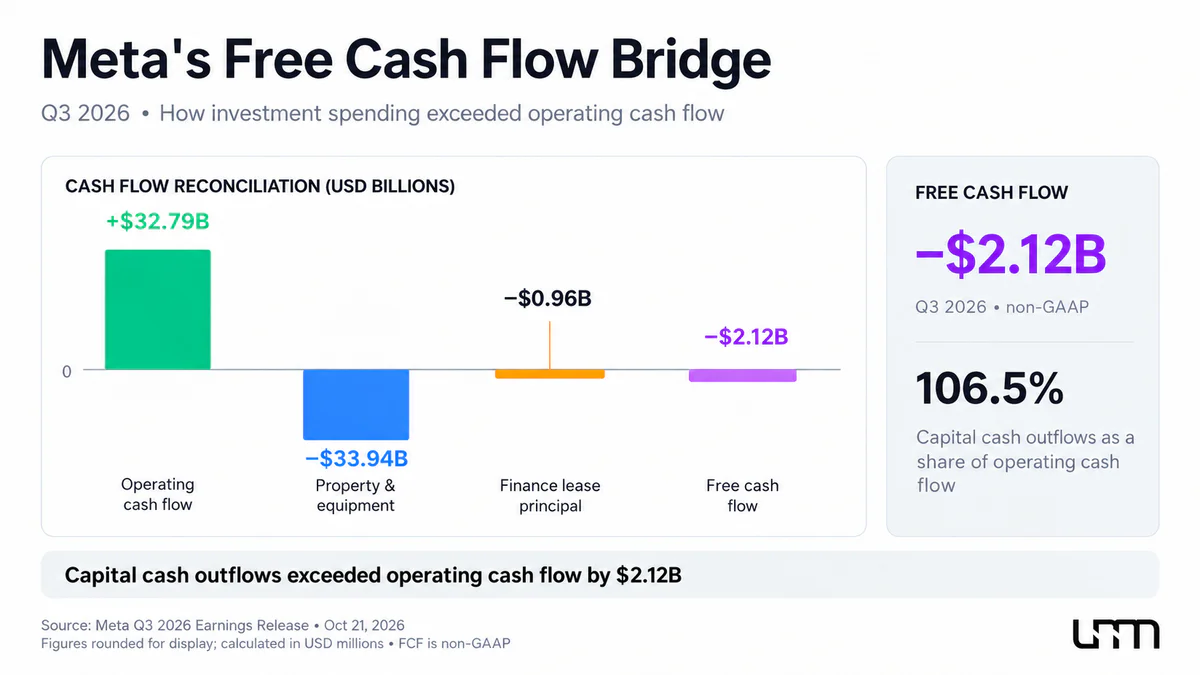
A negative FCF means that the company spent more cash on the considered capital investments than it received from operating activities during the quarter. However, such a result does not in itself indicate a financial crisis.
When assessing Meta's financial stability, it is necessary to consider not only the negative free cash flow for a single quarter but also cash reserves, debt load, and the business's ability to finance investments in subsequent periods.
As of September 30, 2026, Meta's total cash, cash equivalents, and marketable securities amounted to $82.45 billion. However, some of the funds might have usage restrictions. For the nine months of 2026, free cash flow remained positive at $11.05 billion, although it decreased compared to $29.51 billion a year earlier.
Thus, Meta retains significant financial resources and the ability to generate operating cash flow. The main question is how long the company can maintain such high rates of capital investments without further reducing free cash funds.
The structure of financing is also important. Besides its own cash resources, Meta can attract debt and equity capital. However, additional borrowings increase financial obligations, and issuing new shares can alter the economic interests of existing investors.
Amid growing financing needs, the company announced another major corporate decision — the creation of a new class of shares.
Why Meta is Creating a New Class of Class C Shares
Meta's Board of Directors approved the creation of a new class of publicly traded Class C common shares without voting rights. The company plans to formalize the corresponding changes in corporate documents by January 19, 2027.
According to the published decision, holders of existing Class A and Class B shares should receive one new Class C share for each share they own. The record date and distribution date will be determined later.
After the distribution of Class C, Meta expects that the market price of Class A shares will reflect an effect comparable to a two-for-one split. Existing shareholders will receive an additional share of another class rather than a second Class A share. Each shareholder's voting share will remain unchanged since the new securities do not grant voting rights.
To understand the implications of the decision, it is important to consider the differences between Meta's classes of shares:
Class A — publicly traded shares providing one vote per share.
Class B — shares with enhanced voting rights, providing ten votes per share. This structure allows Mark Zuckerberg to maintain control over the company.
Class C — a new class of non-voting shares that Meta plans to use for raising capital, employee compensation, potential acquisitions, and other corporate purposes.
The creation of Class C expands Meta's ability to attract additional capital for financing long-term projects without the need to grant new investors additional votes in business management. This is especially important for a company where the shareholder capital structure historically provides the founder with significant influence over strategic decisions.
However, the emergence of a new class of shares does not automatically mean attracting money. The initial distribution of Class C to existing shareholders also does not automatically create additional economic value. Significant changes may occur later if Meta starts issuing new shares to finance investments or other purposes.
For existing shareholders, such a structure has ambiguous consequences. On one hand, it allows the company to expand access to capital and finance development. On the other hand, future share issues may dilute investors' economic stakes, and the lack of voting rights limits the influence of new Class C owners on corporate governance.
What risks remain for Meta shareholders
Meta's financial results show that the company is in a period of large-scale restructuring of its investment model. The advertising business continues to generate growing revenue, but a significant portion of the resources it creates is directed towards developing infrastructure and new technological directions.
For Meta shareholders, the main sources of uncertainty remain several factors:
Return on investment in artificial intelligence. The company expects to generate additional income from more effective advertising and new AI products, but the timing of capital return remains uncertain. If the expected commercial effect is lower than forecasts, the high cost of infrastructure may continue to limit profitability.
Growth of fixed costs. New computing capacities require expenses for electricity, maintenance, and depreciation. Even after the active construction phase is completed, these costs will continue to affect Meta's financial performance.
Dependence on the advertising business. Advertising revenue forms almost the entire income of the company, so changes in demand from advertisers, rules for processing user data, or market competition can significantly affect financial results.
Legal and regulatory risks. The agreement with the attorneys general of 52 U.S. states and other jurisdictions allows for the settlement of a certain group of legal claims, but does not exclude new proceedings. Meta warns of ongoing regulatory attention to user protection issues, especially minors.
Losses of Reality Labs. Despite the development of AI as a priority direction, the virtual and augmented reality segment continues to operate with large operating losses. Meta forecasts them at $18–19 billion in 2026 and expects a reduction to approximately $15 billion in 2027 due to the reallocation of investments in favor of other areas, primarily artificial intelligence. These estimates remain the company's forecasts.
A separate factor is the capital structure. The new class of non-voting shares provides management with additional financing opportunities, but at the same time strengthens a corporate governance model where strategic decisions largely depend on the company's founder.
For the stock market, not only the magnitude of these risks is important, but also Meta's ability to offset them with revenue growth and increased efficiency of existing services.
What Meta's reporting means for investors
Meta's quarterly report shows why analyzing only profit dynamics is insufficient for assessing the financial condition of a technology company. The 37% reduction in operating profit is largely due to a large legal charge, while the core advertising business continues to increase revenues.
However, excluding the one-time expense does not eliminate the main question: can the company ensure sufficient returns from a large-scale investment program that has already led to negative free cash flow for the quarter.
In upcoming reporting periods, investors should pay attention primarily to three indicators: the dynamics of capital expenditures relative to revenue, the recovery of free cash flow, and changes in operating margin without the influence of large one-time factors. Additional significance will be given to the results of new AI products and the practical use of Class C shares to finance growth.
For the fourth quarter of 2026, Meta forecasts revenue in the range of $73–76 billion, indicating expectations of further business expansion. At the same time, the company intends to continue active investments in computing infrastructure in 2027.
The long-term dynamics of Meta Platforms' shares will depend not only on the growth of advertising revenue but also on how successfully the company can monetize investments in artificial intelligence. Meanwhile, the market value of the shares is also determined by investor expectations, the assessment of future cash flows, and overall conditions in the stock market.
Thus, Meta maintains strong positions in digital advertising and significant financial resources, but its future profitability increasingly depends on the effectiveness of investments in artificial intelligence. One of the key factors for shareholders will be the company's ability to achieve sufficient returns from infrastructure investments while maintaining profitability and positive cash flow in the long term.