US Inflation Exceeds Expectations
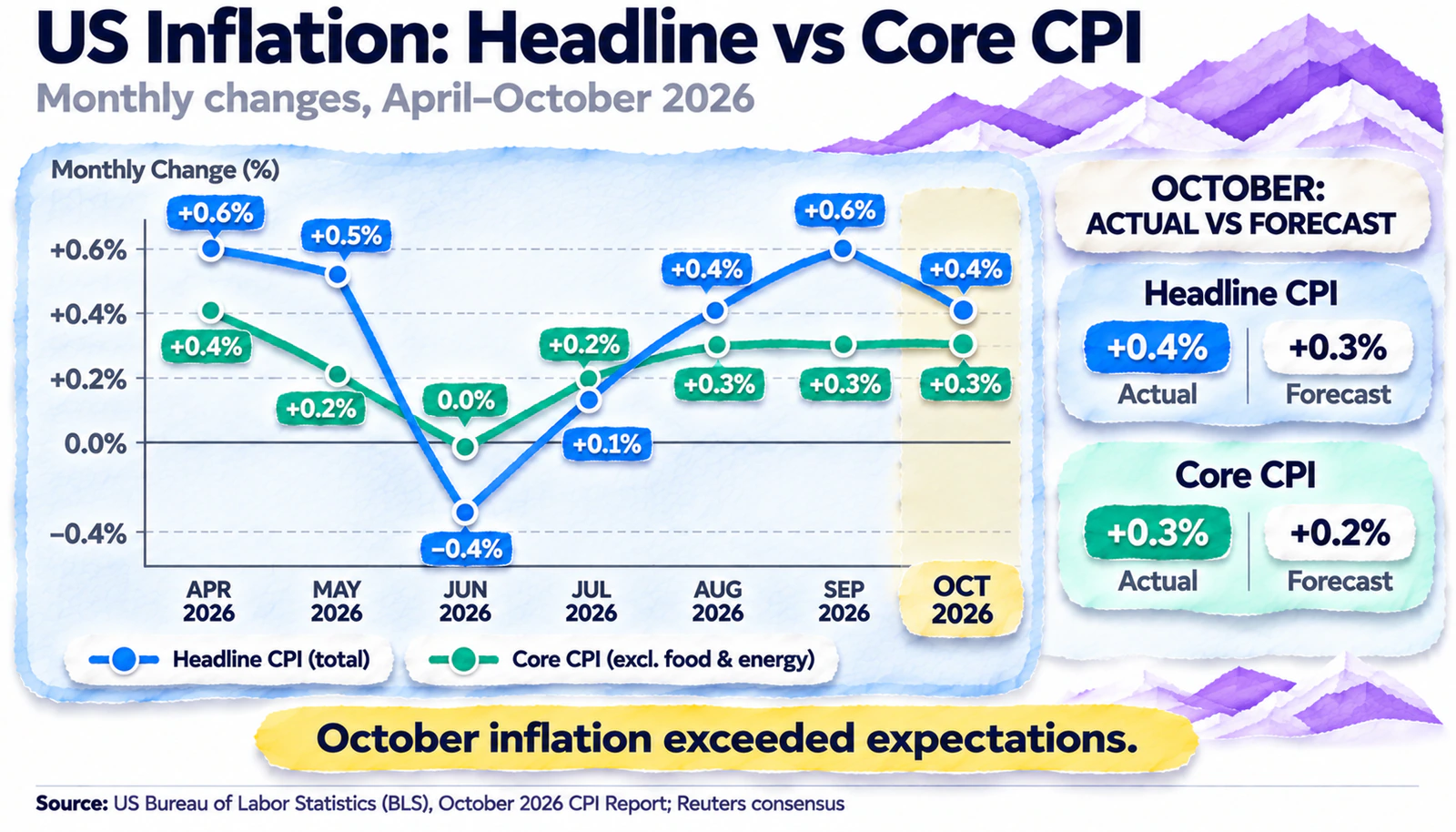
The release of the US CPI for October was the main inflation event of the week. According to data from the US Bureau of Labor Statistics (BLS), published on November 10, the consumer price index rose by 0.4% compared to the previous month. Economists polled by Reuters had forecast a 0.3% increase. Although the figure slowed after a 0.6% rise in September, exceeding expectations heightened concerns about persistent inflationary pressure.
Core CPI rose by 0.3% for the month against the expected 0.2%. The same increase was recorded in August and September. Core inflation helps assess the persistence of price pressure without the influence of food and energy, whose costs can fluctuate significantly from month to month. The sustained high growth rate of the core index indicates that inflationary risks are not limited to specific categories of goods.
According to the BLS report, in October:
Housing costs rose by 0.3%, accounting for more than 30% of the total monthly CPI increase.
Food prices increased by 0.5%, including groceries and dining out.
Energy prices rose by 0.7% following a 5.2% jump in September.
Medical services, car insurance, and leisure expenses also continued to rise.
A feature of the October report is the absence of most annual CPI figures. Due to a government funding hiatus, the BLS did not collect data for October 2025, and therefore could not calculate most annual CPI changes for October 2026. As a result, investors focused on the monthly dynamics and structure of inflation.
Why the Fed Considers Further Rate Hikes
At the October 28 meeting, the Federal Reserve maintained the target range for the federal funds rate at 3.75–4.00%. The decision was supported by 10 out of 12 voting members, while Lisa Cook and Beth Hammack advocated for a 25 basis point increase. This showed that there were already disagreements within the regulator regarding the necessary pace of monetary policy tightening.
The current Fed rate is in the range of 3.75–4.00%, but the further trajectory depends on the persistence of inflation and the state of the US economy. Prolonged price increases raise the risk of anchoring inflation expectations, where companies and consumers begin to anticipate further price increases in their decisions.
Even before the October CPI release, Christopher Waller suggested a sharper Fed rate hike. The data released later reinforced the relevance of this scenario. In his speech on November 10, the Fed Board of Governors member explained that a more significant step might be needed if the monthly core CPI growth is around 0.3% or exceeds this level.
"In that case, I believe a 50 basis point rate hike should be considered at the December meeting," said Christopher Waller in an official Federal Reserve speech on November 10, 2026.
Dallas Federal Reserve Bank President Lorie Logan also advocated for further policy tightening, pointing to the need for at least two additional 25 basis point hikes. Meanwhile, Fed representative Anna Paulson supported a more gradual approach, allowing for the assessment of the consequences of already made decisions.
Differences in positions show that the further trajectory of the Fed rate remains a subject of discussion. The regulator needs to curb inflation while considering the impact of expensive credit on consumption, investment, and economic activity.
How Market Expectations Changed Before December
Investor expectations for the Fed's December decision changed after the CPI release. Higher-than-forecast inflation increased the likelihood of further monetary policy tightening and prompted the market to revise forecasts for the upcoming Federal Open Market Committee (FOMC) meeting.
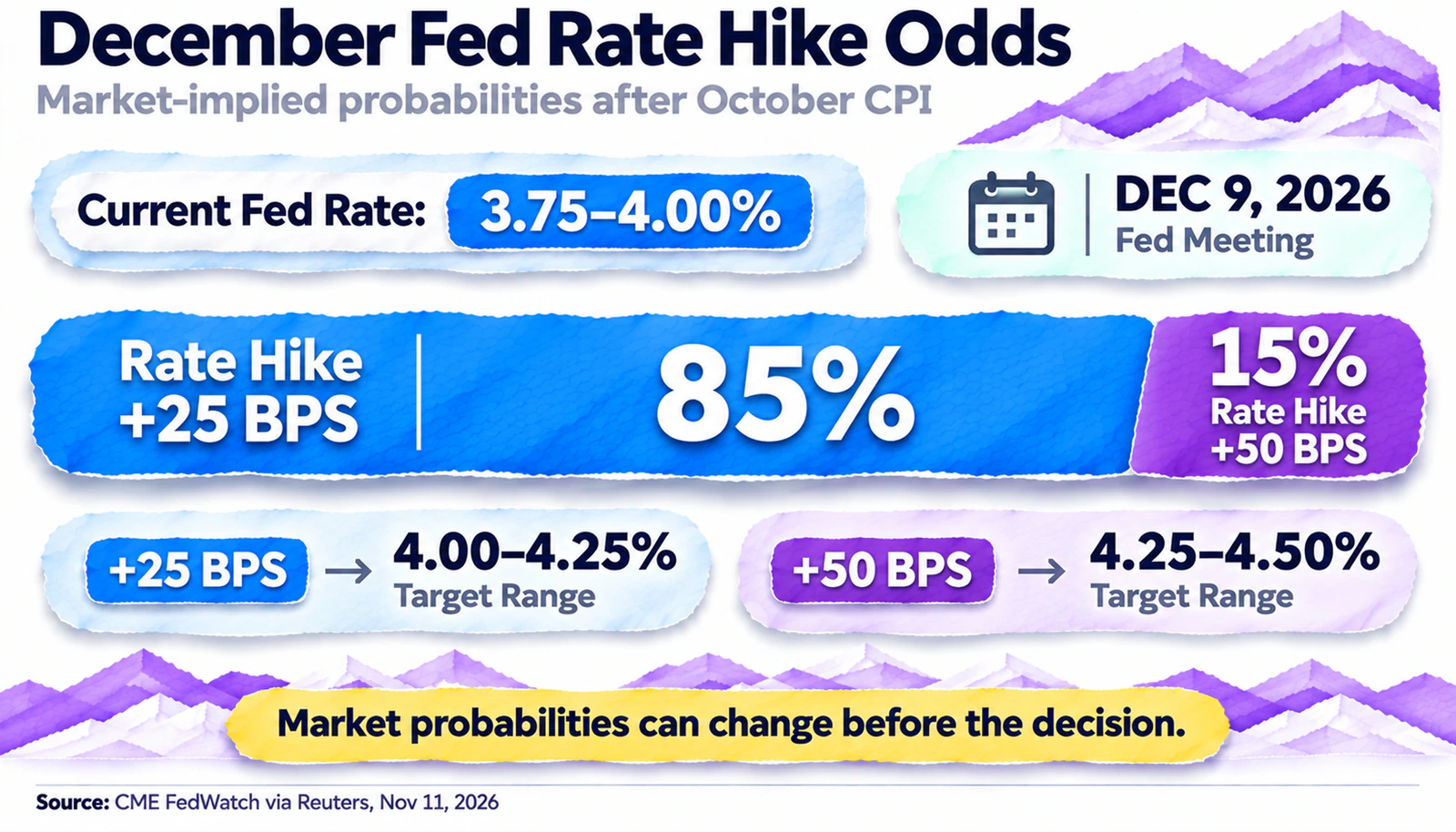
According to Reuters on the morning of November 11, CME FedWatch assessed the probability of a 25 bp hike at 85%, and a 50 bp hike at 15%. Just a day earlier, the market had considered the possibility of maintaining the rate with a probability of about 16%, but after the release of the statistics, it practically excluded this option.
A 50 basis point rate hike by the Fed remains one of the possible, but not the baseline scenarios. Investors are considering not only the likelihood of a specific decision in December but also how long the U.S. regulator will maintain restrictive financial conditions.
Changes in expectations immediately reflected on the debt market. As of the close of trading on November 10, the yield on two-year U.S. Treasury bonds rose by approximately 18.4 basis points, reaching 4.731%. On the morning of November 11, the yield on ten-year bonds was around 4.996%.
The rise in bond market yields is accompanied by a decrease in their price, all else being equal. Investors demand higher yields when they expect interest rates to remain elevated or continue to rise.
Why the Dollar Strengthens Amid Inflation Risks
U.S. monetary policy remains one of the key factors influencing global currency markets. When investors expect higher interest rates, dollar instruments may become more attractive due to increased yields. The dollar exchange rate remains sensitive to changes in Fed rate expectations, especially after the release of important macroeconomic indicators.
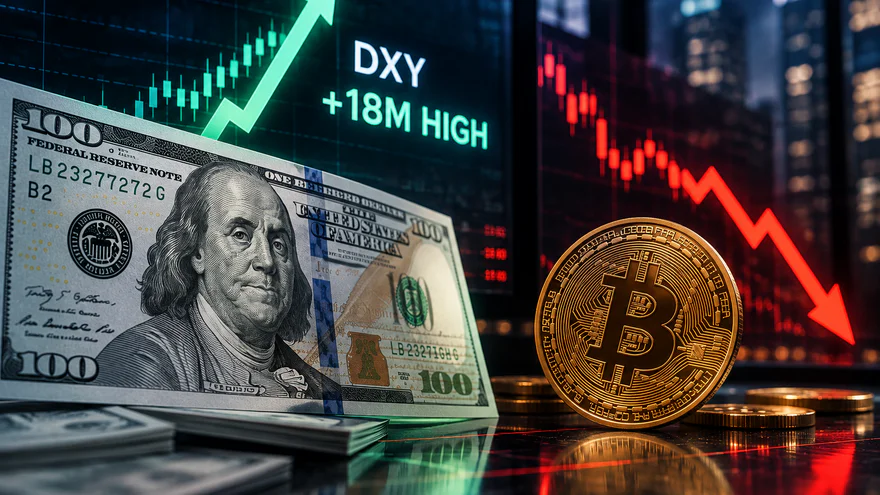
According to Reuters, on November 11, the dollar index DXY, which reflects the value of the U.S. currency relative to a basket of six major currencies, rose to 102.30 points. After a 0.5% increase on Tuesday, it added about another 0.1% during Asian trading, approaching the peak since October 29.
The strengthening of the dollar is explained by several interrelated factors:
Rise in U.S. bond yields. Higher interest rates increase the potential yield of dollar-denominated debt instruments and may support demand for the U.S. currency.
Differences in central bank policies. If the Fed tightens policy faster than the ECB or the Bank of Japan, the interest rate differential may work in favor of the dollar.
Decrease in risk appetite. In times of increased uncertainty, investors sometimes reduce investments in risky assets and increase holdings of liquid dollar instruments.
However, high inflation alone does not guarantee further dollar growth. More important is how new data diverges from market expectations and how it affects the forecast for future interest rates.
As noted by Chris Weston, head of research at Pepperstone, in a Reuters commentary on November 11: “The rate market is pricing in not just another hike.” The analyst explained that investors are assessing how restrictive U.S. monetary policy might ultimately become.
In the currency market on the morning of November 11, the EUR/USD pair was trading around 1.1163. The USD/JPY rate was around 158.82 yen per dollar. Further dynamics of these instruments can be tracked in the UNUM currency quotes section.
How a Strong Dollar Affects Gold, Stocks, and Cryptocurrencies
The rise in borrowing costs affects companies' financial decisions and the valuation of investment assets. More expensive loans alter financing conditions, influence investment flows, and compel market participants to reassess the prospects of various financial instruments.
The reaction to October's CPI data already demonstrated how sensitive markets remain to changes in inflation expectations.
Gold. The spot price of gold fell by 2.62% to $4,030.56 per troy ounce on November 10, according to Reuters. The rise in U.S. bond yields increases the opportunity cost of holding gold, which itself does not yield interest. All else being equal, a stronger dollar raises the cost of gold for buyers transacting in other currencies.
U.S. Stocks. The U.S. stock market reacted with declines in the S&P 500 and Nasdaq Composite. By the end of trading on November 10, the former index lost 0.38%, and the latter 0.74%. Higher rates increase the cost of corporate financing and reduce the current valuation of expected future cash flows. The rise in borrowing costs may limit companies' investment plans, especially in the tech sector, where market valuations often depend on future growth expectations. The dynamics of the U.S. stock market can be tracked in the UNUM indices quotes section.
Cryptocurrencies. On the morning of November 11, Bitcoin was trading around $73,712, approaching a three-month low. The Fed's tight policy may limit capital inflows into risky assets; however, BTC's movement also depends on spot market demand, ETF flows, and liquidations of leveraged positions.
In a separate analysis of Bitcoin's decline on UNUM, additional factors affecting the cryptocurrency market are considered.
At the same time, the reaction of the listed assets is not always the same. For example, gold may receive support during serious geopolitical instability even with high rates, while American stocks can rise if strong corporate results outweigh concerns about credit costs.
What Awaits the Dollar Before the December Fed Meeting
The short-term forecast for the dollar will depend on new inflation data and Fed signals. The decision of the Federal Reserve System on December 9 and comments from regulatory representatives about possible actions in 2027 will be of significant importance.
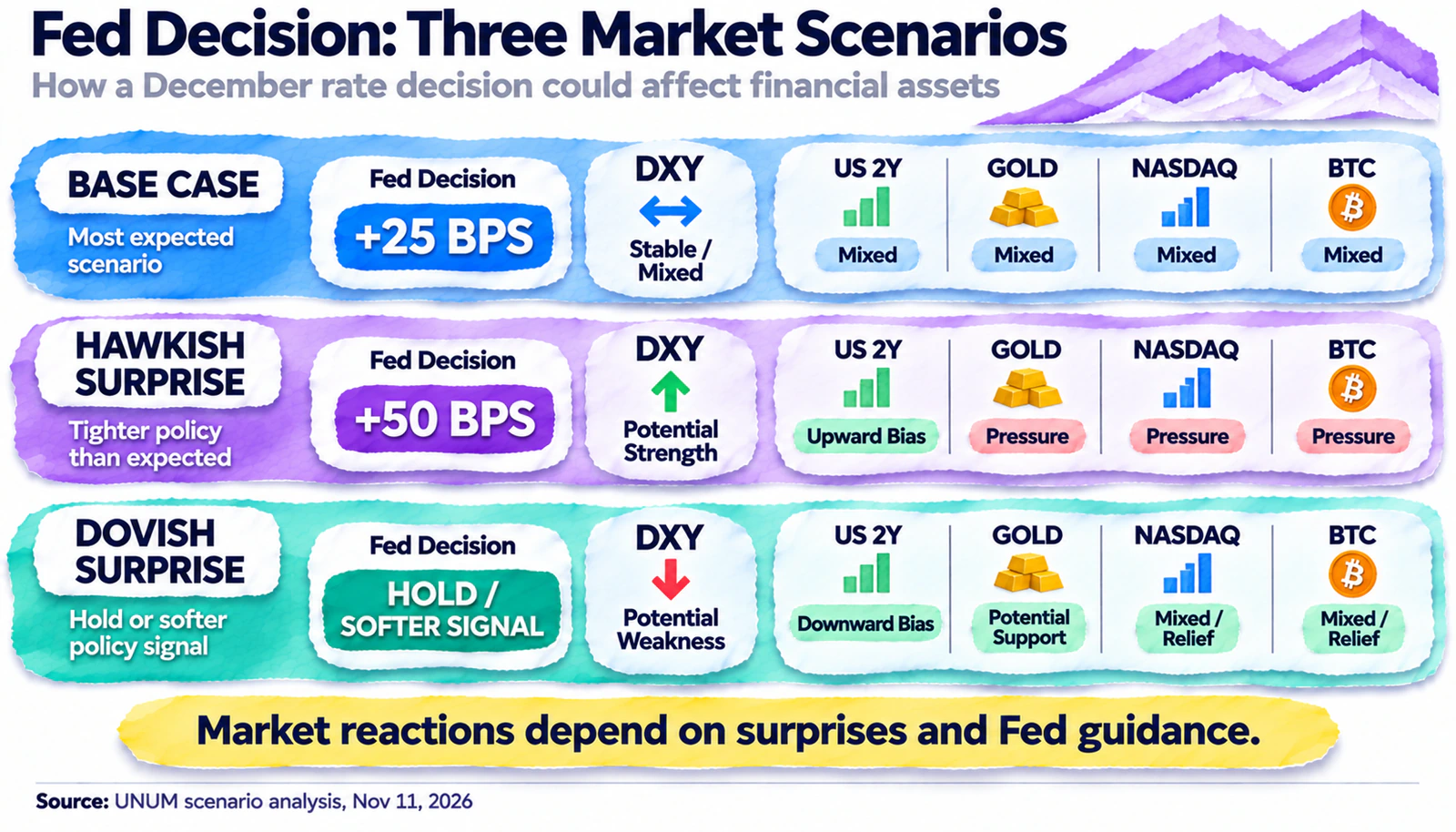
Considering current inflation indicators and market expectations, three main scenarios can be highlighted.
Scenario | Fed Decision | Possible Consequences for the Dollar |
|---|---|---|
Base | Rate hike by 25 bps | The dollar may maintain stable positions if the Fed confirms the need for further tightening |
Hawkish | Increase by 50 bps | Stronger dollar strengthening is possible if the decision is unexpected for the market |
Dovish | Rate hold or signals of slowing tightening | The dollar may weaken due to revised expectations for the yield of American assets |
As of November 11, the base market scenario remains a rate hike by 25 basis points. However, even its implementation does not guarantee further strengthening of the dollar, as a significant part of the expected decision is already priced in.
For investors, updated economic forecasts from the Fed and comments from the regulator's leadership will be equally important. If they indicate the need for a longer period of high rates, the dollar may receive additional support. Conversely, softer rhetoric may change market sentiment.
Economic Events for Investors to Watch
Before the December Fed meeting, market participants will need to assess several important publications that could change expectations for interest rates.
November 13 — U.S. Producer Price Index (PPI) for October, allowing assessment of inflationary pressure at the production level.
December 4 — employment report for November, including changes in the number of jobs and the unemployment rate.
December 8–9 — FOMC meeting, after which the rate decision and updated economic forecasts will be published.
December 10 — November CPI, which will be released after the Fed decision and will affect expectations for policy in 2027.
Additional significance will be given to data on the Personal Consumption Expenditures (PCE) index, which the Fed uses as a primary guide for assessing inflation. Publications can be followed through the UNUM economic calendar.
As noted in the review of key events for the trading week of November 9–13, U.S. inflation indicators remain one of the main factors shaping market expectations.
October statistics have already strengthened the dollar's position and increased the likelihood of further Fed policy tightening. However, the sustainability of this movement will depend on new data and the regulator's willingness to act more aggressively than the market anticipates. For investors, the main guide remains not only the rate decision itself but also its possible impact on financial conditions in 2027.