
US Opens Market for Perpetual Stock Futures
On November 3, 2026, the Chairman of the US Commodity Futures Trading Commission (CFTC), Michael Selig, announced the potential launch of perpetual futures on individual stocks, known as equity perpetual futures or equity perps.
In the official CFTC statement, it was noted:
Today, perpetual futures contracts on individual equity securities (Equity Perps) can begin trading for the first time on exchanges registered with the CFTC.
This does not mean a free-for-all launch of contracts on any trading platforms. Such instruments can be offered by certain futures exchanges, which also have the necessary registration with the US Securities and Exchange Commission (SEC) for trading futures on securities.
The CFTC reported that the contracts have been approved under rule 40.3 as security futures products. Thus, they are subject to applicable provisions of commodity futures and securities laws, as well as regulations from both regulators.
However, the decision does not yet mean the mass emergence of liquid contracts on all American stocks. The availability of perpetual stock futures in the US will depend on specific exchanges, contract conditions, and the readiness of trading infrastructure.
How Perpetual Futures Differ from Regular Ones
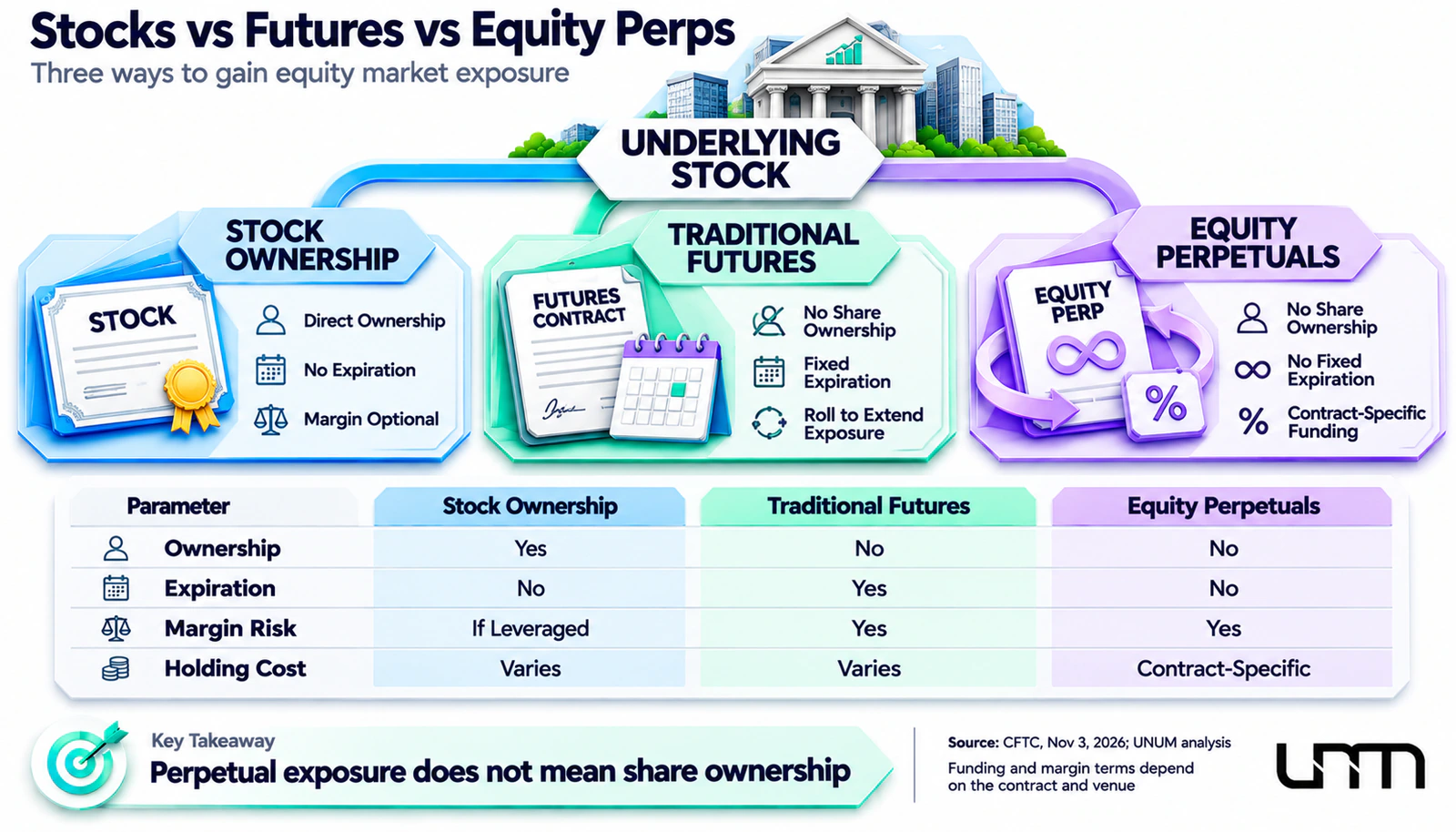
A traditional future is a derivative contract with a set expiration date. Its terms may provide for the delivery of the underlying asset or cash settlement, and a trader wishing to maintain exposure after expiration typically rolls the position into the next contract.
Perpetual futures do not have a fixed expiration date, so the trader does not need to regularly roll the position. This structure has become widespread in the cryptocurrency market, particularly in trading derivatives on Bitcoin and Ethereum.
However, the absence of expiration creates another challenge. The price of a perpetual contract must maintain a connection with the quotes of the underlying asset, even if participants can hold positions without a predetermined end date.
On crypto exchanges, this is often achieved using a funding rate—a periodic payment between holders of long and short positions. With a positive rate, buyers usually pay; with a negative rate, sellers do. The specific mechanism depends on the platform.
The CFTC statement does not set uniform funding rate parameters for all equity perps. Therefore, the mechanism for maintaining the connection with the underlying asset and the cost of financing must be checked in the specification of each contract.
Parameter | Stocks with Direct Purchase | Regular Futures | Perpetual Futures |
|---|---|---|---|
Stock Ownership | Yes | No | No |
Expiration | No | Yes | No |
Leverage | Possible on a margin account | Through collateral | Through collateral |
Holding Cost | Possible loan interest | Financing included in price, possible rollover costs | Depends on financing mechanism |
Forced Liquidation | Possible in margin trading | Possible | Possible |
In terms of profit or loss from price changes, perpetual futures share common features with contracts for difference (CFD). However, CFDs are typically agreements with a broker, whereas the equity perps in question are exchange-traded derivatives regulated under security futures rules.
Thus, perpetual futures do not replace regular stocks. The trader acquires a derivative instrument that allows for profit or loss depending on price movement but does not become a shareholder of the company and does not acquire corresponding corporate rights.
How Much Will Trading New Contracts Cost
The absence of expiration relieves the trader from the need to regularly roll over the position, but does not make holding it free. Overall costs depend on several components:
Trading Commissions. Fees for opening and closing a position set by the exchange and intermediary.
Spread. The difference between the best bid and ask price, especially important with insufficient liquidity.
Financing Cost. Funding rate or another contractually provided mechanism for periodic settlements.
Slippage. The difference between the expected and actual execution price, occurring with rapid market movement or insufficient order book depth.
Let's consider a hypothetical example based on a common model of cryptocurrency perpetual contracts.
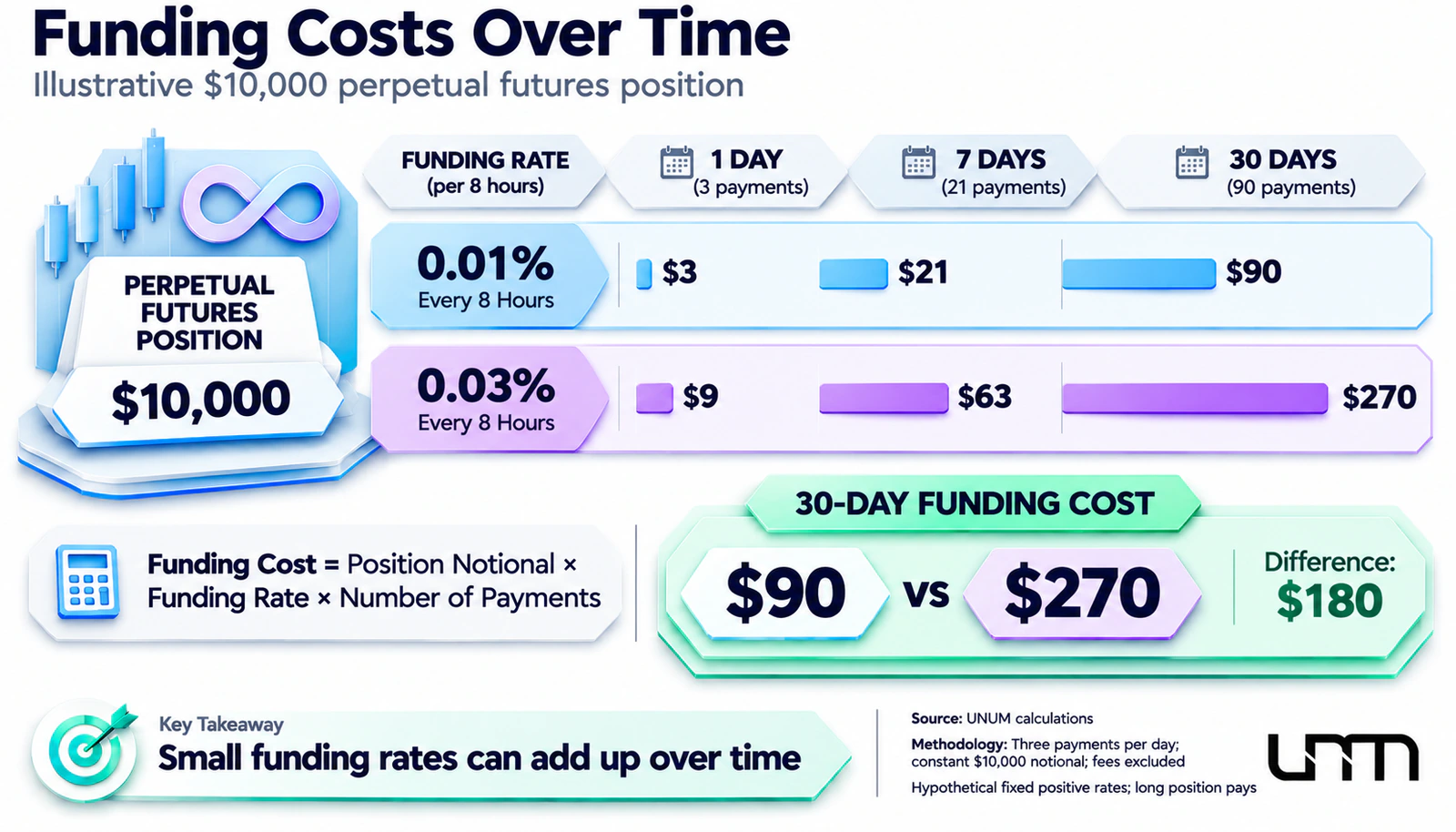
A trader opens a long position of $10,000. If the funding rate is 0.01% every eight hours and remains unchanged, three payments of $1 will be required per day. Over 30 days, expenses will reach $90 if the position size remains unchanged.
With a hypothetical rate of 0.03% every eight hours over the same period, the amount will be $270. Such payments reduce the financial result of the position even with favorable movement of the underlying asset. The calculation does not include trading commissions, spread, and possible rate changes. Additionally, with a negative funding rate, the holder of a long position may receive payments instead of making them.
It is important to note that the mentioned rates and eight-hour intervals are used solely for illustration. They are not confirmed conditions of American equity perps.
For a trader, this means evaluating an instrument not only by its potential return but also by the total cost of the position over the intended trading horizon.
How Leverage Changes Risks for Traders
Perpetual futures allow for market exposure that exceeds the amount of collateral posted. This increases capital efficiency but simultaneously heightens the sensitivity of the trader's funds to changes in the stock price.
For example, with collateral of $2,000, it is possible to open a position of $10,000 if the platform's rules allow for such leverage. In this case, a leverage of 5x is used. If the price of the underlying asset decreases by 5%, the loss on a long position would be approximately $500, or 25% of the initial collateral. If it increases by the same 5%, the profit before expenses would also be $500.
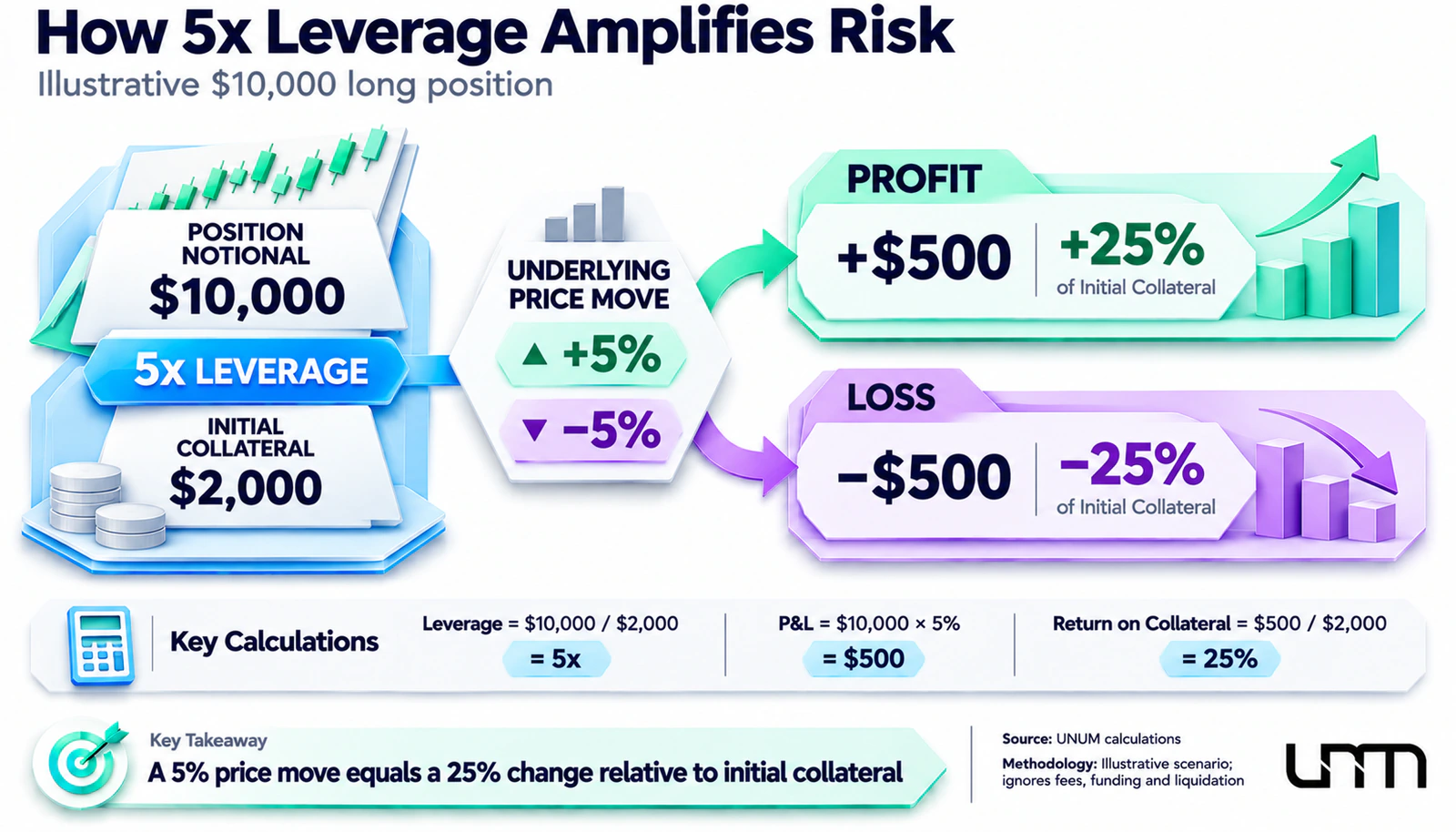
However, the actual result depends on the price calculation mechanism, fees, margin requirements, and conditions for forced liquidation.
It is especially important to consider two indicators:
Initial margin determines the minimum amount of funds required to open a position.
Maintenance margin shows the level of collateral needed to keep a position open.
If own funds become insufficient, the broker may require additional collateral or forcibly reduce or close the position. Liquidation of a position differs from a regular stop-loss in that it is triggered by the broker's risk management rules and does not necessarily occur at a price pre-selected by the trader.
In the U.S., a regulatory framework for security futures is already in place. In 2020, the SEC and CFTC reduced the basic client margin requirement for unhedged positions from 20% to 15% of market value. However, trading platforms and brokers may set higher requirements.
For example, with a basic requirement of 15%, a position of $10,000 would require at least $1,500 in collateral if there are no special risk offset conditions. However, this does not mean that every new contract will be available with such a margin level.
This is where an important line is drawn between regulated American derivatives and some cryptocurrency platforms offering leverage of 20x, 50x, and higher. Allowable leverage is determined by regulatory requirements and platform rules, not just trader preferences.
Moreover, while the CFTC classified equity perps as security futures products, market participants are already challenging the legality of this classification in court.
What Opportunities Traders Will Gain
The spread of perpetual futures on stocks could expand the range of strategies available in the regulated American market.
This primarily concerns directional trading. Participants will be able to use long positions when expecting a price increase and short positions when anticipating a decline, without directly acquiring company stocks. The possibility and conditions for opening short positions will be determined by the rules of the specific contract.
Another scenario involves hedging. An investor holding a stock portfolio can theoretically use a short position in the corresponding derivative to partially offset market losses. However, such hedging requires consideration of financing costs, contract size, and potential price discrepancies.
Additional interest lies in arbitrage between the spot stock market and derivatives. If a perpetual contract significantly deviates from the price of the underlying asset, participants may attempt to profit from the price discrepancy. However, fees, capital requirements, and the risk of spread changes can make such a strategy unprofitable.
Finally, the absence of expiration simplifies the technical management of a long-term position. Instead of regularly rolling over a future, a trader can focus on their own trading horizon, considering the current cost of holding.
However, the advantages will not be the same for all participants. For short-term strategies, commissions and execution speed may be crucial, while for long-term hedging, financing costs and the stability of the link between the contract and the underlying asset become more important.
How Competition Between Stock and Crypto Exchanges Will Change
The introduction of perpetual stock contracts could intensify competition between traditional derivatives operators and platforms using crypto market trading models. Meanwhile, the confrontation has already moved beyond technological solutions.
On November 3, the Capital Markets Alliance (CMA), which includes Cboe Global Markets, Citadel Securities, and Healthy Markets Association, initiated a legal challenge against the CFTC's decision to approve perpetual derivatives on U.S. stocks and ETFs.
The plaintiffs dispute the legality of applying the security futures regime to such instruments. In their view, the regulator's decision allows circumvention of established legal requirements for securities trading and investor protection.
Cboe CEO Craig Donohue emphasized in the company's official statement: "However, this case is about investor protection in securities trading and the rule of law."
The CFTC, on the other hand, believes that the new contracts comply with the existing regulatory framework for security futures and should be available within the regulated U.S. infrastructure.
The legal dispute creates regulatory uncertainty that could affect the timing and conditions for the development of the equity perps market. However, the mere fact of filing a lawsuit does not automatically mean a halt or ban on trading.
At the same time, the emergence of regulated equity perps offers an alternative to offshore platforms that already offer derivatives on traditional financial assets. However, the shift of liquidity to U.S. exchanges is not guaranteed: participants will compare fees, available collateral, market depth, and execution quality.
Key Metrics to Monitor Before Trading Begins
As perpetual futures on stocks are launched, traders will need to assess not only the movement of the underlying asset but also the conditions of the contract itself. It is particularly important to compare the parameters of different platforms, as identical exposure to stocks can come with varying costs and risks.
The main benchmarks will be six metrics:
Regulatory status of the platform. It is necessary to check whether the exchange has the required registrations for trading the relevant security futures and whether the specific product is available to the chosen category of clients.
Initial and maintenance margin. The higher the proportion of mandatory collateral, the lower the potential leverage. Margin call thresholds should be assessed separately from the requirements for opening a position.
Funding cost. If the contract includes a funding rate, it is important to consider the calculation formula, payment frequency, and rate change history. A low transaction fee does not necessarily mean low total costs.
Liquidity and open interest. Trading volume, order book depth, spread, and open interest help assess the feasibility of executing a trade. High turnover alone does not guarantee the absence of slippage.
Liquidation mechanism. It is important to find out what prices are used to calculate margin sufficiency, how forced liquidation works, and whether a loss beyond the initially deposited funds is possible.
Trading hours and corporate events. Periods outside the main stock market session, earnings releases, dividend payments, stock splits, and other events that can affect the derivative's settlement value require special attention.
For single stock contracts, corporate events are particularly important. Apple's quarterly earnings, for example, can cause a sharp change in AAPL's price, and the derivative's settlement terms determine how this will impact a trader's position. More on the factors affecting the company's valuation can be read in UNUM's analysis on Apple's earnings and margin.
To track the movement of underlying assets, you can use the UNUM stock quotes section. Meanwhile, quotes for perpetual contracts, funding conditions, and margin requirements should be checked directly with the relevant trading platform.
What Will Change for the Market and Traders
The CFTC's decision allows the introduction of a derivative structure on the U.S. stock market that is already widely used in cryptocurrency trading. The absence of expiration may simplify position management and expand opportunities for speculative strategies, hedging, and arbitrage.
However, the attractiveness of the new instruments will depend on the actual trading conditions. Funding costs, leverage restrictions, liquidation mechanisms, and exchange liquidity may have a greater impact on the outcome than the mere absence of a contract expiration date.
An additional factor remains the legal dispute over the legal status of equity perps. Therefore, the main change for traders is not yet the emergence of a universal way to trade stocks, but the development of a new segment of regulated derivatives trading.