Bank of Korea Raises Rate to 3.25% Amid Semiconductor Boom
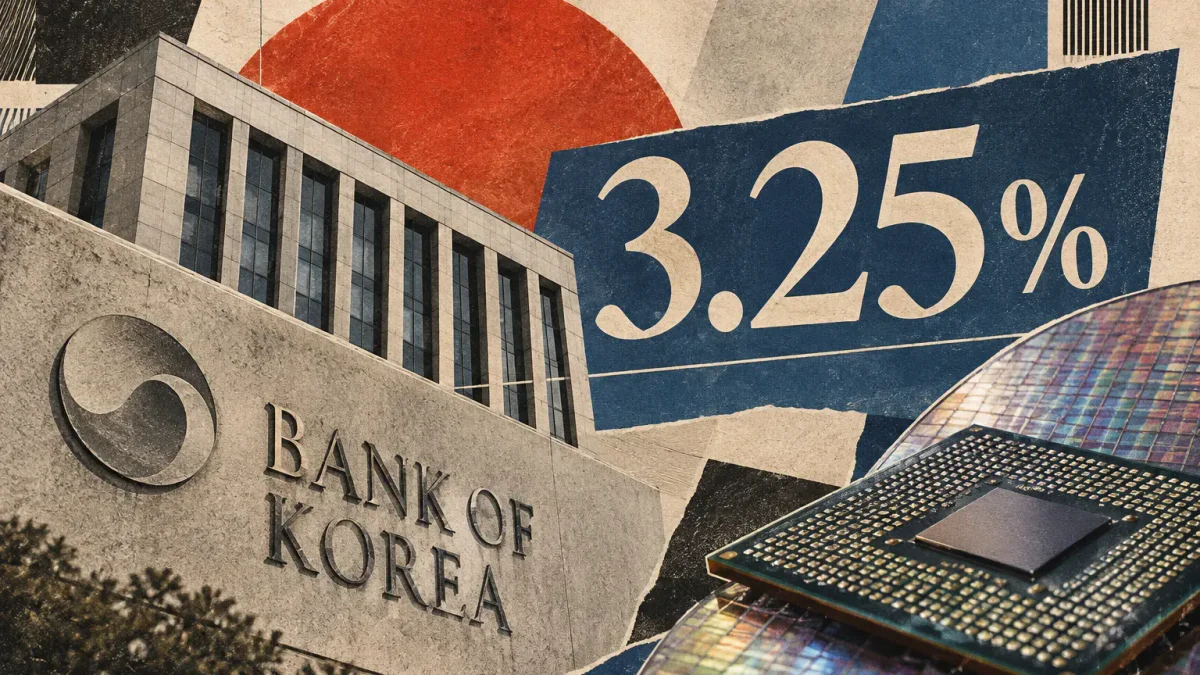
The Bank of Korea raised its key interest rate by 25 basis points to 3.25% on November 26. The regulator resumed tightening monetary policy amid accelerating economic growth and persistent inflationary pressure. Simultaneously, the central bank significantly improved its economic growth forecast for South Korea for 2026 and 2027.
The decision was supported by five of the seven members of the monetary policy committee. The rate hike was expected by 21 out of 23 economists surveyed by Bloomberg. Following previous increases in July and August, the total rate increase since the beginning of the year reached 75 basis points.
Demand for Semiconductors Accelerates South Korea's Economic Growth
The Bank of Korea revised its economic forecasts amid high global demand for memory chips and the expansion of computing infrastructure for artificial intelligence.
The GDP growth forecast for 2026 was raised from 3.3% to 3.9%, and for 2027 from 2.9% to 4.1%. If the regulator's expectations are met, the country's economy will demonstrate the highest growth rates since 2021 next year.
In the third quarter of 2026, South Korea's GDP increased by 1% compared to the previous quarter, exceeding economists' forecast of 0.8%. Equipment investments grew by 4.1%.
The boom in the semiconductor industry also contributes to updating export records. According to South Korea's Ministry of Economy and Finance, the country's exports in October grew by 93.7% year-on-year. Taking into account the number of working days, the increase was 76.1%.
On November 19, the total volume of South Korea's goods exports since the beginning of the year exceeded $1 trillion for the first time.
Inflation Limits the Bank of Korea's Options
Despite high economic growth rates, inflation remains above the central bank's target level. In October, consumer prices rose by 2.8% year-on-year. Core inflation, excluding food and energy, also stood at 2.8%.
The Bank of Korea maintained its inflation forecast for 2026 at 2.7%, while raising the estimate for 2027 from 2.3% to 2.4%.
The regulator's chairman, Shin Hyun Song, previously stated the need to maintain restrictive monetary policy until there is confidence in returning inflation to the target level of 2%.
Meanwhile, the economic upturn is not yet evenly reflected in the population's well-being. Despite increased exports and corporate investments, private consumption fell by 0.2% in the third quarter. Rising borrowing costs and high household debt may further limit domestic demand.
Analysts Expect Further Rate Hikes
Economists at Bloomberg Economics anticipate the Bank of Korea's key rate could rise to 3.5% in February 2027. However, a slowdown in global investments in artificial intelligence infrastructure could alter this forecast.
For the regulator, the main task remains curbing inflation without excessively weakening domestic demand. Steady semiconductor exports currently allow for continued monetary policy tightening, but the high dependence of economic growth on the technology sector increases South Korea's sensitivity to changes in global investments in artificial intelligence.
This material is prepared solely for informational purposes and does not constitute financial advice or a recommendation.