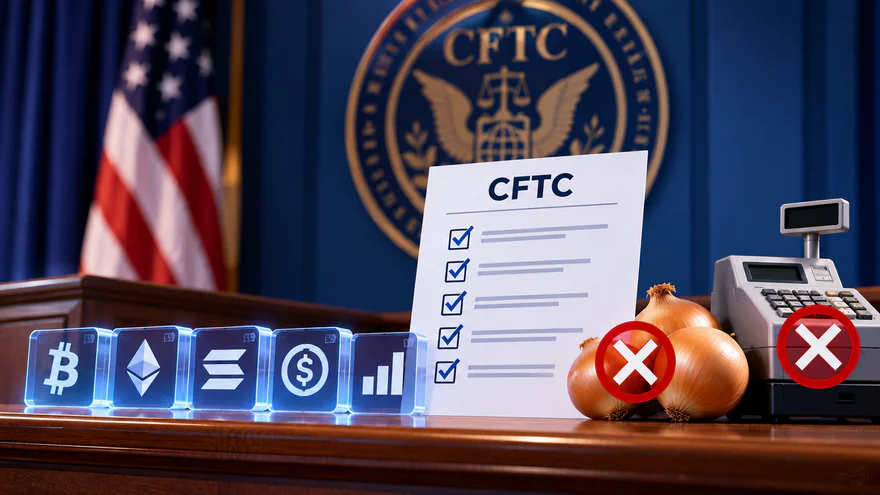
Former acting chair of the CFTC, Caroline Pham, stated that the agency can regulate almost everything except "onions and box office receipts": the Commodity Exchange Act is worded in such a way that almost everything is a commodity. Pham is now the chief legal and administrative officer at MoonPay. She shared this with The Block at Token2049 in Singapore.
According to her, after the failure of the Clarity Act, the industry shifted to regulatory rule-making, and the CFTC's framework is sufficient: it is principles-based and flexible for new types of commodities, including AI computations and derivatives on them.
Under the leadership of Chairman Michael Selig, the CFTC issued a preliminary notice on Regulation CAM and Regulation CTX – a federal framework for retail leveraged crypto transactions as an alternative to state licenses. Pham called this a continuation of the Crypto Sprint initiative she launched in 2025, which allowed the first spot crypto trading on registered CFTC exchanges. The initiative relied on the Dodd-Frank provision of 2010, which the agency had not applied for years. "This is exactly the protection retail traders in the US need. It's better to place this on a strictly regulated exchange than to leave it to a patchwork of different laws," she said.
Pham believes that the industry overestimates stablecoins compared to tokenized deposits in wholesale markets: atomic settlements in one day would require about $15 trillion in cash, which is not available. Banks use net settlements, and that's where tokenized deposits will be necessary. Stablecoins are more useful where counterparties do not trust each other.
She expects NYSE and Nasdaq to start listing tokenized shares of real companies and show significant volume within two years, distinguishing them from synthetic tokens without issuer approval. In her opinion, real securities provide voting rights and participation in management. Pham anticipates a second wave of NFTs as regulatory clarity improves, but sees them as a tool for customer engagement rather than securities, comparing them to Starbucks points or airline miles.
This material is prepared solely for informational purposes and does not constitute financial advice or a recommendation.
Related articles