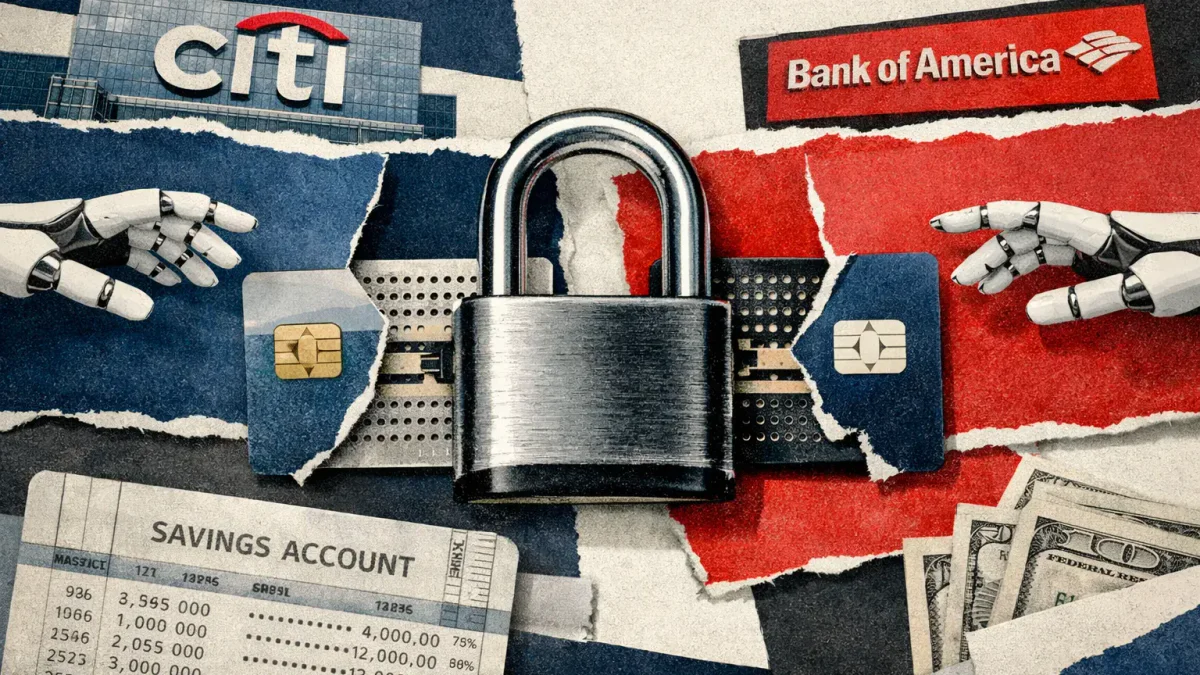
American banks Citigroup and Bank of America have decided to limit AI agents' access to customer accounts. They fear that autonomous assistants could rapidly transfer depositors' funds into higher-yield financial products, according to FT. In October 2026, representatives of the banking sector approached the regulators of the Federal Reserve System (FRS) in the US due to the increased use of AI for financial operations. Banks express concern about losing a significant portion of cheap deposits, which they use for lending. Citigroup reports that they do not allow third-party AI agents to access customer accounts or conduct transactions independently in digital banking services. This is done to protect users' accounts and personal data. At the same time, clients have the option to provide certain open banking services with limited read-only access to account information.
Bank of America CEO Brian Moynihan emphasized the need for control over AI actions. He noted that the bank is working with developers to create rules that will determine responsibility for payments initiated by artificial intelligence. "We firmly believe that a human should be involved in the process and confirm the transfer of funds from the account," – Moynihan stated. He added that banks want to avoid situations where clients discover missing funds and do not understand where they were transferred. The discussion gained relevance with the launch of the personal AI assistant Muse by Meta in September. Meanwhile, tech companies are developing tools for financial management that can automatically move funds between accounts to optimize returns. According to Apollo's chief economist Torsten Slok, AI agents can automatically transfer household savings to accounts with rates of 3.3–5% instead of the average yield of current accounts in the US at 0.1%. If such tools become widely used, banks could incur significant losses, as JPMorgan, Bank of America, and Wells Fargo collectively have $1.6 trillion in deposits that do not earn interest – about 16% of their liabilities. If these funds had to be serviced at a 3% rate, banks' expenses would increase by $47 billion annually – almost half of their combined annual profit.
JPMorgan Chase CEO Jamie Dimon also confirmed that the bank will restrict third-party AI agents' access to customer accounts, as there could be many such uncontrolled agents. According to a source familiar with the discussion, FRS representatives privately supported restrictions on AI agents' access to client accounts. Regulators believe it is necessary to clarify the legal rules for authorizing operations by autonomous systems and to bear responsibility in case of errors. Christoph Stegmeier, a senior partner at consulting firm Simon-Kucher, noted that banks need to more actively encourage clients to keep their savings, particularly through loyalty programs and more attractive lending conditions. "Banks need to make their deposit products more attractive to retain clients," – he said.
This material is prepared solely for informational purposes and does not constitute financial advice or a recommendation.
Related articles