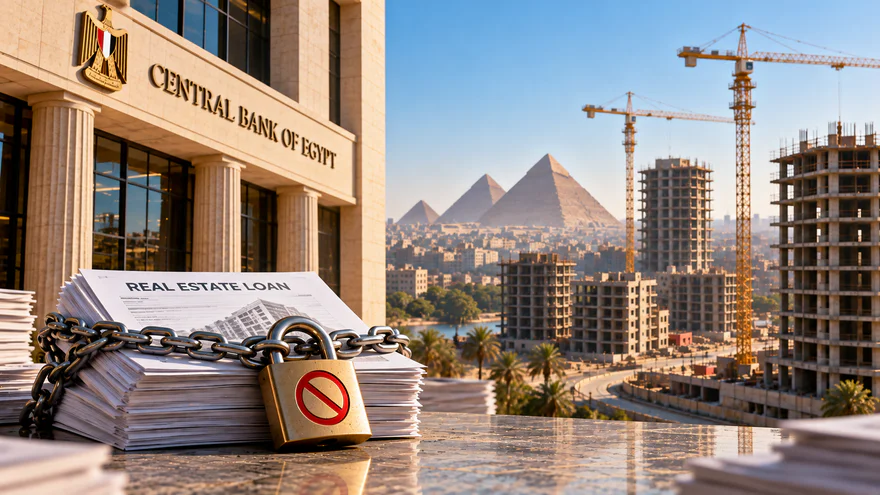
Egyptian banks have temporarily halted issuing new loans to companies engaged in development until the assessment of problematic projects is completed. This is due to the intensifying situation in the real estate market and government efforts to monitor companies and their projects. The Central Bank of Egypt has asked banks to compile a list of issued loans and conditions, especially those concerning projects not completed on time. It has also requested detailed data on the 15 largest development companies and the degree of completion of their projects. As a precautionary measure, some banks have begun reviewing their credit decisions regarding real estate companies.
Among the banks that have postponed issuing new loans are the National Bank of Egypt, Bank of Cairo, ABC, Housing and Development Bank, Suez Canal Bank, QNB, United Bank, and Alexandria Bank. According to eight bankers interviewed by Ash-Sharq Bloomberg, the delay is due to the need to reassess the financial positions of companies, the status of their projects, and expected cash flows considering current market conditions and government measures.
Exceptions are made for companies with strong financial stability and foreign shareholders. Banks evaluate each company individually—based on its solvency, sales volume and receipts, project implementation rates, and credit servicing discipline. This means there is no unified policy regarding the sector: decisions depend on risk assessment and market conditions in each specific bank. The status of development projects in Egypt remains under scrutiny in light of government and banking sector actions aimed at ensuring obligations to clients are met and deadlines are adhered to. According to Tarek Shoukry, head of the Development Chamber at the Federation of Egyptian Industries, the government intends to announce the results of a comprehensive assessment of problematic projects across the country in October. The goal is to more accurately measure the scale of delays, as in one project, some units may lag behind schedule while others are delivered on time.
The real estate market in Egypt is feeling pressure from both buyers and the requirements to meet deadlines and financial obligations. The financial inflows of many companies have begun to decline, affecting their ability to secure new financing. The caution of banks extends not only to developers but also to construction firms. At the same time, large developers continue to have strong sales, with price growth forecasts for 2026 ranging from 15% to 35%—amid rising construction costs and demand for real estate as a means of preserving value. Meanwhile, the government is working on a bill to establish the Egyptian Real Estate Developers Union, which will introduce new rules for classifying companies, regulating unit sales, protecting client funds, and dealing with problematic projects. Further changes in the market will depend on the results of the current project assessment and credit policy decisions.
This material is prepared solely for informational purposes and does not constitute financial advice or a recommendation.
Related articles