IBM Connects Two 120-Qubit Processors with 99% Transmission Accuracy

IBM researchers have connected two 120-qubit Nighthawk R1 processors and achieved an average quantum state transmission accuracy of 99%. The experiment demonstrated the possibility of combining individual superconducting chips into larger systems. The results are in a preprint and have not yet undergone independent peer review.
Scaling is one of the main challenges of quantum computers: increasing the number of qubits on a single chip complicates management, electronic connections, and error suppression. An alternative is to combine several smaller chips, but this requires transmitting states between processors without destroying the information.
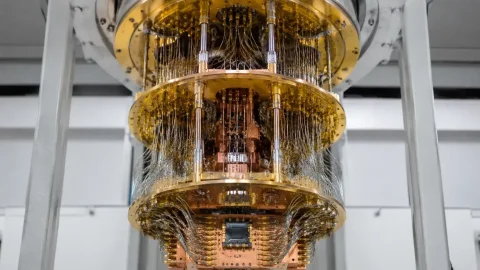
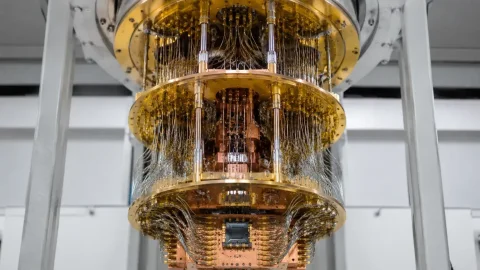
The IBM team used four L-coupler connectors. Each includes a superconducting aluminum coaxial cable 80 cm long, two tunable intermediate qubits, and two RF-SQUID-based coupling elements. The cables are connected perpendicularly to the processor surfaces, allowing for more connections. The qubit state is sequentially transferred through the connector to a qubit of another processor. The best connector achieved 99.29%: the transmitted state closely matches the original with high accuracy.
To test the joint operation of the chips, two-qubit CZ operations were performed, creating entanglement. The average accuracy of interprocessor operations was 94.75%, with a maximum of 96.42%. The scientists also simultaneously created two entangled pairs through neighboring connectors and demonstrated four- and six-qubit GHZ states distributed between the processors.
A universal system capable of utilizing all 240 qubits for arbitrary algorithms was not demonstrated. The main limitation is the quality of interprocessor operations: 94.75% is significantly lower than the best two-qubit operations within modern chips, and in complex algorithms, errors accumulate. Coherence losses and connector characteristics affect transmission: the magnetic field during cable cooling significantly degrades their parameters.
According to IBM's roadmap, they plan to combine up to three Nighthawk modules into systems with 360 programmable qubits. In August, the company introduced a modular cryogenic architecture for housing and cooling multiple processors.
This material is prepared solely for informational purposes and does not constitute financial advice or a recommendation.
Related articles