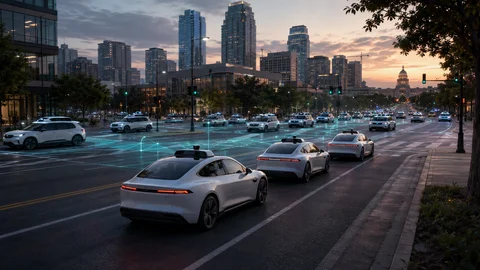
Research shows that autonomous vehicles are significantly less likely to be involved in accidents and cause less damage than humans. According to the Insurance Institute for Highway Safety (IIHS), automatic emergency braking (AEB) systems that detect pedestrians in front of the vehicle reduce pedestrian accidents by 27 percent. These AEB systems will be mandatory for all passenger cars in the U.S. by 2029, and more than 90 percent of new models already comply with this requirement voluntarily.
A separate IIHS study found that automatic braking significantly reduced rear-end collisions by 50 percent and injuries from them by 56 percent. The Highway Loss Data Institute found that vehicles with AEB systems show a 13 percent reduction in damage claims. Cars equipped with multiple ADAS features, such as pedestrian automatic braking, adaptive cruise control, and lane departure warnings, showed a reduction in claims by up to 39 percent. Waymo reported that its robotaxis have conducted 20 million paid trips over a distance of 220 million miles – equivalent to 250 human lifetimes of driving. In March, an independent study by Waymo showed that its robotaxis are 92 percent less likely to be involved in collisions with fatal or serious injuries – a 13-fold reduction compared to human drivers in similar urban environments. At the same time, pedestrian injuries decreased by 92 percent, airbag deployment accidents by 83 percent, and accidents with any injuries by 82 percent. At road intersections, one of the most dangerous places for vehicles, there was a 96 percent reduction in injury-causing accidents. However, the question arises as to how comparable Waymo's data, obtained in limited conditions (only in good weather in a few U.S. cities), is to human drivers operating vehicles on more diverse roads and in changing conditions. IIHS conducted an independent review, clearing often incomplete data. Approximately half of human accidents go unreported, and up to a third of injury accidents, as drivers avoid insurance premium increases. This potentially skews statistics in favor of human drivers. Meanwhile, Waymo is more transparent than others, and robotaxi operators are required to report even minor damage to the National Highway Traffic Safety Administration (NHTSA), although not all companies voluntarily report total mileage.
A July IIHS study found that driverless cars are involved in accidents less frequently than humans. Scientists created a more reliable category of 'police-reportable crashes' and compared Waymo's performance with human drivers in San Francisco, Phoenix, Los Angeles, and Austin. Waymo's Jaguar I-Pace engine taxis covered about 50 million miles without a driver during the study period, while human drivers in the same cities drove 222 billion miles. Waymo taxis were involved in 68 percent fewer accidents overall: 76 percent fewer in Phoenix, 71 percent in Los Angeles, and 35 percent in San Francisco.
In Austin, a higher rate of 4 percent was recorded, which may be explained by the very small sample size. Meanwhile, Waymo accidents with injuries remained 81 percent lower per mile. On July 30, NHTSA granted Zoox, an Amazon subsidiary, the first-ever exemption from certain vehicle safety standards. This allowed the commercial operation of Zoox robotaxis, which have no steering wheel or pedals, to begin. The regulator determined that the specially designed Zoox robotaxi provides an equivalent level of safety to a conventional vehicle. On the same day, NHTSA announced a partnership with SAE Industry Technologies to develop national performance and competency standards for autonomous vehicles through a three-year, $5 million A2SCEND consortium. Some doctors and health specialists insist that lawmakers should view autonomous vehicles not as a technological breakthrough but as a critical public health intervention. Neurosurgeon Jonathan Slotkin presents compelling arguments for the medical and social benefits of autonomous vehicles. Researchers from the Bloomberg School of Public Health at Johns Hopkins University point out that highlighting the social value of autonomous vehicles is critically important for building public trust and technology adoption.
Related articles