KOSPI fell by 5.28% amid chipmakers stock sell-off
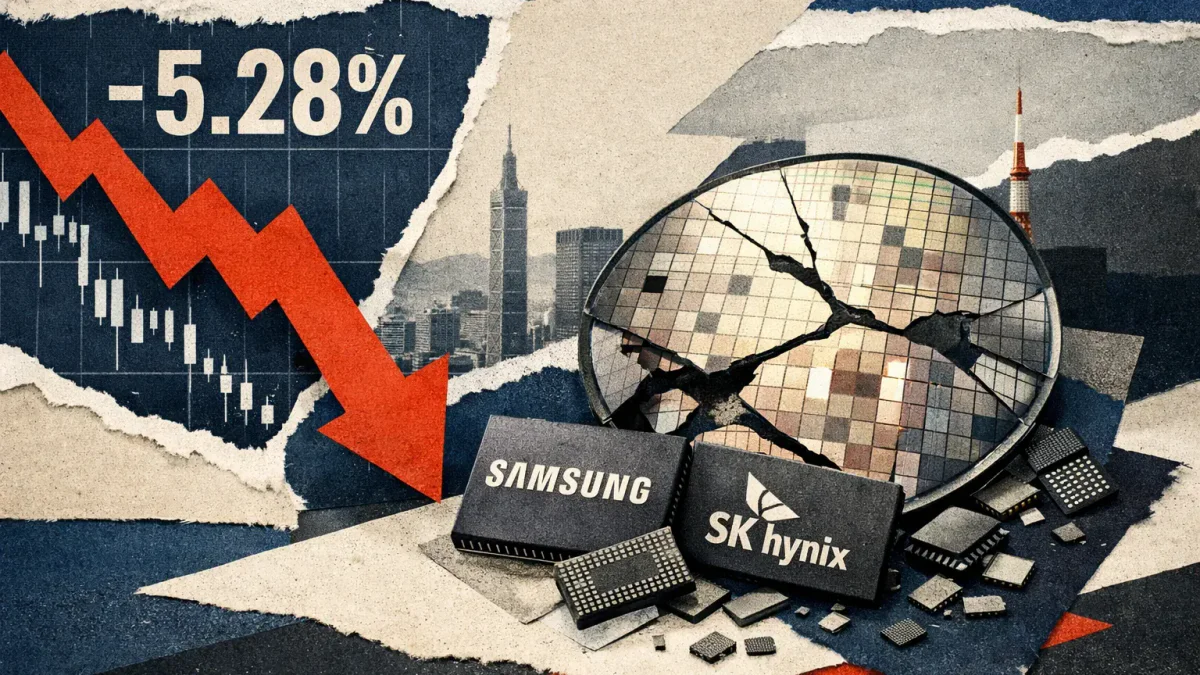
On November 5, 2026, the stock markets in South Korea, Taiwan, and Japan saw a decline in shares of semiconductor manufacturers and companies related to artificial intelligence infrastructure. The drop was particularly notable in South Korea, where the KOSPI index fell by 5.28% to close at 5,383.80 points. The sell-off also affected memory manufacturers, whose prospects depend on orders for data center equipment.
Shares of Samsung Electronics dropped by 7.57% to 201,500 won, while SK Hynix fell by 9.46% to 1,264,000 won. During trading, the Korean exchange limited program sales for five minutes through a special mechanism designed to curb sharp fluctuations. Foreign investors sold Korean stocks with a net value of about 3.4 trillion won.
The Sell-off Affected Taiwan and Japan
In Taiwan, the TAIEX index fell by 3.20% to 41,574.72 points. Shares of chip designer MediaTek decreased by about 6.9%, and those of the largest contract chip manufacturer TSMC fell by 0.9%. The decline affected not only companies directly producing processors but also suppliers of electronic components.
Japan's Nikkei 225 lost 1.79%, ending the session at 61,077.90 points. Shares of memory manufacturer Kioxia decreased by about 13.1%, and those of chip testing equipment maker Advantest fell by 14.7%. Meanwhile, the broader TOPIX index rose by 1.16%. Thus, the decline in the Nikkei did not indicate a uniform drop across all sectors of the Japanese market.
Pressure on stocks increased after quarterly reports from U.S. chip developers Qualcomm and Arm. Qualcomm's smartphone chip sales did not meet expectations, while Arm reported a record quarterly revenue of $1.44 billion. However, some of Arm's metrics, including revenue from licensing fees, fell short of market expectations. Therefore, it is incorrect to label both reports as weak overall.
Market participants also assessed the prospects for investments in American data centers following the U.S. Congressional midterm elections. Among the discussed risks are potential increased oversight of the construction of computing facilities and the timing of capacity commissioning. However, it is currently impossible to isolate the impact of political events from other reasons for the decline in stock prices.
This material is prepared solely for informational purposes and does not constitute financial advice or a recommendation.
Related articles