MacBook Pro Owners with OLED Report Discomfort: Tests Reveal 240 Hz Flicker

The first buyers of the new MacBook Pro with an OLED display PROLED XDR reported unpleasant sensations during prolonged text work. In a discussion on Reddit, some owners described dizziness, headaches, and nausea that occur when reading from the laptop screen. Meanwhile, independent measurements by Notebookcheck showed that the display uses brightness adjustment with a flicker frequency of 240 Hz.
There is no official data on the prevalence of the problem yet. These are individual reports from owners who associate discomfort with the features of the new screen. Notebookcheck specialists also noted the relatively low flicker frequency, which may be noticeable to users with increased sensitivity.
MacBook Pro users report dizziness when reading
One of the first reviews appeared in the r/macbookpro community on Reddit. A user with the nickname HD4kAI stated that he was initially satisfied with the image quality of the new laptop but noticed unpleasant sensations during prolonged text reading. According to him, quick eye movement between lines causes slight dizziness, which gradually intensifies and may be accompanied by nausea.
The author of the post emphasized that he uses several devices with OLED displays and had not encountered such a problem before. He noticed particularly pronounced discomfort on pages with a dark theme, where white text is displayed on a black background. According to him, similar sensations do not occur when watching videos and regular browser use.
The discussion also included other reports of difficulties using the new MacBook Pro. Some participants mentioned eye strain and headaches, and one owner reported returning the 16-inch model due to discomfort. Meanwhile, other users noted that they do not experience such problems even if they have sensitivity to certain displays.
Notebookcheck recorded 240 Hz brightness flicker
Independent measurements of the new MacBook Pro 14 with a PROLED XDR display were published by Notebookcheck on November 5. Testing showed the presence of brightness flicker at a frequency of 240 Hz when the brightness level is set to 99% and below. The measured amplitude was 56%, and additional DC regulation did not eliminate the detected fluctuations.
The flicker is related to the brightness adjustment features of the screen. One of the applied methods is pulse-width modulation (PWM), where the duration of lighting periods in a repeating cycle is changed. Such a process is not always perceived as visible flicker, but under certain parameters, it can cause discomfort in sensitive users.
The 240 Hz frequency refers specifically to brightness flicker, not image refresh. The new MacBook Pro supports an adaptive refresh rate of up to 120 Hz, and these two indicators describe different characteristics of the display. Subjective perception is also influenced by the depth of flicker, chosen brightness, and individual vision characteristics.
How Apple's OLED display differs from mini-LED
Comparative tests by Notebookcheck showed significant differences in flicker characteristics between laptops. The Asus ProArt P14 had a frequency of 960 Hz, the Dell XPS 14 about 240 Hz. For the MacBook Pro 14 with a mini-LED display and M4 Pro processor, a value of 14,880 Hz was previously recorded.
Against this background, the PROLED XDR result differs from the indicators of previous MacBook Pro models with mini-LED. However, a higher frequency does not guarantee the complete absence of discomfort, as other brightness adjustment parameters are also important. Moreover, the results of individual measurements do not automatically extend conclusions to all laptop modifications.
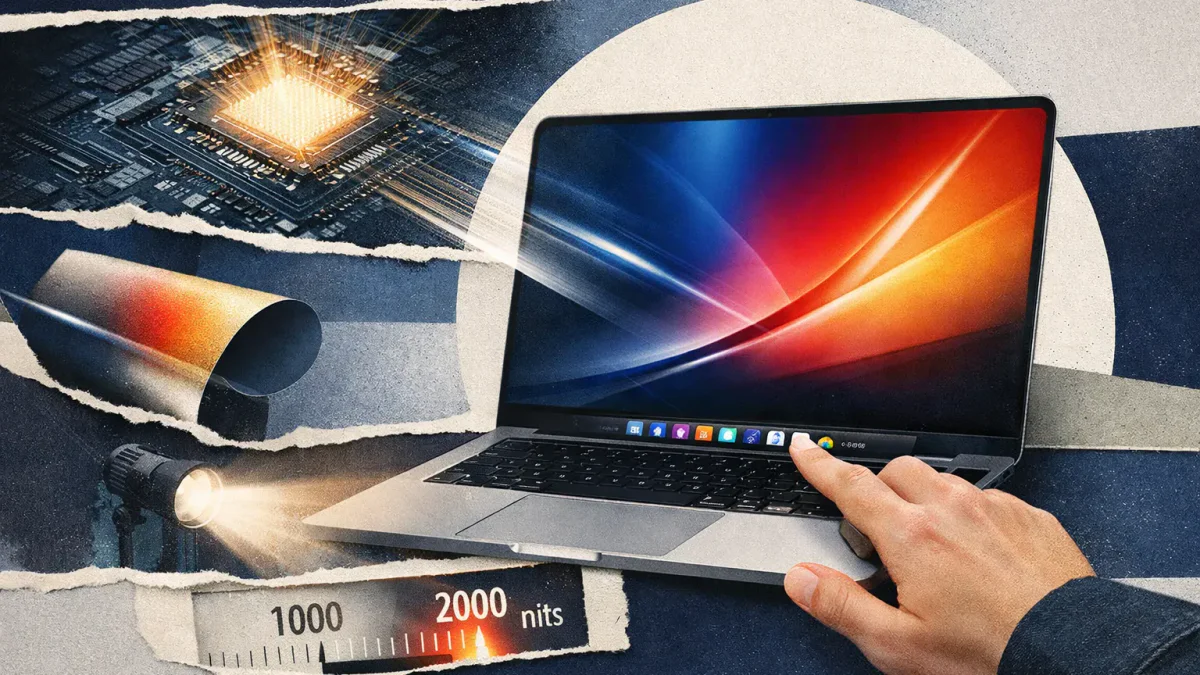
Apple introduced the MacBook Pro with a PROLED XDR display on October 28, 2026, and sales began on November 6. The new lineup features tandem OLED panels, touch control, M5 Pro and M5 Max processors, and a claimed peak brightness of up to 2,000 nits. In the US, the 14-inch version with the M5 Pro starts at $2,899, which is $400 more expensive than a comparable mini-LED option.
What other causes of discomfort are discussed by owners
Participants in the Reddit discussion suggest that unpleasant sensations may not only be related to brightness flicker. Possible causes include the peculiarities of the OLED panel's subpixel arrangement, affecting the display of small text, and the high contrast between light characters and a completely black background. Some users note that the most pronounced discomfort occurs when working with text in a dark theme.
Other participants suggest checking the text display and font smoothing settings in macOS. However, the effectiveness of such changes concerning the new PROLED XDR displays has not yet been confirmed by independent tests. It is also not established which specific screen characteristic could have caused symptoms in particular owners.
As an additional comparison, users discuss the iPad Pro with tandem OLED displays. Some owners note that they can comfortably read text on Apple tablets but experience discomfort when using the new MacBook Pro. Such reviews indicate differences in individual perception of devices, although they do not allow establishing the technical cause of the problem.
This material is prepared solely for informational purposes and does not constitute financial advice or a recommendation.
Related articles