Quantitative Trading Funds Compete with AI Labs for Scientists
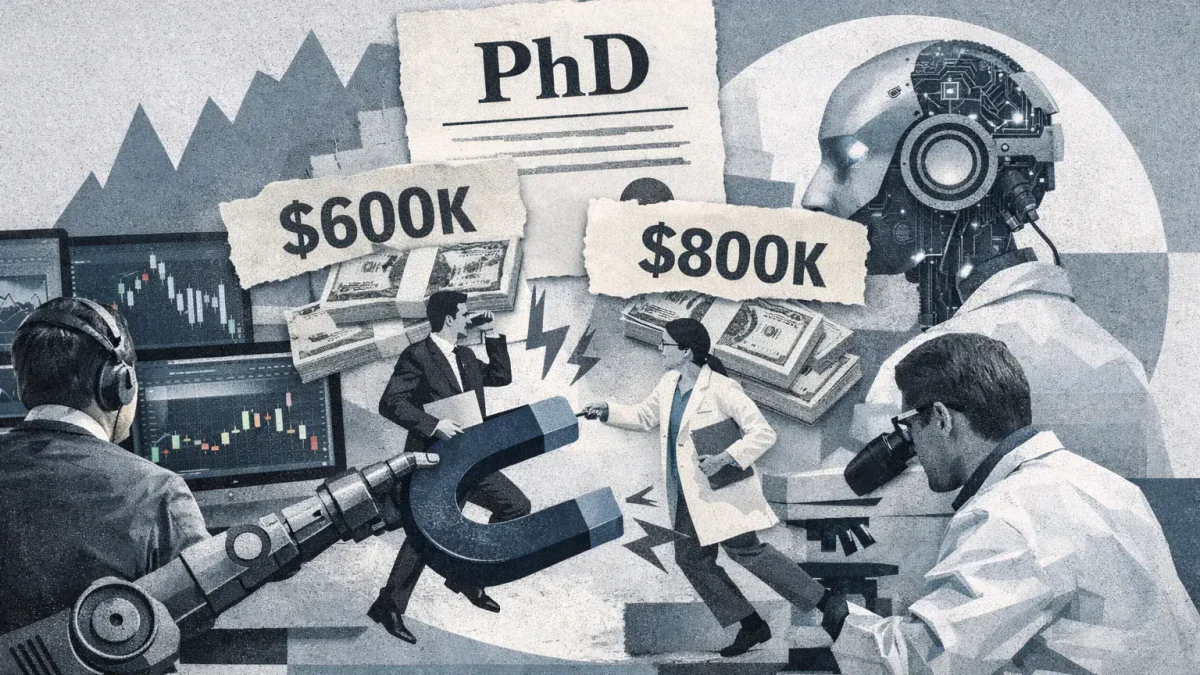
Quantitative trading funds, long considered the most lucrative place for scientific minds, have found new competitors with the AI boom and have moved to public recruitment. Charles Martinez, a physicist with a PhD, leads the academic direction at London's G-Research: he attends AI conferences, visits universities from Boston to the Arctic, and conducts quizzes where mathematics replaces general questions. The essence of the offer is to build models that predict the next step of financial markets, not the next token in an AI system.
"Your friend at OpenAI will say, 'I did this and that,' and you'll reply, 'I also did something, but I can't tell you,'" says Martinez.
Starting packages for PhDs in machine learning typically range from $450,000 to $650,000, but can reach up to $800,000. AI labs offer something different: fame, publicity, and the possibility of a stake in a rapidly growing company.
Qube Research & Technologies launched QRT Labs – a program supporting over 70 PhDs and postdocs. Jump Trading funds scholarships, Abu Dhabi Investment Authority opened a residency for PhDs, and Paris-based Capital Fund Management created a lab modeled after a university.
G-Research announced the largest private investment in the European Laboratory for Learning and Intelligent Systems, funding 36 researchers and supporting 43 PhD students across eight UK universities with a staff of about 1,000 people. There are no expectations that the fellows will join the company: the gain is reputational.
CFM, with assets of about $35 billion, hired a mathematics professor from New York University; he works with two researchers and a rotating group of postdocs. "They are not pressured to build alpha models," says product director Laurent Laloux.
Almost half of the top sponsors of December's NeurIPS are financial companies. HRT, XTX, and Jane Street maintain data centers with GPUs: "It's not just about compensation, but also about the willingness to invest in computing," says Tom Chambers of Maven Partnership. HRT lost some employees to OpenAI, Two Sigma to Anthropic. "The competition for talent is like nothing I've ever seen. AI labs are clearly the main competitor now," noted Jump's CTO Alex Davis.
This material is prepared solely for informational purposes and does not constitute financial advice or a recommendation.
Related articles