Riemann Hypothesis Proof by Claude Passes Independent Verification
Anthropic mathematician Levent Alpege announced that, together with the AI model Claude, he obtained a proof of the Riemann Hypothesis – one of the most famous mathematical problems that has remained unsolved since 1859. The formal proof he presented underwent independent computer verification, as reported by the Lean and Mathlib communities on November 21. However, the Clay Mathematics Institute has not yet officially recognized the problem as solved.
How Claude Contributed to the Proof of the Riemann Hypothesis
On November 20, Alpege published a four-page statement describing the collaborative work with Claude.
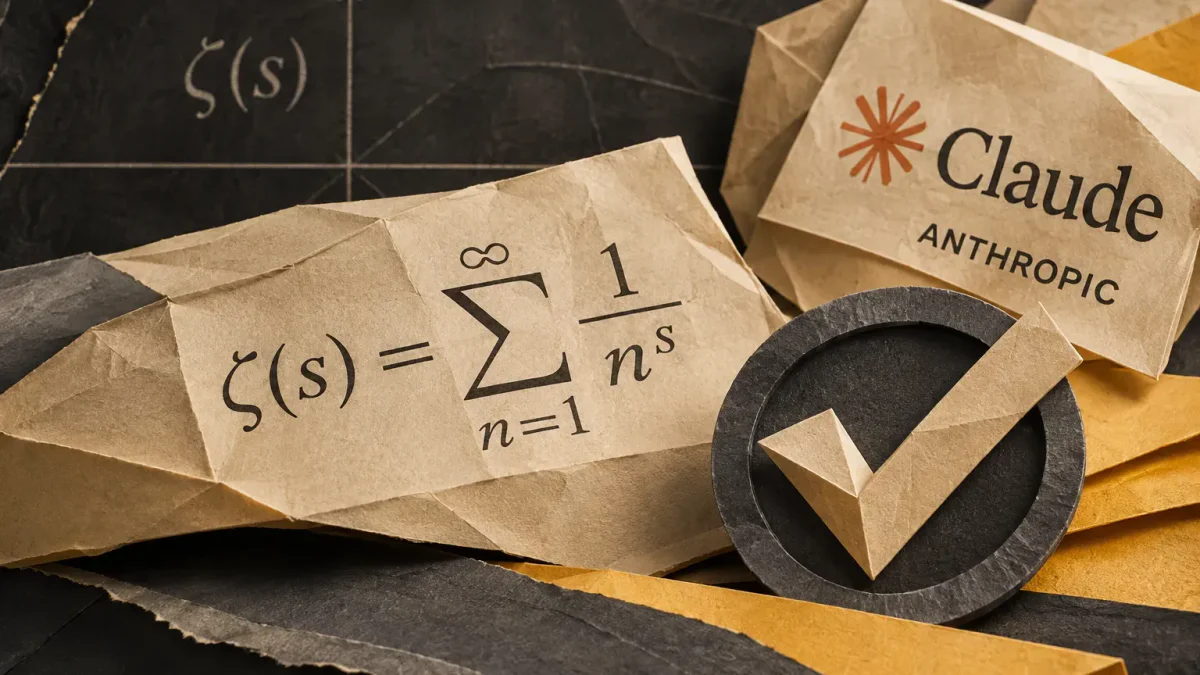
The Riemann Hypothesis, formulated by German mathematician Bernhard Riemann in 1859, concerns the location of the non-trivial zeros of the zeta function.
According to the hypothesis, all such zeros have a real part equal to 1/2. This property is closely related to the distribution of prime numbers and the accuracy of mathematical estimates of their quantity.
Alpege claims that together with Claude, he obtained a proof not only of the classical hypothesis but also of its generalization for Dirichlet L-functions.
According to the mathematician, Claude played a crucial role in developing certain stages of the proof, suggesting mathematical constructions that helped unify different approaches from number theory.
The researcher presented the result as a formal proof in the Lean language, designed for computer verification of mathematical reasoning.
Independent Researchers Confirm Formal Verification
On November 21, the Lean and Mathlib communities published a joint statement supported by the Lean Focused Research Organization and the Mathlib Initiative.
Experts reported that they verified the published proof, consisting of approximately 17 million lines of code and 175,187 modules.
During the verification, researchers established that:
the formulation of the theorem being proved corresponds to the Riemann Hypothesis;
the software code compiles successfully;
the proof relies only on standard logical axioms;
several independent verification systems accept the result.
The communities expressed high confidence in the correctness of the formal proof.
Additional checks were conducted by researchers, including Andrew Sutherland from the Massachusetts Institute of Technology. Results and technical logs were published for independent reproduction.
Meanwhile, a detailed explanation of the mathematical ideas in traditional scientific form is still in development.
Why the Riemann Hypothesis Is Still Officially Considered Unsolved
The Riemann Hypothesis is part of the list of seven Millennium Prize Problems, formulated by the Clay Mathematics Institute in 2000. A $1 million prize is awarded for solving each problem.
Verification of the formal proof is an important step in confirming the result. However, official recognition by the Clay Institute requires meeting certain conditions, including the publication of the solution and its widespread acceptance by the mathematical community.
As of November 23, 2026, the hypothesis is still listed as unsolved on the institute's website.
If the result receives final recognition, its significance will extend beyond a single mathematical problem. The proof will allow for the reevaluation of numerous theorems that are currently formulated under the assumption of the Riemann Hypothesis or its generalizations.
However, specific implications for computational algorithms and cryptography will require separate studies.
Alpege's publication coincided with Anthropic's entry into the stock market. Since November 19, the developer of Claude has been trading on Nasdaq under the ticker ANT.
The main feature of the result is not its coincidence with the IPO, but the fact that AI was used to construct a mathematical proof, the correctness of which was then verified by independent formal systems.
This material is prepared solely for informational purposes and does not constitute financial advice or a recommendation.