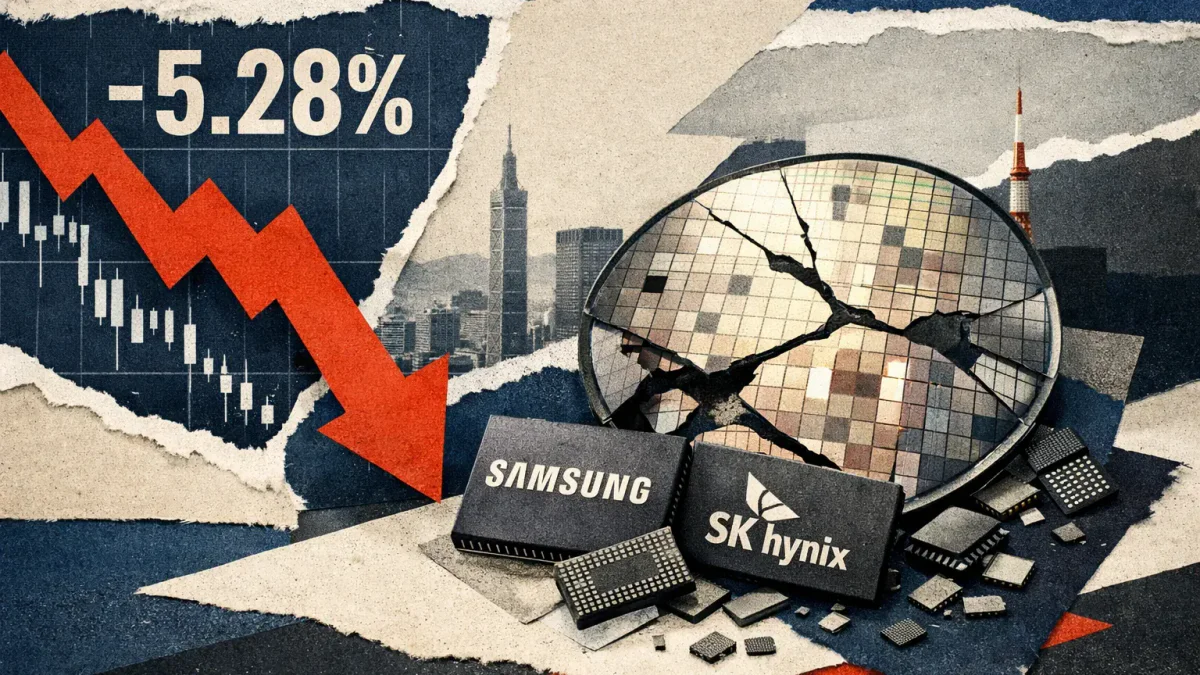
TSMC Shares Drop 5% Amid New US Chip Export Restrictions
Shares of Taiwanese semiconductor manufacturer TSMC fell by approximately 5% from November 16 to 19 amid new US export restrictions. According to the Financial Times, the company temporarily halted some shipments of advanced chips to Chinese customers pending necessary approvals.
The restrictions also affected Samsung Electronics, which suspended certain shipments to China. However, the shares of the South Korean company remained almost unchanged during the period under review.
Some Chinese tech companies showed more noticeable declines. In particular, Alibaba's shares lost about 8% over the same period. Baidu's shares also faced pressure, as its AI chip development unit Kunlun is a client of Samsung.
Chinese tech companies have already faced limited access to advanced semiconductors, and the new requirements further complicate obtaining the necessary components.
Which Chip Shipments Are Affected by the New US Rules
The new export requirements were introduced by the US Bureau of Industry and Security (BIS), which is part of the country's Department of Commerce.
The restrictions apply to certain categories of advanced logic chips, including those used for high-performance computing and artificial intelligence systems.
Previously, some Chinese developers could order chip production through TSMC and Samsung, using mechanisms provided by the rules to confirm technical specifications and compliance with export requirements.
Now, separate US export licenses are required for some of these orders. This limits the ability to produce and supply certain advanced chips without prior regulatory approval.
However, the new rules do not mean a complete halt of all semiconductor shipments to Chinese clients.
How the Restrictions Might Affect TSMC's Revenue
According to TSMC's financial report for the third quarter of 2026, clients from China accounted for 5% of the company's total revenue. With quarterly revenue of $46.72 billion, this corresponds to approximately $2.34 billion.
A year earlier, the share of Chinese customers was 8%, indicating a decrease in their relative contribution to the company's business.
However, the new export restrictions apply only to some advanced chips. Therefore, the entire revenue from Chinese clients cannot be considered as potential losses for TSMC.
The majority of the manufacturer's revenue comes from North American clients, who accounted for 79% of the quarterly revenue.
If the company can reallocate the freed-up production capacity among other customers, the financial impact of the restrictions may be relatively small.
At the same time, delays in obtaining export licenses and the inability to quickly fill production lines with other orders could increase potential losses.
Thus, the further impact of the new rules on TSMC will depend on the timing of licensing, the structure of affected orders, and the ability to reallocate production capacity. Meanwhile, the dynamics of the company's shares are also determined by other factors, including the overall state of the semiconductor market.
This material is prepared solely for informational purposes and does not constitute financial advice or a recommendation.