

After a notable rise in September, Bitcoin found itself in a situation where the further movement of BTC's price will depend not only on trader sentiment but also on the quality of demand in the cryptocurrency market. Investors are assessing how sustainable the current momentum remains and what factors may determine Bitcoin's forecast in 2026.
September was a period of recovery for Bitcoin after increased volatility. Following a decline and a period of caution from market participants, the cryptocurrency once again attracted investor attention: buyer activity increased, expectations regarding the market's further dynamics changed, and Bitcoin once again became one of the assets closely watched by both cryptocurrency traders and participants in traditional financial markets.
However, the mere fact of a price increase does not provide a complete answer about the market's condition. The history of cryptocurrencies shows that a sharp upward movement can have different causes: from the emergence of new long-term demand to a short-term surge in activity caused by speculative players.
That is why, after the September rise, the main question for the market has changed. Previously, investors tried to understand why Bitcoin started to rise, but now the focus has shifted to another question: how sustainable is this growth, and who will continue to support demand after the price increase.
September Changed Market Sentiment
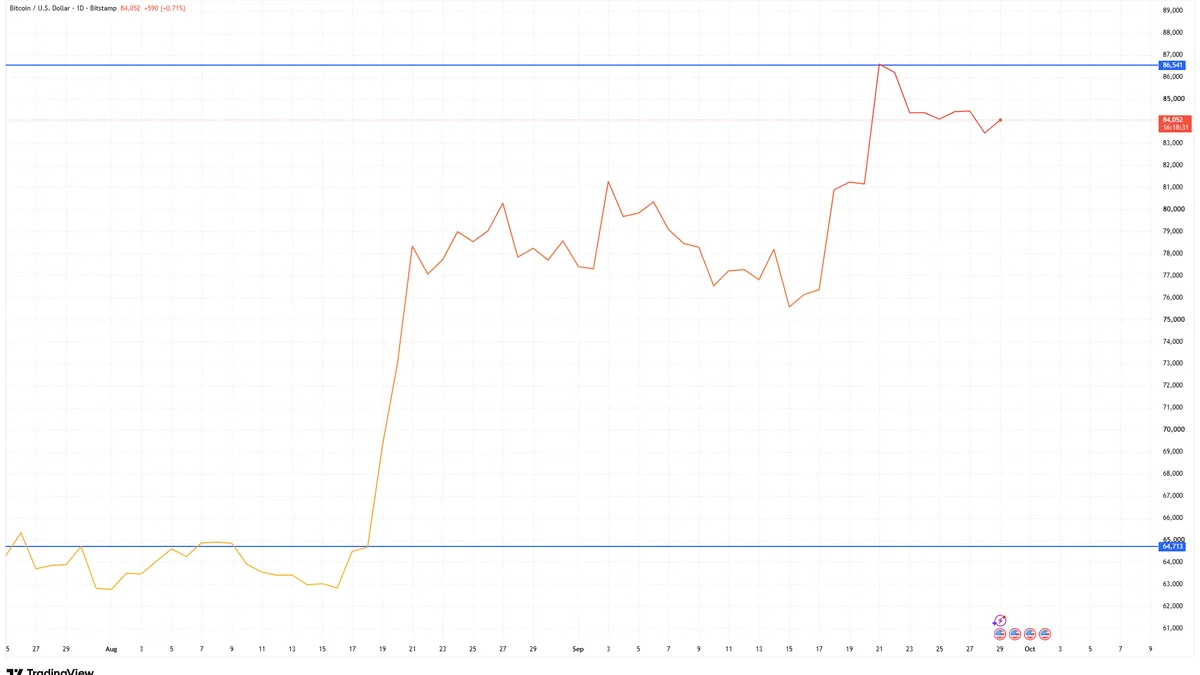
September was a remarkable period for the cryptocurrency market: Bitcoin recovered after a period of increased volatility, and interest in digital assets intensified again. At the beginning of the month, BTC was trading around $76,000, but by the second half of September, buyers began returning to the market. By September 21, the price of the first cryptocurrency reached about $87,400, showing an increase of more than 14% from the month's lows.
After the sharp movement, the market entered a phase of increased volatility. By the end of September, Bitcoin was trading near the $83,000–84,000 mark, indicating the retention of a significant portion of the September growth despite profit-taking by some investors.
For the market, this was a signal, as after the previous volatility, some market participants took a wait-and-see position and assessed how sustainable the demand remained. The rise above key price levels showed that buyers were ready to return, but at the same time, questions arose about who exactly was forming this demand — long-term investors, institutional capital, or short-term traders.
However, the September movement cannot be viewed solely as an internal event of the crypto market. In recent years, Bitcoin has increasingly reacted to processes occurring in the global financial system. Changes in expectations regarding the Fed's rates, the movement of the US dollar, and the state of stock markets have become as much factors for analyzing BTC as the internal indicators of the cryptocurrency industry.
The Main Question After the Rise: Who Is Buying Bitcoin
When the price of Bitcoin increases rapidly, it is important to look not only at the price change but also at the demand structure. Analyzing market participants helps to understand how sustainable the further movement of BTC can be. The same growth can occur for completely different reasons and, therefore, have different sustainability.
Return of Buyers. The rise in BTC showed that after a period of caution, some investors began to increase their positions again. However, for the market, it is important not only the price increase itself but also the composition of the movement's participants. If the growth is supported by long-term holders and new capital, it may have a more sustainable nature. If short-term traders and speculative transactions play the main role, the risk of sharp fluctuations remains higher.
Institutional Interest. One of the factors that attracted attention to Bitcoin was the return of interest from large investors. Flows into exchange-traded instruments related to BTC, including spot Bitcoin ETFs, became one of the indicators of how actively the traditional financial sector participates in market movements.
Fed Policy and the Cost of Money. Despite internal factors of the crypto market, Bitcoin remains sensitive to changes in global financial conditions. Decisions by the US Federal Reserve affect the cost of capital and investors' attitudes toward risky assets. Changes in interest rate expectations can increase or decrease interest in assets like cryptocurrencies.
Dynamics of the Dollar and US Bonds. The American currency and the government bond market remain benchmarks for investors. Strengthening of the dollar or rising yields on US Treasuries can create pressure on risky assets, while softer financial conditions can support demand.
Connection with the Global Financial System. The September movement cannot be viewed solely as an internal event of the crypto market. In recent years, Bitcoin has increasingly reacted to processes occurring outside the digital asset industry. Therefore, when analyzing BTC, investors consider not only blockchain indicators, trading volumes, and market participant activity but also the state of stock markets, inflation expectations, and the overall willingness of investors to take risks.
The main difference between the current market and previous cycles is the emergence of institutional infrastructure around Bitcoin. If previously the price movement depended more on the activity of retail traders, crypto exchanges, and speculative capital, today market participants also evaluate fund flows through regulated financial instruments. That is why data on Bitcoin ETFs have become one of the important indicators when analyzing demand for the first cryptocurrency.
Institutional Demand: Why ETFs Have Become an Important Market Indicator
One of the main changes in the Bitcoin market in recent years has been the emergence of new access channels for large investors. If previously institutional capital's participation in cryptocurrency was limited due to asset storage features, regulation, and infrastructure, now some investors can access Bitcoin through traditional financial instruments.
The market pays special attention to spot Bitcoin ETFs, which have become one of the key factors in changing the demand structure for Bitcoin. These products allow investors to gain exposure to Bitcoin's price changes without the need to buy and store the cryptocurrency themselves. For large funds and asset managers, this simplifies the inclusion of digital assets in investment strategies.
“Flows [into Bitcoin ETFs] have grown significantly again, and the nature of investors is changing: if retail participants played the main role at the start, now more institutional investors and financial advisors are participating” — Robert Mitchnick, Head of Digital Assets at BlackRock.
That is why the dynamics of inflows and outflows in ETFs have become one of the indicators closely watched by market participants. If funds record a steady inflow of capital, it may indicate the presence of long-term demand from large players. If investors start actively withdrawing funds, the market receives a signal of declining interest or changing expectations.
At the same time, it is important to consider that ETFs themselves are not a guarantee of continued growth. They show the direction of capital movement, but the price of Bitcoin remains dependent on a wide range of factors — from the macroeconomic situation to the behavior of short-term traders.
To assess the sustainability of Bitcoin's growth, investors also analyze not only the price of BTC but also additional indicators: flows into Bitcoin ETFs, trading volumes, open interest in futures, the level of liquidations, and the activity of long-term holders. These data help to understand what drives the movement — real capital inflow and long-term demand or predominantly speculative activity using leverage. Growth supported by spot purchases and stable interest from large investors is usually considered more sustainable than movement based solely on short-term trading.
The Market Tests Whether Bitcoin Can Hold New Levels
After strong growth, the market situation changes. If during a decline investors primarily seek the level at which the fall may stop, after a sharp upward movement, attention shifts to another question: is there enough new demand to hold the achieved prices.
The history of Bitcoin shows that rapid growth is often accompanied by a period of market testing. After a significant increase, some investors take profits, and new buyers begin to assess whether the current price level is justified by fundamental factors.
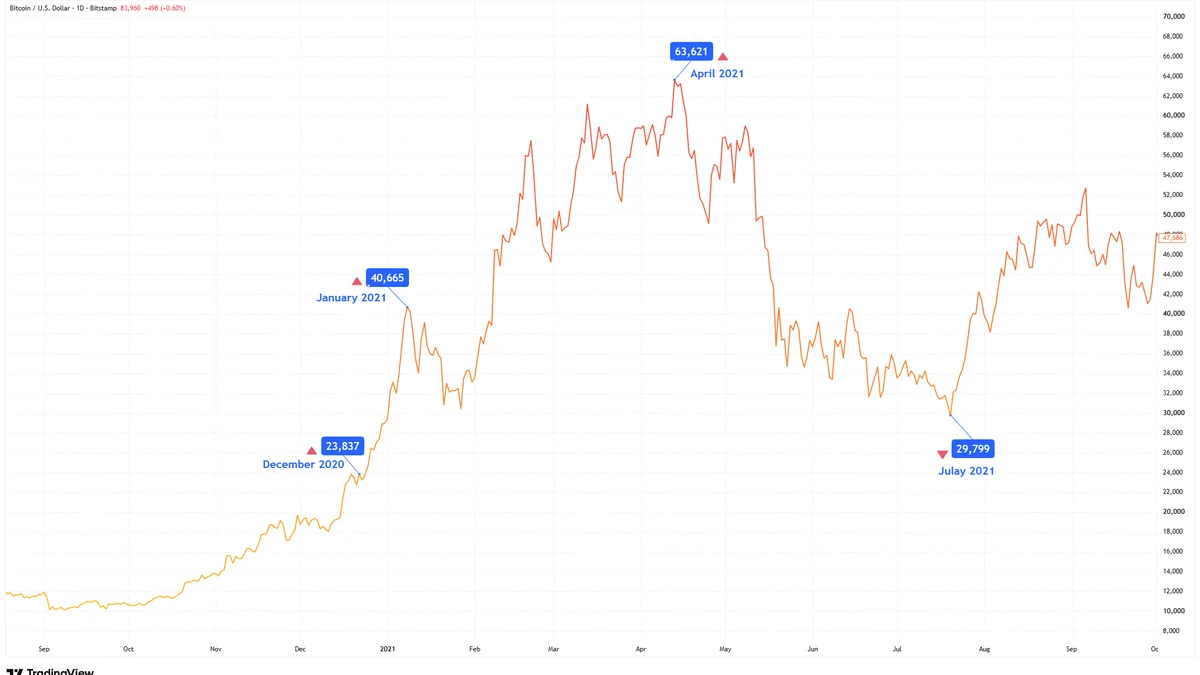
For example, after Bitcoin's rise at the end of 2020 and its first breakout above the $20,000 level, the market continued to move upward in early 2021, reaching almost $64,000 in the spring. However, a deep correction followed: in the summer of 2021, the price of BTC fell below $30,000. This showed that even a strong upward trend can be accompanied by sharp pullbacks when some participants take profits, and the market redistributes positions.
Another example is the period after the launch of spot Bitcoin ETFs in the US in early 2024. After the rise in expectations before the launch of the instruments, Bitcoin initially reached new highs but then faced a correction. Some investors took profits, and the market assessed how sustainable the real capital inflow through the new financial products would be.
These examples show that a high price alone is not a guarantee of continued movement. That is why one of the main questions for Q4 will be not only Bitcoin's ability to continue growing but also the market's ability to consolidate at new levels amid changing external conditions — from Fed decisions to dollar dynamics and the overall attitude of investors toward risky assets.
Why Q4 Will Be a Test for Bitcoin
The September growth occurred in a complex global economic environment. Despite the increased interest in cryptocurrencies, investors continue to consider factors that affect all risky assets — from tech stocks to commodity markets.
In the coming months, the main focus will be on several areas: US monetary policy, the state of global liquidity, and investors' willingness to take risks.
Factor #1: US Federal Reserve Policy
One of the main factors for financial markets remains the Fed's policy. Decisions by the US regulator affect the cost of borrowing and the overall conditions for capital movement.
When interest rates remain high, investors have more opportunities to allocate funds in relatively safe instruments, such as government bonds. In such a situation, demand for more volatile assets may decrease.
Conversely, expectations of monetary policy easing often support interest in risky instruments, as investors begin to seek assets with potentially higher returns.
However, the Fed's influence on Bitcoin is not direct. Changes in rates are just one element of a broader picture. Therefore, analysts, when assessing the BTC forecast, consider not only internal indicators of the crypto market but also macroeconomic factors: Fed decisions, inflation, dollar dynamics, and the state of global liquidity.
Factor #2: The Dollar Remains a Market Benchmark
Another indicator considered by digital asset market participants is the dynamics of the US dollar. The relationship between the dollar and Bitcoin remains one of the factors influencing the long-term analysis of BTC.
Since Bitcoin is predominantly traded in pairs with the dollar, changes in the value of the US currency can affect investors' attitudes toward digital assets.
Dollar strengthening often occurs during periods of increased caution when investors prefer more defensive instruments. Conversely, the weakening of the US currency can create more favorable conditions for risky assets.
However, this relationship is not mechanical. In certain periods, Bitcoin can move independently of the dollar if internal factors of the crypto market are stronger.
Factor #3: US Bond Yields and Competition for Capital
Another indicator is the yield on US government bonds.
For investors, the market constantly presents a choice between different opportunities. If the yield on safe assets increases, some capital may be redistributed from more risky instruments.
Therefore, rising bond yields can create pressure on assets such as growth stocks and cryptocurrencies.
At the same time, a decrease in yields, on the contrary, can support interest in assets that investors view as an opportunity to achieve higher potential returns.
Three Scenarios for Bitcoin in Q4
Market development can be considered through several possible scenarios. They are not a forecast of a specific price but show how different conditions can affect participant behavior.
Scenario 1: Consolidation After Growth
After strong movement, the market may enter a stabilization phase. In this case, the price of Bitcoin does not necessarily have to quickly continue rising or falling — investors may take a wait-and-see position, assessing new conditions.
When considering possible scenarios for Bitcoin's price, it is important to consider that the cryptocurrency market remains highly volatile. Therefore, analysts usually assess not a specific BTC level but the conditions under which a particular scenario may develop.
Key factors:
sustained interest from buyers;
absence of a sharp deterioration in the macroeconomic situation;
stable capital flows through ETFs.
Scenario 2: Continuation of the Upward Movement
A more positive scenario is possible if the market receives confirmation that demand remains sustainable.
For this, several conditions are important:
continued capital inflow into cryptocurrency instruments;
improvement in conditions for risky assets;
reduced concerns about tight monetary policy.
In this case, investors may view the September rise not as a separate episode but as part of a more prolonged movement.
Scenario 3: Correction After the Rise
After a significant price increase, a correction remains a natural part of the market cycle.
Reasons for the decline may include:
profit-taking by large participants;
reduction of speculative positions;
changing expectations regarding Fed policy;
deterioration in global market sentiment.
At the same time, short-term declines do not necessarily indicate a change in investors' long-term outlook. To assess the situation, it is important to consider not only the price change but also the state of demand.
The September rise brought Bitcoin back into the spotlight for investors and once again made BTC one of the main assets for analysis in the cryptocurrency market. However, further dynamics will depend not only on price movement but also on the quality of demand, the behavior of institutional investors, and the state of the global economy.
In Q4, Bitcoin will be influenced by several factors — from the actions of large investors to central bank decisions and the state of the global economy. It is the combination of these factors that will show whether the September rise marked the beginning of a new stage for the cryptocurrency market or just one of the episodes in another cycle of high volatility.
Related articles