
Strategy shifts capital allocation priorities
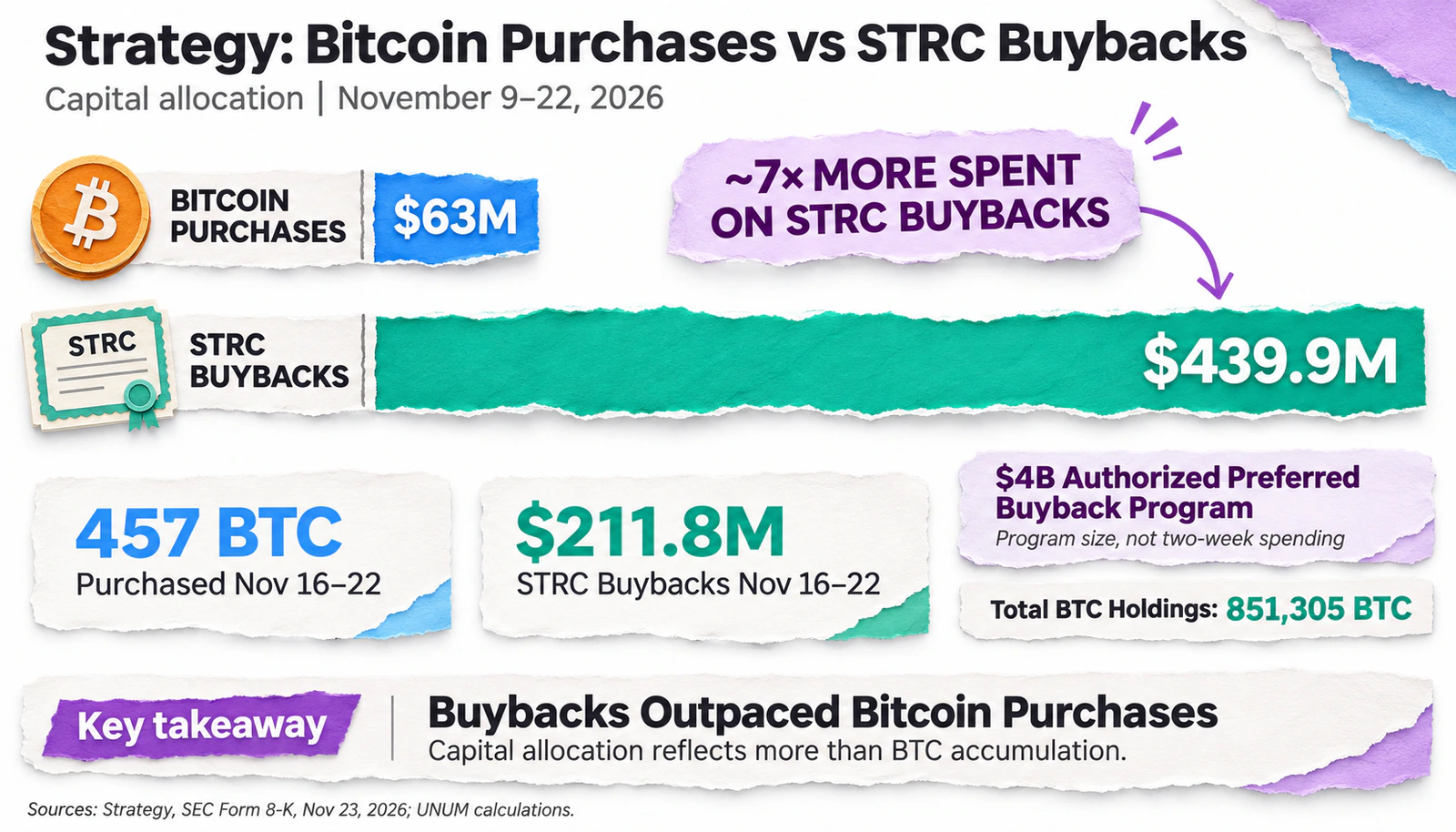
According to the Form 8-K dated November 23, 2026, from November 16 to 22, Strategy acquired 457 BTC for $29.6 million at an average price of $64,898. Reserves reached 851,305 BTC, acquired for $64.23 billion at an average price of $75,446. The company allocated $211.8 million for the repurchase of preferred shares Stretch (STRC).
From November 9 to 22, expenditures on Bitcoin amounted to $63 million, while the buyback of STRC reached $439.9 million. The difference is nearly sevenfold. Simultaneously, the board of directors increased the total limit of the preferred stock buyback program from $3 billion to $4 billion. This does not signify a withdrawal from BTC accumulation but highlights the importance of managing financial obligations.
How Strategy's financial model works
Strategy, formerly known as MicroStrategy, uses the stock market to finance Bitcoin purchases. The model, one of whose architects is founder and executive chairman Michael Saylor, falls into the category of Bitcoin Treasury—companies forming corporate Bitcoin reserves.
Main sources of financing:
Common shares MSTR. The ATM (at-the-market) program allows for the issuance of additional shares at market prices, increasing the number of shares in circulation without mandatory interest payments.
Preferred shares STRC, STRK, STRF, STRD, and STRE. They provide dividends and priority rights over common shareholders; STRK also allows conversion into MSTR.
Convertible bonds. Borrowed funds are subject to repayment or conversion into shares upon meeting issuance conditions.
Own funds. Accumulated dollar assets and proceeds from operating activities.
In Q3 2026, Strategy's revenue amounted to $125.4 million, while net proceeds from the ATM program reached $5.41 billion. These figures demonstrate the scale of BTC accumulation's dependence on capital markets, although revenue is not equivalent to free cash flow. More about Strategy's financing programs can be found in UNUM's material.
The growth of Bitcoin and demand for securities simplifies capital raising. With a prolonged market downturn, this mechanism may become less effective.
Why Strategy repurchases its own preferred shares
STRC are perpetual preferred shares with a variable dividend rate. In November, it stands at 12% per annum of the declared value of $100. The rate is reviewed monthly, payments depend on the board of directors' decision, and unpaid regular dividends accumulate. As of November 1, the company switched to a daily STRC dividend mode considering applicable business day rules.
In the last reporting week, Strategy repurchased approximately 2.18 million STRC at an average price of about $97. With an unchanged rate of 12% and no reissuance, this is equivalent to reducing estimated annual dividend payments by approximately $26.2 million.
Of the $176.7 million raised through MSTR, $147 million (about 83%) went to repurchase STRC, with the remaining portion primarily for Bitcoin purchases. An additional $64.8 million for buyback was allocated from dollar funds.
Additional issuance of MSTR shares reduces dependence on preferred capital but may lead to dilution of existing shareholders' stakes. Therefore, the economic effect of the operation depends not only on the reduction of dividend expenses but also on changes in asset value per share.
How Bitcoin's decline limits capital raising
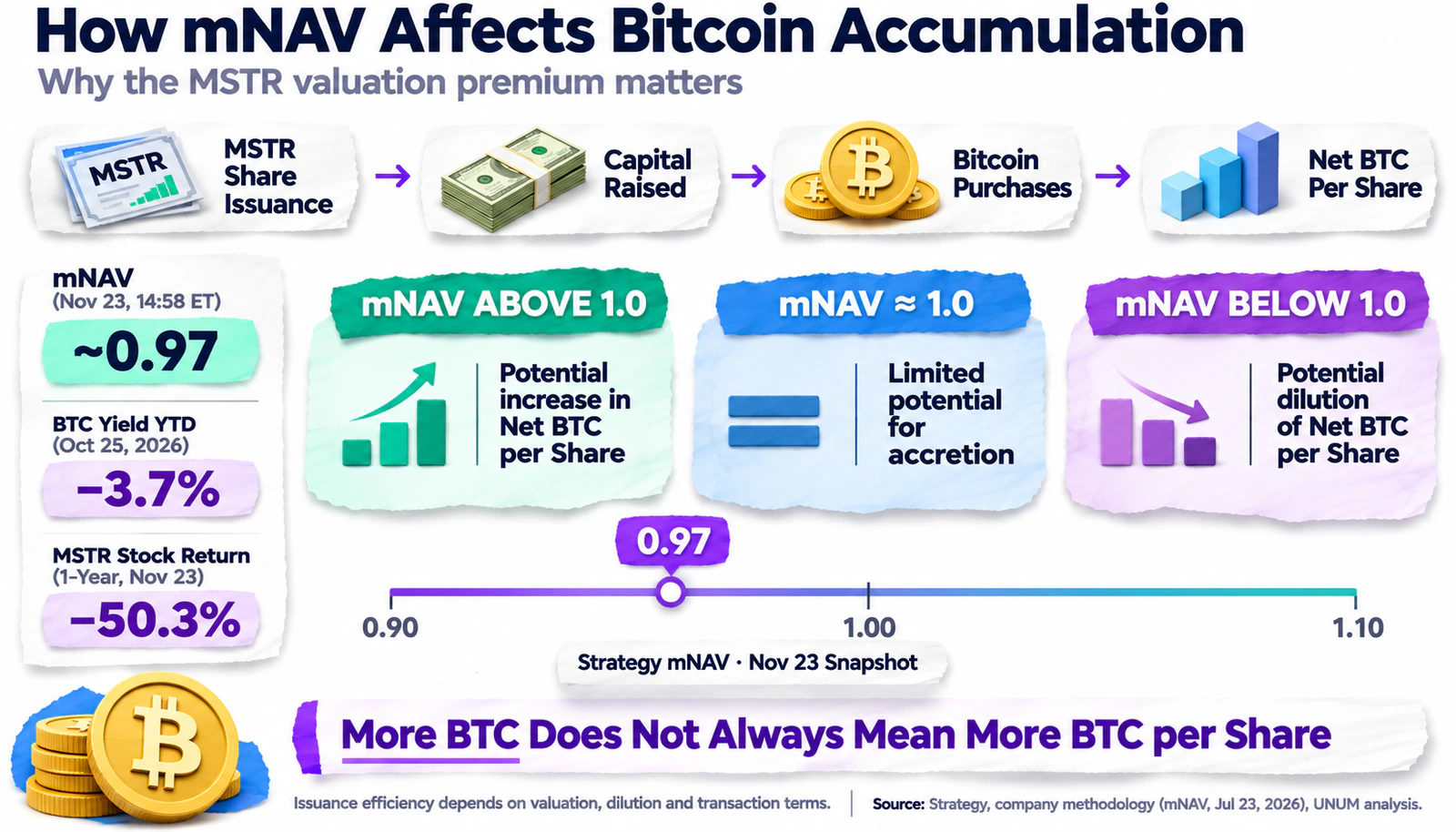
To assess the effectiveness of issuance, Strategy uses mNAV. Since July 23, 2026, the company has applied an updated methodology: the market price of MSTR is divided by the dollar cost of Net BTC Per Share (the estimated net volume of Bitcoin per share). The calculation considers dollar assets, preferred shares, debt instruments with a conversion price above the market price of MSTR, and potential capital dilution. This is not a traditional net asset value (NAV), as the indicator does not cover all balance sheet items.
mNAV above 1: MSTR placement followed by BTC purchase can increase Net BTC Per Share unless offset by fees, price changes, and other operations.
mNAV around 1: potential for increasing net BTC per share is limited.
mNAV below 1: similar issuance may decrease Net BTC Per Share.
On the market snapshot on November 23 at 2:58 PM New York time, mNAV was around 0.97, Strategy's market cap was $36.43 billion, and MSTR's yield over the past 12 months was −50.3%. This trend should be considered in the context of the reasons for Bitcoin's decline, including liquidations and weakening spot demand.
BTC Yield reflects the percentage change in the ratio of the company's BTC holdings to the calculated number of shares considering potential dilution over a certain period. As of October 25, the figure was −3.7% year-to-date. Thus, an increase in total reserves does not guarantee growth in the amount of Bitcoin per share.
How long can Strategy service its obligations with cash reserves
For Strategy's financial stability, not only the value of Bitcoin is important, but also the availability of funds for current payments. On November 22–23, the company indicated the following figures:
Debt — $6.71 billion.
Total declared value of preferred shares — $12.49 billion.
USD Reserve — $3.73 billion; USD Cash — $1.09 billion.
Total dollar assets amount to approximately $4.82 billion, with estimated annual interest and dividends of $1.41 billion.
We increased the volume of dollar assets to $5.1 billion, brought the USD Duration to 3.4 years, and repurchased STRC shares for $2 billion.
On November 23, the board of directors authorized the reallocation of up to $1 billion from USD Reserve to USD Cash. The stated balances account for this reallocation. It does not increase total liquidity but expands the possibilities for using funds.
With unchanged payment volumes, total dollar assets provide estimated coverage for approximately 3.4 years (USD Duration). If only the specialized reserve is considered, coverage is about 2.7 years — a separate UNUM calculation. Neither of these figures guarantees solvency: the calculation does not include the principal amount of debt, early bond redemption, operating expenses, new BTC purchases, or preferred stock buybacks.
From September 15, 2027, holders of convertible bonds maturing in 2028 can present them for repurchase. The outstanding principal amount of the issue as of September 30 was $1.01 billion. Upon presentation, the company must pay the corresponding amount and any accrued but unpaid interest. With such a debt load, refinancing the debt becomes an important factor in maintaining liquidity.
What will happen to Strategy's reserves if Bitcoin continues to fall
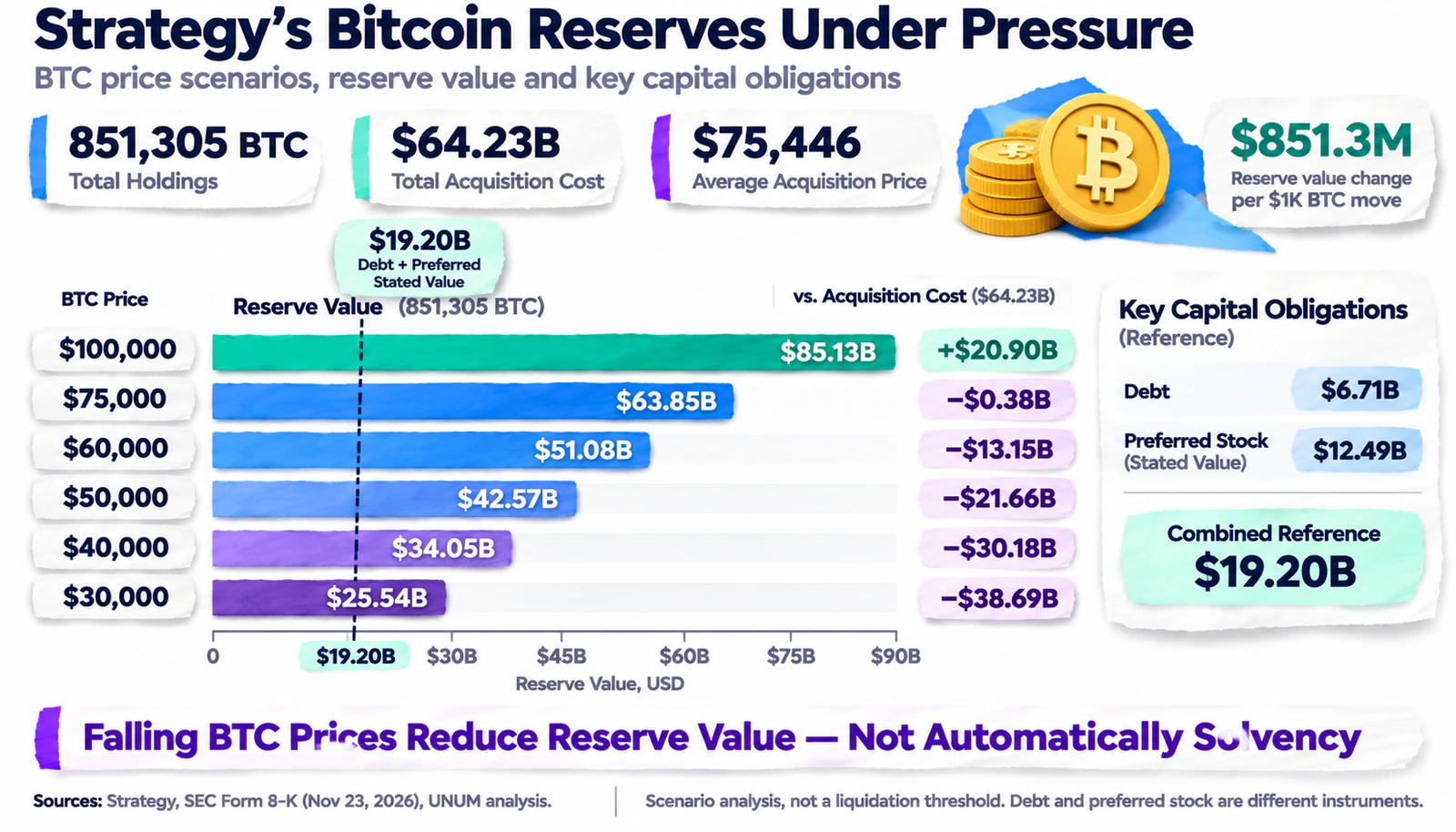
The company's reserves account for about 4.05% of Bitcoin's maximum supply. With unchanged reserve volumes, each $1000 drop in Bitcoin's price reduces their market value by approximately $851.3 million.
Bitcoin Price | Reserve Value | Deviation from Acquisition Cost |
|---|---|---|
$100,000 | $85.13 billion | +$20.90 billion |
$75,000 | $63.85 billion | −$0.38 billion |
$60,000 | $51.08 billion | −$13.15 billion |
$50,000 | $42.57 billion | −$21.66 billion |
$40,000 | $34.05 billion | −$30.18 billion |
$30,000 | $25.54 billion | −$38.69 billion |
Source: UNUM calculations based on 851,305 BTC and costs of $64.23 billion. Excludes new purchases, sales, taxes, and transaction costs.
At a price of $30,000, the market value of the reserves is estimated to exceed the total debt and stated value of preferred shares by approximately $6.34 billion. This is not an assessment of liquidation value or residual equity for common shareholders: it does not account for other liabilities and potential changes in capital structure.
In Q3, Strategy's operating profit and revaluation profit from digital assets were $20.91 billion each, rounded. In a market downturn, significant accounting losses are possible without actual BTC sales. A decline in quotes below the average acquisition price does not automatically mean bankruptcy.
Could Strategy Start Selling Bitcoin
In June 2026, Strategy introduced the BTC Monetization Program, allowing the sale of Bitcoin to replenish dollar reserves, make financial payments, and repurchase securities. Over the nine months ending September 30, the company received about $431.8 million from digital asset sales.
In a prolonged bear market, three scenarios are possible:
Reduction of purchases. The company redirects capital to service obligations while preserving reserves.
Planned sale of Bitcoin. Part of BTC is sold to maintain liquidity, pay dividends, or manage debt.
Forced asset liquidation. Possible in case of cash shortages, limited access to capital, and the need for large payments.
According to the quarterly report, 847,666 BTC as of September 30 were unencumbered, and the existing convertible bonds are unsecured. This does not confirm the existence of a single automatic liquidation price for reserves. More on risks in UNUM's news about Peter Schiff's warning.
Amid outflows from Bitcoin ETFs, potential sales also warrant attention. From November 2–6, the net outflow from U.S. spot funds amounted to $1.28 billion. From November 16–20, reports published later based on Farside Investors indicate $1.79 billion; the early available slice of the primary table contained incomplete data for Friday. The impact of Strategy's sales on the price will depend on the volume, speed, and method of executing transactions, as well as the depth of market liquidity.
Key Metrics Investors Should Monitor
When assessing the investment risks of Strategy's shares, it is important to consider not only the dynamics of Bitcoin but also the company's capital structure. Key metrics include:
mNAV — a persistent discount may limit the attractiveness of MSTR issuance for BTC purchases.
Price and Dividend Rate of STRC — prolonged downward deviation from $100 and an increase in the rate may indicate worsening financing conditions.
USD Reserve and USD Duration — reduction in reserves and settlement coverage of payments increases the risk of liquidity shortage.
BTC Yield and Net BTC Per Share — changes in the number of BTC per share and the net indicator considering priority claims, respectively.
Debt Schedule and Net Purchases or Sales of Bitcoin — help assess refinancing needs and changes in accumulation policy.
Unlike direct Bitcoin ownership, investments in Strategy's shares come with additional risks: management decisions, cost of capital, conditions of debt instruments, and demand for securities. They can amplify both the rise and fall of MSTR.
Conditions Under Which Strategy Can Continue Buying Bitcoin
As of November 23, Strategy retains the ability to buy Bitcoin. However, in the last two reporting weeks, the reduction of potential dividend expenses has become one of the priority areas of capital allocation. The duration of further accumulation will depend on the availability of financing, liquidity, and the schedule of financial obligations.
If these conditions worsen, the company may slow down BTC accumulation or increase the volume of reserve sales. Therefore, it is more important for investors to monitor cash flows, debt burden, and cost of capital than to seek a conditional Bitcoin price at which Strategy's model will cease to work.