


Why global economic growth is becoming uneven
According to the IMF's October forecast, the global economy will grow by 3.1% in 2026, and growth rates will accelerate to 3.4% in 2027. Meanwhile, global inflation, according to the fund's estimate, will reach 4.7% this year before slowing to 4.1% next year.
Behind relatively stable global indicators lie significant differences between countries. Investments in artificial intelligence stimulate demand for semiconductors and servers, as well as investments in the development of digital infrastructure. At the same time, the energy crisis increases costs for industrial and transportation companies, worsening the prospects for countries dependent on fuel imports.
The global economy has shown resilience, but it is now being tested, and the risks are predominantly associated with a worsening situation.
Thus, global economic growth is simultaneously influenced by several divergent processes. The technological boom supports investment and international trade, while rising energy prices limit production and accelerate inflation. Additional influence is exerted by trade restrictions that change traditional supply chains. Countries capable of benefiting from technological development and containing energy costs gain a competitive advantage.
Which countries benefit from investments in artificial intelligence
The development of AI has become one of the largest sources of investment demand. According to the International Energy Agency (IEA), the combined capital expenditures of the largest technology companies, including investments in data centers and other infrastructure, exceeded $400 billion in 2025. In April 2026, the agency forecasted an increase in these expenditures by another 75% by the end of the year.
A significant portion of the funds is directed towards the construction of data centers, the acquisition of computing equipment, and the development of digital infrastructure. The new technological revolution creates demand not only for software solutions but also for the equipment needed to operate them. Therefore, the benefits of AI spread through global supply chains to manufacturers of chips, memory, and computing systems.
The US holds strong positions due to the concentration of technology corporations, research centers, and investment capital. American companies develop AI models, design processors, and manage the largest cloud platforms, earning revenue at several stages of the technological chain.
However, the production of a significant portion of the equipment is concentrated in Asia. Taiwan plays a key role in the production of advanced chips, while South Korea specializes, in particular, in the production of memory needed for powerful computing systems. Growing technological demand supports exports and investments in several Southeast Asian countries, including Malaysia and Vietnam.
In the IMF's October Regional Outlook, it is noted that technological demand helps Asian economies offset the effects of energy shocks and trade restrictions. South Korea, in particular, benefits significantly, as the semiconductor industry remains one of its most important export sectors. The fund raised its growth forecast for the South Korean economy to 3.3% in 2026 after 1.1% in 2025.
However, increased investment does not yet mean a comparable increase in labor productivity. The construction of data centers creates demand today, but the long-term economic effect depends on how successfully enterprises can apply artificial intelligence in production and services.
How energy dependence affects the competitiveness of countries
Another factor in the divergence of economic trajectories has been the energy shock caused by the conflict in the Middle East. Disruptions in international oil and gas supplies and rising energy prices have increased the expenses of countries dependent on imported fuel.
Energy dependence affects the economy through several channels. Industrial enterprises face rising production costs, transportation companies spend more on fuel, and the population spends more on electricity and goods. Increased expenses support inflation and may limit central banks' ability to lower interest rates.
Energy-intensive industries, including metallurgy, the chemical industry, and fertilizer production, are particularly sensitive to such changes. When energy prices remain high for an extended period, enterprises may reduce investments or relocate production to regions with lower costs.
For exporters, the situation looks different. Norway and other producers maintaining stable supplies can earn additional income from rising global prices. However, having large reserves of oil and gas does not guarantee economic benefits. Gulf states directly affected by the conflict face risks of infrastructure damage and export restrictions.
More details on the impact of geopolitical risks on the oil market were discussed by UNUM in the article “What Will Happen to Oil Prices Amid the Middle East Conflict and US Sanctions”.
Thus, the advantage is gained not just by a country with its own energy resources, but by an economy capable of providing reliable energy supply at affordable prices. In conditions of instability, energy security becomes one of the factors attracting international investments.
Why Artificial Intelligence Enhances the Importance of Energy
Technological and energy factors are closely linked. Training and using AI models require computational power, which consumes significant amounts of electricity. As digital infrastructure expands, the availability of electricity becomes one of the conditions for the development of the technology sector.
According to the IEA, in 2025, global electricity consumption by data centers reached 485 TWh, increasing by 17% over the year. Meanwhile, energy consumption by data centers focused on artificial intelligence grew by 50%.
By 2030, the total electricity consumption by data centers, according to the agency's baseline forecast, could reach 950 TWh, or about 3% of global demand. For infrastructure directly focused on AI, even faster growth is expected — approximately three times relative to 2025. Thus, AI energy consumption is becoming an increasingly significant factor in planning the development of power grids.
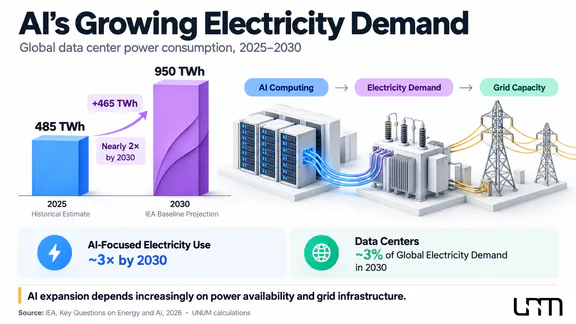
The problem lies not only in the cost of electricity but also in the ability to connect new facilities to power grids. Building a data center may take less time than upgrading the infrastructure needed for its operation. A shortage of transformers, network capacities, and equipment can delay the launch of even fully funded projects.
According to the IEA report Electricity 2026, projects for generation, energy storage, and large consumers with a total capacity of more than 2500 GW are expected to be connected to power grids worldwide. To meet the projected demand by 2030, annual global investments in power grids need to increase by about 50% from the current level of around $400 billion.
As a result, the competitiveness of countries in the AI field increasingly depends on the state of energy infrastructure. Having qualified specialists and investment capital remains important, but without reliable power supply, implementing large technological projects becomes significantly more challenging.
How the Position of the World's Largest Economies is Changing
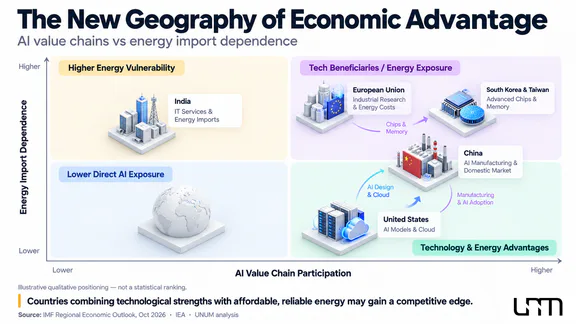
The impact of the technological boom and energy crisis is evident when comparing the largest economies. Some countries have a developed AI industry but rely on imported energy resources. Others have energy advantages but currently occupy less significant positions in global technological chains.
Country or Region | Main Advantages | Key Limitations |
|---|---|---|
USA | AI development, investment capital, domestic energy production | Grid limitations and high infrastructure costs |
China | Industrial base, domestic market, own AI developments | Trade restrictions and dependence on certain foreign technologies |
South Korea and Taiwan | Advanced semiconductor manufacturing | High dependence on imported energy resources |
European Union | Scientific base, developed industry, skilled workforce | Energy costs and market fragmentation |
India | Growing domestic market, IT sector, and human resources | Fuel imports and infrastructure constraints |
The comparison reflects structural advantages and risks rather than ranking economies by growth rates.
The example of South Korea is particularly illustrative. The country remains a major importer of energy resources, but at the same time, it gains significant advantages from the demand for semiconductors. Therefore, technological exports partially offset the negative impact of high energy costs.
China is striving to develop its own technological ecosystem and reduce dependence on foreign suppliers. Meanwhile, its positions in equipment manufacturing and digital infrastructure are combined with restricted access to some advanced technologies. The scale of Chinese investments is illustrated by corporate projects, including Alibaba's $10.2 billion fundraising for AI development.
For the European Union, one of the main tasks is to develop the technological sector while maintaining affordable energy prices for industry. India, in turn, can benefit from the growing demand for digital services and the expansion of the domestic market, although dependence on imported oil remains a source of economic risk.
The IMF forecasts India's economy to grow by 7% in the 2026/27 fiscal year, which began on April 1, 2026, and the entire Asia-Pacific region by 4.8% in the 2026 calendar year. However, even within the region, advantages are distributed unevenly: the most noticeable support from the technological boom is received by countries directly involved in equipment manufacturing.
Why emerging economies risk falling behind
The most challenging situation arises for countries that are simultaneously dependent on expensive imported energy resources and have little involvement in technological production. For them, global changes create additional expenses without providing a comparable inflow of investments.
High fuel prices increase import costs and put pressure on national currencies. Meanwhile, the ability of the state to support the population and industry is often limited by high debt burdens and borrowing costs.
Technological lag can exacerbate the situation. Implementing artificial intelligence requires reliable power supply, developed digital infrastructure, and skilled specialists. Countries lacking these resources find it harder to attract international capital and increase labor productivity.
In the IMF working paper on economic differences in Asia, published in August 2026, the authors demonstrate through an economic model that more prepared countries can adopt AI faster and gain productivity increases earlier. For emerging economies, technology adoption may occur more slowly due to high capital costs and infrastructure constraints. However, the study's results represent model estimates rather than a forecast of an inevitable increase in economic disparity.
The redistribution of capital in favor of technological hubs can complicate investment attraction for countries with less developed infrastructure. As a result, developed and emerging economies may face further divergence in growth rates, even if the global economy overall maintains positive dynamics.
However, technological development does not necessarily lead to increased economic inequality. Emerging countries do not have to create their own advanced processors or the largest AI models. Using ready-made technologies in agriculture, logistics, education, and services can enhance production efficiency without comparable development costs.
Therefore, the future position of emerging economies will depend not only on access to capital but also on the ability to adopt technologies, modernize energy infrastructure, and train specialists.
How the global economy might change by 2030
The further restructuring of the global economy will be determined by the speed of artificial intelligence adoption, the dynamics of energy prices, and the ability of states to adapt to new conditions. Three main scenarios can be identified.
Acceleration of technological growth. Investments in AI lead to sustainable increases in labor productivity, and the spread of technologies benefits not only developers but also companies in traditional industries. Sources of economic growth become more diverse.
Increase in economic inequality. Production of advanced equipment and investments are concentrated in a limited number of countries, while high energy costs and lack of infrastructure hinder the development of others. The productivity gap between economies widens.
Slowdown of the technological cycle. The commercial results of AI implementation fall short of expectations, leading companies to reduce investments in computing infrastructure. This weakens demand for equipment and creates risks for countries dependent on technological exports.
The IMF considers the potential revision of expectations regarding artificial intelligence as significant risks to the global economy. Large-scale investments are already supporting production and financial markets, but their long-term sustainability depends on the ability of technologies to deliver measurable economic effects.
The economic risks of the new technological cycle are also related to the state of energy infrastructure and trade restrictions. To assess future changes, it is important to monitor not only the growth rates of global GDP but also investments in data centers, the dynamics of semiconductor exports, electricity costs, and labor productivity.
These structural changes in the economy may impact international competition significantly more than short-term fluctuations in commodity prices.
In the coming years, the competitiveness of countries will increasingly depend on the combination of technological capabilities and available energy. However, the advantages are not definitively distributed: infrastructure development, education, investment policy, and international cooperation can help countries close the gap. The main outcome of the ongoing restructuring will not just be the emergence of new economic leaders, but a change in the very conditions necessary for long-term growth.