Why the Ethereum Foundation is focusing on privacy
On October 26, 2026, the Ethereum Foundation confirmed its support for the development of tools aimed at making privacy a standard feature of Ethereum wallets. Amid recent attacks and discovered vulnerabilities, the foundation emphasized the connection between privacy and security.
“Privacy and security cannot be viewed as separate goals,” stated the Ethereum Foundation in a declaration published on October 26 on X.
The public Ethereum blockchain allows for tracking operations of known addresses, and infrastructure providers can obtain information about user requests. Such openness creates risks of disclosing financial connections, asset sizes, and transaction history.
In the Ethereum roadmap, three directions for privacy development are highlighted: confidential reading of blockchain data, sending transactions with less information disclosure, and protecting digital identity. For the latter, zero-knowledge technology is used, allowing cryptographic confirmation of the validity of statements without revealing the original data.
Data protection is especially important for companies and financial organizations that need transaction confidentiality while maintaining the ability to verify their legality.
How Kohaku will change Ethereum wallet capabilities
Kohaku is not a separate cryptocurrency or a network update that automatically makes all transfers anonymous. It is an open toolkit for developers (SDK) designed to integrate privacy functions directly into crypto wallets.
The development of Kohaku is led by Ethereum Foundation researcher Nicolas Consigny. Together with Ethereum co-founder Vitalik Buterin, he will present the project at the Devcon conference on November 3, 2026.
The Kohaku SDK contains components for working with several protocols:
Railgun allows hiding information about token transfers within protected pools. In the Kohaku repository, the corresponding module is currently marked as under maintenance.
Privacy Pools use cryptographic proofs to confirm certain properties of the origin of funds without revealing the entire transaction history.
Tornado Cash provides tools for enhancing the privacy of transfers using cryptographic proofs.
Additionally, Kohaku develops support for light clients, allowing blockchain data verification with less reliance on trusted third-party providers. However, this technology alone does not eliminate all risks of user information disclosure.
The Ambire Wallet team is already testing Kohaku integrations. A demonstration of the project's functions in the Ethereum mainnet using Ambire Wallet is scheduled for November 3. However, a mass launch has not yet been announced, and the official Kohaku repository warns that certain components are under development and contain unaudited security code.
How privacy can impact demand for ETH
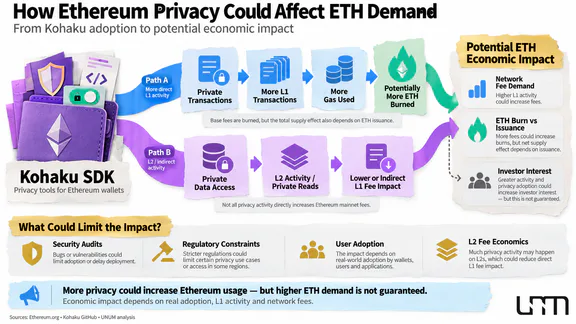
For investors, it's important to understand how enhancing the convenience of crypto wallets can lead to increased activity on Ethereum and affect demand for ETH. The potential economic effect is related to three areas.
1. Attracting new users. Private Ethereum wallets may appeal to people who do not want to disclose their entire transaction history to counterparties or analytical services. However, the demand for new features still needs to be confirmed, and the number of installed wallets does not equal the number of active users.
2. Development of DeFi and corporate settlements. Financial privacy can expand Ethereum's use for asset tokenization, lending, and settlements between organizations. Interest in such technologies is already emerging in other projects: previously, UNUM reported on the launch of Fhenix confidential computing on Ethereum and Arbitrum.
3. Growth of the network's economic activity. If private applications create additional transactions in the Ethereum mainnet, it will increase the demand for ETH to pay fees. The base fee for operations is burned, reducing the number of coins in circulation relative to a scenario without burning. However, the final change in ETH supply also depends on the issuance of new coins to validators.
At the same time, operations on second-layer networks can create significantly less direct demand for main blockchain fees. Therefore, the rise in popularity of private applications will not necessarily lead to a proportional increase in ETH burning.
Thus, investments in Ethereum cannot be assessed solely based on the number of new technologies. Their significance for the asset's value will depend on the actual use of the network, additional economic operations, and how much the created demand is directly related to ETH.
How the ETH market reacted to the foundation's statement
There is not enough evidence to claim that the Ethereum Foundation's initiative caused an independent positive reaction in the ETH rate.
According to data from October 26, 2026, ETH was trading at $2320.28, having decreased by 0.29% over the previous 24 hours. The trading volume for this period was about $10.12 billion. For comparison, Bitcoin in the same snapshot lost 0.02%.
These figures characterize the market state at the time of data capture but do not allow for isolating the impact of the privacy statement. To assess the direct reaction, it is necessary to compare the change in price and trading volumes over the same time intervals before and after the publication.
The ETH rate is simultaneously influenced by the overall liquidity of the crypto market, the activity of large holders, and capital flows through investment funds. For example, in the UNUM article about Ethereum outflows from exchanges, it was noted that the reduction in ETH exchange reserves was accompanied by outflows from US spot ETFs.
Against this backdrop, Kohaku should be considered primarily as a long-term technological initiative rather than a confirmed factor in changing ETH's value.
What risks could limit the privacy effect
One of the main obstacles remains the need to combine the confidentiality of financial transactions with regulatory requirements. Institutional investors are interested in protecting commercial data, but cryptocurrency regulation requires considering client verification procedures and the origin of funds.
Privacy Pools involve the use of cryptographic proofs that allow confirming certain properties of asset origins without revealing the entire transaction history. However, compliance with AML requirements depends on the specific implementation of the technology and applicable legislation.
Equally important is the security of crypto wallets. Hiding transaction history does not protect users from phishing links, private key compromises, or smart contract vulnerabilities.
Meanwhile, the Ethereum ecosystem also faces other threats, including attacks on protocol governance mechanisms. One recent example is the incident with the X100 project, associated with unauthorized asset withdrawals. This attack is not related to Kohaku but shows why the development of privacy needs to be accompanied by enhanced technical protection.
Even after audits, the mass adoption of Kohaku is not guaranteed. Wallet developers must ensure compatibility of new features with existing infrastructure, and users must receive understandable tools that do not complicate transaction execution.
What indicators investors should watch
After the demonstration of Kohaku scheduled for November 3, it is important to evaluate not only the presented features but also their technical readiness, security, and implementation prospects.
Indicator | What it will help assess |
|---|---|
Kohaku demonstrations and audits | Technical readiness of features and security risks |
Kohaku integrations into wallets | Availability of private operations to users |
Railgun and Privacy Pools activity | Actual demand for privacy tools |
Transactions, Ethereum network fees, and ETH burning | Potential economic effect on the main blockchain |
ETH/BTC dynamics, trading volumes, and ETF flows | Change in market interest in ETH |
These indicators need to be assessed collectively. On-chain activity may increase due to the redistribution of existing operations among protocols rather than the influx of new capital. Similarly, a short-term rise in the ETH rate does not prove that investors are buying the coin specifically because of the development of Ethereum's privacy.
To confirm the investment effect, a sustainable growth in the use of new features, accompanied by an increase in the network's economic activity, will be required.
The development of Ethereum's privacy can enhance the convenience of crypto wallets, expand the use of blockchain in DeFi and corporate settlements, and attract users for whom transaction confidentiality is important.
However, support from the Ethereum Foundation alone does not guarantee increased demand for ETH. The investment effect will depend on the successful implementation of Kohaku, the security of technologies, and the emergence of additional economic activity. The next checkpoint will be the project's demonstration on November 3.