Macroeconomic indicators help participants in the foreign exchange market assess the prospects for interest rates and currency exchange rates. In this material, prepared with the support of international broker AXI, we will examine how inflation statistics affect the value of the dollar, why price movements do not always match expectations, and what risks arise when trading CFDs.
What's Happening with Inflation in the US
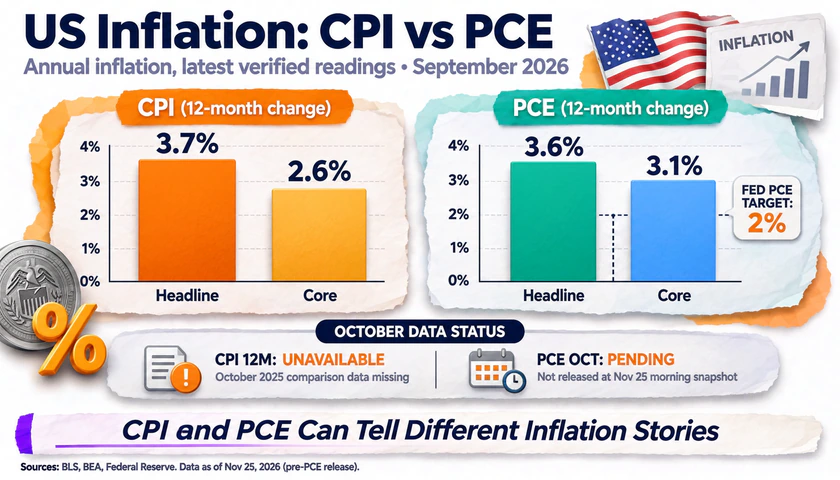
The latest US CPI data show that inflationary pressure persists despite a slowdown in the monthly growth of consumer prices. According to the US Bureau of Labor Statistics (BLS), the Consumer Price Index (CPI) with seasonal adjustments rose by 0.4% in October after a 0.6% increase in September. Economists had expected a 0.3% increase.
The Core Consumer Price Index (Core CPI), which excludes food and energy prices, rose by 0.3% for the third consecutive month. This indicates continued price pressure outside the food and energy components.
Compared to September, in October:
housing expenses increased by 0.3%, accounting for more than 30% of the monthly increase in the overall CPI;
food prices rose by 0.5%;
energy prices increased by 0.7%;
the medical care expenses index rose by 0.3%;
gasoline prices increased by 1% after a 9.1% jump in September.
The agency did not publish annual figures for the overall and core CPI for October due to the lack of necessary data for the same period in 2025, when a federal government funding halt disrupted data collection.
The Personal Consumption Expenditures (PCE) price index remains an equally important indicator. The Federal Reserve uses it to assess the achievement of its long-term inflation target of 2% per year. PCE covers a broader range of consumer spending and differs from CPI in its calculation methodology and the weights of individual categories of goods and services.
According to the US Bureau of Economic Analysis (BEA), in September, the overall PCE price index rose by 0.5% for the month, while the core index increased by 0.3%.
The next PCE report for October will be released on November 25 at 13:30 UTC. Economists expect a slowdown in the monthly growth of the overall index to 0.3%, but the dynamics of core inflation will also be important for the market. Simultaneously, the BEA will present the second estimate of US GDP for the third quarter, so currency reactions may reflect several economic signals at once.
More about the key macroeconomic events of the week can be found in the UNUM article "US PCE and Dell Report to Set the Tone for Markets November 23–27".
How Inflation Affects Fed Decisions
At the October 28 meeting, the Federal Reserve maintained the target range for the interest rate at 3.75–4%. However, two of the 12 members of the Federal Open Market Committee (FOMC) who participated in the vote advocated for a 25 basis point rate hike.
In its statement, the regulator noted the resilience of the US economy and the persistence of elevated inflation.
The Committee will ensure price stability.
The FOMC meeting minutes published on November 18 also showed that the trajectory of monetary policy remains dependent on incoming economic data. Persistent inflation and economic growth could strengthen the case for a rate hike, but the Fed also considers the state of the labor market and employment risks.
According to CME FedWatch, cited by Reuters on the morning of November 25, futures market participants estimated a 96% probability of a Fed rate hike in December and a 64% probability of an additional hike in January.
High market probabilities suggest that currency market participants may have already priced in a significant portion of the December rate hike scenario. Therefore, even high inflation may not necessarily lead to a substantial strengthening of the dollar. Additional arguments for a more prolonged monetary tightening cycle may be needed for continued growth.
What Bond Yields Indicate About Dollar Prospects
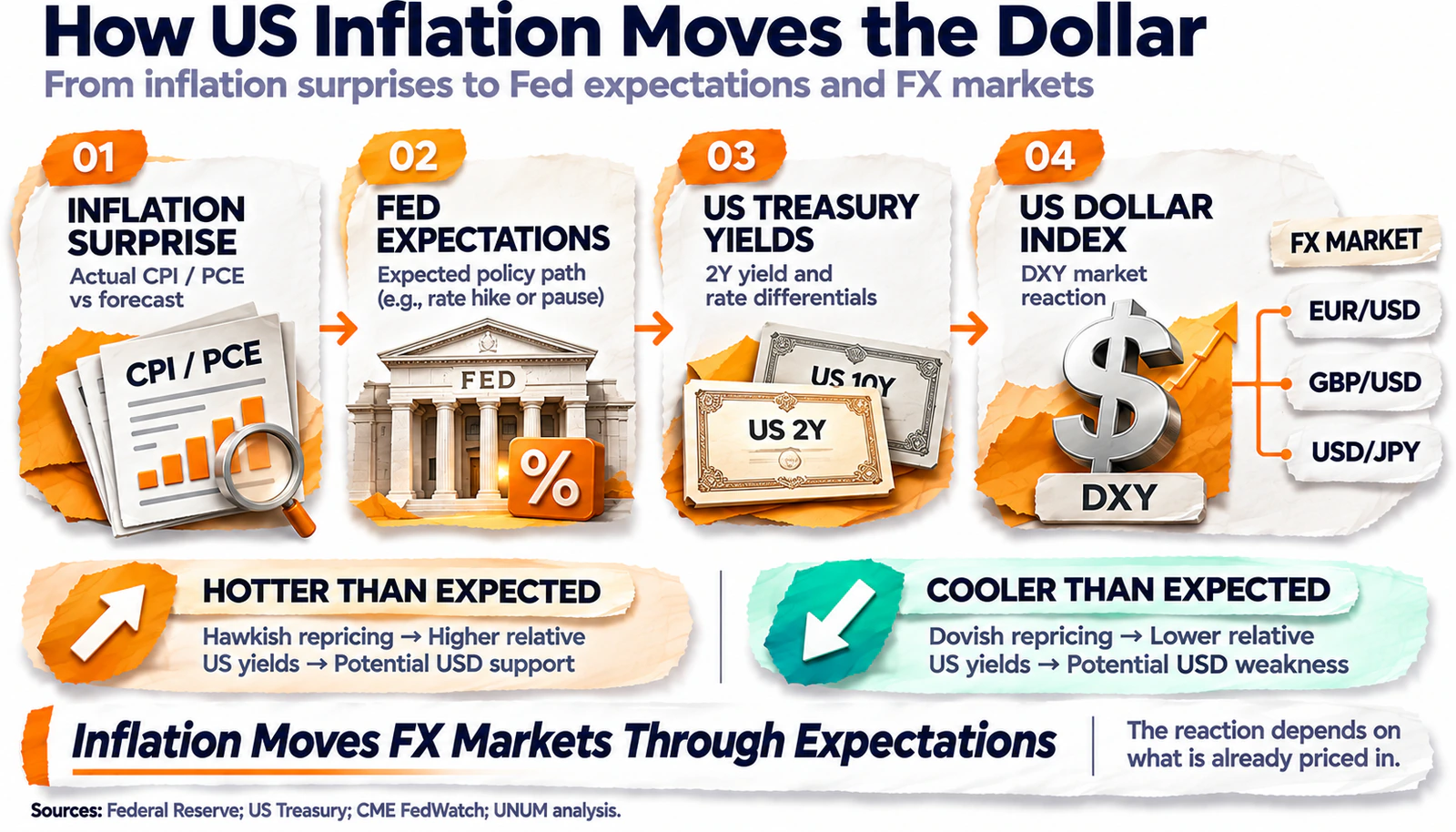
One of the main benchmarks for assessing the currency market's reaction to inflation is the yield on U.S. Treasury bonds. It reflects investors' expectations regarding interest rates, economic growth, and future inflation.
According to official data from the U.S. Department of the Treasury, as of November 24, the yield was:
two-year Treasury bonds (US 2Y) — 4.63%;
ten-year Treasury bonds (US 10Y) — 4.91%.
The yield on two-year bonds is particularly sensitive to expectations of the Fed rate. Ten-year bonds reflect a broader set of factors, including long-term inflation expectations, economic growth prospects, and the risk premium for holding long-term bonds.
For the currency market, the interest rate differential — the difference between interest rates or comparable market yields in different countries — is important. An increase in the expected real yield of U.S. assets relative to foreign counterparts, all else being equal, can support the dollar.
If, after the publication of the inflation report, the yield on two-year U.S. bonds rises and the dollar does not strengthen, it is worth checking the dynamics of foreign rates and changes in demand for risky assets. Other factors may be offsetting the impact of U.S. statistics.
How U.S. Inflation May Affect Major Currency Pairs
The currency market's reaction to U.S. statistics is heterogeneous. Even with the overall strengthening of the dollar, certain currencies may maintain relative stability due to internal economic factors and the policies of national central banks.
EUR/USD
The European Central Bank at its meeting on October 29 kept the deposit rate at 2.5%. The difference between the midpoint of the Fed's target range and the ECB's deposit rate is about 1.38 percentage points in favor of the U.S. rate.
Acceleration of inflation in the U.S. can increase pressure on EUR/USD, especially if expectations for further Fed rate hikes grow faster than expectations for ECB policy tightening.
At the same time, high energy prices increase inflationary risks in the eurozone and can simultaneously slow economic growth, complicating decisions for the European regulator. Therefore, for a sustainable recovery of the euro, not only the dynamics of U.S. inflation but also the expected interest rate differential between the U.S. and the eurozone is important.
GBP/USD
The position of the British pound differs from the situation with the euro. In November, the Bank of England raised the key rate by 25 basis points to 4%. The decision was supported by eight out of nine members of the Monetary Policy Committee.
Higher expected returns on pound-denominated assets, all else being equal, can support the British currency. However, this effect may weaken if the UK's economic outlook deteriorates.
Further Fed rate hikes without similar actions by the Bank of England could increase pressure on GBP/USD. Besides U.S. inflation, the pair's dynamics will depend on the state of the UK labor market, consumer demand, and internal price indicators.
USD/JPY
The Japanese yen remains particularly sensitive to changes in U.S. bond yields. Following the October meeting, the Bank of Japan maintained its target for the uncollateralized overnight call rate at around 1.25%.
The significant difference between interest rates in Japan and the U.S. supports the attractiveness of carry trade operations. In this strategy, investors borrow in a currency with low borrowing costs and purchase higher-yielding assets. However, an unfavorable exchange rate change can completely offset the interest income.
The potential for further yen weakening may be limited by expectations of a rate hike by the Bank of Japan and the risks of currency interventions. A decline in U.S. bond yields could support the Japanese currency, especially if expectations for tightening Japanese regulatory policy are rising simultaneously.
With a narrowing interest rate differential, investors may begin to close carry trade positions, increasing demand for the yen and putting pressure on USD/JPY.
The experience of previous interventions also increases the market's sensitivity to statements from Japanese authorities. From July 30 to August 3, 2026, Japan allocated 15.4 trillion yen to support its national currency. This does not mean that the authorities will necessarily intervene in the market upon reaching a specific exchange rate, but the likelihood of sharp changes in quotes must be considered.
How the currency market reacted to previous inflation releases
The last three CPI releases illustrate various scenarios of currency market reactions. Although this sample is insufficient to identify a stable statistical pattern, it allows us to see why the movement of the dollar does not always correspond to the initial interpretation of inflation data.
Publication Date | CPI Forecast, m/m | Actual CPI, m/m | Market Reaction |
|---|---|---|---|
09/11/2026 | 0.4% | 0.4% | DXY retreated from its peak after the release |
10/14/2026 | 0.6% | 0.6% | Dollar +0.35%; US 2Y +1.5 bps |
11/10/2026 | 0.3% | 0.4% | DXY +0.57%; US 2Y +18.44 bps |
Sources: Reuters, FXStreet. Market changes are presented at the time of the respective reviews, not for a single fixed interval after the publication of statistics.
In September, the monthly growth of the overall CPI matched the forecast, but core inflation exceeded expectations. The likelihood of a Fed rate hike increased, but the subsequent decline in long-term bond yields limited the strengthening of the dollar.
In October, the monthly overall CPI also matched the forecast, but annual inflation reached 3.7% against the expected 3.6%, and core inflation was 2.6% against the forecast of 2.5%. The initial strengthening of the dollar subsequently weakened amid changing expectations regarding the Fed's upcoming decision.
In November, the acceleration of inflation relative to the forecast was accompanied by a rise in U.S. bond yields and the strengthening of the dollar. Additional support for the currency came from statements by Fed officials about the need for further rate hikes.
These examples show that even when the main inflation indicator matches the forecast, significant fluctuations in exchange rates can occur. To assess the sustainability of the movement, it is necessary to analyze the details of the report, the reaction of the debt market, and changes in interest rate expectations.
Three scenarios for the future movement of the currency market
Any forecast for the dollar's exchange rate in the coming months depends on how new macroeconomic data will change expectations regarding the policies of the Fed and other central banks.
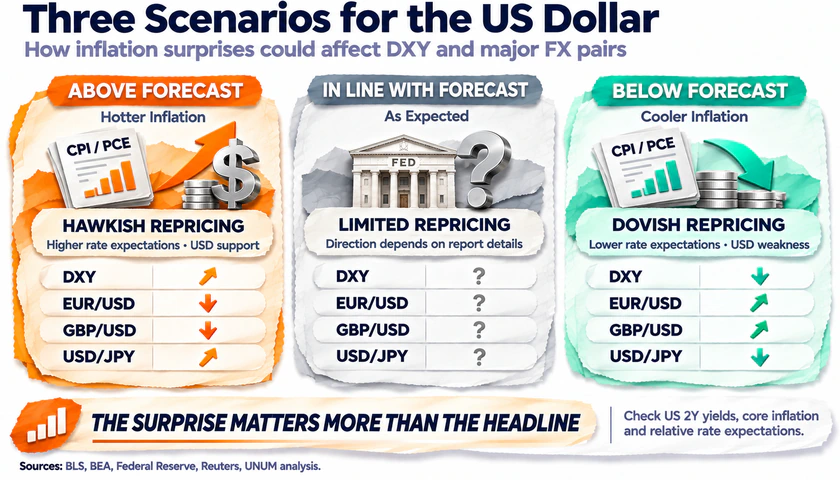
Before the publication of the October PCE, the currency market is in a state of high uncertainty. On the morning of November 25, the dollar index DXY was around 103.97 points. Below are three possible scenarios for its future movement.
Scenario 1: Inflation exceeds expectations
If the overall and especially the core PCE price index exceed market forecasts, the likelihood of a more aggressive Fed policy may increase. The rise in U.S. bond yields relative to foreign counterparts could provide additional support to the dollar.
Since the futures market was already pricing in a 96% probability of a December rate hike, investors' attention may shift to the regulator's decisions at the beginning of 2027.
Expected reaction: DXY ↑, EUR/USD ↓, GBP/USD ↓, USD/JPY ↑.
Confirmation of the scenario will be the simultaneous strengthening of the dollar, an increase in the yield of two-year bonds, and a revision of expectations regarding further Fed rate hikes. If the debt market does not support the movement of the U.S. currency, the initial rise may be short-lived.
Scenario 2: Inflation meets expectations
The alignment of published figures with economists' forecasts may not provide investors with sufficient grounds for a significant revision of interest rate expectations. In such a situation, currency quotes will be more sensitive to individual components of the inflation report, accompanying economic statistics, and market participants' positioning.
Expected reaction for DXY, EUR/USD, GBP/USD, and USD/JPY: direction of movement is undefined.
The alignment of actual inflation with forecasts does not guarantee low volatility. If investors have already taken significant positions anticipating a strengthening of the dollar, the absence of new positive factors may trigger profit-taking and a decline in its rate.
Scenario 3: Inflation falls below expectations
A slowdown in inflation can reduce the likelihood of further Fed rate hikes and lead to a decrease in the yield of U.S. government bonds. As a result, the relative attractiveness of dollar assets may weaken.
This scenario is also considered by Kristina Clifton, Senior Currency Strategist at Commonwealth Bank of Australia.
Lower inflation in the U.S. will exert downward pressure on American interest rates and the dollar exchange rate.
Expected reaction: DXY ↓, EUR/USD ↑, GBP/USD ↑, USD/JPY ↓.
The market's reaction to a slowdown in core inflation could be particularly noticeable, as the persistence of price pressure remains one of the key factors for Fed decisions. However, if the slowdown in price growth is accompanied by a sharp deterioration in the economic situation, demand for the dollar as a safe haven or source of liquidity could limit its weakening.
All three scenarios describe possible reactions of the currency market under equal conditions and do not guarantee corresponding price movements.
What traders should consider when trading on inflation data
The publication of macroeconomic statistics can significantly increase the volatility of the Forex currency market. However, sharp changes in quotes simultaneously increase trading risks. Even a correct assessment of the direction of a currency pair's movement does not guarantee a positive financial result, as trading costs and order execution conditions play a significant role.
When preparing for the publication of inflation data, traders should pay attention to five factors:
Market consensus. Compare actual figures not only with previous values but also with economists' forecasts.
Fed rate expectations. Assess how likely regulatory decisions may have already been factored into currency quotes.
Yield on two-year U.S. bonds. Check if the debt market confirms the initial reaction of the dollar.
Core inflation dynamics. Determine whether the change in the overall index is related to volatile components or more persistent price pressure.
Trading costs. Consider possible widening of spreads, slippage, and reduced liquidity after the release of statistics.
You can track the publication time of macroeconomic indicators using the UNUM economic calendar, and assess the reaction of individual instruments in the currency quotes section.
One of the tools for trading on currency rate changes is contracts for difference (CFDs), which are provided by specialized brokers, including UNUM partner — AXI. Such instruments allow opening positions both for the rise and fall of a currency pair's value without directly owning the underlying asset.
At the same time, using leverage increases both potential profits and possible losses. During periods of high volatility, an order may be executed at a price less favorable than the trader anticipated. A regular stop-loss also does not guarantee the closing of a position at the set price, especially during price gaps and sharp liquidity declines.
Risk management when trading currency pairs during macroeconomic publications involves controlling position size, available margin, and potential losses. It is equally important to check trading conditions, margin requirements, and the presence of negative balance protection in advance with the specific legal entity of the broker serving the client.
CFDs are complex financial instruments, and trading them carries a high risk of rapid money loss due to leverage. This material is not an individual investment recommendation.
What will determine the future direction of the currency market
Ahead of the upcoming macroeconomic releases, the US dollar remains supported by expectations of a Fed rate hike. However, these very expectations may limit its potential for strengthening if inflation figures do not provide investors with additional reasons to forecast a tighter monetary policy.
The next significant indicators for the currency market will be the Fed meeting on December 8–9 and the release of the November CPI on December 10.
To confirm a new direction for the currency market, a coordinated change in several factors will be required: interest rate expectations, interest rate differential, bond yields, and currency exchange rate dynamics. Their combination will allow for a more accurate assessment of the dollar's prospects than a single release of inflation statistics.