


What has changed in global markets by November 13
In the previous issue of UNUM, key attention was paid to American inflation and the financial stability of companies involved in building AI infrastructure. Events from November 9–13 confirmed that investors are increasingly assessing not only the growth rates of the tech business but also management risks, financing costs, and cash flow prospects.
The main corporate event of the week was the resignation of Jensen Huang as CEO of Nvidia. On November 11, Nvidia's board of directors accepted Huang's resignation, effective immediately. On November 12, the company officially announced this and the appointment of CFO Colette Kress as interim CEO. The board has begun the search for a permanent successor.
Nvidia's shares ended trading on November 12 down 4.3%, although losses were significantly greater during the session. The leadership change raised questions about the continuity of the company's strategy, which holds a central position in the global supply chain for AI computing equipment.
Meanwhile, other industry participants continued to show high growth rates. Cisco increased its quarterly revenue by 24% to $18.5 billion and raised its revenue forecast from AI infrastructure for major cloud clients in the 2027 fiscal year from $7.5 billion to $9 billion.
Applied Materials also reported record results: quarterly revenue rose 53% to $10.41 billion, and GAAP gross margin reached 50.4%.
CoreWeave showed a more complex financial picture. With revenue of $3.66 billion, the company reported a net loss of $709 million, despite operating income of $207 million. Net interest expenses reached $846 million. This demonstrates the disparity between the growing demand for AI infrastructure and the financial results of companies directly financing its construction.
New US inflation data also did not provide a clear signal of the end of the high-rate period. In October, the Consumer Price Index (CPI) rose by 0.4% for the month after a 0.6% increase in September. Meanwhile, the core CPI, excluding food and energy, maintained a growth rate of 0.3% for the month.
A significant feature of the publication is that the BLS could not calculate most of the annual changes for October 2026 due to missing data from October 2025, when data collection was disrupted by a federal government shutdown. Therefore, the slowdown in the monthly overall CPI cannot automatically be presented as confirmed annual inflation reduction.
The main outcome of the week is the growing contradiction between the high revenues of AI technology providers and the risks associated with financing, management, and future investment returns. Financial markets from November 16–20, 2026, will assess the resilience of the AI industry and the prospects for US monetary policy.
Nvidia's report will be the main test for the tech sector
On November 17, after the US market closes, Nvidia will present its results for the third quarter of the 2027 fiscal year. This will be the company's first major report following Jensen Huang's departure as CEO.
In the previous quarter, Nvidia reported $96.2 billion in revenue, up 106% from a year earlier. Data center revenue reached $89 billion, up 117% year-over-year.
For the third quarter, the company projected revenue of $108 billion with a possible deviation of 2%, and GAAP and non-GAAP gross margins of about 74% with a deviation of up to 0.5 percentage points. The $108 billion forecast did not include revenue from data center computing solutions in China.
Now investors will need to assess not only the fulfillment of financial forecasts but also the business's resilience amid the leadership change.
We remain focused on working for our customers, partners, developers, and shareholders.
For the market, three groups of indicators are important:
Revenue and demand forecasts. Investors will compare actual results with the previously announced forecast of $108 billion and analysts' expectations just before publication. Comments on orders from major cloud companies, delivery timelines, and next quarter prospects will be of particular importance.
Gross margin and operating expenses. Even with high demand, Nvidia's profitability can fluctuate due to sales structure, component costs, production expansion, and the emergence of new generations of accelerators.
Strategy continuity. The market will assess how well the current management team can maintain the technological roadmap, relationships with major clients, and fulfill long-term contracts without the founder at the helm.
Nvidia's short-term stock forecast will depend not only on revenue but also on future margins and management's comments. Strong earnings alone do not guarantee stock growth. If financial results exceed forecasts but management presents more cautious expectations for future revenue or expenses, investors may reassess the company's valuation.
Conversely, confirmation of sustainable demand, maintaining high margins, and specific comments on business continuity can reduce some of the uncertainty that arose after Huang's departure.
Nvidia's results will have implications far beyond its own stock. They affect expectations for orders from memory manufacturers, network equipment providers, data center operators, and energy companies.
What to watch: NVDA, Nasdaq 100, SOX semiconductor index, Nvidia's gross margin, revenue forecasts, data center order dynamics, and management comments.

US Retail Sales to Test Consumer Demand Resilience
On November 17, the US Census Bureau will release preliminary data on retail sales for October. Simultaneously, the Federal Reserve will present statistics on industrial production and capacity utilization.
These publications will allow us to assess how resilient the US economy remains after GDP acceleration in Q3 and amid high borrowing costs.
In September, retail sales and food service revenue rose by 0.8% compared to August, reaching $745 billion. Year-on-year, the increase was 6.3%.
However, the growth structure was less straightforward. Sales excluding automobiles increased by 0.9%, while the figure excluding automobiles and gasoline rose by only 0.2%.
This distinction is particularly important after the energy shock. The increase in monetary spending may reflect both real consumption growth and the rising cost of purchased goods.
Retail statistics are published without inflation adjustment, so they do not directly indicate changes in the physical volume of purchases. For a more accurate analysis, nominal sales should be compared with corresponding price indices.
The main question is how capable consumers are of maintaining previous spending levels if high rates increase borrowing costs and prices for certain goods and services continue to rise.
For investors, three indicators are particularly important:
Core retail sales. They allow for an assessment of consumption dynamics without the influence of individual volatile categories.
Industrial production. It will show whether sustainable consumer demand is accompanied by an increase in output from American enterprises.
Capacity utilization. It will help determine how well enterprises are using existing infrastructure and whether there is potential for growth without new large-scale investments.
Strong retail sales along with sustainable industrial production could confirm the economy's ability to withstand high rates. However, such a result could also heighten expectations for maintaining tight monetary policy.
If sales fall short of consensus and the industry shows a slowdown, government bond yields may decline. For stocks, the impact will depend on whether investors perceive weak statistics as a precursor to future Fed easing or as a threat to corporate profits.
Additional insights will be provided by reports from consumer sector companies.
On November 17, Home Depot will present its results, and on November 19, Walmart will do the same. These reports will help assess household spending across different market segments.
Home Depot is particularly sensitive to the state of housing construction, renovations, and mortgage financing costs. Walmart, on the other hand, will provide insights into demand for everyday goods, changes in purchasing patterns, and consumer behavior in a high-inflation environment.
What to watch: retail sales excluding autos and gasoline, industrial production, US Treasury 2Y, dollar index DXY, S&P 500, HD and WMT.
Fed minutes to reveal the extent of internal disagreements within the regulator
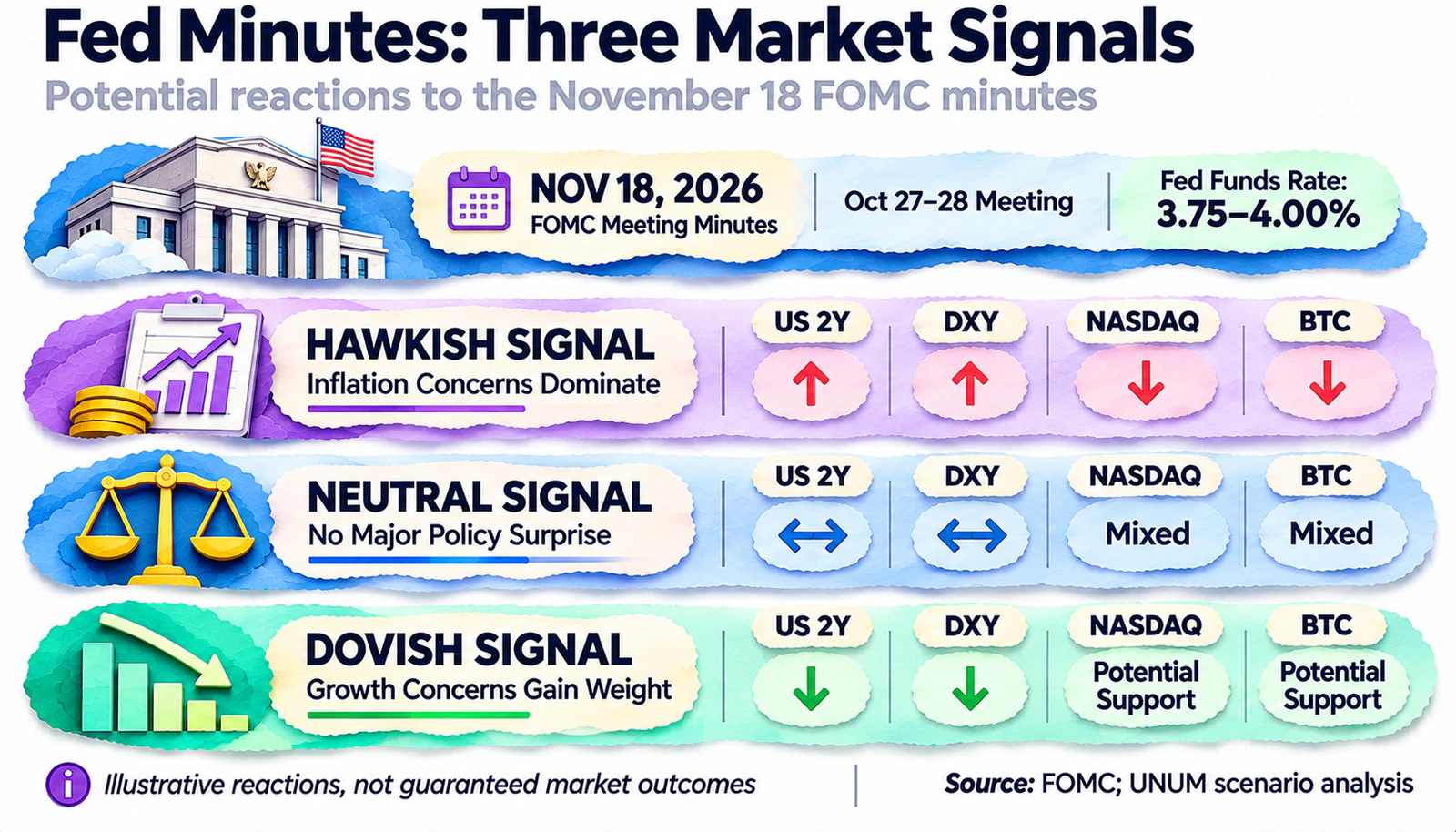
On November 18, the Federal Reserve will release the minutes of the FOMC meeting held on October 27–28.
At that meeting, the regulator maintained the target range for the federal funds rate at 3.75–4.00%. The decision was made with ten votes in favor and two against: Lisa Cook and Beth Hammack advocated for a 25 basis point rate hike.
Unlike the brief statement following the meeting, the minutes will provide more detailed insights into the participants' arguments, their assessments of inflation, economic growth, and risks to the financial system.
The main analytical question is how many Fed representatives believe it is necessary to maintain restrictive monetary conditions.
For traders, it is important to distinguish between three possible signals:
Predominance of inflationary concerns. If the minutes show that a significant portion of participants discussed the need for tighter policy, the market may revise expectations for the December meeting. This could potentially support short-term Treasury yields and the dollar.
Increased focus on economic growth. If participants discussed more about the risks of slowing employment and consumption, investors might increase the likelihood of a more cautious policy at future meetings.
Lack of new signals. If the content of the minutes does not change the perception of the Fed's stance, market movement may be limited, with attention remaining focused on statistics and Nvidia's reporting.
However, the minutes reflect discussions from late October. In the weeks since, new data on inflation, employment, and corporate activity have emerged, so its content should not be considered a direct forecast of the Fed's future decision.
Particularly telling will be the comparison of the reactions of two-year Treasuries, DXY, and Nasdaq after the document's release.
A decline in bond yields does not necessarily signal a positive sign for stocks. If investors expect lower rates due to a deteriorating economy, risk assets may continue to decline.
China to test the resilience of industrial growth and domestic demand
On November 16, China's National Bureau of Statistics will release October data on industrial production, retail sales, fixed asset investments, and the real estate market.
This data will serve as an important benchmark for Asian stock markets and the global commodity sector.
In September, industrial production of large Chinese enterprises grew by 5.5% year-on-year, while retail sales increased by only 1.1%. Fixed asset investments for January–September decreased by 7.2%.
Such a discrepancy indicates uneven economic growth. Industrial production is growing faster than consumer sales, but domestic consumer demand and investment activity remain significantly weaker.
Moreover, production growth does not necessarily accompany profit increases. If the cost of raw materials and other resources rises faster than selling prices, profitability may deteriorate even with high production volumes.
The new data will help determine how capable Chinese industry is of continuing growth without a full recovery in domestic demand.
Particular importance is placed on the dynamics of car sales, consumer durables, real estate investments, and industrial equipment indicators.
For international investors, it is crucial that China's economy remains one of the main sources of demand for copper, iron ore, and other commodities.
If industrial production and investments exceed expectations, this could support certain commodity assets and currencies of resource-exporting countries.
However, if production growth is accompanied by continued weakness in retail sales, investors may doubt the domestic market's ability to ensure sustainable economic expansion.
What to watch: CSI 300, Hang Seng China Enterprises, USD/CNH, AUD/USD, copper, and iron ore.
Japan's GDP and inflation to determine the Bank of Japan's outlook
November 16 Japan will release a preliminary estimate of GDP for Q3, and on November 20, national consumer inflation statistics for October.
These two indicators will allow for a comparison of the state of economic growth with inflationary conditions following the latest rate hike by the Bank of Japan.
After the September rate hike, the Bank of Japan targets a short-term money market rate of about 1.25%, and September's core inflation excluding fresh food reached 2.1% year-on-year. The figure excluding fresh food and energy was 2.4%.
For the Bank of Japan, it is important not only that inflation exceeds the 2% target level, but also the sustainability of domestic sources of price growth, including wages, demand, and the cost of services.
Strong GDP with persistent core inflation could strengthen expectations of further normalization of monetary policy.
However, if economic growth is weak and inflation is primarily dependent on imported energy, the room for further rate hikes may be more limited.
The international aspect is related to Japanese government bonds and capital movement. Rising domestic yields can change the attractiveness of foreign investments for Japanese financial institutions, especially considering the cost of currency hedging.
What to watch: USD/JPY, Nikkei 225, JGB yields, Japan's core CPI, and Bank of Japan's policy forecasts.
UK Inflation and European Data to Test Growth Resilience
UK inflation for October, to be released on November 18, will help assess the need for further tightening by the Bank of England. On November 20, the country will present retail sales statistics.
In September, UK CPI inflation reached 3.5% year-on-year, accelerating from 3.1% in August. The core rate rose to 2.8%, and inflation in the services sector was 3.7%.
At the meeting on November 5, the Bank of England raised the rate to 4% and warned that inflation could approach 5% by mid-2027.
Meanwhile, the UK economy has shown relatively resilient results. According to the first ONS estimate, GDP for Q3 grew by 0.7% compared to the previous quarter after a 0.5% increase in Q2. The main contribution came from the services sector.
The key question now is whether the economy can maintain such growth amid further increases in borrowing costs and consumer prices.
Strong inflation along with stable retail sales could strengthen expectations of further tightening by the Bank of England. If sales begin to slow significantly, investors will assess the risk of deteriorating economic activity.
For the currency market, the dynamics of GBP/USD and UK gilts yields are particularly important. The pound's reaction will depend on changes in expected rates relative to the US, not just on UK indicators themselves.
In the eurozone, on November 17 Eurostat will release final inflation data for October. The main focus will be on the revision of figures and the structure of price pressure, especially in the energy sector.
Key international benchmarks will remain EUR/USD, German Bunds, and the dynamics of European stock indices.
Oil to Remain a Source of Inflationary Uncertainty
Despite a decline in oil prices in early November, geopolitical risks remain significant for global financial markets.
Prices for Brent crude will remain sensitive to export volumes, stock levels, and risks to maritime transport.
For market participants, it is crucial to distinguish between a reduction in geopolitical premium and a real improvement in the supply-demand balance.
If Brent declines amid a recovery in exports and reduced transportation costs, this could alleviate future inflationary risks.
However, if the cause of the decline is a deterioration in global industrial demand expectations, the consequences for stock markets will be less straightforward.
Particularly indicative will be the comparison of oil prices with Chinese industrial statistics publications and changes in expectations for rates by leading central banks.
What to watch: Brent, WTI, spreads between nearest oil futures, oil and petroleum product inventories, freight rates, and DXY.
The dynamics of major commodity instruments can be tracked in the UNUM quotes section.
Bitcoin to Test Demand Resilience Amid New Risks
For the cryptocurrency market, the week of November 16–20 will combine two important external factors — Nvidia's earnings report and the release of the Fed minutes.
The forecast for Bitcoin for the week of November 16–20 should be assessed considering flows into spot ETFs, futures positions, and Fed rate expectations.
Bitcoin remains sensitive to changes in capital costs and investor attitudes towards risk assets. However, its movement cannot be explained solely by the dynamics of the Nasdaq or the dollar: the cryptocurrency market's own liquidity, capital flows, and the structure of positions on derivative platforms are also important.
In November, U.S. spot Bitcoin ETFs continued to record predominantly net outflows. According to Farside Investors, on November 9, 10, and 11, net outflows amounted to $201 million, $95 million, and $299.8 million, respectively — totaling $595.8 million. Preliminary data for November 12 indicates an outflow of about $47.7 million; the result should be clarified after the final reconciliation of fund reports.
This indicates ongoing caution among stock market participants, although ETF flows do not allow for a definitive determination of the behavior of all institutional investors.
To assess BTC prospects, it is important to separate several factors:
Spot demand. Sustained purchases in the spot market can create a more reliable foundation for price recovery than an increase in leveraged positions.
Futures positions. An increase in open interest and positive funding rates amid weak spot demand can raise the risk of liquidations.
Monetary expectations. Changes in Treasury yields and DXY after the Fed minutes may affect market participants' risk appetite.
Technology sector. Nvidia's results can shift market sentiment, but Bitcoin's reaction does not have to align with the Nasdaq.
If Nvidia's report confirms strong demand for AI infrastructure and the Fed minutes do not deliver unexpectedly hawkish signals, conditions for risk assets may improve.
However, weak corporate forecasts or heightened expectations of high interest rates could prolong pressure on Bitcoin, especially in the absence of consistent inflows into spot ETFs.
For practical analysis, BTC/USD, DXY, Nasdaq 100, Bitcoin ETF flows, open interest, and funding rates should be compared. None of these indicators alone provides sufficient grounds for concluding a market reversal.
Market Benchmarks of the Week
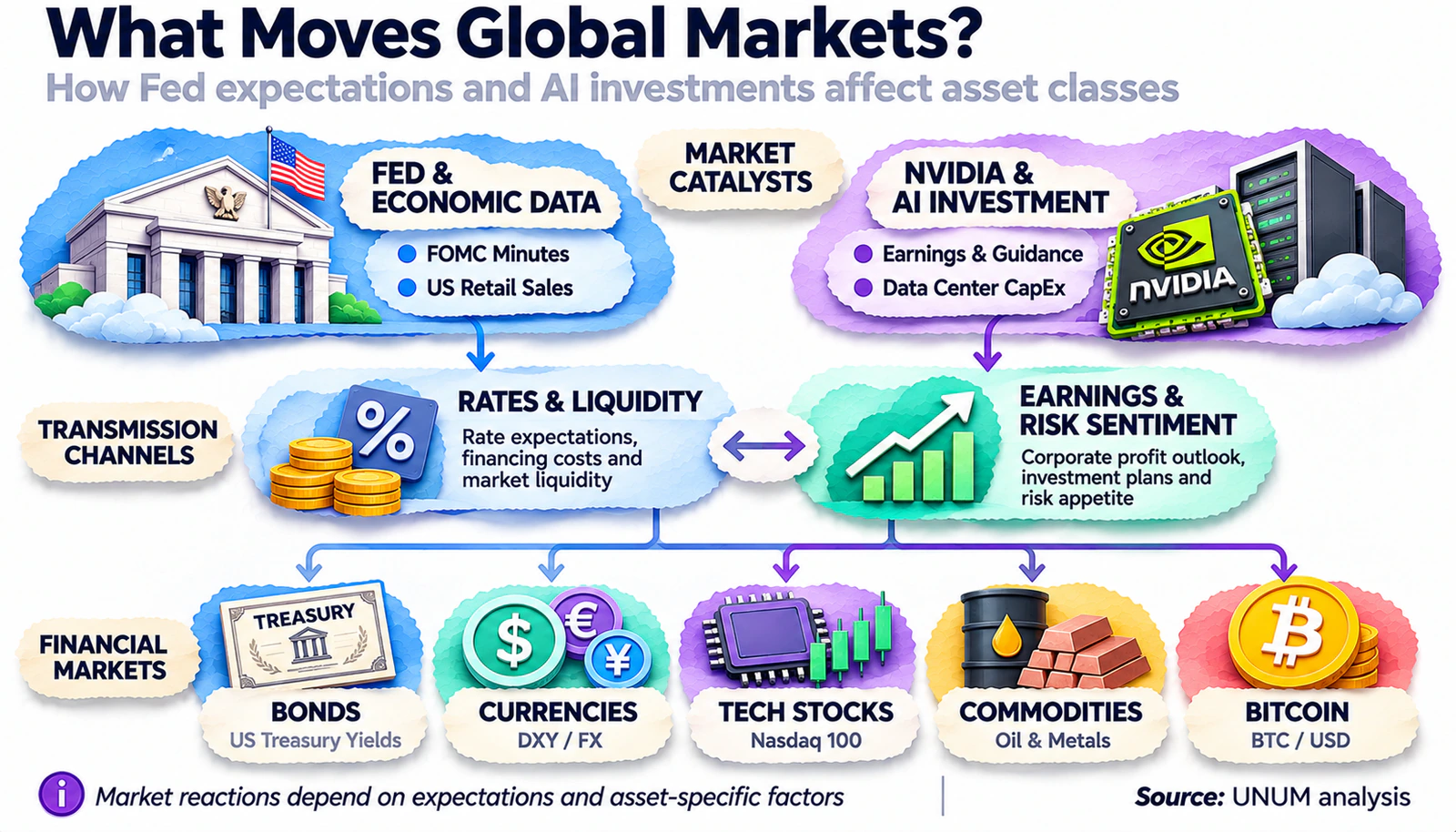
The financial market forecast for the week will depend on Nvidia's results, U.S. retail sales, and signals from the FOMC minutes.
The most important factor will be not the direction of a single indicator, but the consistency of reactions across different asset classes.
US Treasury 2Y — will show how expectations regarding the December Fed meeting are changing.
US Treasury 10Y — will help assess the balance between inflationary risks and concerns about economic growth.
DXY — the short-term dollar forecast will depend on how U.S. retail sales and the Fed minutes alter interest rate expectations.
Nasdaq 100 — will be the main benchmark for the technology sector's reaction to Nvidia's report and AI investment prospects.
USD/JPY — will allow for an assessment of differences in monetary policy expectations between the U.S. and Japan.
Brent — will show changes in oil risks amid Chinese statistics and the Middle East situation.
BTC/USD — will help assess the resilience of the cryptocurrency market amid changing global financial conditions.
When evaluating economic publications, it is important to first compare actual figures with market consensus, then assess the reaction of interest rates, bonds, and the dollar, and only then draw conclusions about stock and Bitcoin movements.
This approach allows for distinguishing short-term volatility from more prolonged asset revaluation, although it does not rule out ambiguous market reactions.
Three Key Questions of the Week
1. Can Nvidia convince investors of business stability after leadership change?
Key indicators will be data center segment revenue, gross margin, forecasts for the next quarter, and comments from the new leadership. Not only exceeding financial consensus will matter, but also the assessment of long-term risks.
2. Will the American economy confirm its ability to maintain growth with high rates?
Retail sales, industrial production, and the Fed's minutes will show how resilient domestic demand is and how the regulator assesses the balance of inflationary risks and threats to economic growth.
3. What will determine the direction of global markets — technological profits or changes in interest expectations?
Nvidia's results, statistics from China and Japan, as well as the Fed's minutes and new statistics affecting interest rate expectations of leading central banks, will help investors assess the state of global demand and capital cost prospects.
Economic calendar for the week of November 16–20
The dates of key publications are confirmed by official calendars of the Fed, U.S. Census Bureau, National Bureau of Statistics of China, Japanese Cabinet Office, ONS, and corporate announcements from Nvidia, Walmart, and Home Depot. The schedule should be additionally verified before the respective trading sessions.
The week of November 16–20 may become an important stage in reassessing the prospects of the technology sector and the global economy. Nvidia's report will show how financial results support high expectations regarding the AI boom, while American macro statistics and the Fed's minutes will help evaluate the future cost of capital.
For investors, the key will be the combination of three factors — the stability of corporate profits, consumer demand, and inflation expectations. If these indicators confirm the possibility of economic growth without a new acceleration of prices, conditions for risky assets may improve.
However, even strong Nvidia results do not guarantee a stock market recovery if interest expectations become stricter or investors continue to reduce risky positions.
Therefore, the main task for market participants next week is to assess not individual events, but their combined impact on stocks, bonds, currencies, commodities, and Bitcoin.