


Copper
HG


Copper is a non-ferrous metal with high electrical and thermal conductivity, widely used in energy, construction, industry, and electronics manufacturing. In financial markets, copper is considered a major exchange-traded industrial metal, and its quotes depend on the state of the global economy, demand in China, production volumes, and the availability of refined metal. For traders and investors, copper prices on the LME and COMEX, warehouse stocks, production activity, and energy infrastructure development prospects are of particular importance.
What is copper and why is it important for financial markets
Copper (Cu) is a metal with atomic number 29, known for its high electrical conductivity, ductility, and corrosion resistance. These properties allow its use in cables, electric motors, transformers, heat exchangers, and other industrial equipment.
Unlike gold, which has significant investment and reserve roles, copper is predominantly used in industry. Silver occupies an intermediate position: its value is influenced by both industrial and investment demand.
Due to its widespread use in construction, energy, and engineering, copper is sometimes referred to as "Doctor Copper." This unofficial name reflects the perception of the metal as an indicator of global economic activity.
When businesses expand production and governments and companies invest in infrastructure, demand for copper can increase. Conversely, a slowdown in construction and industry can reduce metal consumption.
However, the price of copper is not an independent and infallible indicator of economic conditions. Quotes are also influenced by production disruptions, changes in warehouse stocks, trade policy, and financial participants' operations.
Where copper is used
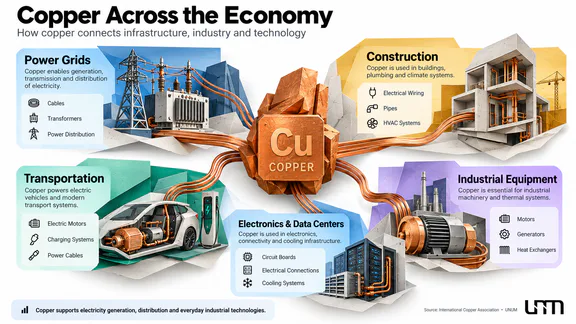
The main economic value of copper is related to its ability to efficiently conduct electricity and heat. The metal is used at various stages of electricity production, transmission, and use, as well as in construction and industry.
Electric power and infrastructure
Copper is used in electrical cables, transformers, generators, switchgear, and other power grid equipment.
The development of energy infrastructure requires significant volumes of conductors and electrical components. During the modernization of old networks or the construction of new facilities, demand for copper may increase regardless of short-term changes in consumer goods production.
Projects of transport electrification, expansion of transmission networks, and connection of new energy sources are of particular importance.
Construction and industry
In construction, copper is used for electrical wiring, piping, heating systems, air conditioning, and individual structural elements.
Demand from the construction industry depends on the activity of housing construction, commercial real estate, and infrastructure investments.
In industry, copper is used in engines, machinery, manufacturing equipment, and heat exchangers. Therefore, changes in industrial production volumes can affect metal consumption.
Electric vehicles and renewable energy
Copper is used in electric motors, power cables, inverters, battery systems, and charging infrastructure for electric vehicles. Fully electric cars generally contain more copper than comparable vehicles with internal combustion engines.
The metal is also necessary for connecting solar and wind power plants, building electrical networks, and energy storage systems.
The expansion of these sectors creates additional long-term demand. However, its scale depends on the pace of construction, technological changes, and the possibility of partially substituting copper with other materials.
Electronics and data centers
Copper is used in electrical connections, printed circuit boards, cooling systems, and data center equipment.
The development of cloud computing and artificial intelligence increases the need for electricity and infrastructure, for which industrial metals are required.
However, the expansion of computing infrastructure does not imply a proportional increase in copper consumption. Actual demand is influenced by equipment design, electrical system efficiency, and the volume of new construction.
How copper prices are formed
The price of copper depends on the balance of physical metal demand and supply, the availability of warehouse stocks, and the expectations of financial market participants.
Key international benchmarks are copper prices on the London Metal Exchange (LME) and COMEX futures quotes, part of the CME Group.
Copper on the exchange is represented by standardized contracts that differ in volume, delivery terms, and execution rules.
On the LME, quotes are usually expressed in US dollars per metric ton, while on COMEX, they are in dollars per pound. Therefore, direct numerical comparison without conversion is incorrect.
Copper price on the LME
The London Metal Exchange (LME) is one of the main centers of global trade in industrial metals. LME copper quotes are used as an international benchmark in physical contracts and price risk management.
The exchange publishes LME Official Prices for various delivery terms. The LME Official Settlement Price, corresponding to the official settlement price of the nearest delivery, is of particular importance and widely used in physical contracts.
In analysis, it is necessary to distinguish between the official price of the nearest delivery, three-month quotations, and closing prices. They refer to different price benchmarks and may differ from each other.
The standard delivery futures LME Copper with the code CA corresponds to 25 metric tons of refined Grade A copper in the form of cathodes of exchange-approved brands. Such metal must meet established requirements for chemical composition and quality.
At a hypothetical price of $10,000 per ton, the nominal value of the contract is $250,000. A change in the quotation by $100 per ton will lead to a change in the position value by $2,500 before accounting for trading expenses.
For regular trades on the standard CA contract in the LMEselect system, the minimum price change is $0.50 per ton. With a contract size of 25 tons, the cost of one such step is $12.50. For certain types of operations and trading mechanisms, the minimum steps may differ.
Copper Price on COMEX
On the American exchange COMEX, the standard delivery futures Copper Futures with the code HG is traded. Its size is 25,000 pounds of copper, or approximately 11.34 metric tons.
The price of copper per pound is used to calculate the value of the HG contract. Quotations are expressed in US dollars and cents per pound, although in analytical materials they may additionally be converted into other units.
At a hypothetical price of $4 per pound, the nominal value of a standard contract is $100,000. A change in the quotation by $0.10 per pound will result in a profit or loss of $2,500 per position before accounting for commissions and other expenses.
The minimum price step for the HG contract is $0.0005 per pound, which corresponds to $12.50 per one standard contract.
In addition to HG, CME Group offers copper contracts of other sizes, including Micro Copper Futures. Therefore, when choosing an instrument, it is necessary to check its specification rather than rely solely on the name of the base metal.
How to Convert Copper Price per Ton and Pound
One metric ton is approximately equal to 2,204.62 pounds. To convert the price from dollars per pound to dollars per metric ton, the formula is used: Price per metric ton = price per pound × 2,204.62. For example, a hypothetical quotation of $4 per pound corresponds to approximately $8,818.48 per metric ton. The reverse calculation is performed by dividing the price per ton by 2,204.62.
Such conversion helps to compare LME and COMEX quotations in the same units but does not eliminate differences between the contracts themselves, terms, and delivery conditions.
Comparison of LME and COMEX Contracts
| Parameter | LME Copper | COMEX Copper |
| Exchange Code | CA | HG |
| Standard Contract Size | 25 metric tons | 25,000 pounds |
| Currency and Unit of Price | USD per metric ton | USD per pound |
| Type of Execution | Physical delivery | Physical delivery |
| Minimum Price Step | $0.50/ton for regular LMEselect trades | $0.0005/pound |
| Cost of Indicated Step | $12.50 per contract | $12.50 per contract |
| Hypothetical Example of Nominal Value | $250,000 at $10,000/ton | $100,000 at $4/pound |
The characteristics of standard contracts are indicated. The rules of other instruments and trading mechanisms may differ.
Why the Exchange Price Differs from the Cost of Physical Metal
The price of physical copper is often determined based on an agreed exchange benchmark with a premium or discount for quality, location, transportation, and delivery conditions.
This surcharge is sometimes called a premium for physical metal. Its size may vary between regions, even when international quotations remain relatively stable.
For example, an increase in the regional premium may indicate limited availability of copper in a particular country or industrial center. However, it does not necessarily mean a shortage of metal in the entire global market.
What Influences the Price of Copper
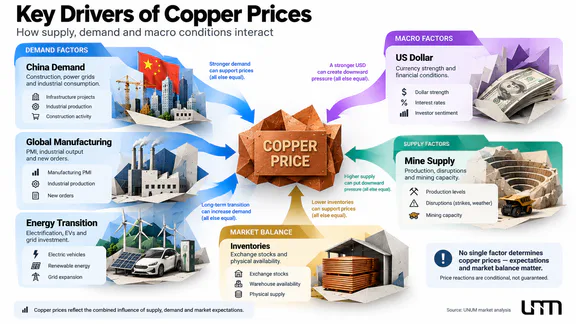
The global copper market is sensitive to changes in industrial production, infrastructure investments, mining volumes, processing, and international trade. The significance of individual factors depends on the current balance of supply and demand, as well as market participants' expectations.
Demand in China
China occupies a central place in the global consumption of refined copper. Its economy generates significant demand for metal from construction, energy, and electrical equipment manufacturing.
Investments in power grids, the state of the construction sector, industrial production output, and equipment manufacturers' activity are especially important for analysis.
Acceleration in infrastructure construction can support copper consumption, while a downturn in the real estate market can limit demand from the construction industry.
However, growth in Chinese industrial production does not necessarily lead to an immediate increase in quotations. The market considers not only actual data but also preliminary expectations, inventory changes, and metal availability.
State of the Global Economy
Copper is widely used in industry, so its cost often reacts to changes in the global economic cycle.
Growth in production, investments, and construction usually supports demand. When economic activity slows down, enterprises may reduce raw material purchases and use previously accumulated stocks.
Traders often monitor PMI business activity indices, which help assess changes in conditions in the manufacturing sector.
Particular importance is given to indicators of new orders and industrial output. However, their impact on quotations depends on market expectations and other factors.
Mining and Supply Disruptions
The supply of mined copper depends on the condition of mines, metal content in ore, production costs, infrastructure, and expansion capabilities.
Important producing countries include Chile, the Democratic Republic of the Congo, and Peru. Other countries in Latin America, Africa, and Asia also play a significant role.
Production can be affected by accidents, strikes, water and power supply disruptions, changes in the average copper content of mined ore, and regulatory constraints.
With low inventory levels, unexpected supply cuts can cause sharp price fluctuations. If the market anticipates such disruptions or has sufficient stocks, the reaction may be weaker.
Development of Energy Infrastructure
The construction of power grids, charging stations, renewable energy facilities, and the production of electric vehicles create a long-term demand for copper.
When assessing demand, it is important to consider not only announcements of new projects but also the actual construction timelines, equipment volumes, and sources of financing.
Technological changes can reduce the copper content in certain products. In some areas, aluminum may also be used as an alternative conductor material.
Therefore, long-term growth in electrification does not guarantee a constant increase in copper prices: the outcome depends on the balance of supply, demand, and technological changes.
US Dollar and Interest Rates
International copper exchange prices are predominantly expressed in US dollars. A strengthening USD can increase the cost of the metal for buyers using other currencies, potentially restraining demand.
Interest rates affect the cost of financing industrial activities, infrastructure investments, and inventory.
However, copper's dependence on the dollar and rates is not constant. Changes in the physical balance can have a stronger impact on prices than macroeconomic factors.
Inventory and Metal Availability
Stocks at LME, COMEX, and other trading platforms help assess the amount of metal available for delivery under exchange contracts.
A decline in exchange inventories may reflect increased shipments, movement of copper outside the warehouse system, or supply tension. The reasons should be verified with additional data.
An increase in inventories does not always indicate a rise in global supply: metal may be redistributed between regions and storage forms.
It is important to note that exchange warehouses reflect only a portion of global reserves. Significant volumes of copper are held by producers, industrial consumers, and trading companies.
Therefore, changes in visible inventories cannot be automatically equated with a shortage or surplus of copper in the entire market.
Copper Production and Supply
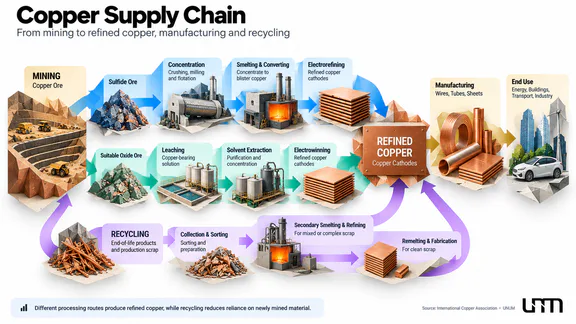
The global copper production chain includes ore mining, beneficiation or chemical processing, obtaining refined metal, and manufacturing final products.
For analysis, it is important to distinguish between mined copper, copper concentrate, and refined metal. Changes in production volumes do not always immediately reflect the supply of copper available to industrial consumers.
From Ore to Refined Copper
Copper ores vary in mineral composition and processing methods. Many sulfide ores undergo beneficiation to produce copper concentrate, smelting, and subsequent refining.
For some oxidized ores and other suitable materials, hydrometallurgical processes are used, including leaching, copper extraction from solutions, and electrolytic deposition.
As a result of the relevant technological processes, refined, including electrolytic, copper is obtained. Products in the form of cathodes of suitable quality can be used for further industrial processing and, if exchange requirements are met, for delivery under LME contracts.
There may be discrepancies between mining volumes and refined metal production. Output depends on the availability of concentrate, the capacity utilization of smelting and refining facilities, secondary raw material processing, and logistics.
Why Copper Production is Difficult to Increase Quickly
Creating a large mine requires exploration, obtaining permits, capital investment, and constructing production infrastructure.
The preparation of such projects can take many years. Therefore, copper supply cannot always quickly respond to an increase in exchange prices.
Expanding production at existing facilities is also limited by available ore reserves, production capacities, energy supply, and environmental requirements.
As a result, prolonged demand growth can lead to market tension if mining and processing capacities expand more slowly than consumption.
Smelters and Concentrate Processing Costs
The production of refined copper depends not only on the amount of mined ore but also on the availability of facilities for processing concentrate.
One of the industry indicators is TC/RC (Treatment Charges / Refining Charges) — the fee for processing concentrate and refining under relevant commercial agreements.
Changes in these rates help assess the balance of concentrate supply and demand from processing enterprises.
With limited concentrate availability, processing companies may face pressure on profitability. However, TC/RC are not a direct analog of refined copper prices, so they should be analyzed alongside production volumes, inventories, and capacity utilization.
Copper Recycling
Copper is suitable for multiple recycling. However, obtaining metal of the required quality may require sorting, cleaning, and refining of secondary raw materials.
Sources of copper scrap include used cables, electrical equipment, construction materials, and industrial waste.
Rising copper prices can increase the profitability of scrap collection and recycling, but the availability of secondary raw materials depends on the lifespan of products, collection efficiency, and the capabilities of recycling facilities.
Recycling helps reduce the need for primary extraction but cannot instantly compensate for any increase in global demand.
How to Trade Copper on Financial Markets
Investments in copper can be made through exchange-traded derivatives and investment products, as well as indirectly through shares of companies mining the metal.
The choice of instrument depends on the investor's goals, holding period, capital requirements, and willingness to take on associated risks.
Copper Futures
Futures are standardized exchange contracts that allow fixing the cost of future copper deliveries or obtaining financial results from changes in its quotations.
Standard deliverable futures LME Copper CA and COMEX Copper HG differ in contract sizes, units of measurement, delivery dates, and trading rules.
Opening a position usually requires margin, which can be significantly less than the nominal value of the contract. This creates a leverage effect: relatively small price changes can lead to significant profits or losses relative to the funds deposited.
Producers and industrial consumers use futures to hedge price risks, while traders use them for operations based on changes in metal prices.
When choosing an instrument, it is necessary to consider the term of circulation, margin requirements, liquidity, and execution order. Deliverable contracts require special attention to trading end dates and physical delivery procedures.
Copper CFDs
CFDs (Contracts for Difference) are over-the-counter derivatives that allow trading on changes in copper prices without purchasing physical metal.
A trader can open long positions expecting price increases or short positions anticipating declines. The financial result is determined by the difference between the opening and closing prices of the deal, taking into account spreads, commissions, and other expenses.
Some brokers offer copper CFDs with leverage, allowing positions to be opened with a nominal value exceeding the amount of margin deposited. However, losses relative to the initial margin also increase.
Consider a hypothetical CFD with a position volume equivalent to one metric ton of copper. At a price of $10,000 per ton, the nominal position value is $10,000.
If the broker's conditions allow using leverage of 1:10, the initial margin requirement will be $1,000. A 3% change in copper price will result in a profit or loss of $300 before trading expenses, which corresponds to 30% of the margin deposited.
This calculation illustrates the leverage mechanism, not the actual conditions of a specific broker. CFD sizes, base quotes, margin requirements, and available leverage are determined by the instrument specification and applicable rules.
When trading CFDs, it is necessary to consider spreads, rollover costs, the risk of price gaps, and the possibility of forced position closure due to insufficient margin.
Shares of Copper Mining Companies
Investing in the copper market can be done indirectly through shares of companies engaged in mining and processing the metal.
Their financial results may depend on the price of copper, production volumes, metal content in ore, and extraction costs.
However, the value of such shares is determined not only by market quotations. It is also influenced by debt load, management decisions, tax conditions, geopolitical risks, and the cost of other extracted resources. Therefore, shares of copper mining companies cannot be considered a complete analogue of a direct position in the metal.
Exchange-Traded Investment Products
In some markets, exchange-traded products tracking copper futures, as well as funds investing in shares of copper industry companies, are available.
The product structure determines the nature of its dependence on the metal's price. For futures strategies, management costs, the structure of the forward market, and the transition between contracts are important. For equity funds, the financial results of companies and the portfolio composition are of additional importance.
Before investing, it is necessary to check the underlying assets, fees, and the mechanism for forming the product's value.
Comparison of Copper Investment Methods
| Instrument | What the Investor Gets | Main Risks |
| LME or COMEX Futures | Position in a standardized exchange contract | Leverage, margin, physical delivery |
| CFD | Financial result under a contract with a broker | Leverage, spreads, counterparty, rollover costs |
| Mining Company Shares | Stake in the producer's business | Corporate, production, and market risks |
| Exchange-Traded Investment Products | Exposure according to product structure | Fees, price tracking features, and asset composition |
How to Analyze Copper Prices
A copper price chart helps study the dynamics of the selected exchange contract, assess volatility, and explore market trends.
For a comprehensive analysis, it is useful to combine fundamental indicators with forward market data and technical analysis.
Fundamental Analysis
The main task of fundamental analysis is to determine how expected copper supply matches future consumption.
Key indicators include:
- PMI business activity indices in China and other major economies.
- Industrial production and the state of the construction sector.
- Investments in electrical grids and infrastructure.
- Production volumes and operations of major mines.
- Utilization of smelting and refining facilities.
- Concentrate processing conditions, including TC/RC.
- Stock levels at LME, COMEX, and other platforms.
- Copper scrap processing.
- US dollar dynamics and international trade policy.
For practical analysis, it is convenient to follow the sequence:
- Assess demand: industrial production, construction, China's economic condition, and infrastructure investments.
- Check supply: production, concentrate availability, processing capacity utilization.
- Study stock levels: compare changes in exchange reserves with physical deliveries.
- Analyze futures spreads: assess the difference between near and distant delivery dates.
- Move to price charts: explore trends, volatility, and market activity.
It is important to compare actual indicators with market participants' expectations. For example, an increase in copper production does not necessarily lower the price if investors anticipated an even more significant supply growth.
Spreads and the futures curve
In addition to the nearest contract price, traders analyze the difference between futures with different delivery dates.
Contango is a situation where longer-term contracts trade higher than the nearest ones. Conversely, when the nearest delivery price is higher, it is referred to as backwardation.
For copper, these relationships help assess storage and financing costs, as well as the availability of physical metal.
On the LME, an important indicator is the Cash–3M spread — the difference between the nearest delivery price and the three-month copper price.
If the nearest delivery price exceeds the three-month price, a positive Cash–3M spread may indicate tightness in physical metal supply. However, it should be compared with stock levels, regional premiums, and other indicators.
If the three-month price is higher than the nearest, a negative Cash–3M corresponds to contango between these terms.
However, an individual futures spread does not reliably predict the future direction of prices.
Technical analysis
Technical analysis includes studying price trends, support and resistance levels, moving averages, trading volumes, and volatility.
For copper, it is especially important to consider which contract is displayed on the chart. Continuous futures charts over a long period may include transitions between delivery dates, affecting the comparability of historical values.
Trading volume and open interest help assess market participant activity, but they do not reliably determine the future direction of price movement.
Technical signals are useful to consider alongside fundamental indicators, especially during periods of sharp changes in supply or industrial demand.
Main risks of investing in copper
Copper is an industrial asset, so its value is sensitive to changes in economic activity, production chains, and international trade.
| Risk | Possible market impact |
| Slowdown in China's economy | Decrease in demand from construction and industry |
| Global industrial downturn | Weakening metal consumption |
| Production disruptions | Supply constraints and potential price increases |
| Increase in stock levels | Price pressure amid insufficient demand |
| Trade restrictions | Redistribution of supplies and changes in regional premiums |
| Strengthening of the dollar | Increased copper costs for buyers with other currencies |
| High volatility | Significant fluctuations in position values |
| Use of leverage | Increased potential losses relative to collateral |
Special attention should be paid to the risks of derivative instruments. When trading futures or CFDs, an unfavorable price change can lead to a rapid loss of margin collateral, and depending on the instrument's conditions and legal regime, additional obligations may arise.
For a long-term investor, it is important to consider that structural growth in copper demand does not guarantee a constant price increase. Expansion of production, secondary processing, technological substitution, and changes in the economic cycle can affect the market balance.
Frequently asked questions about Copper (HG)
Copper is widely used in construction, energy, and industry. Therefore, changes in demand for the metal can reflect acceleration or deceleration of economic activity. However, quotes also depend on mining, stocks, and financial factors.
On LME, the price of copper is usually quoted in US dollars per metric ton, while on COMEX it is in dollars per pound. To compare quotes, they need to be converted to the same units of measurement and account for contract differences.
Key factors include industrial demand, especially in China, mining volumes, availability of refined metal, and warehouse stocks. Their influence changes depending on the economic cycle and market participants' expectations.
On COMEX, the standard futures contract Copper Futures has the code HG, while on LME the standard contract Copper is CA. Notations may differ in market data provider terminals.
Yes. This can be done through exchange futures, individual investment products, and CFDs, if available in the relevant jurisdiction. Stocks of mining companies can also provide indirect exposure to copper prices.
The price of copper depends not only on demand. If reductions in mining, supply disruptions, or declines in available stocks are more significant than weakening consumption, quotes may rise even in an unfavorable economic situation.
The price of copper is primarily determined by industrial consumption, while gold plays a more significant investment and reserve role. Therefore, the dynamics of these metals can differ significantly during periods of economic instability.
Electric vehicles use copper in electric motors, power cables, inverters, and charging systems. The expansion of such transport production may increase the demand for the metal, but the overall effect depends on vehicle design, infrastructure development, and technological changes.