The activation of Alpenglow on the mainnet is scheduled for epoch 1064, which is expected to begin around 13:20 UTC. However, the actual consensus switch will occur after the first 5,000 slots of this epoch, approximately 18 minutes after it starts.
The Alpenglow update in 2026 will be one of the largest infrastructure changes for Solana, as it will replace the current TowerBFT consensus mechanism. If developers manage to implement the planned changes without significant issues, the network will achieve faster block finalization. This is especially important for financial applications that require fast and reliable settlements.
Previously, UNUM reported on the testing of Solana's new consensus mechanism. Now the technology is preparing to transition from the testing environment to the mainnet.
What is Alpenglow and why is Solana changing its consensus
Alpenglow is Solana's new consensus protocol designed to speed up block agreement among validators. Validators are responsible for verifying transactions, maintaining blockchain operations, and determining which operations can be considered finally confirmed.
Before the update, Solana uses the TowerBFT consensus mechanism, which relies on Proof of History. It allows for fast transaction processing, but additional time is required to achieve final finalization.
It is important to distinguish between the initial confirmation of a transaction and its finalization. The status 'confirmed' means that the block containing the transaction has received the necessary validator support but has not yet reached the level of final finalization. The status 'finalized' indicates that the block is considered finally confirmed according to protocol rules.
The previous Solana finalization time is about 12.8 seconds. Alpenglow is expected to reduce this figure to approximately 150 ms, reducing the delay by more than 85 times.
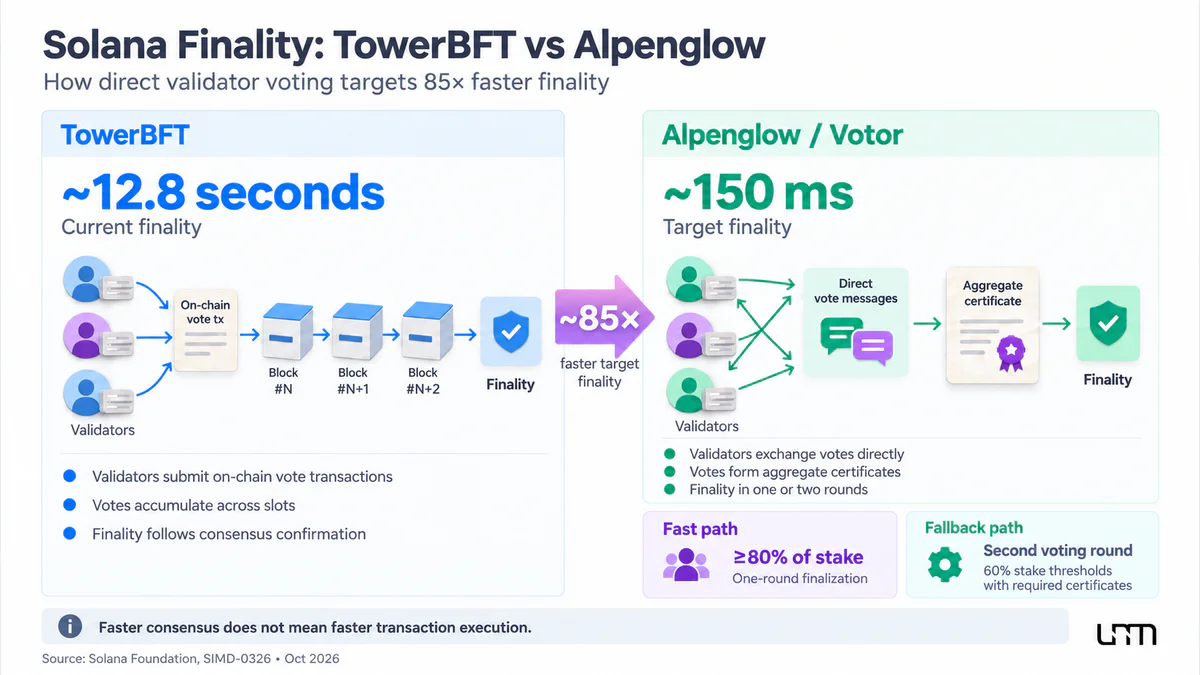
The update is based on Votor — a system where validators exchange votes directly, instead of recording them on the blockchain as separate transactions. These votes are combined into cryptographic certificates, allowing for faster consensus among network participants.
In a fast scenario, Votor uses a certificate formed with the support of at least 80% of the stake. If this threshold is not reached, the protocol provides for an additional voting round with different certificate formation conditions.
This approach should reduce delays, but the actual speed will depend on network conditions, stake distribution, and validator activity. Therefore, 150 milliseconds should be considered a technical benchmark rather than a guaranteed duration for each user transaction.
Additionally, the update is being implemented in stages. The first stage launches Votor, while Rotor — a future system for distributing blocks among validators — will appear later.
In the proposal SIMD-0326, developers describe two possible paths to achieve finalization: fast certificate formation and an additional consensus round. This mechanism should ensure reduced delays without changing the execution of user programs in the Solana Virtual Machine.
How Alpenglow will affect security and validators
Accelerating consensus is accompanied by changes in the security model. One of the key stated advantages of Alpenglow is the resilience model, designated by developers as 20+20.
According to this model, the protocol can combine resilience to 20% malicious stake and 20% unavailable stake, provided the specified technical conditions are met. However, the 20+20 characteristic does not mean that the network is guaranteed to continue operating under any combination of attacks and outages. Actual security depends on validator behavior, stake distribution, and the state of network infrastructure.
The new mechanism also changes the economics for Solana validators: validator voting fees will be replaced by a fixed payment, affecting network operator expenses.
Previously, on-chain transactions were used for voting, with fees averaging about 1 SOL per epoch. With the transition to Votor, votes will no longer be processed as separate transactions, and instead of previous voting fees, a fixed Validator Admission Ticket (VAT) fee of 0.8 SOL per epoch will be charged.
The VAT mechanism, including the registration of validator cryptographic keys, was prepared in advance. The full participation fee begins to apply as part of the transition to the new consensus.
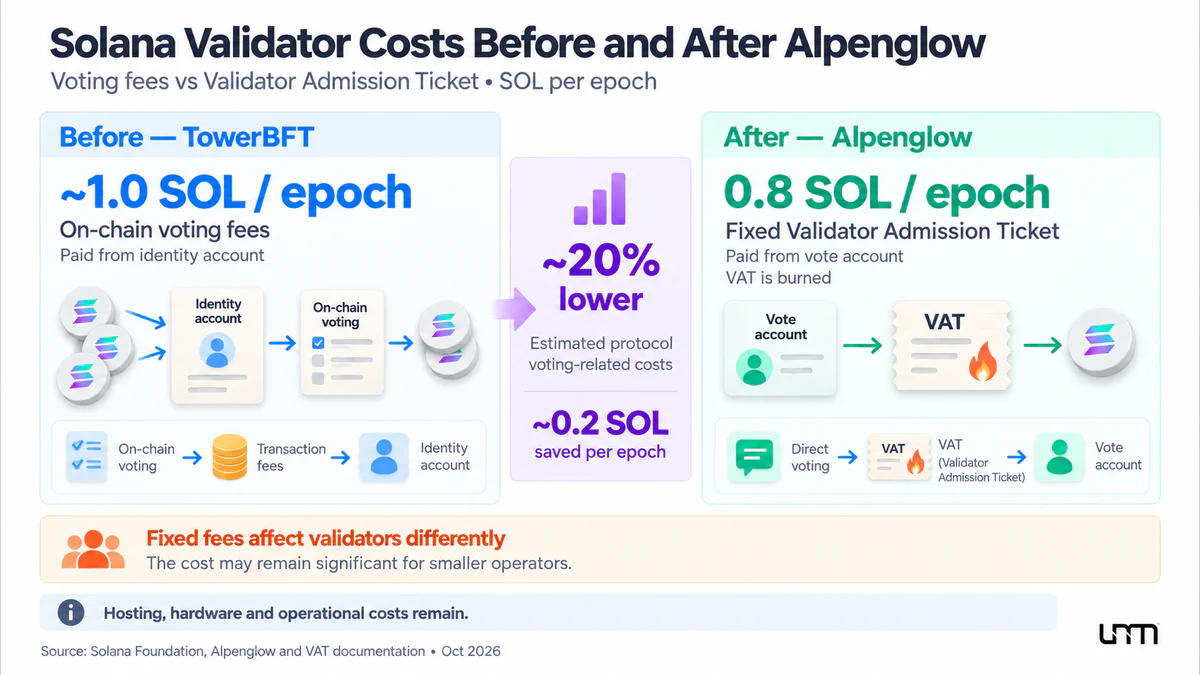
When comparing the approximate cost of about 1 SOL for voting with a fixed fee of 0.8 SOL per epoch, the reduction is approximately 20%. However, the actual savings for an individual validator depend on previous expenses, while the cost of servers, equipment, and infrastructure maintenance remains.
A fixed fee creates an additional economic issue. For large operators, it may be a relatively small part of their income, whereas for validators with a small amount of delegated stake, such a payment can remain a significant burden. Therefore, the impact of Alpenglow on network decentralization will depend not only on the cost of voting but also on the distribution of income among participants.
Additional risks are associated with validators transitioning to compatible software versions. During the migration phase, Firedancer and Frankendancer operators need to use supported clients based on Agave, including Agave, Jito-Solana, or Harmonic Salsa. This temporarily limits the diversity of client implementations, which is important for infrastructure resilience.
A successful transition should confirm that the new consensus can simultaneously provide high finalization speed, security, and stable operation under real load.
What Alpenglow Will Change for DeFi and Cryptocurrency Payments
Fast finalization is especially important for decentralized finance, as many operations here are performed automatically. Credit protocols, cryptocurrency exchanges, and payment applications use blockchain state information before proceeding to the next actions.
The scale of the potential impact of the update on DeFi Solana can be assessed by two indicators: Solana's TVL and the daily trading volume on decentralized exchanges.
According to DefiLlama, as of October 21, 2026, the total value locked (TVL) in Solana's DeFi protocols is approximately $5.95 billion, and the daily DEX trading volume reaches $2 billion. The number of active addresses in the last 24 hours is at 3.04 million, although this number should not be equated with the number of unique users.
Such volumes indicate that technological changes can affect a significant number of operations. However, the benefits of Alpenglow will vary depending on the type of application.
Decentralized Exchanges (DEX). Accelerated finalization will allow applications to receive final confirmation of trading operations faster. This is especially useful for services that perform sequential trades or interact with multiple protocols.
Credit platforms. Faster blockchain state agreement can reduce the waiting time between collateral operations, including debt repayment and position liquidation.
Cryptocurrency payments. Payment services will be able to receive final confirmation of transfers faster, although currency exchanges, compliance checks, and settlements with bank accounts may still take additional time.
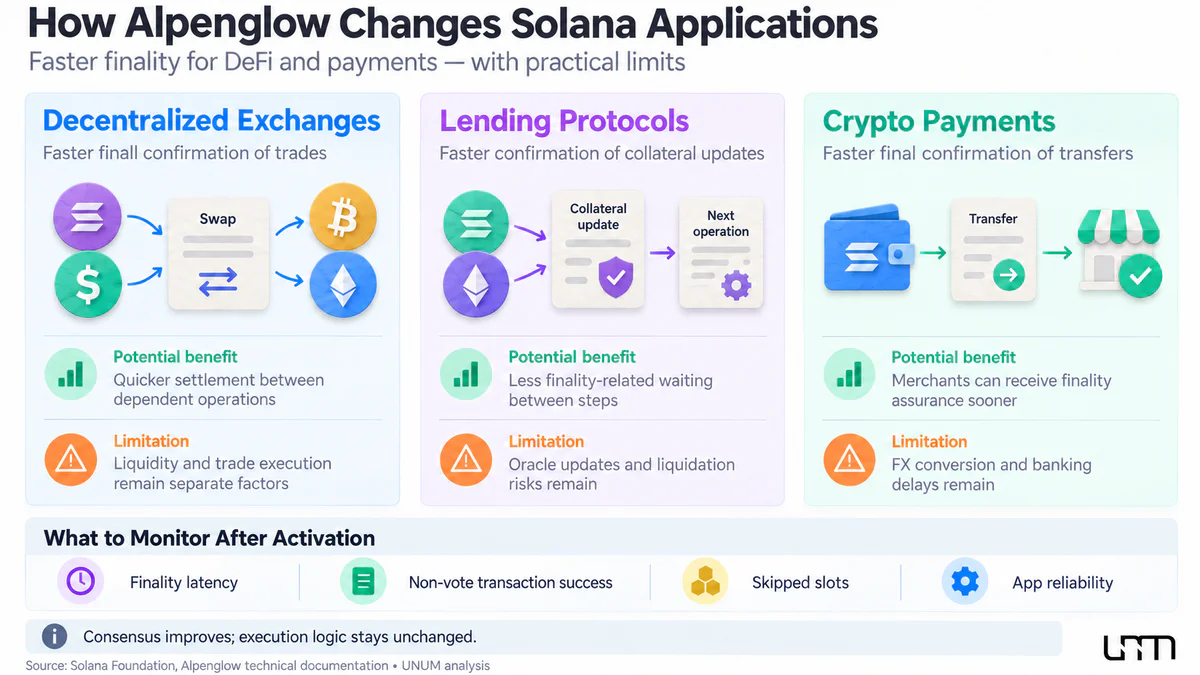
At the same time, Solana's transaction speed depends not only on finalization time but also on network throughput, so Alpenglow does not guarantee a proportional increase in the number of processed operations.
Solana Foundation developers explicitly state: “Transaction execution is not affected: SVM, transactions, programs, and fees remain the same.”
In other words, the update changes the way consensus is achieved but does not speed up the execution of programs in the Solana Virtual Machine itself. Blockchain performance still depends on network load, computational resources, and infrastructure availability.
Therefore, the real effect of Alpenglow needs to be assessed not only by finalization time but also by the share of successfully processed user transactions, the number of missed slots, and the stability of applications during peak load. When analyzing overall activity, it will also be necessary to consider that validator votes will no longer be recorded as on-chain transactions, which may change the usual TPS metrics without a corresponding decrease in user demand.
How Alpenglow Might Affect SOL Price
Technological updates that can improve blockchain performance often attract investor attention. However, trading SOL depends not only on network prospects but also on the overall situation in the cryptocurrency market.
SOL is used to pay transaction fees, staking, and ensuring blockchain operation. If Alpenglow makes Solana more attractive to financial application developers, it could increase network demand over time and create additional prerequisites for SOL demand.
As of the preparation of this material on October 21, 2026, SOL is trading at approximately $106. However, quotes constantly change, so short-term fluctuations should not be taken as a definitive assessment of the update results.
The further market reaction may develop according to several scenarios:
Positive scenario. The activation proceeds without serious technical problems, the actual finalization approaches the stated 150 ms, and applications begin to use the advantages of the new consensus. In this case, the improvement of Solana's technological prospects may increase investor interest in SOL.
Neutral scenario. The update launches successfully, but there is no significant price reaction. This result is possible if market participants have already priced in the expected benefits of Alpenglow or believe that more time is needed to assess the economic impact.
Negative scenario. Technical glitches, activation delays, or instability of certain infrastructure components may worsen market expectations. Additional pressure may be created by reduced liquidity and an unfavorable situation in the cryptocurrency market as a whole.
It is also important to consider the possible realization of the strategy 'buy the rumor, sell the news' — buying on expectations and selling after the event. Even a favorable technological result is sometimes accompanied by a price correction if investors start taking profits.
Notably, SOL has already shown significant fluctuations under the influence of a broader set of factors. In September, UNUM analyzed Solana's recovery above $100, when price movements depended not only on events within the ecosystem but also on the macroeconomic backdrop. This example shows that SOL's dynamics are simultaneously influenced by technical events, macroeconomic decisions, and the overall state of the crypto market.
How traders might react to the Solana update
For traders, Alpenglow is primarily of interest as an event that could affect short-term cryptocurrency volatility. During periods of major technological changes, market participants assess not only the fact of the update but also the discrepancy between preliminary expectations and actual results.
After activation, attention may focus on network stability, developer publications, and changes in trading volumes. However, sharp price fluctuations do not always indicate a fundamental reassessment of the project: they may also be related to short-term speculation, position liquidation, and the general movement of the cryptocurrency market.
Cryptocurrency trading requires an assessment of price dynamics, liquidity, and trading risks. There are specialized platforms for working with digital assets, including TRADEX. Trading tools allow tracking quotes, order books, and trade history.
The platform also provides opportunities for exchanging and storing digital assets, and for large operations, an over-the-counter (OTC) trading service is available. This allows the use of various tools depending on the tasks and features of the trading strategy.
The presence of trading tools does not eliminate market risks. Before opening a position, it is necessary to consider commissions, the liquidity of the chosen asset, and possible price fluctuations. In particular, the successful activation of Alpenglow itself does not guarantee positive returns on SOL operations.
Can Alpenglow strengthen Solana's position in the crypto market
Alpenglow could become one of the most significant technological updates for Solana, as it affects the basic transaction consensus mechanism. Reducing the finalization time from approximately 12.8 seconds to a target of 150 milliseconds potentially increases the network's appeal for financial applications that require fast and predictable settlements.
However, final conclusions can only be made after the launch and accumulation of statistics on the performance of the new consensus mechanism. In addition to speed, important indicators will remain blockchain security, validator resilience, the share of successful transactions, and changes in DeFi activity.
For the cryptocurrency market, Alpenglow represents a significant fundamental event, but not an unequivocal signal for SOL price growth. In the long term, it is much more important whether Solana can turn technological advantages into sustained interest from developers, users, and financial services.
Alpenglow update timeline (updated)
Solana has completed the transition to Alpenglow on the mainnet.
The Alpenglow update was activated on the Solana mainnet on October 21, 2026. The Solana monitoring panel recorded the launch at approximately 13:54 UTC. The Anza team confirmed the completion of the migration at approximately 14:00 UTC at slot 459,653,000.
As a result, the network transitioned from TowerBFT to the new Votor consensus mechanism without restarting the blockchain. Developers claim a reduction in the final transaction finalization time from 12.8 seconds to approximately 150 milliseconds.
However, 150 ms should still be considered a stated indicator: independent statistics of stable mainnet operation after the update still require verification. The first published measurements do not confirm achieving the target finalization time under real load.
The next stage will be to assess network stability, actual finalization speed, and validator participation in the new consensus mechanism.
As of the morning of October 22, 2026, Solana continues to operate on the new Alpenglow consensus mechanism following its activation on October 21. Initial data indicates network stability: during the first full hour after transitioning to Votor, the blockchain processed about 2,500 user transactions per second compared to 2,640 for the same period the previous day. The official Solana Status service reported no new incidents. Meanwhile, the genesis block of the new consensus received confirmation from 446 out of 654 validators, indicating successful transition agreement.
The initial published measurements also showed a finalization time of 202 ms — approximately 63 times faster than the previous benchmark of 12.8 seconds, but 35% higher than Alpenglow's target of 150 ms. This is currently an isolated observation rather than a confirmed average network speed. Solana's market metrics remain significant: TVL is around $6 billion, daily trading volume on DEX is $2.21 billion, and the price of SOL as of the evening check on October 21 was around $108.58. However, it is premature to directly link these values to the update: additional data on performance, network stability, and user activity is needed to assess its real impact.