What's Happening with Oil Prices in October 2026
Oil prices in 2026 surged sharply amid the conflict in the Middle East, and by the end of October, the market remains influenced by geopolitical risks. After relative stabilization of quotes at the beginning of the month, new attacks on Saudi Arabia's energy infrastructure have once again heightened concerns about global supplies.
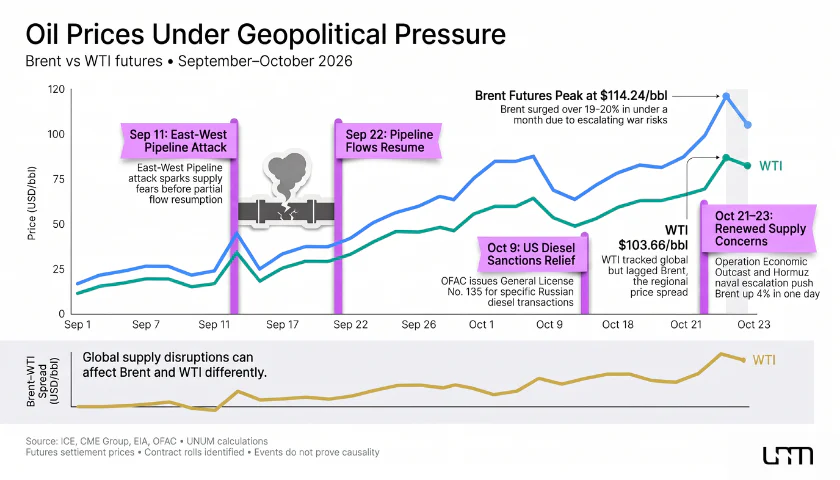
On October 23, Brent crude futures rose by 1.2% to $114.47 per barrel during trading, while WTI crude rose by 1.4% to $100.84. Brent was moving towards its third consecutive weekly gain. The indicated values reflect intraday quotes, not closing prices.
The October price increase continued the rise that began during the September energy shock. According to the October forecast by the US Energy Information Administration (EIA), the average spot price for Brent in September was $114 per barrel compared to $91 in August. On September 15, it reached around $131 amid supply disruptions following an attack on the Saudi East-West pipeline.
To understand why oil is becoming more expensive, it is necessary to consider not only the threat of production cuts but also the rising cost of maritime transport, disruptions in petroleum product supplies, and the reduction of commercial inventories. These factors increase the cost of delivering raw materials even during periods of recovery in physical export volumes.
Tensions are particularly noticeable in the oil market with the nearest delivery dates. According to the International Energy Agency (IEA), in September, the physical benchmark North Sea Dated rose on average to $116.89 per barrel, and at the time of preparing the October report, it was trading around $134.
The discrepancy between physical spot prices and oil futures is partly explained by differences in delivery conditions and timing. Buyers who need raw materials immediately may pay an additional premium for available batches.
Thus, the cost of oil is determined not only by the global demand and production ratio but also by the availability of raw materials considering existing logistical constraints. Therefore, even partial recovery of exports does not yet ensure a sustainable reduction in quotes.
The current dynamics of commodity instruments can be tracked in the UNUM commodities quotes section.
How the Middle East Conflict Affects Global Oil Supplies
The main threat to the oil market is the possibility of prolonged disruptions in exports from the Persian Gulf. The region accounts for a significant portion of international oil trade, but supplies depend on a limited number of maritime corridors and land routes.
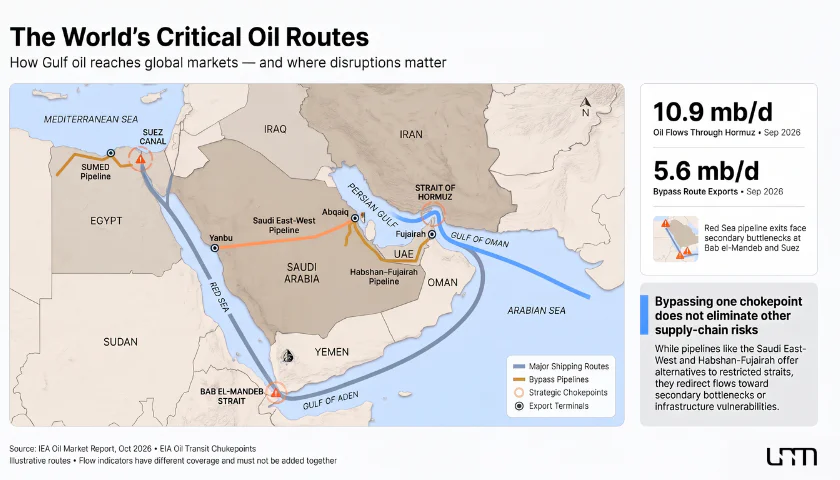
The Strait of Hormuz, connecting the Persian and Oman Gulfs, plays a key role. Disruption of shipping complicates the export of Saudi Arabia, Iraq, Kuwait, the UAE, and other producers, although the consequences for individual countries vary depending on the availability of bypass pipelines and export terminals.
Before the September attacks, the East-West pipeline allowed Saudi Arabia to export over 5 million barrels per day through the Yanbu port on the Red Sea, bypassing the Strait of Hormuz. According to the EIA, the pipeline's damage temporarily halted these flows and was one of the reasons for the September spike in Brent prices.
The temporary halt of East-West showed that alternative routes also remain vulnerable. Even if production continues, damage to export infrastructure can limit supplies to the global market.
Nevertheless, in September, producers managed to restore a significant portion of oil flows. According to the IEA's October report:
Crude oil exports from Persian Gulf countries increased by 4.4 million barrels per day to 13.9 million, exceeding 75% of the pre-war level.
Oil flows through the Strait of Hormuz increased by 3.7 million barrels per day to 10.9 million.
Exports via bypass routes increased by 970,000 barrels per day, reaching 5.6 million.
Total global oil supply increased by 2.5 million barrels per day to 102.3 million.
These figures indicate a recovery in supply, but the data pertains to September and does not fully reflect the impact of new attacks in October.
Meanwhile, petroleum product supplies are recovering more slowly. In September, their exports from Middle Eastern countries amounted to about 1.9 million barrels per day compared to the pre-war 4.7 million. Processing and transportation constraints continue to support tension in diesel fuel and other petroleum product markets.
Additional costs are created by record freight rates, insurance premiums, and the need to use longer routes. As a result, the cost of oil for the end buyer may remain high even with increased production volumes.
The risks were specifically noted in the official statement of OPEC+:
Restoring damaged energy facilities to full capacity requires significant costs and a long time.
This explains why a geopolitical premium remains in oil quotes. Market participants assess not only current export volumes but also the risk of new infrastructure damage, the restoration of which may take a long time.
How U.S. Sanctions Against Russia Are Changing the Oil Market Situation
The second important factor was the adjustment of U.S. sanctions policy regarding Russian energy resources. Amid high fuel prices, Washington allowed certain operations with Russian-origin diesel fuel, which were previously subject to sanctions restrictions.
On October 9, the U.S. Department of the Treasury's Office of Foreign Assets Control (OFAC) issued General License No. 135. The document permits operations related to the sale, delivery, unloading, and import of Russian diesel fuel, including imports into the U.S., under specified sanctions regimes.
The authorization is valid until 12:01 a.m. U.S. Eastern Daylight Time on April 7, 2027. However, the license does not allow debiting funds from accounts of the Bank of Russia, the National Wealth Fund, and the Ministry of Finance of Russia, opened in American financial institutions.
It is crucial that License No. 135 does not mean a complete lifting of U.S. sanctions against Russian oil. It applies to certain operations with diesel fuel and does not cancel other restrictions not covered by the document.
The significance of the decision is explained by the shortage of oil products. According to the IEA, global diesel fuel exports in September were 700,000 barrels per day lower than a year earlier. The combined reduction in supplies from Russia and the Middle East was about 1.3 million barrels per day and was only partially offset by increased exports from other regions.
Diesel fuel is widely used in freight transportation, agriculture, industry, and energy. Its shortage increases the cost of logistics and production, intensifying inflationary pressure even in countries where there is no direct shortage of crude oil.
However, the actual effect of the sanction relief depends on refining capabilities, the availability of export volumes, the operation of payment infrastructure, and the availability of tankers. Legal permission to conduct operations does not automatically mean that Russian supplies will increase.
Moreover, additional diesel fuel exports are not equivalent to an increase in global oil production. The relief measures can potentially reduce tension in the market for certain oil products but do not eliminate infrastructure damage and transportation risks in the Persian Gulf.
Therefore, the impact of U.S. sanctions policy on Brent prices should be assessed through actual changes in oil flows, refining capacity utilization, and the supply-demand balance, rather than solely through the content of permitting documents.
What Could Stop Further Oil Price Increases
Despite the energy crisis, the oil market in 2026 retains several factors capable of limiting further increases in the cost per barrel.
The first is related to the recovery of production and exports in the Middle East. According to the EIA, the volume of forcibly halted production in the region decreased from a peak of 10.9 million barrels per day in May to 4.8 million in September. Further recovery depends on the state of infrastructure, the operation of bypass routes, and the safety of maritime transportation.
The second factor is the increase in supply from producers outside the region. The EIA forecasts U.S. oil production to grow from 13.9 million barrels per day in 2026 to 14.3 million in 2027. These additional volumes can partially offset the deficit, although expanding production takes time.
OPEC+ policy also plays an important role. At the meeting on October 4, seven countries of the alliance, including Saudi Arabia and Russia, maintained the required production levels for November, corresponding to those in September. The next meeting of participants in the voluntary restrictions is scheduled for November 1.
However, increasing allowed production volumes does not necessarily lead to a comparable rise in exports. For producers with damaged infrastructure or limited transportation capabilities, actual deliveries may remain below established quotas.
The third factor is the weakening of global demand. According to the IEA forecast, oil consumption in 2026 will decrease by 2.6 million barrels per day compared to the previous year. In 2027, the agency expects a partial recovery of about 2 million barrels per day.
Expensive energy carriers increase production and transportation costs, worsen economic growth prospects, and force consumers to reduce fuel usage. However, the decline in demand manifests gradually and cannot instantly compensate for sharp supply disruptions.
Strategic oil reserves remain an additional tool. Their use allows for a temporary increase in available supply during disruptions, but does not replace the restoration of production and stable export routes.
The situation is complicated by the reduction of reserves. According to the IEA, by the end of September, global observed oil reserves were 509 million barrels below the level at the end of February 2026. In such conditions, even relatively small new export disruptions can cause a strong market reaction.
As a result, the shortage of oil available for timely delivery to buyers continues to support high prices, while production growth outside the Middle East and reduced consumption gradually create prerequisites for their stabilization.
Oil Price Forecast Until the End of 2026 and for 2027
The oil price forecast for 2027 primarily depends on the duration of the conflict in the Middle East, the speed of recovery of export infrastructure, and the ability of global producers to compensate for supply losses.
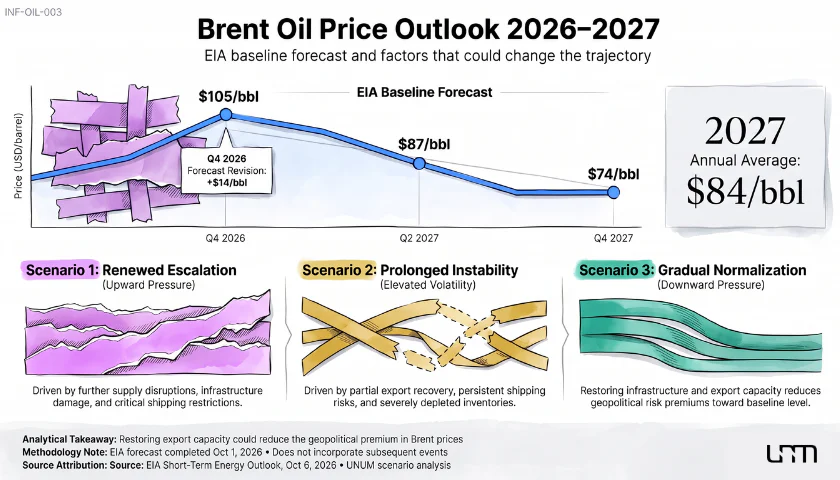
In the October Short-Term Energy Outlook, the EIA raised its estimate of the average spot price of Brent in the fourth quarter of 2026 to $105 per barrel, which is $14 higher than the September forecast. For the entire year of 2027, the agency expects the average Brent price to be $84.
However, this oil price forecast was prepared based on data as of October 1 and does not account for subsequent events, including the OFAC sanction decision on October 9 and the new escalation on October 22–23. Therefore, it should be considered as a baseline scenario under certain conditions, rather than a guaranteed price trajectory.
The agency's forecast includes the following assessment:
We expect that next year the average spot price of Brent will decrease to $84 per barrel.
The main premise for price reduction is the recovery of a significant part of Middle Eastern supplies and the gradual replenishment of oil reserves. However, persistent geopolitical tensions can cause short-term deviations from the projected trajectory.
Three Scenarios for the Oil Market Development
To assess the prospects for Brent, three hypothetical scenarios can be considered, differing in the state of oil infrastructure, transport routes, and global reserves.
Scenario | Main Conditions | Possible Brent Dynamics |
|---|---|---|
New Escalation | Additional attacks on export infrastructure, supply reductions, and new transport restrictions | Price increase with the risk of returning to September highs |
Prolonged Instability | Partial export recovery with ongoing threats to shipping and reserve shortages | High volatility and continued geopolitical premium |
Gradual Normalization | Production recovery, reduced transportation costs, and reserve replenishment | Decrease in average Brent price to $87 in Q2 and $74 in Q4 2027 according to EIA |
Note: the first two scenarios represent a qualitative assessment of possible market developments, not a quantitative forecast. The figures in the third scenario are official EIA forecasts for the average spot price of Brent in the respective quarters.
The new escalation scenario suggests that additional attacks on energy infrastructure will limit exports from the Persian Gulf and lead to further increases in the cost of physical oil. The September spike in the spot price of Brent to approximately $131 per barrel shows how sensitive the market can be to the loss of a major export route.
However, reaching similar levels again will depend on the scale of new disruptions, the duration of supply stoppages, and the ability to use commercial or strategic reserves. The September high itself is not a forecast of future prices.
A scenario of prolonged instability suggests maintaining transportation restrictions without new large-scale production losses. Under such conditions, oil prices may remain high but move unevenly, reacting to news about shipping security, sanction exemptions, and stockpile conditions.
The gradual normalization scenario aligns with the main direction of the EIA forecast. The agency expects most Middle Eastern production to recover to pre-war average levels by the end of the second quarter of 2027. Simultaneously, stock replenishment should gradually ease pressure on prices.
Thus, a decrease in oil prices is possible even with the persistence of certain geopolitical risks if the growth of available supply proves more resilient than global demand.
In the meantime, short-term oil futures may react to supply threats even before actual changes in export volumes are reflected in official statistics.
How Oil Prices Can Affect Financial Markets
The consequences of the oil crisis extend far beyond the energy sector. An increase in the cost per barrel raises transportation, production, and consumer goods costs, and through inflation expectations, affects interest rates and the valuation of financial assets.
For the stock market, the effect is ambiguous. Oil-producing companies may benefit from rising commodity prices if additional revenues exceed increased costs and losses from logistical constraints. At the same time, airlines, chemical enterprises, and transportation companies face rising fuel costs and reduced profitability.
Broad stock indices, including the S&P 500 and Nasdaq, are also sensitive to changes in monetary policy expectations. Rising oil prices can increase inflationary pressure and limit central banks' ability to lower rates, although regulators' final decisions depend on the state of the economy and core inflation.
The transmission mechanism of an oil shock can be represented as follows:
Rising oil prices → increased fuel and logistics costs → increased inflationary pressure → changes in interest rate expectations → revaluation of stocks, bonds, and currencies.
However, the impact on individual assets is not always straightforward. The US dollar may strengthen amid demand for safe-haven instruments and rising yields on US bonds, but its dynamics also depend on the state of the economy and Federal Reserve policy.
During geopolitical uncertainty, investors may increase demand for gold. At the same time, rising real interest rates increase the opportunity cost of holding the metal, which does not yield interest income, and can limit its growth.
The indirect impact of expensive oil also extends to cryptocurrencies. Through inflation expectations, the cost of capital, and investors' risk appetite, an oil shock can increase pressure on Bitcoin and other digital assets. This mechanism is further explored in the UNUM article “Bitcoin Fears Expensive Oil. How $100 a Barrel Could Crash the Crypto Market”.
The main risk for financial markets lies not only in high oil prices but also in the duration of the energy crisis. If fuel costs remain elevated for a long time, businesses and consumers will face a sustained increase in expenses, and central banks will have fewer opportunities to ease monetary policy.
UNUM previously discussed how the return of inflationary pressure changes investors' expectations regarding rates in the article “Markets Expected Cheap Money — Got a New Round of Inflation”.
What Will Determine the Future Dynamics of Oil Prices
In the coming months, the main benchmarks for the global oil market will remain export volumes from the Persian Gulf, shipping security, oil stock conditions, and the pace of recovery of refining infrastructure. Additional influence will come from OPEC+ decisions and the further US sanctions policy regarding Russian energy resources.
Currently, fundamental conditions do not allow for a sustainable end to the oil crisis. Despite partial supply recovery, transportation constraints and a shortage of oil products persist, and new attacks can quickly alter the supply balance.
At the same time, the EIA's baseline forecast for 2027 indicates that a gradual price decline is possible with the restoration of export routes and stock replenishment, even if geopolitical tensions do not fully dissipate.
Therefore, the future cost of Brent will primarily depend on producers' ability to ensure stable supplies. The faster global supply begins to recover relative to demand, the fewer reasons there will be to maintain a high geopolitical premium in oil prices.