

Why Oil Prices Are Falling After October's Rise
On November 2, oil prices dropped sharply: January futures for Brent crude fell by 4.2% to $108.64 per barrel, and American WTI crude dropped by the same amount to $99.71. Meanwhile, Brent ended October at its highest level in six months.
The turnaround was triggered by negotiations between Iranian representatives and Qatari mediators about a possible resolution of the conflict. The parties are discussing a draft agreement, but a final deal has not yet been reached.
The oil market reacts to changes in geopolitical risks before actual supplies change. Even the possibility of export restoration can reduce the geopolitical premium — the additional cost that market participants factor into prices due to the threat of disruptions.
The new month brings new hopes for a breakthrough in resolving the deadlock around Iran.
However, diplomatic expectations do not necessarily mean the restoration of shipping, oil production, and export infrastructure. This is why short-term price declines do not necessarily indicate the disappearance of a deficit.
Why OPEC+'s Decision Didn't Stop Price Declines
On November 1, Saudi Arabia, Russia, Iraq, Kuwait, Kazakhstan, Algeria, and Oman maintained their December production targets that were in place in September 2026. The decision affects seven OPEC+ members, not all countries in the coalition. The next meeting is scheduled for November 29.
However, OPEC+ quotas and actual oil production differ significantly. Production depends not only on official restrictions but also on the technical condition of fields, infrastructure damage, and the availability of export routes.
According to the International Energy Agency (IEA), in September, Saudi Arabia produced 8.30 million barrels per day against a calculated target level of 10.48 million. This gap does not indicate the availability of a similar volume of spare capacity: part of the production is limited by the consequences of conflict, and the IEA's calculated targets account for compensatory reductions.
For assessing the oil balance, the volume of crude that actually reaches buyers is more important. Therefore, even without changing quotas, the restoration of exports can increase supply in the global market and put pressure on prices.
Why Oil Supplies Remain Constrained
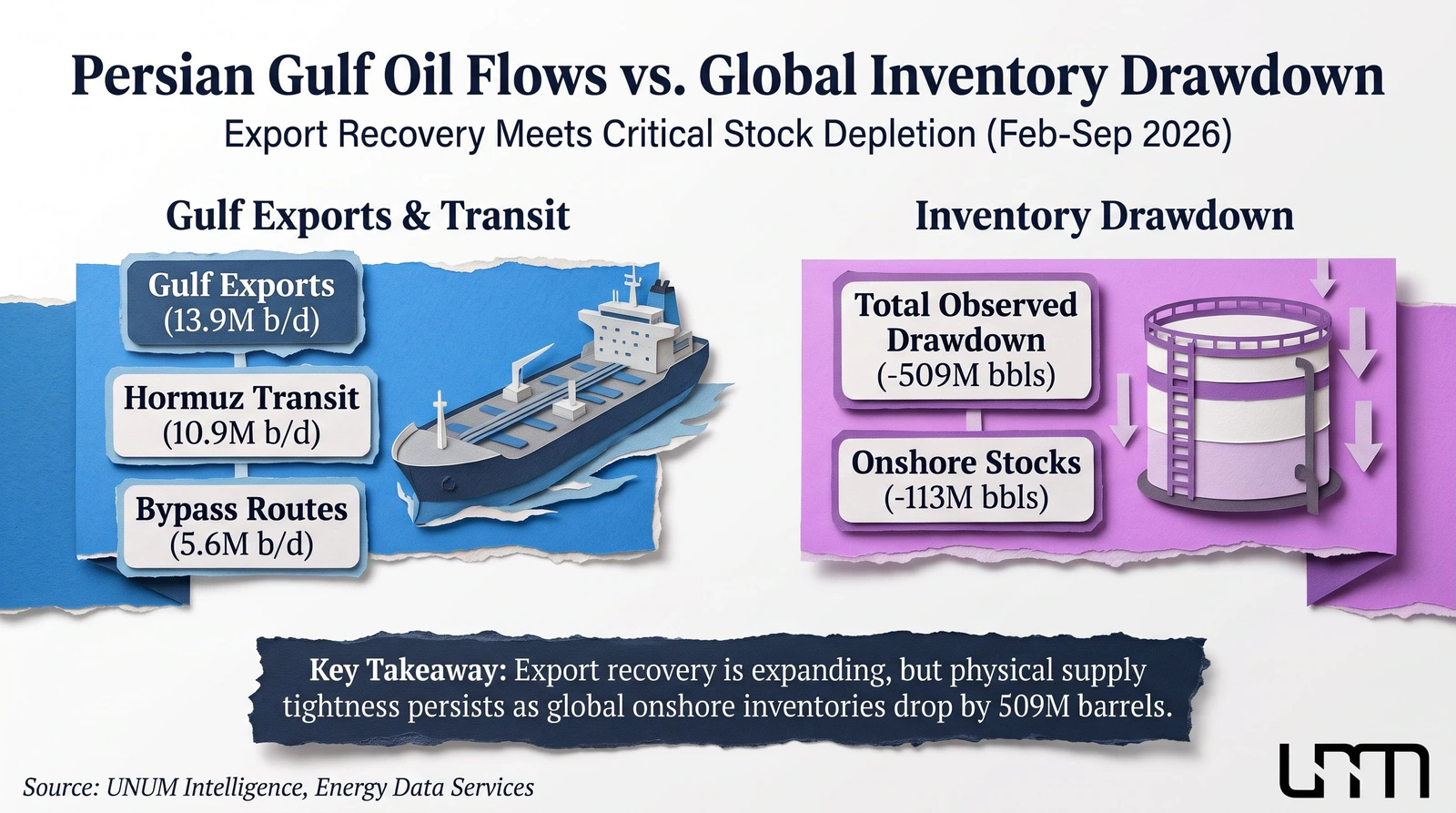
According to the IEA's October report, in September, crude oil exports from the Persian Gulf countries increased by 4.4 million barrels per day to 13.9 million, exceeding 75% of the pre-war level.
Simultaneously, oil flows through the Strait of Hormuz reached 10.9 million barrels per day, and exports via alternative routes increased to 5.6 million. However, September's statistics do not fully reflect the impact of new attacks on energy infrastructure and tankers in October.
The situation is complicated by three factors:
Stock depletion. According to the IEA, by the end of September, global observed oil stocks decreased by 509 million barrels compared to the end of February 2026. This figure includes oil on land and in transit. In September alone, land stocks decreased by 113 million barrels, partially offset by an increase in oil volumes at sea.
High transportation costs. Increased freight and insurance rates raise the cost of transporting oil. Therefore, a drop in market prices does not always lead to a comparable reduction in raw material costs for refineries.
Product shortages. Exports of oil products from the Middle East in September amounted to 1.9 million barrels per day compared to 4.7 million before the war. The situation with diesel fuel remains particularly tense.
Even with stable production, oil may reach refineries with delays. Therefore, restoring logistics and stocks is as important for the oil market as producers' decisions.
What's Happening with Global Oil Demand
High energy prices increase the costs for transportation companies and industrial enterprises while simultaneously intensifying inflationary pressure. The impact of expensive diesel fuel is particularly noticeable, affecting freight transport, agriculture, and some industrial production.
As a result, global oil demand is weakening, but leading analytical organizations have different assessments of the scale of the reduction.
According to a comparative analysis by the International Energy Forum on October 15, forecasts for 2026 vary significantly.
Organization | Demand in 2026 | Yearly Change |
|---|---|---|
OPEC | 105.7 million bpd | +0.2 million |
EIA | 102.4 million bpd | −2.0 million |
IEA | 102.4 million bpd | −2.6 million |
Source: International Energy Forum, October 2026
The difference between the maximum and minimum estimates is 3.3 million barrels per day. The discrepancy is due to differences in baseline consumption calculations, economic activity forecasts, and demand assessments in non-OECD countries.
The IEA expects global demand to decrease by 2.5 million barrels per day in the fourth quarter compared to the same period in 2025. Despite this, the agency forecasts a continued deficit in the oil balance until the end of the year.
Thus, the weakening demand does not yet guarantee a surplus of raw materials. Moreover, energy inflation can simultaneously reduce consumption and maintain high costs of oil products. The impact of such processes on financial markets was previously analyzed by UNUM in an analysis of a new wave of inflation.
What the Brent futures curve says about the market state
To assess the state of the oil market, traders find it useful to compare the prices of near-term and longer-term futures contracts.
If the nearest contract is more expensive than subsequent ones, backwardation occurs. This structure often indicates a high value of immediate delivery and tightness in the physical market.
The opposite situation is called contango: distant futures are more expensive than near ones. This can indicate a less tight balance considering storage and financing costs.
Therefore, even with a decline in Brent, maintaining a significant premium on the nearest contract may mean that the physical deficit persists. Narrowing the difference between contracts along with rising inventories, on the other hand, may indicate easing tension.
The futures curve can be checked on ICE, comparing the nearest, three-month, and six-month contracts. The current oil price today and the dynamics of quotes are also available in the UNUM commodities market section.
What will happen to oil prices by the end of 2026
The forecast for oil prices by the end of 2026 primarily depends on the pace of supply recovery and the further development of the situation around Iran.
In the forecast from October 6, the U.S. Energy Information Administration (EIA) estimated the average spot price of Brent in the fourth quarter at $105 per barrel, raising the estimate by $14 compared to the previous month.
However, the calculation was completed on October 1 and does not account for subsequent events. Moreover, it refers to the average quarterly price, not a forecast for the December 31 quote.
Three scenarios for the further dynamics of the oil market can be highlighted.
1. Diplomatic resolution
If negotiations lead to a sustainable agreement, shipping security will improve, and export routes will begin to recover. Gradual increases in supply and reductions in geopolitical premiums may put pressure on Brent and WTI prices.
2. Continued uncertainty
Negotiations may continue without a final agreement, while oil supplies remain constrained. Under such conditions, high volatility in the oil market will persist, and prices will be sensitive to diplomatic statements, export data, and inventory changes.
3. New escalation
Additional damage to terminals, pipelines, or tankers can further restrict supply. Rising transportation and insurance costs will enhance the geopolitical premium and create conditions for higher oil prices even with relatively weak demand.
The scenarios presented describe possible directions for price movements but do not contain precise price forecasts. A detailed context of the conflict and sanction restrictions is presented in the previous UNUM analysis on the oil market.
Indicators for investors and traders to watch
To assess the future movement of oil prices, it is important to track not individual news but a combination of indicators reflecting the real balance of supply and demand.
Particular attention should be paid to the following data:
Oil exports. Growth in physical shipments through the Strait of Hormuz and alternative routes will confirm the recovery of supply.
Commercial inventories. Sustained accumulation of reserves on land may signal a weakening of the deficit.
Brent futures. A reduction in the premium of near-term contracts may indicate a decrease in tension in the physical market.
Demand and refining. Data on consumption and production of oil products will show how quickly the energy market is recovering.
OPEC+ decisions. Changes in production targets need to be compared with actual production and exports.
The upcoming benchmarks for market participants include the release of the new EIA forecast on November 10, the IEA report on November 13, and the meeting of seven OPEC+ countries on November 29.
The convergence of multiple market signals provides a more reliable basis for analysis than a single news item about negotiations.
What will ultimately determine oil prices
The current decline in oil prices mainly reflects changes in market participants' expectations. However, the cost of oil until the end of 2026 will depend on how quickly diplomatic agreements can lead to the restoration of exports, transportation, and inventories.
As long as physical indicators do not confirm a sustainable improvement, the oil market remains sensitive to geopolitical risks. Therefore, OPEC+ decisions, demand dynamics, and supply conditions need to be considered together rather than as independent factors.