Why Solana decided to drop the beta status
The main network of Solana started in March 2020 under the mainnet-beta designation. The beta prefix usually indicates software that is available to users but continues to be tested in real-world conditions. However, in Solana's case, it gradually stopped reflecting the actual state of the infrastructure.
For several years, the blockchain processed real transactions, supported decentralized applications, and maintained stablecoins and other digital assets. Meanwhile, the formal mainnet-beta status remained even after numerous updates, ecosystem expansion, and the emergence of new validator software implementations.
After dropping the previous designation, Solana's main network (mainnet) continues to operate without transferring assets or transaction history. The name change is not accompanied by the launch of a new blockchain.
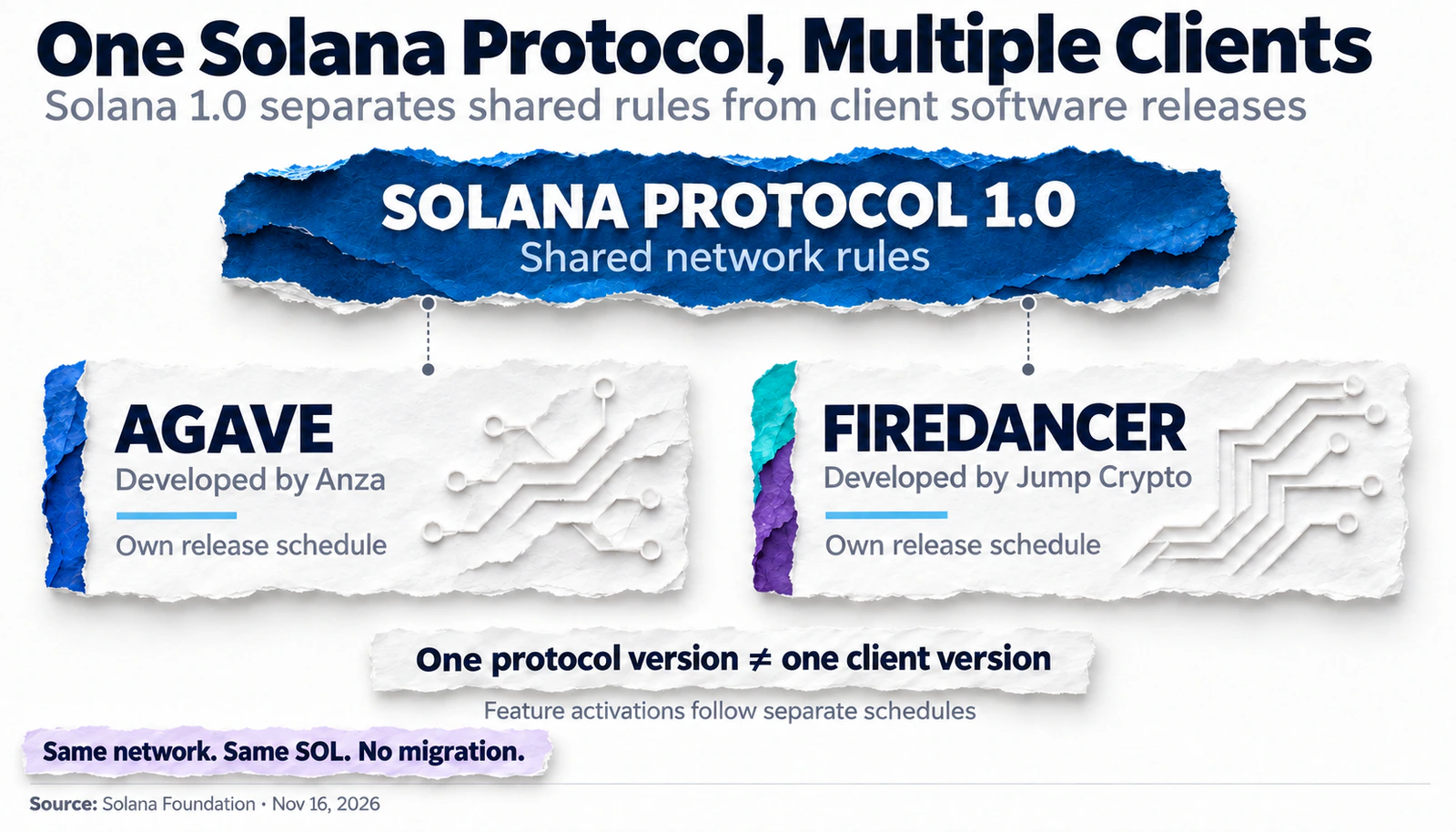
In the official statement from November 16, 2026, the Solana Foundation explained the decision to drop beta due to accumulated technical progress. The decision was agreed upon with the Anza team, which develops Agave, and Firedancer. According to the foundation, the network has reached a stage where further development requires clearly separating the blockchain's general rules from the software versions of individual validators.
Several important events preceded the transition. In 2026, Solana gradually reduced the target slot duration from 400 to 200 ms and increased the computation limit per block from 60 million to 100 million Compute Units. Additionally, a new consensus mechanism, Alpenglow, was activated on October 21. Meanwhile, Firedancer, an independent validator client, was developed to reduce the network's dependence on a single codebase.
Thus, dropping mainnet-beta solidified the results of previous technical changes. The new status itself does not confirm that Solana has completely eliminated technical vulnerabilities or achieved a certain level of reliability. It primarily marks a transition to a more precise protocol versioning system.
What changed after the transition to Solana 1.0
The main innovation is the unified version of the Solana 1.0 protocol, which exists separately from the versions of validator client software. This distinction is particularly important for a blockchain where the same network rules can be implemented by multiple independent teams.
The protocol defines how validators agree on the blockchain's state, verify transactions, and apply network rules. A client is software that implements these requirements. For example, Agave and Firedancer may use different programming languages, architectural solutions, and update schedules, but they must interpret the network's rules in the same way.
Unified versioning helps separate the development of the protocol itself from the lifecycle of a specific client.
Component | What it means | How it relates to Solana 1.0 |
|---|---|---|
Protocol version | General rules for blockchain operation | Solana 1.0 becomes the unified protocol version designation |
Client version | Specific release of Agave, Firedancer, or another implementation | Different client versions can support a single protocol version |
Feature activation | The moment a specific change takes effect in the network | Occurs on its own schedule and does not necessarily coincide with the announcement of a new version |
This approach simplifies infrastructure maintenance. Developers can determine which features a specific client release supports, and validator operators can check software compatibility with current rules.
Meanwhile, Solana 1.0 does not involve creating a new blockchain, transferring tokens, or changing transaction history.
The Solana Foundation emphasized this in an official statement:
For users, it's the same network, nothing changes.
Wallet addresses, accounts, digital assets, and applications are preserved. SOL holders do not need to perform migration or any additional actions. Details of the announcement are also presented in UNUM news about Solana's transition to version 1.0.
How Agave and Firedancer Impact Network Resilience
One of the most significant changes in the development of Solana's blockchain infrastructure has been the emergence of multiple validator software implementations.
For a long time, the network heavily relied on a single family of clients. Agave is a client developed by the Anza team based on the original Solana software implementation. Various modified versions, including Jito-Solana, are also built on it.
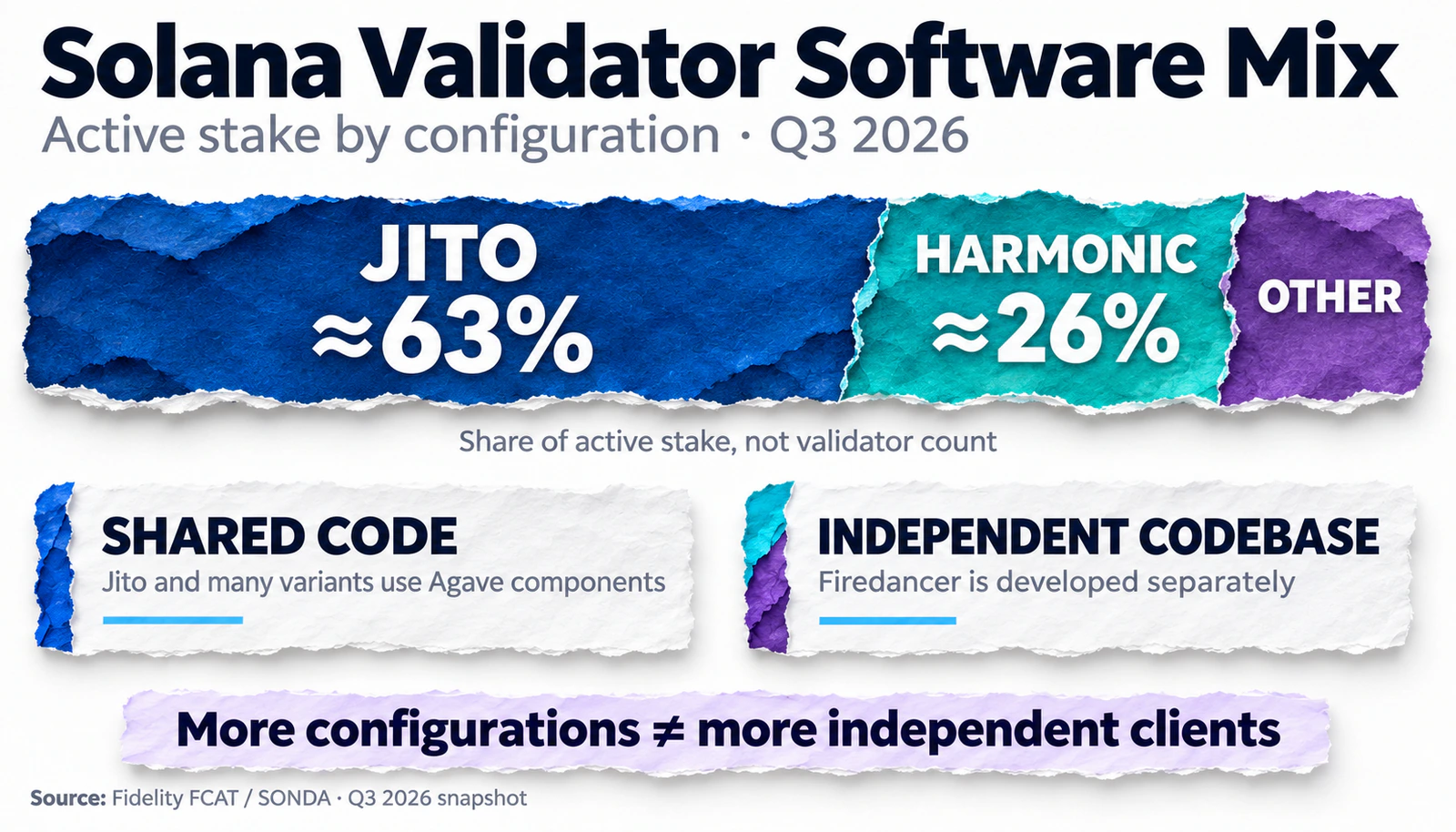
These solutions may differ in block formation mechanisms, transaction processing, and validator revenue distribution. However, having different names does not necessarily mean independence of the underlying software code. If multiple clients use common consensus or transaction execution components, a bug in these components could potentially affect them simultaneously.
This issue was investigated by Mia Galvin and Kevin Kelly from the Fidelity Center for Applied Technology. In the report The State of Solana: Network Health and Resilience, the authors noted: “The use of two client configurations did not actually eliminate the dependency on Agave's common code.”
Firedancer addresses this issue differently. Developed by Jump Crypto, the client uses an independent codebase with separately implemented network functions, block production, execution environment, and consensus. Unlike Agave modifications, the full-fledged Firedancer does not depend on its implementation of key components.
Initially, the project developed through Frankendancer—a hybrid system combining separate Firedancer components with Agave's software code. Subsequently, the independent implementation was launched on the main network.
Client independence potentially enhances blockchain resilience. If a software bug occurs in only one implementation, others can continue to function correctly. However, the outcome depends on the share of active stake held by unaffected clients and whether the remaining set of validators can maintain consensus.
How Diverse Are Solana Clients
The Fidelity Center for Applied Technology study used SONDA data for the Q3 2026, obtained on October 13. According to this snapshot, approximately 63% of active stake was attributed to Jito configurations and 26% to Harmonic. These categories include different software variants and are not equivalent to shares of independent underlying clients.
A significant portion of such solutions continued to use Agave's core components. Each of the remaining categories, including Firedancer, Agave, and Rakurai, accounted for less than 10% of active stake. These figures pertain to a specific research period and do not represent the client distribution as of November 17.
To assess the network's true independence, it's important to distinguish between two metrics:
Number of validators on a specific client. Indicates the prevalence of software among operators.
Share of active stake attributed to the client. Allows assessment of what portion of consensus weight depends on a specific software implementation.
The second metric is particularly important when analyzing potential failures. Even a large number of independent nodes cannot ensure sufficient resilience if the majority of the stake is concentrated on an implementation with a common software vulnerability.
How Alpenglow Update Relates to Solana 1.0
One of the key technical achievements preceding the beta exit was the activation of Alpenglow on October 21, 2026.
Alpenglow replaced the previous TowerBFT consensus mechanism and changed the order in which validators agree on blocks and confirm transaction finality.
Under TowerBFT, finalization took about 12.8 seconds. The new mechanism is designed to reduce this time to approximately 150 milliseconds. This refers specifically to finalization—the state after which a transaction is considered definitively confirmed according to consensus rules.
The core of the activated part of Alpenglow is the Votor mechanism. Instead of sending votes as regular transactions, validators send them directly to each other and combine them into confirming certificates. This allows for consensus to be reached in one or two rounds of voting.
The second component of Alpenglow, Rotor, intended to change the distribution of block data, had not yet been activated at the time of the Solana 1.0 announcement. Therefore, even a major technical update can be implemented in stages rather than simultaneously with a change in the overall protocol designation.
Transaction speed and finalization time are different metrics. Alpenglow accelerates the achievement of final consensus among validators but does not imply a proportional increase in blockchain throughput. The reduction of the target block production interval to 200 milliseconds was conducted separately, and the consensus update primarily changed the transaction finality confirmation mechanism.
For financial applications, faster finalization potentially reduces the wait for final settlement. This is especially important for stablecoin transfers, inter-platform settlements, and operations with tokenized assets. However, actual user delay also depends on network load, transaction transmission, RPC infrastructure, and specific applications.
The technical features and possible economic consequences of the update were examined in detail by UNUM in the article “Solana accelerates finalization to 150 ms. What will the Alpenglow update change”.
It is important to note that the activation of Alpenglow occurred almost a month before the Solana 1.0 announcement. Therefore, the reduction in finalization time cannot be considered a direct result of abandoning mainnet-beta.
Has Solana become more reliable and what risks remain
Historically, Solana's reliability has been questioned due to prolonged network outages. Some incidents were related to high transactional load, others to software errors or data transmission issues between validators.
In February 2023, the network faced significant finalization issues following an overload of the Turbine block propagation mechanism. A coordinated restart was required to restore normal operations.
On February 6, 2024, another error led to a consensus halt for approximately five hours. According to the Anza technical report, the issue arose in the LoadedPrograms component responsible for loading and caching programs. The error caused an infinite loop, and since the vulnerable version was used by validators with a dominant stake share, the network could not continue block consensus.
This case illustrates why diversity in software implementations is important for blockchain reliability. An error in common code can affect a large number of consensus participants regardless of how many individual validators service the network.
Since then, resilience metrics have noticeably improved. According to data published by the Solana Foundation in September 2026, the network maintained 100% availability after the February 2024 outage.
Before the activation of Alpenglow, Fidelity FCAT research recorded a voting success rate of about 99.7%. After transitioning to the new consensus, votes ceased to be recorded in blocks as regular transactions, so previous metrics need to be recalculated using the updated methodology. This limits the ability to directly compare statistics before and after October 21.
The infrastructure underwent additional testing on August 12, 2026, when a routing failure at provider TeraSwitch temporarily disabled validators accounting for nearly 29% of the active stake. Despite the scale of the problem, the blockchain continued to produce blocks and process transactions.
This incident demonstrated both the network's ability to withstand major infrastructure disruptions and its ongoing dependence on individual providers. More details on its consequences are described in the UNUM article on the TeraSwitch failure.
What decentralization metrics show
In the November 2026 data snapshot from the Solana Foundation, there were 650 consensus validators operating in 27 countries. About 73% of the total SOL supply was staked, and the Nakamoto coefficient was 18.
A Nakamoto coefficient of 18 means that in the specified snapshot, 18 validator identifiers controlled more than a third of the active stake. This is a measure of the concentration of voting power, not the number of independent infrastructure owners. It also does not fully account for connections between operators, shared server owners, and other dependencies.
Therefore, assessing Solana's resilience requires considering several factors:
Stake concentration. Large validators have a more significant weight in network state consensus.
Independence of software clients. Different implementations should limit the spread of errors occurring in individual codebases.
Geographical distribution. Placing nodes in multiple regions reduces dependence on local infrastructure issues.
Provider concentration. Validators with different owners may use the same data centers, data networks, and hosting companies.
Economic sustainability of operators. High costs of equipment and maintenance can hinder the operation of small independent validators.
Fidelity FCAT highlights the significant concentration of Solana's infrastructure. According to the study, in Q3 2026, about 40% of active staking was located in Frankfurt and Amsterdam. However, the authors note that geographical assessments based on IP addresses have limitations.
Blockchain security also depends on the independence of infrastructure providers and the network's ability to continue operating when individual components fail. Multiple software implementations reduce certain technological risks but do not protect against all possible disruptions.
Statistics on validator availability and success indicate an improvement in Solana's operational resilience. However, it is impossible to determine from the provided data how much of this result was due to the emergence of Firedancer. General infrastructure dependencies and errors in the protocol rules themselves can still affect multiple clients simultaneously.
What Solana 1.0 means for users and the institutional market
For regular users, the transition is almost imperceptible. The SOL cryptocurrency continues to operate on the existing network, and applications and wallets do not require special migration. User experience will primarily change due to independent technical updates and the implementation of their capabilities by service developers.
For validator operators, the consequences are more significant. Unified protocol versioning should simplify the determination of compatible client releases, but it does not eliminate the need to verify the requirements of specific updates.
A notable example was the migration to Alpenglow. During the transition to the new consensus on October 21, operators were required to use compatible versions of Agave, Jito-Solana, or Harmonic Salsa. Firedancer and Frankendancer were not directly supported during the migration, although Firedancer development continued afterward.
This demonstrates that having multiple independent clients does not guarantee their simultaneous readiness for every network change.
For financial organizations, the most important factors are not the version names, but the measurable characteristics of the infrastructure: network availability, predictability of calculations, asset security, and application stability.
Institutional use of Solana imposes higher requirements on the reliability of calculations, software compatibility, and management of infrastructure risks. A more formalized versioning system can facilitate the maintenance of corporate solutions, especially if the organization uses multiple RPC infrastructure providers or its own validator nodes.
However, the presence of version 1.0 itself does not guarantee compliance with the requirements of a specific financial regulator and does not replace a technical audit.
The growing interest of the institutional sector in Solana is confirmed by the development of payment solutions, stablecoins, tokenized assets, and validator services. One example is Solana Company, which earns revenue from staking SOL and servicing third-party delegations. Its financial performance and infrastructure risks were analyzed by UNUM in the article “Solana Company: How Sustainable is the Staking-Based Business Model”.
At the same time, institutional use of the blockchain cannot be directly linked to changes in its official status. For large financial market participants, proven operational reliability, risk management, and the ability to use infrastructure in real operations are crucial.
What changes will define the future development of Solana
The next stage of Solana's development will depend on how successfully teams can align independent client versions with the network's common rules.
At the time of the Solana 1.0 announcement, developers continued to work on new Agave features, the development of Firedancer, and further components of Alpenglow. However, individual updates were at different stages of development and activation.
Evaluating the transition results solely by the new protocol designation would be insufficient. It is much more useful to track changes in several measurable indicators:
Share of independent clients in the active stake. The growth of full-fledged independent implementations can reduce dependence on errors of a single software product.
Consensus stability. The success of voting, the share of missed slots, and the actual finalization time allow assessing the network's performance under varying loads, provided the metrics are calculated considering Alpenglow changes.
Frequency of technical incidents. Not only complete blockchain stoppages are important, but also the duration of degradation of individual infrastructure components.
Validator distribution. Reducing the concentration of stakes, data centers, and providers can decrease the risk of simultaneous disconnection of a large number of nodes.
Update compatibility. Special attention should be paid to the ability of Agave and Firedancer to support new rules without prolonged dependence on a single implementation.
The dynamics of SOL/USD quotes on UNUM may reflect market participants' expectations regarding the ecosystem's development; however, the token's value is simultaneously influenced by liquidity, macroeconomic conditions, and the overall state of the cryptocurrency market. Therefore, the rise or fall of SOL alone does not allow assessing the technical outcome of the transition to version 1.0.
What Solana 1.0 Will Ultimately Change
The departure from mainnet-beta marks a new stage in Solana's development but does not mean the automatic upgrade of all blockchain components. The main change lies in the emergence of a unified protocol version that allows independent clients to develop on their own schedules while maintaining compatibility with network rules.
The technical foundation of this transition was formed by previously implemented updates, including Alpenglow, and the development of independent validator implementations, primarily Firedancer. However, the network's reliability still depends on stake distribution, infrastructure independence, and software quality.
The main result of Solana 1.0 will not be the mere disappearance of the beta prefix, but the network's ability to maintain stable operation amid further protocol complexity, increased load, and the expansion of independent clients.