AI Coinbase Prevented Transfers of $4.7 Million to Fraudsters Using Deepfake of Musk
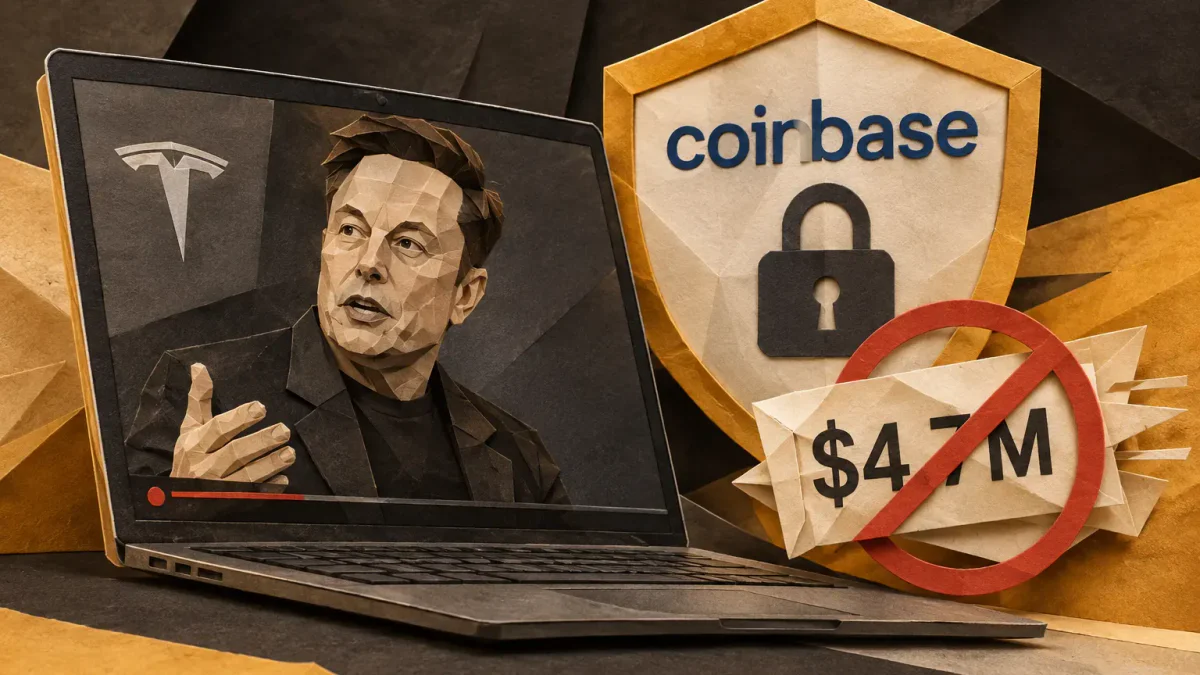
Cryptocurrency exchange Coinbase reported that its AI-powered security system prevented transfers amounting to approximately $4.7 million during a fraudulent campaign involving a deepfake of Elon Musk. The perpetrators used a fake Tesla broadcast and offered viewers to send cryptocurrency with a promise to return double the amount. According to the company, the system stopped about 91% of the funds that clients attempted to transfer to the fraudsters.
How Fraudsters Used Elon Musk's Deepfake
Details of the incident were disclosed by Coinbase on November 17, 2026, in a publication dedicated to protecting users from cryptocurrency fraud.
According to the exchange, the fraudsters organized a fake broadcast on YouTube related to a Tesla car demonstration. The broadcast featured an AI-generated image of Elon Musk.
Viewers were shown cryptocurrency wallet addresses and a QR code for transferring funds. The organizers promised to return the sent cryptocurrency in double the amount.
This scheme assumes that the user first independently transfers assets to the specified address. After that, the promised reward does not arrive, and the sent funds may become unavailable for return.
According to Coinbase, the fake broadcast was watched by over 500,000 people. In about two hours, hundreds of the exchange's clients attempted to send cryptocurrency to addresses associated with the fraudulent scheme.
The company's security system detected suspicious operations and stopped a significant portion of the transfers. Coinbase estimated the amount of prevented transfers at approximately $4.7 million.
How Coinbase's AI Detected Fraudulent Transfers
Coinbase uses several mechanisms to detect suspicious operations.
First, machine learning models analyze outgoing transactions and identify signs of possible fraud. These include attempts to impersonate a well-known company, characteristic fake giveaway schemes, and transfers to newly created cryptocurrency addresses.
If an operation is marked as high-risk, an AI agent is involved in the verification.
It initiates a short dialogue with the user, explains the signs of common fraudulent schemes, and asks clarifying questions about the offer for which the person intends to send funds.
This approach allows assessing the circumstances of the transfer, which cannot be determined solely by the recipient's address or transaction amount.
Before displaying each response to the user, the system also checks the AI agent's confidence level in the provided information.
Coinbase emphasized that the agent had not previously been trained on the specific scheme involving Musk's deepfake and the fake Tesla broadcast. Nevertheless, the system recognized several characteristic signs of deception: the promise to increase the sent amount, the limited time offer, and the need for an irreversible transfer.
According to the company, the entire process was carried out automatically, without employee involvement in the verification of these operations.
Why the Fraud Was Not Related to Account Hacking
Coinbase specifically emphasized that in this case, the fraudsters did not gain unauthorized access to client accounts.
Users independently logged into their accounts and confirmed the transfers because they believed the offer was genuine.
This circumstance complicates the work of traditional security systems. They can detect unusual operations and attempts to access accounts but cannot always determine whether the user understands the true purpose of the transfer.
In this scheme, the fraudsters targeted not the technical security of the exchange but the decisions of the clients themselves.
The use of deepfakes makes such attacks more convincing. Synthetic video allows simulating the participation of a well-known person in an event that genuinely attracts the audience's attention.
However, the presence of a recognizable face, branded design, or broadcast on a popular platform does not in itself confirm the authenticity of the offer.
How Coinbase Plans to Develop AI Protection
The company stated that it intends to expand the use of artificial intelligence to detect risky cryptocurrency transfers.
In particular, Coinbase is working on improving models for detecting fraudulent schemes, automatically classifying new cases of fraud, and using AI agents to verify various types of suspicious operations.
The company also draws attention to a common sign of fraud: the promise to return more cryptocurrency than the user initially sends to the specified address.
However, the results of the described incident do not mean that such protection can detect every fraudulent operation. The approximately 91% figure relates to a specific case and is based on Coinbase's own data.
Thus, the example presented by the company demonstrates how artificial intelligence can complement traditional security mechanisms by analyzing not only the transaction parameters but also the circumstances under which the user decides to transfer funds.
This material is prepared solely for informational purposes and does not constitute financial advice or a recommendation.