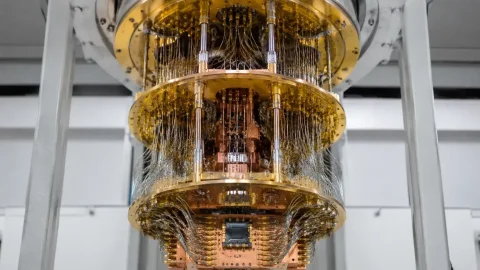
IBM and AMD Launch Platform for Quantum Error Correction

IBM, AMD, and the Quantum Science Center at Oak Ridge National Laboratory (ORNL) announced on November 5, 2026, the launch of a joint research platform for quantum error correction. The project combines IBM's quantum processors with AMD's high-performance computing infrastructure, allowing researchers to test methods for enhancing the reliability of quantum systems.
One of the main challenges of modern quantum computers remains errors caused by external noise and instability of quantum states. When performing complex algorithms, such errors accumulate, reducing the accuracy of results. Detecting and correcting them requires additional information processing, which can be performed by classical computing systems.
The new platform is designed to develop and test ways to combine these two types of computing. Its first configuration includes the IBM Quantum Nighthawk processor with 120 qubits and the high-performance Umbra system installed at Oak Ridge Laboratory.
Umbra uses AMD Instinct MI355X graphics accelerators and fifth-generation AMD EPYC central processors. They provide the classical computing resources necessary for processing qubit measurement results, researching error correction algorithms, and coordinating equipment operation.
How Quantum Error Correction Will Work
The platform allows for measuring the state of individual qubits directly during computations and using the obtained results to adjust further operations. Researchers will also be able to manage the timing parameters of signals and analyze the raw measurement data of quantum equipment.
This approach is necessary for studying real-time error correction methods. Specialists will be able to compare algorithms by speed, the number of required qubits, and the need for classical computing resources.
“With Umbra, we will now test new ideas and evaluate approaches at scale,” said Quantum Science Center Director Travis Humble.
Original: “With Umbra, we will now test new ideas, evaluate approaches at scale.”
The project also supports the research goals of the U.S. Department of Energy. As part of the Quantum Genesis Mission program, the department aims to achieve the level of 100 logical qubits capable of performing 100,000 complex operations by the end of 2028.
According to IBM, previous experiments have demonstrated systems with up to 70 logical qubits and the execution of up to 438 complex operations. Further development will require significant improvements in the reliability and scalability of computations.
In the future, the results of this collaboration may be used in the development of quantum computers for modeling materials, chemical processes, and other scientific tasks. However, specific performance metrics of the new platform and the timeline for achieving them have not yet been disclosed.
This material is prepared solely for informational purposes and does not constitute financial advice or a recommendation.
Related articles