Quantum Gravity Research Using GPT-6 Astra Sparks Controversy Among Scientists
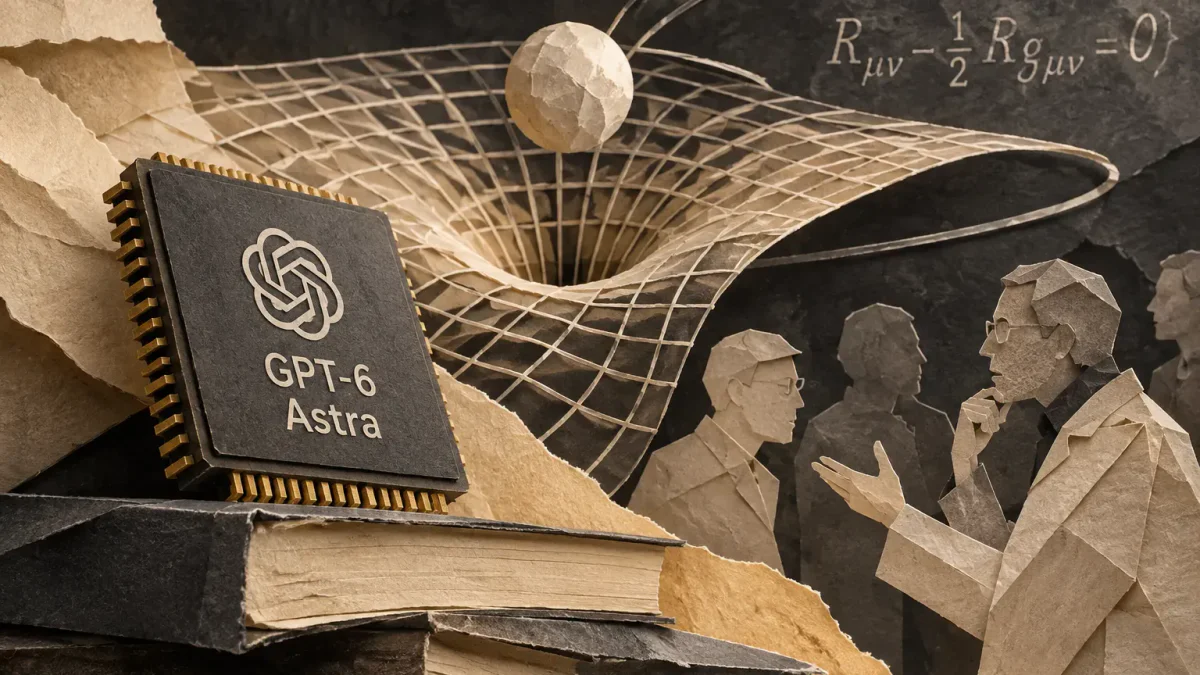
Stanford University physicist and OpenAI collaborator Venkatesa Chandrasekaran has introduced a new mathematical approach to quantizing gravity, developed with the participation of GPT-6 Astra. The study, published on November 25 on the arXiv platform, sparked a discussion among scientists about the potential of artificial intelligence in solving fundamental scientific problems.
The study required 400 million tokens
The unification of Einstein's general theory of relativity and quantum mechanics remains one of the major unsolved problems in modern physics. Creating a unified theory would allow for more accurate descriptions of processes within black holes and in the early stages of the universe's existence.
Chandrasekaran proposed a mathematical approach to quantizing gravity in four-dimensional spacetime based on light cones – geometric structures that define the possibility of causal connections between events.
In his work, the researcher reported achieving several results:
a finite mathematical expression for the amplitude of graviton pair creation and annihilation;
the Bekenstein-Hawking black hole entropy formula and its known logarithmic correction;
semi-classical Einstein equations in the low-energy limit.
Reproducing known physical results allows for assessing the internal consistency of the proposed approach but does not confirm its ultimate scientific validity.
In the acknowledgments section, Chandrasekaran stated that he spent several months working on calculations and proofs together with GPT-6 Astra. During this time, around 400 million tokens – units of information processed by the language model – were used. The necessary computational resources were provided by OpenAI.
However, the researcher remains the sole author of the work and does not specify which results were obtained with the direct involvement of AI.
The scientific community questioned the significance of the study
University College London physics professor Jonathan Oppenheim stated that the proposed mathematical framework does not address the fundamental issues of canonical quantization – an approach that involves building a quantum theory based on classical physics.
For additional analysis, Oppenheim used AI agents based on Claude models from Anthropic. They compared the study's results with 21 known problems of canonical quantization. According to the scientist's preliminary assessment, the work addresses only one relatively minor problem, while the others remain unsolved or are bypassed through additional assumptions.
Columbia University mathematician Peter Woit also assessed the study skeptically. Astrophysicist Hontas Farmer, in comments cited by Business Insider, pointed out the lack of testable experimental predictions and the overlap of the work with previously published scientific approaches.
Theoretical physicist Nirmalya Kajuri took a more reserved stance. He acknowledged some achievements of the researcher but emphasized that the work does not solve the problem of quantum gravity.
As of the time of publication, Chandrasekaran's preprint had not undergone scientific peer review.
AI accelerates scientific calculations but does not yet replace researchers
The discussion around quantum gravity is developing against the backdrop of significant progress in artificial intelligence in solving theoretical physics problems.
In October, an international group of scientists introduced the TheoPhysEval test, which includes 50 previously unpublished research-level problems. Solving one such problem could take a specialized expert an entire workday.
During testing, GPT-6 Astra, under Codex's management, correctly solved 49 out of 50 problems, demonstrating 98% accuracy. The average cost of calculations was less than $3 per problem. In several cases, the model also identified errors in the benchmark answers prepared by physicists.
Previously, OpenAI had already opened access to GPT-6 Astra for a limited number of organizations, positioning the model as a tool for solving complex problems.
However, the ability to perform specialized calculations is not equivalent to the ability to independently make fundamental scientific discoveries. Unlike tasks with a known answer, new physical theories require independent verification of the mathematical framework, assessment of scientific novelty, and, if possible, experimental confirmation.
The spread of AI in the scientific community can significantly accelerate research while simultaneously increasing the requirements for transparency of calculations, reproducibility of results, and the quality of scientific peer review.
This material is prepared solely for informational purposes and does not constitute financial advice or a recommendation.