Why Mastercard and Visa Are Interested in the Hong Kong Stablecoin
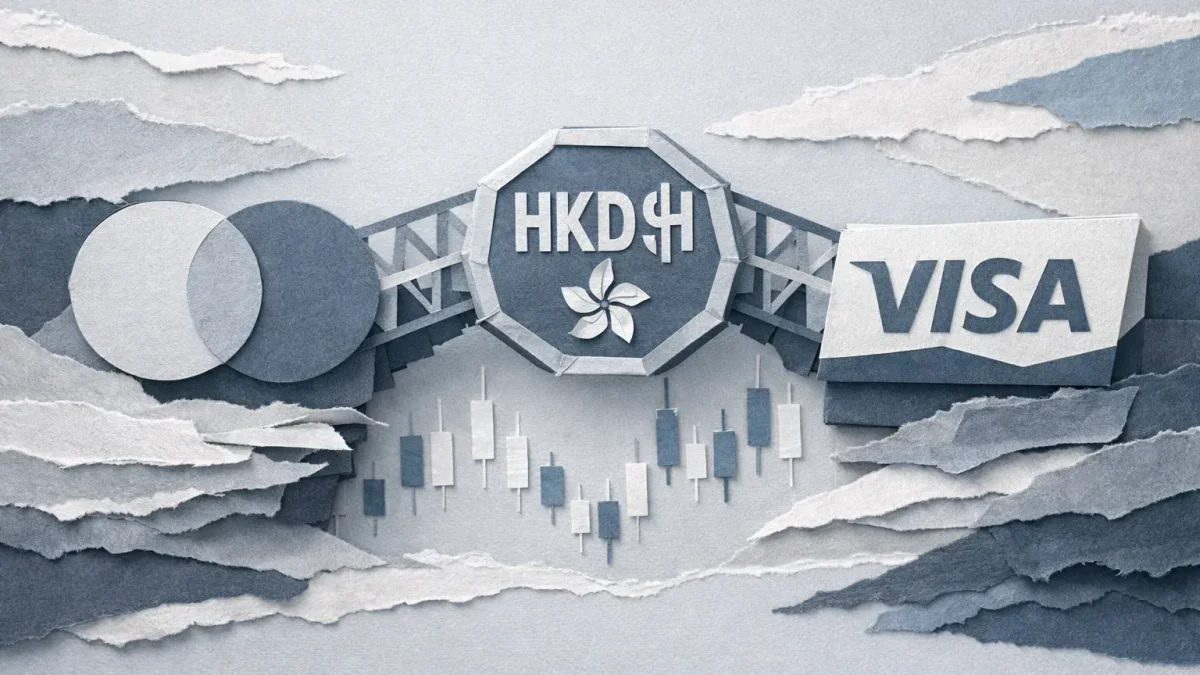
On October 30, 2026, Hong Kong's Anchorpoint Financial announced strategic partnerships with Mastercard and Visa. The parties are exploring the possibility of integrating the regulated stablecoin HKDAP into the infrastructure of the two international payment systems.
Initially, the collaboration will focus on card issuer settlements. Financial institutions may potentially use the digital Hong Kong dollar to fulfill payment obligations within the card infrastructure, including outside standard banking operational hours.
On the same day, Anchorpoint signed an agreement with the Solana Foundation. It provides for the preparation of native issuance and redemption of HKDAP on the Solana blockchain, as well as expanding access to the token through digital wallets and applications.
The new agreements reflect a change in the approach of financial companies to the use of stablecoins. Whereas such assets were previously mainly used for cryptocurrency trading and transfers between wallets, they are now increasingly seen as a tool for banking settlements and corporate liquidity management.
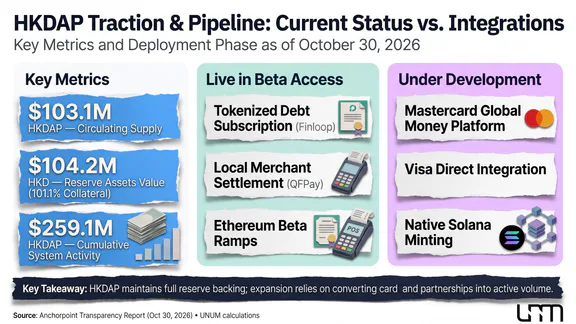
However, the partnerships do not yet mean that HKDAP is already supported by the global networks of Mastercard and Visa or issued on Solana. The companies are exploring the relevant integrations, and the launch timelines have not been announced.
What is HKDAP and How Does It Work
HKDAP (HKD At Par) is a regulated stablecoin whose value is pegged to the Hong Kong dollar at a 1:1 ratio. Each token has a nominal value of 1 HKD and is redeemable at this nominal value according to the issuer's terms.
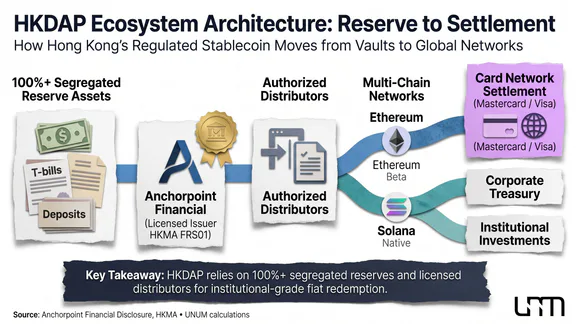
The issuer of HKDAP is Anchorpoint Financial, established with the participation of Standard Chartered Bank (Hong Kong), telecommunications company HKT, and investment group Animoca Brands. On April 10, 2026, the company received the FRS01 license from the Hong Kong Monetary Authority (HKMA).
Unlike central bank digital currencies (CBDCs), HKDAP is issued by a commercial organization. Its value stability depends on reserve backing, the issuer's fulfillment of obligations, and redemption availability.
According to Anchorpoint's official documentation, the reserve volume must be at least 100% of the nominal value of the issued tokens. Permissible assets include cash, bank deposits with terms up to three months, certain high-quality debt securities with a residual maturity of up to one year, and other approved instruments. Reserves are segregated from the company's own assets and held in a trust structure for the benefit of holders.
HKDAP began limited institutional distribution on August 12, 2026, as part of the Beta Access program. At this stage, the token is available on the Ethereum network, and its acquisition and conversion are organized through authorized distributors. The primary users remain corporate and institutional clients, including professional investors.
According to Anchorpoint Transparency, as of October 30, 2026, there were 103.1 million HKDAP in circulation, the reserve value was 104.2 million HKD, and the accumulated transaction volume reached 259.1 million HKDAP. The latter figure includes registered token activity and is not equivalent to the volume of commercial payments.
During the Beta Access phase, the company publishes weekly unaudited reserve reports. Independent confirmations of reserve assets are planned to be published by Anchorpoint after the full launch of HKDAP.
An important feature of the token is its redemption mechanism. According to the issuer's terms, Anchorpoint aims to process relevant requests within one business day if the established requirements are met. However, for most users, funds are received through authorized distributors, who set their own conversion procedures and timelines.
How Stablecoins Could Change International Settlements
International payments remain a complex process even with the development of digital banking. To transfer money between countries, financial institutions often have to use correspondent accounts, interact with intermediaries, and consider the operating hours of settlement systems.
SWIFT provides the transmission of financial messages, but the movement of funds occurs through banking infrastructure. Therefore, the speed of an international payment depends not only on information transmission but also on checks, currency conversion, and the availability of participant banks.
Settlements in stablecoins offer an alternative way to move funds. A company can purchase tokens from an authorized intermediary, transfer them to the recipient via a supported blockchain, after which the recipient can convert the asset into national currency if necessary.
This model allows for token transfers around the clock, including weekends and holidays. However, using blockchain does not negate the requirements of financial legislation and the need for banking infrastructure to exchange digital assets for regular money.
In the case of HKDAP, additional restrictions apply. During the Beta Access stage, users must undergo verification through authorized distributors, and the token mechanism provides restrictions on transfers between unverified wallets. Therefore, the presence of a public blockchain does not mean free access to HKDAP for any market participant.
Indicator | Bank Transfers | Settlements via Stablecoins |
|---|---|---|
Availability | Depends on settlement channels | Token transfers can be made around the clock |
Intermediaries | Banks and correspondent organizations | Issuer, distributors, and payment providers |
Fees | Bank tariffs and currency conversion | Network fees, intermediary services, and conversion |
Speed | Depends on route and banking procedures | Fast token transfer, but receiving fiat funds may take additional time |
Main Restrictions | Settlement cycles, checks, and bank availability | Liquidity, regulation, and exchange availability |
Advantages depend on the specific payment route. If a company first has to buy Hong Kong dollars to obtain HKDAP, and the recipient then exchanges them for another currency, additional costs can eliminate the savings on network fees.
For example, for a hypothetical transfer of 1 million HKD, the blockchain transaction fee may be only 10 HKD. But if the costs of acquiring and subsequently converting the tokens reach 0.6% of the amount, total expenses will be about 6,010 HKD. This is an illustrative calculation, not the actual HKDAP rate.
As shown by the BIS study previously analyzed by UNUM, low network fees do not guarantee savings on international transfers. For businesses, the main indicator becomes the total cost of the operation, including conversion, intermediary services, and receipt of funds by the recipient.
Why Mastercard and Visa are Integrating Stablecoins
For international payment systems, stablecoins are primarily of interest as a new form of settlement means that can be used alongside existing financial infrastructure.
On October 15, Mastercard and BVNK announced the launch of the Mastercard Global Money Platform. The platform integrates operations with traditional currencies and stablecoins, allowing financial organizations to manage accounts, conduct conversions, and organize international payments through a single infrastructure. BVNK, specializing in payment solutions for digital assets, joined Mastercard in August 2026.
Collaboration with Anchorpoint opens the possibility to add a regulated digital Hong Kong dollar to this model. For banks and payment providers, this potentially means expanding the set of settlement currencies without the need to independently create the entire infrastructure for working with blockchain.
Visa is developing a similar direction. The company already uses USDC for settlements with certain partner banks. In particular, Cross River Bank and Lead Bank conduct settlements with Visa through the Solana blockchain. As previously reported by UNUM, Visa is also developing the use of USDC in the Visa Direct international payment infrastructure.
In a statement regarding the collaboration with Anchorpoint, the following assessment was made:
Stablecoins are entering a new phase, moving beyond the realm of digital assets and becoming part of the global trade infrastructure.
The focus is primarily on changes in settlements between financial institutions. The buyer will still be able to pay for goods with a regular card, while part of the transactions between banks and the payment system may potentially be conducted using digital assets.
Thus, Mastercard and Visa view stablecoins not necessarily as a replacement for bank cards, but as an additional tool for settlements, liquidity management, and international transfers.
Why Solana was chosen for HKDAP expansion
In addition to banking infrastructure, the distribution of a stablecoin requires a blockchain capable of supporting a large number of transactions with relatively low costs.
Solana is focused on high throughput and low network fees. This makes it potentially suitable for retail payments, international transfers, and operations with tokenized financial assets.
Anchorpoint intends to ensure native issuance and redemption of HKDAP on Solana. This model implies that tokens will be issued directly on this network, rather than only entering it through cross-chain bridges. This will allow interaction with the ecosystem of wallets, applications, and financial services operating on Solana.
Stablecoins play an important role in integrating digital assets into everyday financial activities.
However, technological integration does not automatically lead to increased demand for the native token SOL. It is used to pay network fees, but their amount relative to the value of transferred funds may remain small.
The economic effect for SOL will depend on the number of transactions, network load, and other factors, rather than the nominal volume of payments in HKDAP. Additionally, the availability of the stablecoin itself will continue to be determined by the issuer's conditions and regulatory requirements.
What economic benefits banks and companies can gain
The practical value of regulated stablecoins is evident in operations where the speed of settlements affects capital utilization and cash flow management.
International trade. A Hong Kong company can use HKDAP to pay a foreign supplier if both parties have access to the token and the necessary conversion channels. The transfer of the settlement asset may potentially be faster, but the final savings will depend on the currency route, intermediary fees, and local legal requirements.
Corporate liquidity management. For international settlements, companies and payment providers can pre-place funds in accounts across various jurisdictions. Round-the-clock transfers allow for quicker liquidity redistribution and potentially reduce the need for pre-financing individual operations. For banks, this also opens up opportunities to optimize cash balance management and settlement obligations.
Tokenized financial assets. Stablecoins can be used for settlements on digital securities. On October 16, Finloop announced its participation in the issuance of tokenized notes, providing for the use of HKDAP for subscription, redemption, and interest payments. The product is intended for professional investors and demonstrates the application of a regulated stablecoin at various stages of servicing a financial instrument.
On the same day, Finloop and QFPay confirmed the execution of a payment transaction using HKDAP in Hong Kong. The transaction was part of a collaboration to develop local payment solutions and demonstrated the token's applicability beyond transactions with investment instruments.
These examples confirm that HKDAP is already being used in certain commercial and financial processes, although the scale of operations is still limited. For further adoption, new settlement tools need to provide a sustainable advantage in terms of cost, speed, or capital management efficiency.
The development of such mechanisms is linked to the broader tokenization market. For example, the DTCC initiative, previously analyzed by UNUM, shows the interest of traditional financial infrastructure in transitioning securities operations to a digital environment.
Can HKDAP Compete with Dollar Stablecoins
The global stablecoin market is predominantly oriented towards the US dollar. USDT and USDC are used on cryptocurrency exchanges, in decentralized financial services, and international settlements. Their advantage lies not only in their scale of circulation but also in their developed liquidity and wide accessibility.
HKDAP offers a different model. Its value is expressed in Hong Kong dollars, making the token potentially in demand for settlements related to the Hong Kong financial market, regional trade, and investment products denominated in HKD.
The peculiarity of the Hong Kong currency lies in its link to the US dollar. Since 1983, a currency exchange system has been in place that maintains the HKD in the range of 7.75–7.85 per $1. However, this mechanism does not make the Hong Kong dollar completely identical to the American dollar.
Therefore, HKDAP cannot be considered a complete analogue of a dollar stablecoin. Its holder has the right to redeem in HKD, and for settlements in USD, conversion at the current rate will be required.
In the future, regulated stablecoins of different currencies may develop in parallel. Dollar tokens retain advantages in global cryptocurrency liquidity, while regional digital currencies can service settlements where the use of a specific national currency is important.
But for successful competition, one license is not enough. Market participants need accessible channels for purchase and redemption, reliable infrastructure, and the ability to conduct large transactions without significant conversion costs.
What Risks Could Limit HKDAP's Spread
Despite support from major financial companies, the further development of HKDAP is associated with several limitations.
Insufficient liquidity. If there are no counterparties on the market for exchanging large amounts, the actual costs of settlements may exceed initial estimates.
Regulatory differences. A license in Hong Kong does not mean automatic permission to use the token in all countries. International payments require compliance with the rules of each relevant jurisdiction.
Dependence on intermediaries. For converting HKDAP into bank money, most users need access to authorized distributors and payment channels.
Technological risks. Infrastructure vulnerabilities, errors in smart contracts, or loss of wallet access can lead to financial losses.
Competition. Banks may prefer existing payment solutions, dollar stablecoins, or tokenized deposits if they provide comparable efficiency with lower operational costs.
Security requires special attention. On April 28, 2026, Anchorpoint issued a warning about counterfeit tokens using the HKDAP designation without relation to the licensed issuer. To verify authenticity, it is necessary to refer to the company's official data on supported networks, smart contract addresses, and authorized distributors.
When assessing risks, it is important to consider that HKDAP is not a bank deposit or legal tender. Its regulated status does not imply a government guarantee of redemption. Holders still depend on the quality of reserve assets, the issuer's fulfillment of obligations, and the availability of settlement infrastructure.
What Indicators Will Show Real Demand for HKDAP
To assess the project's prospects, it is not enough to follow news about partnerships. More important are the indicators of actual stablecoin usage.
First of all, it is necessary to monitor the volume of tokens in circulation and the dynamics of reserves. An increase in supply may indicate an expansion of HKDAP usage, but by itself does not show for which operations the tokens are acquired.
Equally important is the structure of transactional activity. Movements between participants' own wallets, liquidity management operations, and real payments to trading enterprises have different economic significance. Therefore, the total volume of transfers cannot be automatically equated to commercial turnover.
Additional indicators will include the number of active distributors, the depth of stablecoin liquidity, and the cost of converting HKDAP into other currencies. The more accessible the exchange and the wider the network of participants, the more opportunities to use the token in international settlements.
Finally, it is necessary to observe the transition of announced integrations to commercial use. Confirmed settlements through Mastercard and Visa, the launch of HKDAP on Solana, and expanded access for retail clients will allow for a better assessment of the project's scale.
What Will Change in the International Payments Market
Anchorpoint's collaboration with Mastercard, Visa, and Solana shows how regulated stablecoins are gradually becoming part of the traditional financial infrastructure.
The main change may not occur in payment methods for regular consumers, but in the mechanisms of money movement between banks, payment companies, and corporate clients.
Meanwhile, the prospects for HKDAP will be determined not by the number of partnership agreements, but by the ability to provide affordable, liquid, and reliable settlements. If these conditions are met, the digital Hong Kong dollar can carve out its own niche in the international payment system.