Why the US Congress is increasing oversight of tech companies
Following the midterm elections on November 3, 2026, the Democratic Party gained a majority in both houses of the US Congress. From January 2027, its representatives will be able to lead key committees, hold parliamentary hearings, and more actively use their powers to request documents.
Lawmakers are particularly focused on the relationships of major tech companies with federal agencies. Government contracts, export licenses, and potential conflicts of interest in administrative decisions may be subject to scrutiny.
The degree of oversight over companies varies. Lawmakers have already begun investigating the US administration's decisions on export licenses for Nvidia, while additional checks on Elon Musk's companies' government contracts are mostly in the preparatory stage. Separate investigations into the activities of the Department of Government Efficiency (DOGE), previously led by Elon Musk, began even before the elections.
The parliamentary investigation itself does not imply that a company is guilty or that existing contracts will be automatically reviewed. However, it may lead to additional checks by regulators and increase uncertainty for businesses.
Why Nvidia faces risks of new export restrictions
On November 12, Senator Ron Wyden and Representative Richard Neal announced the start of an investigation into the US administration's decisions related to the supply of advanced Nvidia AI chips to China.
In an official letter to the US Department of Commerce, lawmakers stated that "we are initiating an investigation."
The investigation focuses on the export of Nvidia chips to China and the actions of government bodies in approving such supplies. Lawmakers demanded the preservation of documents related to the issuance of licenses, the application of trade tariffs, and the contacts of company representatives with the Department of Commerce.
Specifically, questions were raised about the mechanism for permitting the export of H200 processors with a 25% tariff under section 232 of US trade law. Lawmakers are examining the justification of administrative decisions rather than pre-establishing violations by Nvidia.
Additional pressure is created by the tightening of export regulations. On November 16, the US Bureau of Industry and Security (BIS) introduced new rules aimed at preventing circumvention of restrictions through foreign data centers. They affect the supply of advanced computing equipment to infrastructures that provide significant capabilities to companies from countries subject to relevant export control.
For Nvidia, this creates additional requirements for verifying certain buyers and conditions for equipment use. Possible consequences include delays in deal approvals, increased compliance costs, and restrictions on certain sales directions. However, the new measures do not imply a complete ban on the company's foreign business.
Regulatory risks have intensified amid a leadership change at Nvidia. On November 12, Jensen Huang stepped down as CEO, and interim duties were assigned to CFO Colette Kress.
We expect the company's operations, fulfillment of client obligations, and product development plans to continue without disruption.
Nvidia's financial position remains strong for now. In the second quarter of the 2027 fiscal year, the company's revenue reached $96.2 billion, up 106% year-over-year. However, investors will need to assess whether the chipmaker can maintain its growth pace amid changing conditions for accessing international markets.
The detailed consequences of the leadership changes are examined in UNUM's analysis "Nvidia without Huang: What Risks Await the AI Industry".
What risks SpaceX faces related to government contracts
Unlike Nvidia, the main potential risks for SpaceX are related to its interactions with government clients. The company conducts space launches for commercial and federal clients, provides satellite communication services, and develops infrastructure for government space programs.
After the November elections, Democratic representatives expressed their intention to examine Elon Musk's activities in DOGE and potential conflicts of interest related to his involvement in government structures. Additional questions may arise regarding the conditions under which the entrepreneur's companies receive federal contracts, although specific procedures for new investigations have not yet been defined.
Government contracts for SpaceX cover several strategically important areas. The company is involved in the Artemis lunar program, provides crew transport to the International Space Station, and conducts launches for national security purposes. In September, NASA announced it had awarded SpaceX contracts for three more crewed missions.
The satellite business is also of significant importance. Alongside the commercial Starlink network, the company is developing the Starshield system aimed at government customers. In its Q2 2026 report, SpaceX announced it had secured multi-year government contracts for the Starshield direction worth over $6 billion. However, the value of the contracts should not be equated with revenue already received.
If investigations reveal violations, Congress can forward relevant materials to competent agencies. Potential changes to contracts would require separate decisions and legal grounds, so the initiation of an investigation does not in itself terminate existing agreements.
An important limiting factor remains the dependence of government programs on SpaceX's technological capabilities. For some space missions, quickly replacing the contractor could be challenging due to equipment specifics, the duration of developing alternative solutions, and launch reliability requirements.
For example, NASA continues to collaborate with SpaceX and Blue Origin on the lunar landing systems program, despite identified project timeline shifts.
For investors, the significance of these risks has increased following SpaceX's stock market debut in June 2026. The company's shares are traded under the ticker SPCX, so changes in expectations regarding government contracts could affect its market capitalization.
At the same time, SpaceX's value is determined not only by federal contracts but also by the results of commercial launches, the development of satellite communications, AI infrastructure, and other business directions.
Why Tesla might also face consequences
Tesla is not directly involved in the investigation of Nvidia's export licenses. Potential examinations of DOGE activities should not automatically be equated with an investigation into the company's automotive business. Nevertheless, Tesla's risks are linked to its own regulatory procedures and financial relationships with other Elon Musk enterprises.
One of the most important areas remains autonomous driving. In September, the U.S. National Highway Traffic Safety Administration (NHTSA) initiated an investigation into the Cybercab's compliance certification procedures with federal safety standards following the launch of a commercial service in Austin.
The regulator is examining the technical data on which Tesla claimed the driverless vehicle's compliance with current requirements. Separately, NHTSA continues to investigate the FSD (Supervised) system's operation, particularly its ability to timely warn the driver of deteriorating visibility conditions. These investigations have different subjects and are not congressional inquiries.
Their results could impact the need for technical changes, additional expenses, and the pace of commercial expansion of Robotaxi. For Tesla, this is especially important as the development of autonomous technologies occupies a significant place in the company's long-term strategy.
Another channel of potential influence is related to the financial relationships between Tesla and SpaceX.
According to Tesla's Q3 2026 report, in March, the company invested $2 billion in SpaceX common stock after changing the initial investment structure, which provided for the acquisition of xAI preferred shares. The acquired stake represents less than 1% of SpaceX's capital.
Additionally, for the nine months of 2026, Tesla recognized $626 million in revenue from the sale of Megapack energy storage systems to SpaceX.
The boards of directors of both companies have also created special committees to explore the possibility of a business merger. However, a final agreement has not been reached, and any potential deal will require necessary corporate approvals. More about this was covered by UNUM in the article “SpaceX and Tesla Discuss Merger with $2.1 Billion Bitcoin Reserves”.
Financial ties create an additional channel of mutual influence, but their significance must be compared with the overall scale of Tesla's business. Therefore, potential problems at SpaceX should not automatically be considered a comparable threat to the car manufacturer.
How Investigations Could Affect Nvidia, Tesla, and SpaceX Stocks
Increased government oversight does not necessarily lead to an immediate reduction in revenue. Its impact on financial performance depends on specific regulatory decisions and how significant the affected business areas are.
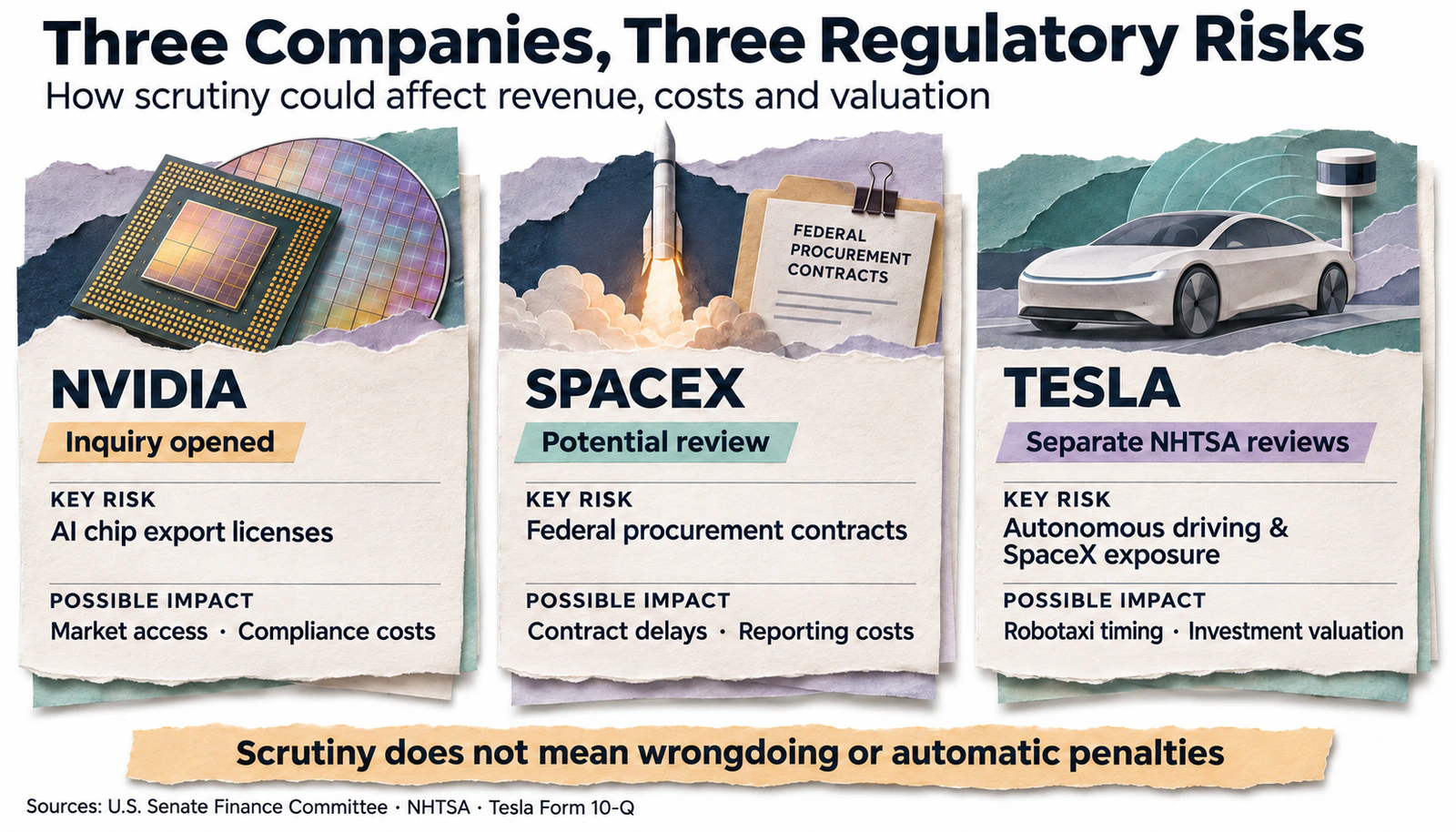
For the three companies, the main risk channels differ.
Company | Main Source of Risk | Possible Consequences |
|---|---|---|
Nvidia | Export licenses and AI chip supply restrictions | Reduction of available market, increased compliance costs |
SpaceX | Potential audits of government contracts and procurement procedures | Delays in new orders, additional reporting costs |
Tesla | Regulation of autonomous driving and financial ties with SpaceX | Delays in Robotaxi development, compliance costs, changes in investment valuation |
These investment risks can affect stock prices even before direct financial consequences emerge. Market quotes are formed based on expectations of future profits, so additional uncertainty may prompt investors to reassess company valuations.
For holders of Nvidia (NVDA) shares, key indicators will remain the volume of orders for AI accelerators, revenue dynamics of the Data Center segment, and gross margin. If export restrictions do not affect a significant share of sales and demand from cloud operators remains, the financial impact of audits may be limited.
At the same time, Nvidia's risks need to be considered alongside competitive pressure. For instance, Google is developing its own AI accelerators, TPU, which can partially reduce the cloud infrastructure's dependence on Nvidia GPUs. More on this in UNUM's analysis “Why Google's Own AI Chips Are Becoming a Threat to Nvidia”.
For investors tracking Tesla (TSLA) shares, the pace of commercialization of autonomous technologies, development costs, and automotive business results are of greater importance. In the case of SpaceX, it is necessary to separately analyze the dynamics of government orders, commercial revenue, and investment commitments.
What Could Change for Companies in 2027
The further development of the situation will depend on the results of parliamentary investigations, the actions of relevant agencies, and the companies' ability to adapt to new requirements. At this stage, three scenarios can be highlighted.
Checks without significant restrictions. Congress holds hearings and obtains necessary documents, but existing commercial permits and government contracts are mostly retained. In this case, the direct impact on financial performance may be minimal.
Increased regulatory scrutiny. Government bodies raise requirements for export licenses, procurement procedures, and technological security. Additional checks increase company expenses and may delay the implementation of certain projects.
Significant business restrictions. If competent authorities identify violations, decisions may follow that directly affect commercial activities. The scale of the consequences will depend on specific measures, the timing of their application, and the possibility of appeal.
These scenarios describe potential developments but are not forecasts with established probabilities.
The nearest market benchmark will be Nvidia's report for the third quarter of the 2027 fiscal year, scheduled for publication on November 17, 2026. It will allow for an assessment of the company's financial position, although the results of the quarter ending October 25 do not reflect the consequences of the November events.
For SpaceX and Tesla, important signals will be new Congressional documents, regulatory decisions, changes in government contracts, and reports on potential business mergers.
Thus, U.S. Congressional investigations create an additional source of uncertainty for tech companies but do not imply inevitable deterioration of their financial performance. For Nvidia, export restrictions remain key, for SpaceX — the stability of relationships with government customers, and for Tesla — the regulation of autonomous technologies and financial ties with Musk's business. The real scale of the consequences will become clearer after official decisions and the publication of new corporate reports.