
What Changed in Global Markets by November 20
In the previous issue of UNUM, the key events were Nvidia's report, the Fed's minutes, and US retail sales. Now the results of these publications help understand what markets expect from the new week: how stable the demand for computing infrastructure is and whether the US central bank will need further rate hikes.
Nvidia concluded the third quarter of fiscal 2027 with record revenue of $115.8 billion, up 103% from a year earlier. The data center segment contributed $107.6 billion. The company exceeded its own forecast of $108 billion and expects revenue of about $130 billion in the next quarter, with a possible deviation of 3%. The forecast does not include revenue from computing solutions for data centers in China, and the quarter itself will be a week longer than usual. Meanwhile, the expected GAAP gross margin is 71–72% compared to the actual 74.8% for the reporting quarter. For investors, this is a reminder: rapid sales growth does not rule out pressure on profitability.
The FOMC meeting minutes from October 27–28, published on November 18, showed that most participants supported maintaining the rate in the range of 3.75–4.00%, but two voted for a 25 basis point increase. Almost all participants in their baseline forecasts considered further tightening likely necessary. In the discussion of financial stability, concerns were specifically raised about the return on investments in artificial intelligence and the opaque mechanisms of their financing.
US retail sales in October, according to a preliminary estimate by the Census Bureau, increased by 0.2% after a 0.8% rise in September. The margin of error for the October estimate is ±0.4 percentage points, so the scale of the slowdown cannot be considered statistically certain. Moreover, sales are presented without adjusting for inflation and do not show changes in the physical volume of purchases.
Financial markets from November 23–27, 2026, will primarily react to whether new data confirm the persistence of high price pressures amid stable demand. This will determine the financial markets' forecast for the week and the direction of expectations for the Fed's rate.
PCE Inflation and US GDP to Test Fed Rate Expectations
The main macroeconomic event of the week will be the US PCE inflation for October, data on which the Bureau of Economic Analysis (BEA) will publish on Wednesday, November 25. Simultaneously, the second estimate of US GDP for the third quarter and the preliminary estimate of corporate profits will be released. The Census Bureau will present October's durable goods orders.
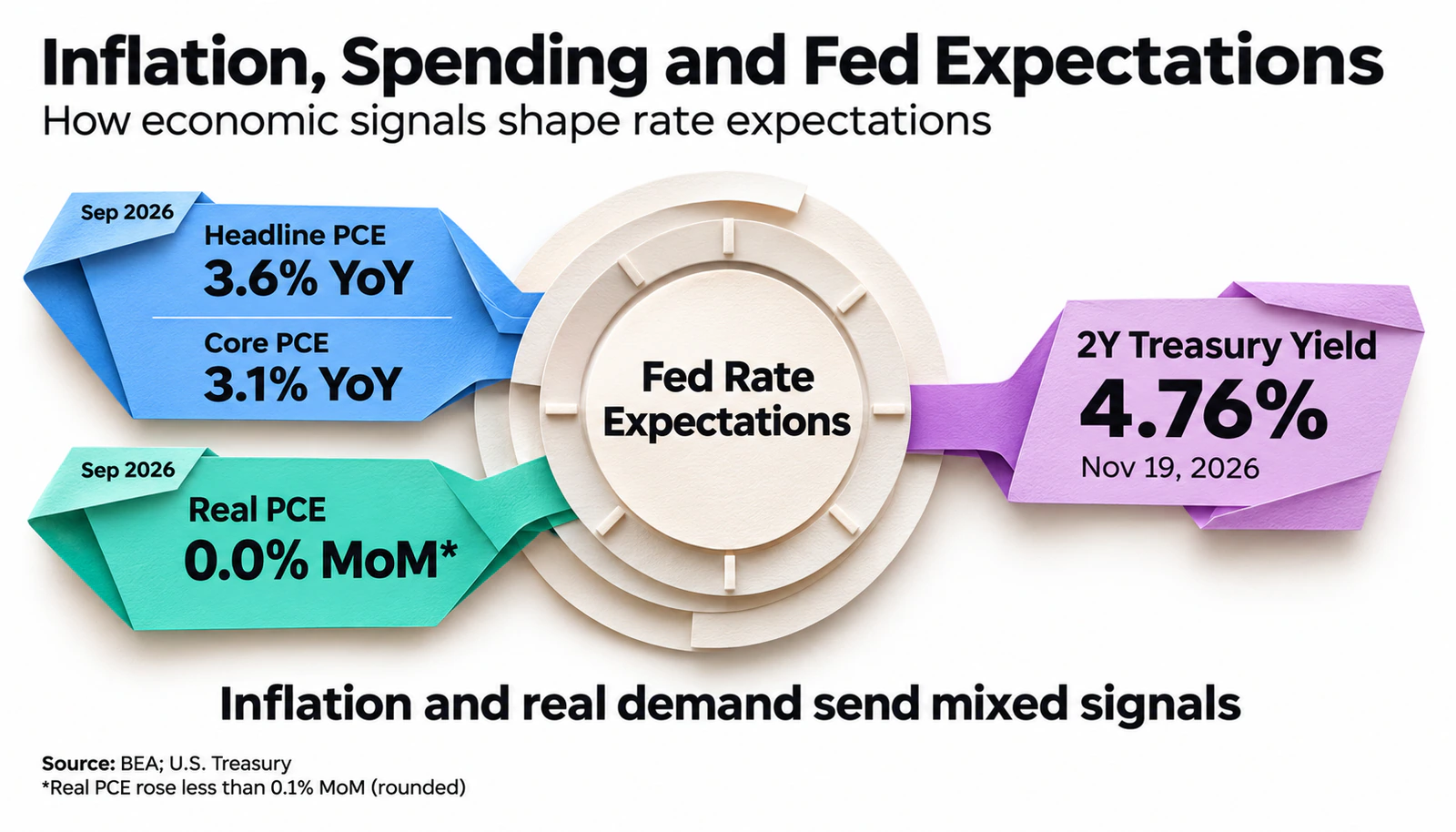
In September, the PCE index rose by 0.5% for the month and 3.6% year-over-year. The core PCE, excluding food and energy, increased by 0.3% for the month and 3.1% for the year. Nominal consumer spending rose by 0.5%, while real spending remained almost unchanged, and the personal savings rate was 3.8%. These figures explain why stable household spending does not yet imply equally stable growth in real consumption.
The first estimate of real US GDP for the third quarter showed a growth of 3.4% year-over-year after 2.2% in the second quarter. Not only possible revisions of the overall figure are important, but also the contribution of consumption, investments, and inventories. If the revision confirms strong demand along with an acceleration of core PCE, arguments for a tighter monetary policy will strengthen. Conversely, more moderate inflation with stable growth will reduce pressure on stock valuations.
When assessing economic publications, it is important to first compare actual figures with market consensus and then analyze their absolute values. It is often the unexpected deviation from the forecast that triggers the main asset reaction.
What to watch: monthly and yearly core PCE, real consumer spending, GDP structure revision, durable goods orders, two-year Treasuries yield, DXY, and EUR/USD.
The publication can alter the Fed rate forecast for the December and subsequent meetings. The short-term dollar forecast will depend on the reaction of rates: the yield on two-year US Treasury bonds is particularly sensitive to the revision of monetary policy expectations. For the foreign exchange market, the DXY index and the yield differential between US bonds and those of other developed economies are also important.
PMI indices to highlight differences among major economies
On Monday, November 23, S&P Global will release preliminary PMI indices for the US, Eurozone, UK, India, and Australia; Japan's PMI will be released on Tuesday. These surveys provide an early picture of business activity, new orders, employment, and price pressures before many official indicators are published.
According to S&P Global, US business activity in October grew faster than in other major developed economies when comparing output dynamics. However, the rise in resource and finished goods prices remained significant. For investors, it is important to see if the US advantage persists and whether Europe can sustain growth without a new inflationary impulse.
For European markets, the Eurozone PMI is indicative, especially the ratio of output to new orders, as well as the output price components. On Friday, November 27, the European Commission will release the Eurozone economic sentiment index, which will complement the picture of business and consumer expectations. International benchmarks will remain EUR/USD, German Bund yields, and European stock indices.
What to watch: composite PMI indices, employment, new orders, output prices, EUR/USD, and the reaction of European bonds.
Dell report to show how profitable AI infrastructure growth remains
On Tuesday, November 24, after the close of the US stock session, Dell Technologies will present its results for the third quarter of fiscal 2027. Following Nvidia's strong earnings report, this will be the next test of demand for artificial intelligence, but from the perspective of a supplier of ready-made server infrastructure. The earnings reports of tech companies will allow for a comparison of revenue growth between chip manufacturers and those assembling and supplying systems for data centers.
In the second quarter, Dell received a record volume of AI server orders amounting to $60.9 billion, reflected revenue from this segment of $16.4 billion, and ended the period with an order backlog of $95 billion. These figures should not be equated: orders indicate future client commitments, while recognized revenue pertains to already delivered products. We received a record order volume of $60.9 billion and reported record revenue of $16.4 billion. — Jeff Clarke, Vice Chairman and COO of Dell Technologies, official release of second quarter fiscal 2027 results
We received a record order volume of $60.9 billion and reported record revenue of $16.4 billion.
The key question for Dell's stock is whether the record order backlog will translate into revenue and free cash flow without excessively reducing gross margins. The market will analyze delivery forecasts, component costs, and order fulfillment timelines. For Nasdaq forecasts, not only the sales dynamics of AI equipment are important, but also how investors assess the future profitability of the entire supply chain.
Also on November 24, HP Inc. will report, and on November 25, Deere will. HP will help assess demand for personal computers and the impact of component prices, while Deere's results will provide additional signals on capital expenditures and the state of the real economy.
What to watch: Dell's revenue and gross margin, volume of new AI server orders, order backlog, free cash flow, Dell and Nvidia stocks, Nasdaq 100, and the semiconductor index.

Asia to test inflation resilience and industrial growth
Inflation in Japan and Australia will serve as an additional benchmark for assessing future decisions by regional central banks. On Friday, November 27, Japan will release preliminary inflation data for Tokyo for November. The nationwide consumer price index rose by 2.3% year-on-year in October, so it is particularly important to understand if price pressures persist in the capital region, which provides an earlier signal of consumer price dynamics.
On Wednesday, November 25, Australia will release its October CPI. In September, the annual inflation rate was 4.3%, and the trimmed mean inflation rate was 3.6%. If the new figure indicates persistent price pressure, investors may reassess expectations for the Reserve Bank of Australia's policy and the trajectory of the Australian dollar.
On Thursday, November 26, the Bank of Korea will hold a rate-setting meeting. Following the October meeting, the base rate stands at 3.00%. For Korean stocks and the won, not only the decision but also the assessment of inflation, currency exchange rates, and export demand are important.
China's economy will be in focus following the expected end-of-month release of profit statistics for large industrial enterprises. From January to September, profits for companies above the statistical threshold increased by 15.5% year-on-year. However, the overall figure conceals significant differences between industries, so investors are particularly interested in the results of electronics, materials, and traditional industry manufacturers. The exact date of the October publication should be checked with the National Bureau of Statistics of China calendar.
What to watch: Tokyo CPI, Australia's core indicators, Bank of Korea's decision, China's industrial profits, JPY, AUD, KRW, and the dynamics of Asian stock indices.
Oil will remain a factor of inflationary risks
Brent oil prices will remain sensitive to export volumes, inventory levels, and risks to maritime transport. On Wednesday, November 25, the U.S. Energy Information Administration (EIA) plans to release weekly data on oil and petroleum product inventories. Changes in not only total crude oil stocks but also gasoline, distillates, and refinery utilization are important for the market.
Additional background is provided by OPEC+ decisions and geopolitical risks, which can create a premium in energy resource costs. The next meeting of the eight OPEC+ countries is scheduled for November 29, already beyond the considered trading week, so any new signals about production can influence expectations in advance.
For investors, the transmission of oil prices into inflation is important. Rising energy costs can complicate the reduction of the overall PCE index and support expectations of higher interest rates, although the reaction of core inflation is usually less direct.
What to watch: Brent quotes, EIA data on stocks and processing, export flows, official OPEC+ announcements, and the dollar.
Thanksgiving will alter trading conditions
Thanksgiving in the U.S. falls on Thursday, November 26, when American stock exchanges will be closed. On Friday, November 27, the main NYSE session will end at 1:00 PM New York time. This means a shortened trading regime for U.S. stocks and exchange-traded funds.
Reduced trading activity does not itself guarantee increased volatility. However, with less market depth, individual orders can move prices more significantly, and spreads may widen. Therefore, it is especially important to distinguish between reactions to new data and movements caused by low liquidity.
Friday also marks Black Friday, the start of the active holiday shopping season. For investors in retail stocks, this day is important primarily as an early indicator of consumer sentiment; reliable data on actual sales will appear later.
What to watch: volumes and spreads in major ETFs and index futures, liquidity at the open and after publications, and confirmation of price movement in the next full session.
Bitcoin will test demand resilience ahead of monthly expiration
The Bitcoin forecast for the week depends on two interrelated factors: the revision of Federal Reserve rate expectations and the state of real demand for the crypto asset. Spot Bitcoin ETFs allow tracking part of this demand, but their flows cannot be considered an exhaustive indicator of all institutional investor behavior.
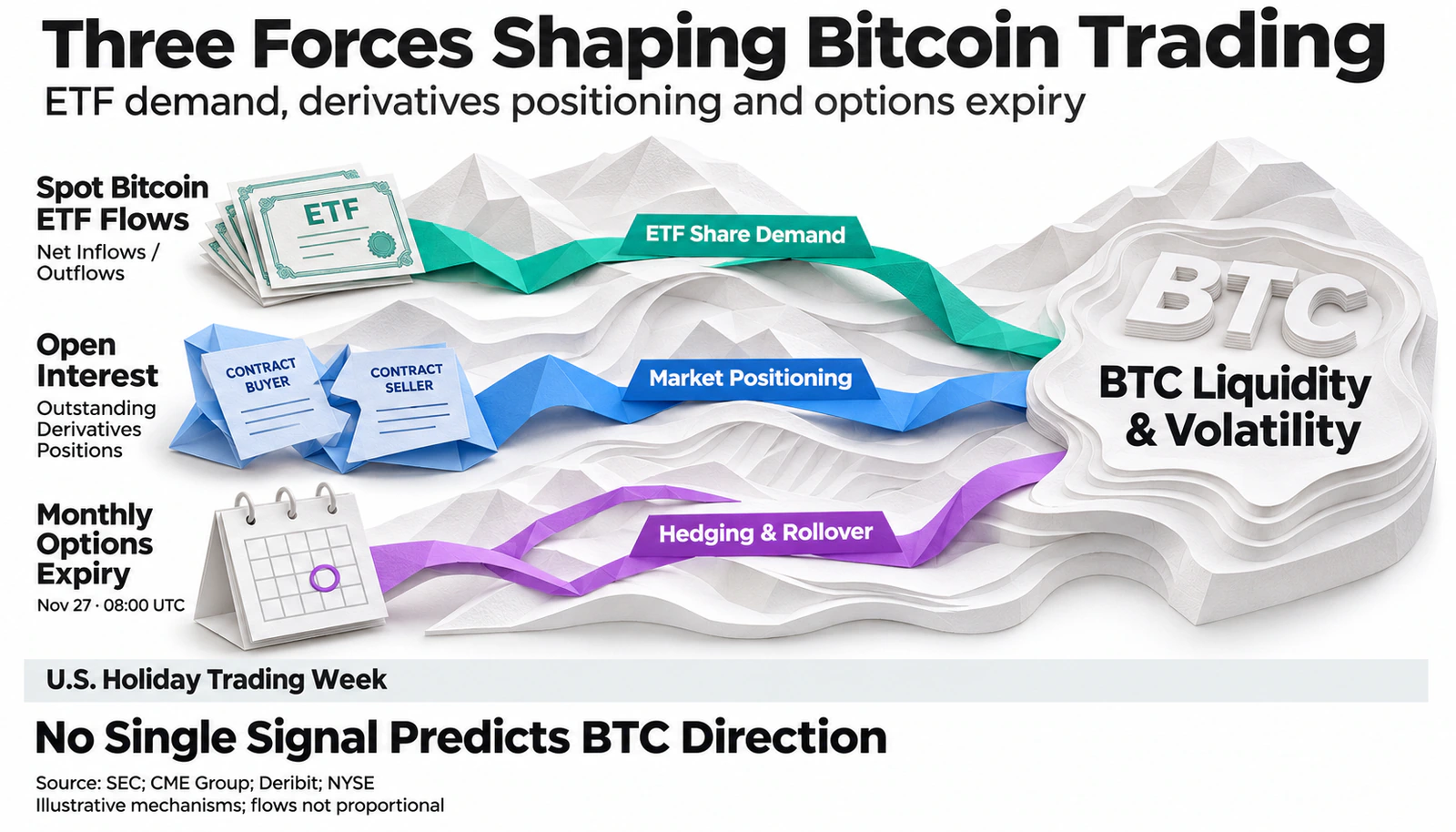
Continued outflows may indicate weakening demand for shares of U.S. spot Bitcoin ETFs, while the resumption of steady inflows could support price recovery. During the U.S. holiday week, ETF flows should be assessed with adjustments for the closure of American exchanges on November 26 and the shortened session on November 27.
On Friday, November 27, the monthly expiration of Bitcoin options will take place on the Deribit exchange at 08:00 UTC, or 11:00 Minsk time. Before settlement, market makers' positions and hedging needs may change, but the expiration itself does not determine the direction of BTC/USD.
To assess the situation, it is useful to compare BTC/USD with spot volumes, open interest, and implied volatility. Funding rates for perpetual futures help understand whether there is an excessive bias towards buyers or sellers. A strong Bitcoin reaction to PCE will be more convincing if confirmed simultaneously by spot demand and derivatives market dynamics.
What to watch: net flows of spot Bitcoin ETFs, BTC/USD, open interest, funding rates, implied volatility, and market reaction after expiration.
Three Key Questions of the Week
1. Will PCE data and GDP revision alter the forecast for further Fed rate hikes, along with the trajectory of the dollar and bond yields?
2. Will Dell's report confirm that demand for AI servers is translating into profit and cash flow, not just large orders?
3. How resilient will the movements of stocks and Bitcoin be during a shortened trading week, holiday liquidity, and monthly option expiration?