
How markets are approaching the end of October
In the previous issue of UNUM, the main question was the contradiction between the high cost of capital and the resilience of economic growth. The results of the Federal Reserve meeting, new U.S. GDP data, and quarterly reports from tech companies showed that it persists.
On October 28, the Federal Reserve left the target range for the federal funds rate at 3.75–4.00%. The decision was made with ten votes against two. Lisa Cook and Beth Hammack advocated for a 25 basis point rate increase to 4.00–4.25%, indicating differences in the assessment of inflation risks within the regulator.
Economic activity is growing at a high pace.
Statistics published the next day confirmed the strength of the American economy. According to the first estimate by the BEA, U.S. real GDP in the third quarter increased by 3.4% annually after a 2.2% rise in the second quarter. The acceleration compared to the previous quarter was primarily due to increased investments and government spending, while exports decreased and imports grew.
However, September data showed another side of the economic picture. Annual PCE inflation reached 3.6%, the core indicator was 3.1%, and real consumer spending increased by less than 0.1% for the month. At the same time, real disposable incomes fell by 0.3%, and the personal savings rate dropped to 3.8%.
Thus, the acceleration of GDP did not eliminate the problem of high inflation and does not guarantee the maintenance of previous consumption growth rates.
Corporate earnings also gave mixed signals to investors. Microsoft increased quarterly revenue by 19% to $92.3 billion, and Azure's income grew by 48%. Amazon reported a 39.3% increase in AWS sales and a record group operating margin of 13.9%. However, the scale of investment in AI infrastructure remains a significant factor in evaluating tech companies: growth in the cloud business does not guarantee a comparable increase in free cash flow.
The European Central Bank also kept rates unchanged, leaving the deposit rate at 2.50%. The Bank of Japan held the rate at 1.25%, maintaining the possibility of further monetary policy normalization.
As a result, global markets are approaching November with conflicting signals. Economic activity in the U.S. remains strong, but inflation and high financing costs limit the potential for further growth. Now investors need to determine how resilient the labor market remains and whether corporate profits can offset increasing risks.
The U.S. labor market will test the resilience of economic growth
On November 6, the U.S. Bureau of Labor Statistics (BLS) will release the NFP report for October — Employment Situation. It includes Nonfarm Payrolls, unemployment rate, wage dynamics, and other indicators that allow assessing the state of the American labor market.
The significance of the publication is especially high after the 3.4% GDP growth in the third quarter. According to a preliminary BLS estimate, in September, the number of nonfarm jobs increased by only 29,000, while the average monthly increase over the previous 12 months was 45,000. The unemployment rate stood at 4.2%, and average hourly wages rose by 3.0% year over year.
Additionally, the U.S. Bureau of Labor Statistics revised data for July and August, reducing the total employment estimate by 60,000 jobs.
These indicators create an important contradiction. The American economy continues to expand, but companies are in no hurry to increase their workforce. The discrepancy between GDP growth and weak employment dynamics may be related to increased labor productivity, changes in the structure of economic growth, or employer caution. However, the available data do not allow for a definitive determination of the contribution of automation and artificial intelligence to the slowdown in hiring.
Additional information will be provided by the Productivity and Costs report, which the BLS will release on November 5. It will show changes in labor productivity and unit labor costs in the third quarter. If productivity accelerates without a comparable increase in labor costs per unit of output, this may partially explain the resilience of the economy with limited employment growth.
Before Friday's NFP, investors will also receive additional guidance. On November 3, the JOLTS report for September will be released, showing the number of job openings, layoffs, and voluntary employee departures. On November 4, the ADP employment report for the private sector and the ISM Services index for October will be published.
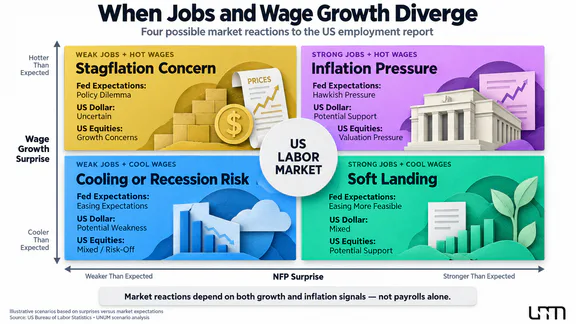
Not only absolute values are important, but also the deviation of actual results from market consensus.
Three main scenarios are possible:
Strong employment and steady wage growth. If the figures exceed expectations, it could increase the likelihood of prolonged high Fed rates or further policy tightening. Such an outcome could support the dollar and short-term Treasury yields while putting pressure on tech stocks.
Moderate employment growth with stable unemployment. This could strengthen expectations of a gradual cooling of the labor market without a sharp economic downturn. This is a relatively favorable scenario for stocks if inflationary risks do not intensify.
Weak job creation and rising unemployment. This could increase expectations of future policy easing, but a drop in Treasury yields does not necessarily lead to a stock market rise if investors start fearing a recession.
Particular attention should be paid to revisions of previous reports. If the October employment increase is moderate and the August and September estimates are significantly lowered, the overall labor market picture may be weaker than initially expected.
For stock market forecasts, it is important to compare NFP with the yield on two-year US Treasuries, the DXY dollar index, and the S&P 500 dynamics. A decline in yields along with rising stocks differs in meaning from a situation where government bonds rise amid a sell-off of risky assets.
US Congressional elections add uncertainty for investors
On November 3, the US midterm elections will take place, where all 435 members of the House of Representatives and about a third of the Senate will be re-elected. The results will determine the new balance of power in the legislative branch and could change the possibilities for adopting economic initiatives over the next two years.
For financial markets, the political process itself is not important, but its potential impact on fiscal, tax, and trade policy is. Congressional decisions can change expected government spending, the US budget deficit, and the working conditions of certain industries.
There are several main areas of influence:
Government finances. Investors will assess the prospects for funding federal programs, tax legislation, and government borrowing. Expectations of an increasing budget deficit can affect long-term Treasury yields, especially if they anticipate a rise in debt supply without a comparable increase in demand.
Trade policy. Possible legislative changes affect industrial support, international trade agreements, and specific tariff mechanisms. Manufacturing companies, importers, and enterprises with global supply chains remain particularly sensitive to such decisions.
Financial regulation. The new Congress composition may change the legislative prospects for initiatives in the banking sector, digital assets, and financial technologies. However, the election results themselves do not mean the immediate implementation of new rules.
For investors, it is important to distinguish between short-term market reactions and long-term consequences. Initial reports on voting results may cause volatility, but changes in fiscal policy depend on the subsequent legislative process, the administration's position, and negotiations between congressional chambers.
Primarily, it is worth monitoring the yields of ten-year and thirty-year Treasuries, DXY, and Russell 2000. Shares of small American companies may be sensitive to expectations regarding domestic taxes, lending, and government spending, although their movement direction is not determined solely by policy.
It is incorrect to unequivocally predict the stock market's reaction to the election results. What matters is the difference between the actual Congress composition and preliminary expectations already reflected in asset prices.
Bank of England and Australia to test global rate expectations
On November 5, the Bank of England will announce its next monetary policy decision and present the Monetary Policy Report with updated economic forecasts.
After the September meeting, the Bank Rate stands at 3.75%. The regulator has to consider the slowdown in economic activity and persistent inflationary pressure, further exacerbated by high energy costs.
For the British economy, it is particularly important how much the rise in fuel and energy prices translates into service costs, consumer prices, and wages. If inflation expectations remain persistently high, the possibilities for rate cuts are limited even with weak economic growth.
The Bank of England's rate decision on November 5 will be accompanied by updated forecasts for inflation and economic growth. Investors should pay attention to the voting distribution of the Monetary Policy Committee (MPC) members, employment forecasts, and the assessment of the energy shock's duration.
Key benchmarks are GBP/USD, yields on British government bonds (gilts), and the FTSE 100 index. For the currency market, the main significance lies in changes in the expected rate trajectory relative to the Fed's policy.
On November 3, the Reserve Bank of Australia (RBA) will present its decision. After the September rate hike, the key rate stands at 4.60%. Along with the decision, a new Statement on Monetary Policy will be released, revealing the regulator's forecasts regarding inflation, domestic demand, and economic growth.
The Australian economy is sensitive to the state of the real estate market, household consumption, and external demand for commodities. Therefore, the dynamics of AUD/USD should be considered alongside changes in Chinese industrial activity and the price of iron ore.
An additional guide for European markets will be the preliminary estimate of eurozone inflation for October, which Eurostat will publish on November 4. In September, annual inflation was 3.8%, and energy prices remained one of the main sources of pressure.
In a statement on October 29, the European Central Bank noted:
Energy prices continued to rise, creating risks of accelerating inflation and worsening economic growth prospects.
New European statistics will show whether the energy component of inflation is weakening or if price pressure continues to spread to other categories of goods and services.
Differences in the policies of the Fed, Bank of England, ECB, and RBA can increase exchange rate volatility. However, for assessing GBP/USD, EUR/USD, and AUD/USD, changes in interest rate expectations are more important than the mere fact of maintaining or raising the rate.
More about the factors driving major currencies can be read in the UNUM analysis on five currency pairs until the end of 2026.
Chinese PMIs to Show Global Industrial State
At the beginning of the week, Asian markets will focus on China's October business activity indices. Official figures are scheduled for October 31, before the opening of the new trading week, and an alternative manufacturing PMI will be released on November 2, providing additional insight into the private sector's condition.
In September, China's official manufacturing PMI rose from 49.8 to 50.1 points, returning to the expansion zone after two months below the 50 mark. The production index was 51.7, new orders were 50.5, while the employment indicator remained below the neutral level.
These data reflect a gradual recovery in manufacturing activity but also show that output growth is not necessarily accompanied by an expansion in hiring and an improvement in companies' financial positions.
The main question is how capable Chinese industry is of sustaining growth amid weak domestic demand and rising raw material costs. New orders, export demand, and purchase prices are particularly important, as increased production without a corresponding expansion in sales can lead to inventory buildup and pressure on profits.
For international investors, Chinese PMIs are significant far beyond the local stock market. Improvement in industrial activity can support demand for copper, iron ore, and equipment, while worsening indicators can increase pressure on commodity currencies and stocks of companies dependent on Chinese imports.
What to watch: CSI 300, Hang Seng China Enterprises, USD/CNH, AUD/USD, copper, and iron ore. Comparing these instruments will help understand whether Chinese statistics are perceived as a signal of demand recovery or merely a short-term increase in production.
OPEC+ and Middle East Conflict to Define Oil Risks
On November 1, before the opening of the new trading week, seven OPEC+ participants will hold another meeting on oil market conditions. At the previous meeting on October 4, the group decided to maintain November production targets at September levels.
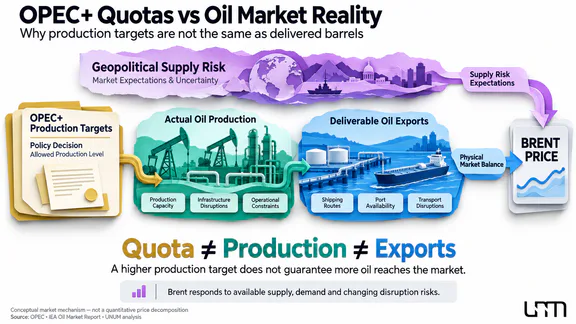
However, the current situation differs from the usual discussion of oil quotas. Due to the Middle East conflict, actual supply volumes and transportation capabilities remain constrained, so changes in allowed production do not necessarily lead to a corresponding increase in supply.
On October 29, the December Brent futures closed at $114.88 per barrel, while the January contract was around $110.80. The difference between them reflects, among other things, the increased cost of near-term deliveries amid current supply constraints. The December contract expires on October 30, so when analyzing the next week, new nearest contract quotes should be used.
In the previous UNUM study on oil market prospects, transportation constraints, stock status, and Brent price forecasts until 2027 were examined in detail. Now the main question is how much OPEC+ decisions can affect the physical availability of oil.
For assessing the oil market, it is important to distinguish between three indicators:
Production quotas — the volume of production allowed by OPEC+ agreements.
Actual production and export — real deliveries, which may be below quotas due to damaged infrastructure or transportation constraints.
Geopolitical premium — additional cost factored in by the market due to the risk of new disruptions and future supply uncertainty.
If the meeting concludes without changes to quotas but threats to transportation routes persist, Brent oil prices may remain high. Conversely, signs of a sustainable recovery in exports could weaken the geopolitical premium even without a formal increase in production targets.
For traders, it is useful to compare Brent and WTI, the spreads between near-term and longer-term oil futures, inventory data, and transportation costs.
The current dynamics of commodities can be tracked on the UNUM quotes page.
Apple, AMD, and Palantir reports to test the resilience of the tech sector
After the publication of results from Microsoft, Alphabet, and Amazon, investors' attention will shift to manufacturers of hardware, software, and consumer electronics.
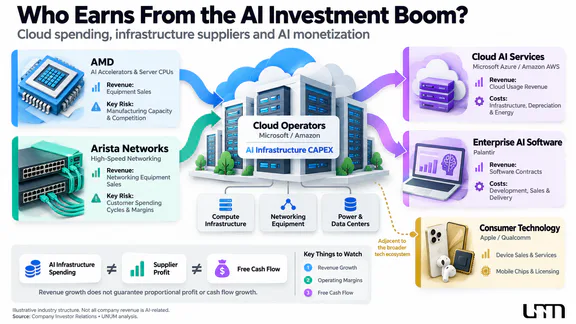
The main question for the new week is how much the increase in spending on AI infrastructure supports demand in related segments and turns into sustainable profits for suppliers.
Apple will release its earnings report on November 2. The results for the fourth fiscal quarter will allow an assessment of the demand for new iPhone models, business profitability, and the impact of component costs on electronics production. Of particular interest are management's forecasts for the holiday season, when consumer spending traditionally plays a significant role in the company's financial results.
For investors, the difference between the growth in the number of devices sold and the increase in revenue is important. Changes in average selling price, exchange rates, and sales structure can affect results even with relatively stable demand.
Palantir will report on November 2. In the second quarter of 2026, the company's revenue grew by 93% year-over-year to $1.94 billion, and the revenues of the American commercial division increased by 149%. For the third quarter, management forecasted revenue in the range of $2.160–2.164 billion.
New results will show how sustainable the demand for corporate AI solutions is and whether the growth rates justify the company's high market multiples. In addition to revenue, it is important to track the value of signed contracts, operating margin, and the forecast for the next quarter.
AMD will present its results on November 3. The main indicators will be sales of server processors and accelerators for artificial intelligence, the dynamics of the data center segment, and the demand forecast from cloud operators.
It is especially important to compare AMD's indicators with the results of Microsoft and Amazon. Strong growth in cloud infrastructure can support orders for computing equipment, but the actual revenues of chip manufacturers also depend on competition, production capacities, and product prices.
On the same day, Arista Networks, which supplies networking equipment for data centers, will report. Its results will allow an assessment of how much the construction of AI infrastructure increases demand for high-speed networks. On November 4, Qualcomm's report will complement the picture with the state of the mobile processor and consumer electronics market.
Thus, the reports of Apple and AMD, as well as the results of Palantir, Arista, and Qualcomm, will allow an assessment of different links in the technology chain. For stock market forecasts, the most important factors will not only be the growth rates of revenue but also the companies' ability to maintain margins, control capital expenditures, and confirm future demand.
Bitcoin to test demand resilience amid macroeconomic risks
For the cryptocurrency market, the week of November 2–6 will be determined not only by expectations regarding the Fed's policy but also by the state of liquidity following October's volatility.
On October 30, Bitcoin fell below $78,000, reaching a six-week low of around $77,600. The decline occurred amid weakening demand for risky assets and new concerns about the security of centralized cryptocurrency infrastructure following reports of an incident at Binance.
Institutional presence in the market continues to expand, but it does not in itself ensure stable price growth.
In UNUM's analysis of Wall Street's role in the Bitcoin market, it was already considered why the presence of large spot Bitcoin ETFs does not guarantee sustainable institutional demand. Funds can attract long-term capital, but their investors may also reduce positions when financial conditions worsen.
In the new week, the behavior of BTC after the NFP report and publications by American tech companies will be particularly interesting.
To assess the situation, it is necessary to compare three groups of indicators:
Flows into spot Bitcoin ETFs. Sequential inflows or outflows help assess demand direction through regulated exchange-traded products but do not reflect all operations in the BTC market.
Open interest and funding rates. Help determine whether price movement is accompanied by leverage accumulation and increased liquidation risk.
DXY, Treasury yields, and Nasdaq 100. Indicate changes in monetary conditions and investors' attitude towards risky assets.
Sequential inflows or outflows help assess demand direction through regulated exchange-traded products but do not reflect all operations in the BTC market.
If a weak employment report causes bond yields to fall but simultaneously intensifies a stock sell-off, Bitcoin may also come under pressure. Conversely, moderate employment slowdown without a sharp deterioration in economic prospects could support demand for risky assets.
Meanwhile, the correlation between Bitcoin and Nasdaq 100 changes over time. Therefore, a Bitcoin forecast for the week should consider not only macroeconomic data but also independent sources of demand, liquidity, and the structure of positions in the cryptocurrency derivatives market.
Market Guidelines for the Week
The financial market forecast for the week depends not only on the events themselves but also on how much the actual figures deviate from market consensus. For practical analysis, it is important to compare the behavior of several asset classes.
Key indicators:
US Treasury 2Y — change in expectations regarding the December Fed decision after the release of JOLTS and NFP.
US Treasury 10Y — bond market reaction to economic growth prospects, inflation, and budget uncertainty.
DXY — direction of the US dollar after elections and employment report.
Nasdaq 100 — resilience of tech stocks after new corporate results.
Brent — change in oil premium after the OPEC+ meeting and new reports from the Middle East.
BTC/USD — the ability of the cryptocurrency market to maintain demand amid changing global financial conditions.
The dynamics of two-year Treasuries and Nasdaq after Friday's NFP will be particularly indicative. If yields fall and stocks rise, the market may interpret the data as a basis for a less stringent Fed policy. However, if bonds rise simultaneously with a decline in stocks, this is more likely to indicate increased concerns about economic growth.
The short-term dollar forecast will also depend on how much employment data changes expectations for future rates compared to other major economies.
None of these combinations provide an independent trading signal. For confirmation, it is necessary to consider the dollar's reaction, credit spreads, and the dynamics of rate expectations.
Three Main Questions of the Week
1. Will the US labor market confirm the economy's resilience or change rate expectations?
After a GDP growth of 3.4%, the October NFP report will be an important test of the state of the US economy. Key factors will be the number of new jobs, unemployment, wages, and revisions of previous statistics.
2. Will the midterm elections change expectations regarding US economic policy?
Investors will assess possible changes in budget spending, taxes, and financial regulation. However, long-term consequences will depend on legislative decisions, not just the composition of the new Congress.
3. Can the tech sector confirm growth resilience after Big Tech reports?
Results from Apple, AMD, Palantir, and infrastructure equipment manufacturers will show how much demand for AI and electronics extends beyond cloud platforms and is accompanied by corporate profit growth.
Economic Calendar for the Week of November 2–6
Key dates are published in the official calendars of BLS, Census Bureau, ISM, Eurostat, the Bank of England, the Reserve Bank of Australia, and on company websites. The schedule of individual corporate publications and statistical releases should be additionally verified before the respective trading sessions.
The week of November 2–6 will test the global economy's ability to sustain growth amid high borrowing costs. The US labor market will show how resilient domestic demand is, elections will add uncertainty regarding budget policy, and corporate earnings will allow assessment of the tech sector's prospects.
For investors, the main focus will not be on individual NFP figures, rates, or quarterly earnings, but on the consistency of incoming signals. It is the reaction of the bond, currency, and stock markets that will help determine whether expectations for further asset growth are strengthening or whether financial conditions are gradually becoming a constraint for the global economy.