Why 2027 could be a turning point for the AI chip market
The semiconductor market forecast for 2027 depends on investments in AI infrastructure. Cloud computing and AI services are driving the server market, increasing demand for accelerators, memory, and networking equipment.
According to an October forecast by TrendForce, the combined capital expenditures of the nine largest cloud providers could exceed $1.5 trillion in 2027, increasing by 60% year-on-year. AI server shipments could grow by nearly 36%. These expenses include not only chips but also construction, cooling, and power supply for data centers.
Additional demand is created by inference — processing requests with trained models. As the audience grows, new computing power is required, but the final profit for suppliers depends on cost, competition, and the ability to fulfill orders.
Nvidia, AMD, and Broadcom intensify competition in the AI accelerator market
The main solutions in the market are graphics processing units (GPUs) and application-specific integrated circuits (ASICs). GPUs are suitable for various computations, whereas ASICs are optimized for specific workloads and can be more cost-effective with large volumes.
Nvidia relies on GPUs, server platforms, and CUDA. In the third quarter of fiscal year 2027, ending October 25, 2026, Data Center revenue reached $107.6 billion, increasing by 110% year-on-year. Blackwell and Vera Rubin support sales, but the high comparison base makes further acceleration challenging.
AMD is expanding deliveries of Instinct MI450 and Helios. In the third quarter of 2026, Data Center revenue reached $8.5 billion, increasing by 97%. Its opportunity for 2027 is to strengthen its position as an alternative to Nvidia.
Broadcom is developing ASICs and networking solutions. In September, the company forecasted about $115 billion in revenue from AI semiconductors for the fiscal year 2027, ending in October 2027. The result depends on large orders and component availability.
Demand for our specialized AI accelerators and networking solutions remains very high.
Google is expanding its lineup of proprietary TPUs, intensifying competition with GPUs. More on this can be found in UNUM's analysis of Google and Nvidia. Analysts' forecasts indicate that the prospects for Nvidia, AMD, and Broadcom are influenced by demand, order structure, and technological competition.
Why HBM and DRAM are becoming critically important for artificial intelligence
The performance of AI systems depends on the speed of data exchange between the processor and memory. Even a powerful accelerator cannot utilize its full potential if data is delivered slowly.
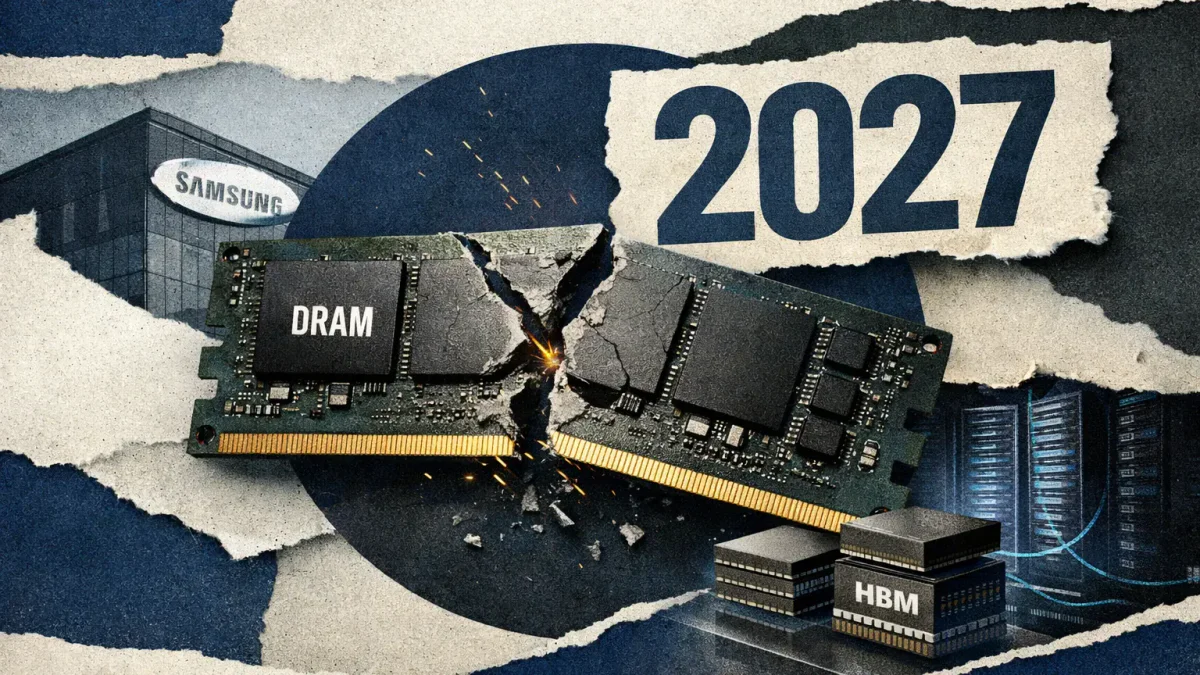
HBM (High Bandwidth Memory) is a type of DRAM with high bandwidth. Its chips are stacked in vertical layers and placed close to the computing chip. Traditional server DRAM serves as working memory for central processors and other components.
HBM4 and HBM4E enhance accelerator performance but complicate production. TrendForce expects limited HBM supply in 2027: new capacities are being introduced gradually and compete with regular DRAM production.
Micron, SK Hynix, and Samsung compete for leadership in memory production
SK Hynix is expanding HBM4 and DRAM production. In October, it announced agreements with 14 customers, with volumes equivalent to more than 50% of planned capacities for 2027 and 2028. The contracts increase sales predictability, but pricing risks remain.
Micron is advancing HBM and plans to commence mass production of HBM4E in 2027. The company is expanding its facilities and advanced packaging, but the timeline for bringing new capacities online limits supply growth.
“We cannot currently predict when memory supply will catch up with growing demand.” Sanjay Mehrotra, CEO of Micron, statement following the third quarter of fiscal year 2026.
Samsung produces DRAM, HBM, and NAND, as well as custom chips. The company has already begun shipping HBM4. Integration of manufacturing processes provides advantages but increases dependency on prices in different segments.
Why NAND might face overproduction in 2027
In the memory market in 2027, demand for HBM and server DRAM may sustain a shortage, while NAND supply risks exceeding demand. NAND Flash is used in SSDs and smartphones, so its market also depends on consumer electronics.
According to a forecast by TrendForce on November 19, NAND supply in bit terms could grow by 25–30% in 2027. Amid reduced orders from Chinese cloud companies, the agency expects contract prices to fall by 0–5% in the first quarter and further declines in major categories from the second quarter.
TrendForce's forecast differs from Micron's assessment on September 30: Micron anticipates a shortage of DRAM and NAND in 2027–2028, while TrendForce predicts an excess of NAND in 2027. The reason is differing expectations regarding demand and new capacities. The impact of memory prices on the profitability of tech companies was previously analyzed by UNUM using Apple as an example.
How TSMC benefits from increased semiconductor demand
Semiconductor production for AI includes accelerators and server processors. TSMC holds a significant position due to its advanced processes and CoWoS packaging, which integrates computing chips with high-speed memory.
On November 10, TSMC's board approved approximately $40.9 billion for capital projects, including the development of factories and packaging. Orders from competing GPU and ASIC developers create opportunities, but new capacities require high utilization.
Which companies have the best prospects in 2027
Developers of accelerators, memory manufacturers, and contract fabs benefit from the growth of AI infrastructure. However, technological success does not equate to stock profitability.
Company | Main Advantage | Main Risk |
|---|---|---|
Nvidia | GPU, server platforms, and CUDA | ASIC competition, high base |
AMD | Expansion of accelerator lineup | Strong Nvidia positions |
Broadcom | Custom ASICs and networks | Dependence on large clients |
SK Hynix | HBM4 and long-term contracts | Limited capacities |
Micron | HBM4E and server DRAM | Timing of new capacity introduction |
Samsung | DRAM, HBM, NAND, and manufacturing | Memory price fluctuations |
TSMC | Process technologies and CoWoS packaging | High capital expenditures |
The investment potential and stock performance of chip manufacturers depend on revenue, profitability, and market expectations. Main risks include:
Capital expenditures of cloud companies: their reduction will slow orders.
Supply and demand balance: new capacities change prices.
Payback of AI infrastructure: clients need income from services.
Technological competition: ASICs and new GPUs change supplier shares.
An optimistic scenario suggests maintaining a deficit and high orders, a base scenario involves supply growth with increased competition, and a negative scenario foresees investment slowdown and component surplus. The November sell-off of AI company stocks, reported by UNUM, shows that strong revenue does not preclude stock price declines.
In 2027, Nvidia, AMD, and Broadcom may benefit from demand for accelerators, SK Hynix, Micron, and Samsung from memory, and TSMC from manufacturing. Results will determine the resilience of orders, cost of goods sold, and AI project payback.