

XPD
XPD · Troy ounce
Loading chart…


Palladium is a precious metal of the platinum group, primarily used in automotive catalysts, as well as in the chemical industry, electronics, and other sectors. In financial markets, palladium is represented by physical metal and related exchange-traded and over-the-counter instruments. Its value depends on industrial demand, mining volumes, recycling, and the state of the global economy. For traders and investors, palladium quotes, supply and demand balance, automotive industry development, and supply disruption risks are of particular importance.
What is palladium and how does it differ from other precious metals
Palladium (Pd) is a rare silvery-white metal with atomic number 46, belonging to the platinum group. Its key properties include corrosion resistance, the ability to accelerate chemical reactions, and hydrogen absorption. These catalytic properties largely determine the metal's industrial applications.
Unlike gold, which is widely used as an investment and reserve asset, palladium is significantly more dependent on industrial consumption. Therefore, its market value is largely determined by the state of industrial sectors, especially the automotive industry.
In terms of industrial application, palladium has similarities with some other precious metals. For example, silver is also in demand in electronics production and various technological components. However, demand for palladium is much more dependent on the automotive industry, making it sensitive to changes in exhaust gas cleaning technologies.
In financial markets, palladium is designated by the code XPD. The designation XPD/USD is used for quoting palladium in US dollars per troy ounce. The specific source of quotes and trading conditions depend on the platform and market data provider.
Where palladium is used
The primary consumer of palladium remains the automotive industry. The metal is used in catalytic converters, which help reduce harmful substances in the exhaust gases of internal combustion engine vehicles.
In catalytic converters of gasoline vehicles, palladium aids in the oxidation of carbon monoxide and unburned hydrocarbons. Along with other components of the catalytic system, it helps ensure vehicles meet environmental standards.
Dependence on the automotive industry makes demand for palladium sensitive to car production volumes, the spread of electric vehicles, and changes in environmental legislation.
Beyond the automotive sector, palladium is used in several areas:
- Chemical industry. Used in chemical synthesis, including hydrogenation reactions and other catalytic processes.
- Electronics. Used in certain electronic components, contacts, and special coatings.
- Oil refining. Used in some catalytic processes.
- Medicine and dentistry. Part of certain alloys and specialized materials.
- Jewelry manufacturing. Used alone and in alloys, including in the production of white gold.
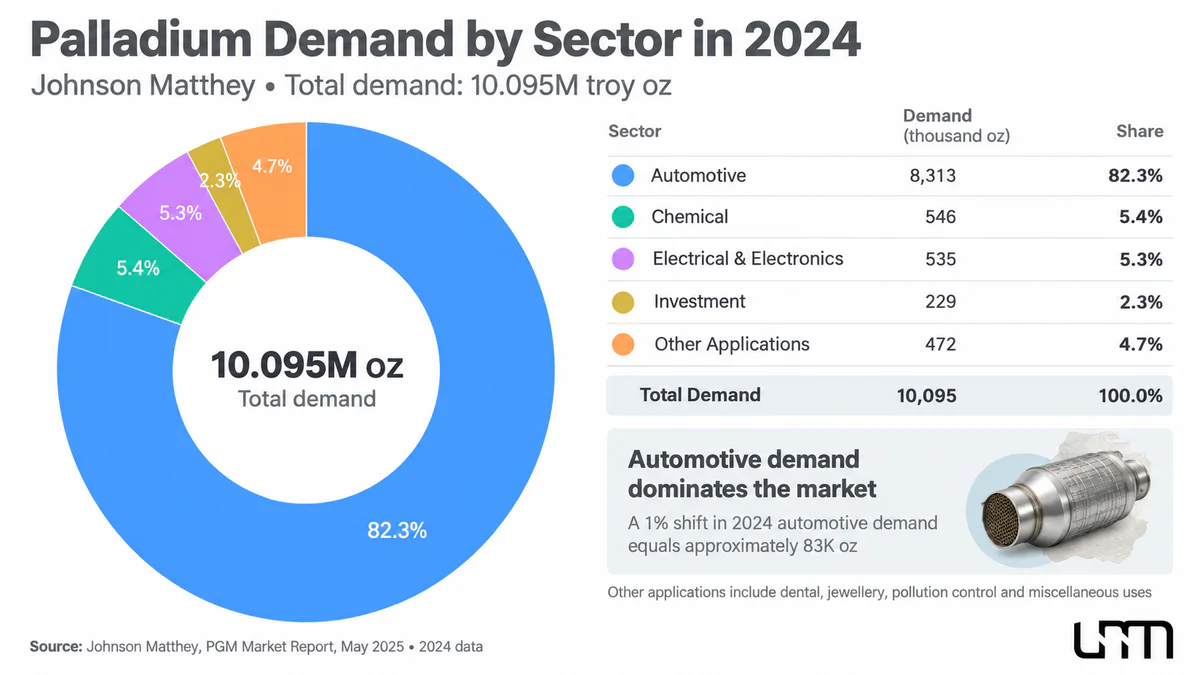
The share of individual sectors in global palladium consumption varies significantly. According to data from Johnson Matthey, cited in the abrdn Physical Palladium Shares ETF report, automotive catalysts accounted for an average of 84.2% of global palladium demand from 2015 to 2024. Therefore, changes in automotive production can have a more noticeable impact on the market than fluctuations in consumption in other sectors.
How the price of palladium is formed
The price of palladium is formed under the influence of supply and demand in the physical market, financial participants' operations, and expectations regarding the future state of the industry.
One of the international price benchmarks is the LBMA Palladium Price, which is set based on the results of two daily London auctions. Since July 2026, the indicator has been administered by ICE Benchmark Administration. Alongside this benchmark, market participants use exchange-traded futures quotes, physical transaction prices, and other market data.
The main international benchmark is the price of palladium per ounce, expressed in US dollars. One troy ounce is approximately equal to 31.1035 grams. Therefore, changes in the dollar exchange rate can affect the cost of palladium for buyers using other currencies, although this relationship is not constant.
The price of palladium per gram is calculated by dividing the cost of a troy ounce by 31.1035. For example, at a hypothetical price of $1,000 per ounce, one gram of metal costs approximately $32.15, excluding commissions and trading markups. This calculation allows for the comparison of international exchange quotes with physical metal prices, which may be quoted in grams.
An important feature of pricing is the relatively small market size and concentration of supply. Significant changes in expected supplies can noticeably affect quotes, especially in conditions of limited metal reserves available for delivery.
Supply and demand balance
If palladium consumption exceeds the combined supply from mining and recycling, a market balance deficit forms, which can be covered by existing reserves. A prolonged reduction in available reserves can increase pressure on prices.
When supply exceeds consumption, a surplus forms. In such a situation, stockpiling can limit price growth if additional volumes are not absorbed by industrial or investment demand.
However, a deficit does not guarantee a price increase, nor does a surplus guarantee a decrease. The financial market primarily reacts to expected changes in balance, the availability of accumulated reserves, and the extent to which new data is already reflected in quotes.
Role of the financial market
Apart from physical deliveries, the dynamics of palladium depend on futures trading, investment fund operations, and changes in the positions of futures market participants.
An increase in demand for futures contracts may be accompanied by rising quotes, especially if it reflects higher price expectations and encounters limited liquidity. Closing large positions, on the other hand, can amplify short-term price fluctuations.
However, purchasing a futures contract in itself does not imply additional physical demand for the metal. The impact of financial operations does not negate palladium's dependence on industrial consumption and real supply.
What influences the price of palladium
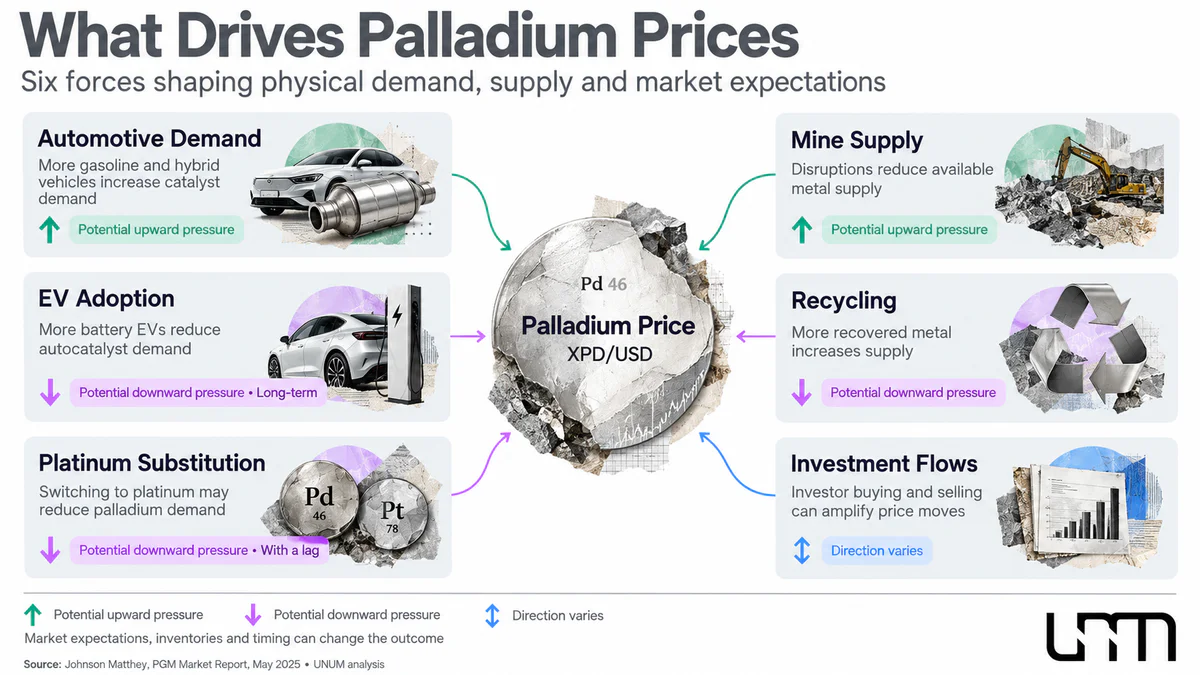
Palladium quotes are simultaneously affected by production, technological, macroeconomic, and geopolitical factors. The influence of each depends on the current balance of supply and demand, the state of physical inventories, and market expectations.
Automobile production
Automobile manufacturing is a major source of physical demand for palladium. An increase in the production of gasoline-powered vehicles, all else being equal, raises the need for catalytic systems and the metals used in them.
Demand is influenced not only by the number of vehicles produced but also by the amount of palladium used in a single catalytic converter. Stricter environmental requirements may increase the need for precious metals, although manufacturers simultaneously improve designs and strive to reduce the consumption of costly materials.
Therefore, an increase in automobile production does not always lead to a proportional rise in palladium consumption.
The spread of electric vehicles
Fully electric vehicles, which run solely on batteries, do not require traditional exhaust gas cleaning catalysts. An increase in their share of global sales can gradually reduce potential demand for palladium.
However, hybrid vehicles with internal combustion engines continue to use exhaust cleaning systems. Their spread may partially compensate for the reduction in metal consumption in the segment of conventional gasoline vehicles.
For long-term market assessment, it is important to analyze the structure of automobile production, not just the total sales volume of electric vehicles.
Supply disruptions
Global palladium production is geographically concentrated, so supplies depend on a limited number of mining regions and large enterprises.
Metal availability can be affected by power outages, accidents, transportation restrictions, sanction risks, and changes in export logistics. Even a temporary reduction in supplies from a major producer can heighten concerns about the availability of physical metal and cause price fluctuations.
The impact of such events depends on the size of accumulated stocks, the expected duration of restrictions, and the ability to compensate for missing volumes from other sources.
Recycling of automotive catalysts
Secondary production is an important source of palladium supply. The metal is extracted from used automotive catalysts and returned to industrial circulation.
The volume of recycling depends on the number of vehicles being scrapped, the efficiency of catalyst collection, and the economic attractiveness of extracting precious metals.
A rise in palladium prices can stimulate recycling, as it increases potential revenue from metal extraction. However, there is a time lag between changes in quotes and the actual expansion of secondary supply.
Recycling can partially offset mining constraints, but its volume depends on the state of the automotive market and the availability of used catalysts.
Substitution of palladium with platinum
Palladium and platinum have similar catalytic properties, so manufacturers of automotive systems can adjust the ratio of these metals in the design of catalysts.
A high price of palladium relative to platinum can stimulate partial substitution if the technical characteristics of the catalytic system allow the use of platinum without compromising the required efficiency.
However, changing the composition of catalysts requires testing, adaptation of production processes, and confirmation of compliance with environmental requirements. Therefore, the industrial demand response to changes in price ratios manifests with a delay.
For fundamental analysis, it is important to track the quotes of both metals. Changes in their relative value can signal strengthening or weakening economic incentives for technological substitution.
Macroeconomic conditions
A slowdown in the global economy may reduce car sales and industrial consumption of precious metals. Conversely, a recovery in production and consumer demand can support the market.
Additional influences include interest rates, exchange rates, financing costs, and investment sentiment. For example, rising rates can increase the cost of borrowed capital and restrain economic activity, which indirectly affects industrial demand.
Palladium should not be considered a complete analog of gold. Its dynamics are largely determined by the industrial cycle, so during periods of economic instability, the metal may depreciate even with increased interest in certain safe-haven assets.
Mining and global supply of palladium
Palladium is primarily extracted during the development of complex deposits of nickel, copper, and platinum group metals. Therefore, its production volume often depends not only on its own market price but also on the economic conditions of mining associated metals.
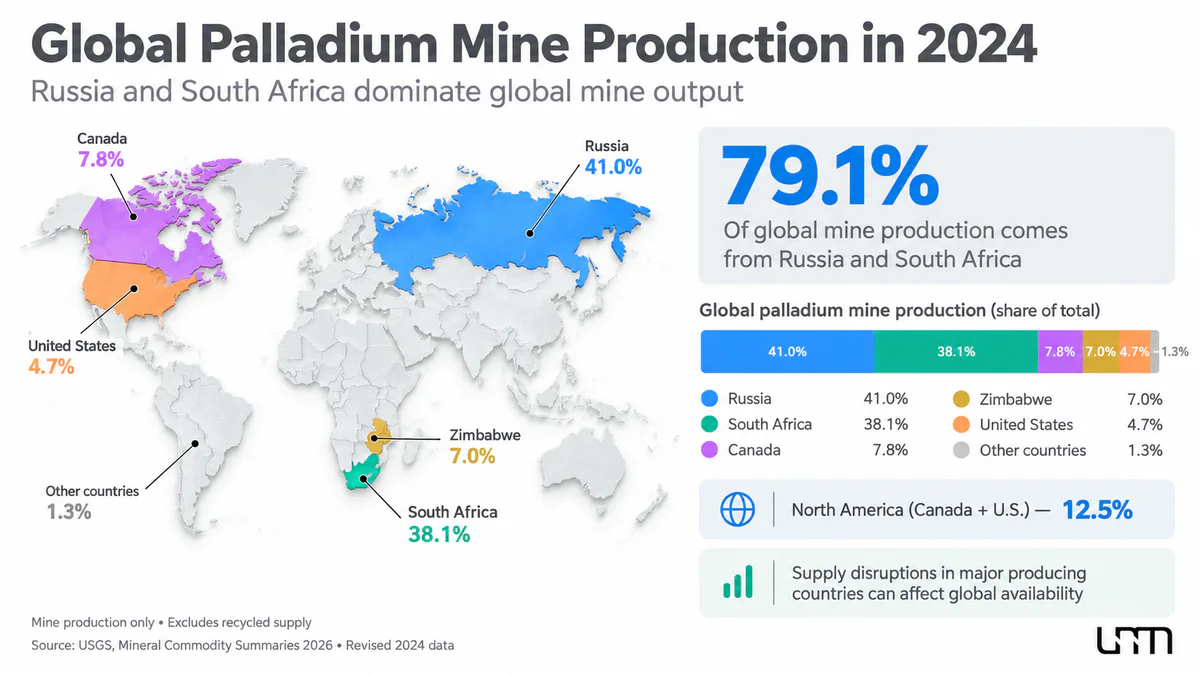
The main production regions include Russia, South Africa, and North America. According to industry statistics for 2024, the combined share of Russia and South Africa in global palladium production exceeded 77%.
The structure of production varies: at some deposits, palladium constitutes a significant portion of the extracted platinum group metals, while at others it is mainly obtained as a byproduct in the production of nickel and copper.
High concentration of supply increases the market's dependence on production conditions in specific regions. It can be challenging to quickly compensate for the reduction in production from one major enterprise by other suppliers.
Why palladium supply is inelastic
Creating new mining capacities can take many years. This requires geological exploration, capital investments, infrastructure construction, and commissioning of enterprises.
Expanding production at existing enterprises depends on available capacity reserves, ore composition, technological capabilities, and the profitability of associated metals.
If palladium is extracted as a byproduct, an increase in its price does not necessarily lead to increased production. Production decisions may primarily be determined by the economics of nickel, copper, or other platinum group metals.
Therefore, even a significant increase in prices does not guarantee a rapid expansion of supply. This feature is particularly important during periods of shortage when supply delays or production cuts can trigger a strong market reaction.
How to trade palladium on financial markets
Investments in palladium are available through physical metal, exchange-traded funds, futures, and other instruments, which vary in liquidity, capital requirements, and risk levels.
Palladium trading can be conducted through exchange-traded futures and over-the-counter derivatives, while long-term ownership is possible through physical metal and certain exchange-traded investment products.
Physical palladium
Investors can purchase palladium in the form of bars and other investment products if they are available in the relevant jurisdiction.
Physical ownership provides direct access to the metal without the use of derivatives but involves costs for storage, insurance, and transactions.
Additionally, the spread between the purchase and sale price of physical palladium can be significant. This limits the attractiveness of the instrument for short-term trading.
Palladium futures
Futures allow participation in the price changes of palladium through standardized exchange contracts.
One of the main platforms is NYMEX, part of the CME Group. The size of a standard deliverable palladium futures contract is 100 troy ounces, and its exchange code is PA.
For example, at a hypothetical palladium price of $1,000 per troy ounce, the nominal value of one standard contract is $100,000. A price change of $10 per ounce corresponds to a position value change of $1,000 before accounting for commissions and other expenses.
Futures trading requires margin deposits, which may represent only a portion of the contract's nominal value. This creates a leverage effect: small price changes can lead to significant profits or losses relative to the deposited capital.
When dealing with futures, it is necessary to consider contract expiration dates, delivery conditions, liquidity of individual contracts, and the risk of forced position closure due to insufficient margin.
Palladium CFDs
CFDs (Contracts for Difference) are over-the-counter derivatives that allow trading on palladium price changes without purchasing and physically owning the metal. A trader enters into an agreement with a broker, and the financial result is determined by the difference between the opening and closing prices, taking into account trading costs.
CFDs allow opening positions on both rising and falling palladium prices. Trading is usually conducted with leverage: to open a position, only a portion of its nominal value needs to be deposited as margin. This lowers initial capital requirements but simultaneously increases potential profits and losses relative to the deposited funds.
For example, at a hypothetical palladium price of $1,000 per ounce, a position of 10 ounces has a nominal value of $10,000. If the broker's conditions provide for a leverage of 1:10, $1,000 is required to open it. A 5% change in the metal's price will result in a profit or loss of $500 before trading expenses, corresponding to 50% of the initial margin.
When trading CFDs, it is necessary to consider the spread, possible commissions, costs of carrying the position overnight, and the risk of forced closure due to insufficient funds. Additionally, since CFDs are over-the-counter instruments, order execution conditions and quote formation depend on the broker. The availability of CFDs, leverage restrictions, and client protection measures vary by jurisdiction.
CFDs can be used for short-term palladium trading, but the high volatility of the metal combined with leverage makes such operations particularly risky.
Exchange-traded funds
Certain exchange-traded investment products provide access to palladium prices without the need for self-storage of the physical metal.
When choosing such an instrument, it is important to consider its legal structure, the presence of physical backing, fees, trading currency, and the specifics of tracking the value of the underlying asset.
The availability of such products depends on the country, broker, and investor category.
Shares of mining companies
An indirect way to participate in the palladium market is to buy shares of companies engaged in mining platinum group metals.
However, the quotes of such shares depend not only on the price of palladium but also on the financial condition of the enterprise, production costs, corporate structure, debt load, and prices of other mined metals.
Therefore, shares of mining companies cannot be considered a complete analogue of investments in physical palladium.
Over-the-counter derivatives
Some brokers provide access to contracts for difference and other over-the-counter instruments related to palladium quotes.
Such products allow opening positions on price increases and decreases but may involve leverage, position rollover costs, spread widening, and counterparty risk.
Trading conditions vary significantly between brokers and jurisdictions, so they need to be evaluated separately.
How to analyze palladium quotes
Fundamental and technical approaches can be used to analyze palladium quotes. The industrial specifics of the metal make information about automobile production, mining, processing, and physical inventories particularly important.
Fundamental analysis
Fundamental analysis is based on assessing the expected balance of supply and demand.
Traders and investors can track the following indicators:
- Production volumes of internal combustion engine vehicles.
- The share of fully electric and hybrid vehicles.
- Production indicators of major mining companies.
- Volumes of palladium obtained from the recycling of spent automotive catalysts.
- Forecasts of industrial metal consumption.
- The price ratio of palladium to platinum.
- The dynamics of the US dollar and general macroeconomic conditions.
- Changes in inventories and the availability of physical metal.
Discrepancies between market expectations and published data play a special role. If a reduction in automotive demand is already priced in, its confirmation may not necessarily lead to further price declines.
Conversely, an unexpected supply restriction can cause a strong reaction even without an immediate change in actual metal consumption.
Technical analysis
Technical analysis is used to assess price trends, trading ranges, support and resistance levels, and changes in volatility.
When analyzing palladium, it is necessary to consider the liquidity of the specific instrument: physical market, futures contract, or over-the-counter derivative product. Large trades in a market with insufficient depth can cause sharp price fluctuations, and levels that worked well in the past do not guarantee a similar reaction in the future.
When analyzing exchange-traded futures, it is useful to compare price dynamics with trading volumes, open interest, and current fundamental events.
Technical signals should not be considered in isolation from the state of the physical market.
Main risks of investing in palladium
Palladium is an asset with high sensitivity to changes in industrial demand and limited supply.
Risk of declining automotive demand. The spread of fully electric vehicles and advancements in catalyst technologies may gradually reduce metal consumption.
Risk of technological substitution. The use of platinum and the reduction of palladium in certain catalytic systems can change the long-term demand structure.
Risk of high volatility. The concentration of supply and the relatively small market size create conditions for sharp price fluctuations.
Geopolitical risk. Export restrictions, logistical problems, and disruptions in mining regions can affect the physical availability of the metal.
Liquidity risk. Spreads and market depth vary between instruments. Under unfavorable conditions, executing large orders may occur at less favorable prices.
Leverage risk. Margin derivatives allow opening positions with a nominal value exceeding the deposited collateral, increasing the risk of significant losses.
Unlike gold, which is widely used by central banks and investors for reserve and portfolio diversification, palladium is much more dependent on the industrial cycle. For this reason, its price may decline during periods of economic uncertainty even when certain safe-haven assets appreciate.
When assessing risks, it is useful to compare the dynamics of palladium with the prices of other precious metals. However, such comparisons should be supplemented by an analysis of the supply and demand structure, as short-term price movements do not imply the same influence of fundamental factors.
The significance of palladium for financial markets
Palladium holds a special position among precious metals due to its close connection with the automotive industry and the high concentration of global production. To assess its market prospects, it is necessary to consider the development of automotive technologies, mining and processing volumes, the price ratio with platinum, and the state of physical inventories. The combined impact of these factors influences the long-term market balance and the nature of price fluctuations.
You can compare the movement of palladium with other metals and commodity assets in the commodity quotes section of The Unum.
About commodities
Palladium is a precious metal whose price is closely linked to the automotive industry and global raw material supply. We explore how palladium quotes are formed, what factors influence its value, where the metal is mined, and what tools are available for traders and investors.