


TTF
TTF · MWh
Updated 12:25
96.085 EUR
-0.596 (-0.62%)


TTF Natural Gas is natural gas traded with the transfer of ownership rights at the virtual hub Title Transfer Facility (TTF) in the Netherlands. TTF transaction and derivative quotes serve as one of the main price benchmarks for the European gas market. For traders and investors, the level of storage reserves, LNG supplies, weather conditions, industrial demand, and geopolitical factors are of utmost importance.
What is TTF and how does the gas hub work
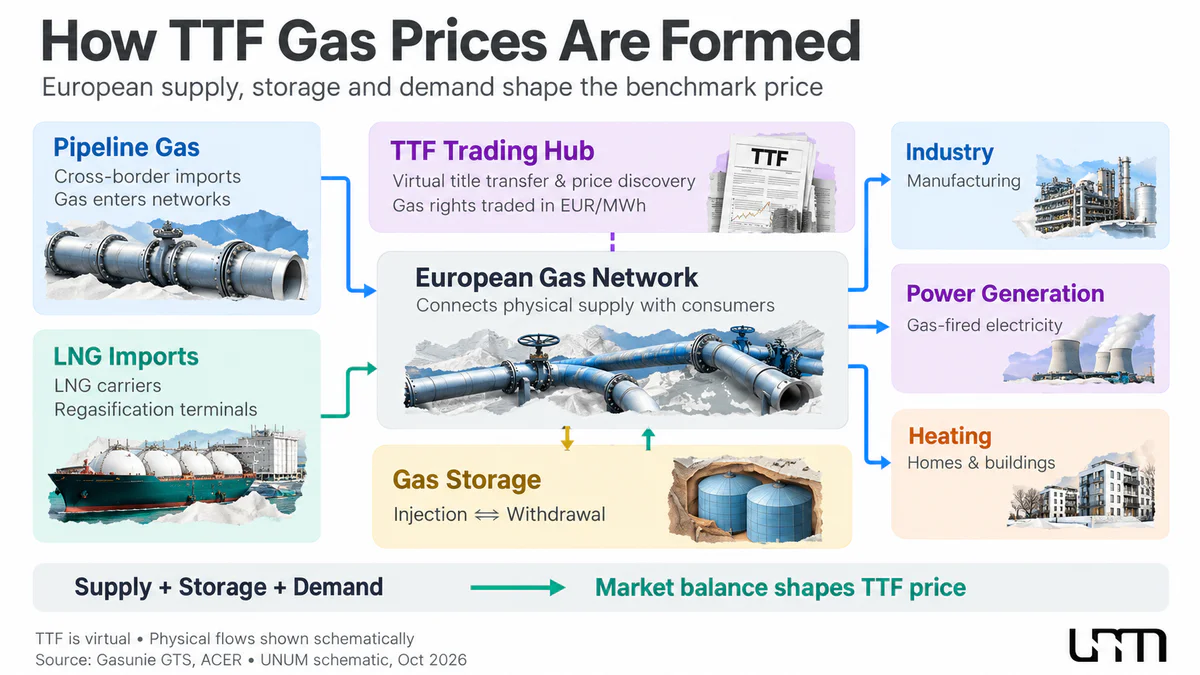
TTF (Title Transfer Facility) is a virtual trading hub operating within the gas transportation system of the Netherlands. It allows market participants to transfer ownership rights to natural gas without the need to specify a specific physical point of gas transfer for each transaction.
The TTF hub was established in 2003 and subsequently became the largest European gas trading center by transaction volume. The developed gas transportation infrastructure of the Netherlands, connections with neighboring markets, and high trading activity contributed to the formation of a liquid price benchmark used far beyond the country.
It is important to distinguish TTF as a trading hub from natural gas as a physical commodity. TTF does not denote a specific type of gas or field. It is a virtual point of ownership transfer on which transactions with various delivery terms are based.
TTF quotes are used by gas companies, industrial consumers, electricity suppliers, financial organizations, and traders to determine gas costs and manage price risks.
TTF Natural Gas Price and Quotation Features
Standard TTF gas futures quotes are expressed in euros per megawatt-hour (EUR/MWh). In the physical market, the price can also be indicated in these units, as natural gas is valued based on the energy it contains.
A megawatt-hour (MWh) is a unit of energy equal to 1,000 kilowatt-hours. The gas price per MWh allows for comparing the cost of supplies with different physical volumes and calorific values of the fuel.
For example, at a hypothetical price of €40/MWh, the cost of a gas volume with an energy content of 100 MWh would be €4,000 excluding transportation costs, taxes, and other expenses. This is a calculated example, not the current TTF quote.
When analyzing gas costs, it is important to understand which specific indicator is displayed on the chart:
- Spot price reflects the cost of gas with the nearest delivery terms.
- Futures price refers to a specific future delivery period, such as the next month.
- Continuous futures chart combines quotes of consecutive contracts and is used for long-term period analysis.
The cost of the nearest future may differ from the spot price due to differences in delivery terms, expected market balance, seasonal factors, and the economic cost of gas storage.
Therefore, the TTF chart should be evaluated taking into account the type of contract, delivery period, and source of market data.
How TTF Gas Price is Formed
The TTF gas price is formed as a result of the interaction between buyers and sellers in the physical and futures markets. Participants assess available supplies, expected consumption, storage capabilities, and the alternative cost of gas in other markets.
In the spot market, the balance of the nearest supplies and consumption is of primary importance. In the futures market, expectations for the following months and seasonal delivery periods are additionally taken into account.
For example, a forecast of a cold winter may increase the cost of contracts for winter months even before actual consumption rises. Similarly, announcements of new LNG production capacities can affect distant futures if participants expect an increase in supply.
The TTF price is not a single regulated gas price for end consumers in Europe. Wholesale quotes serve as a benchmark, while the final cost of the energy resource depends on the national market, transportation, distribution tariffs, taxes, and contract conditions.
Spot and Futures Markets
Spot transactions reflect the cost of gas for the nearest delivery terms, including the next gas day. Such quotes are particularly sensitive to unexpected weather changes, current infrastructure constraints, and short-term buyer needs.
Futures contracts allow for fixing the gas price in advance for a specific future period. For producers, suppliers, and large consumers, this is a risk management tool, while for traders, it is a way to participate in expected price changes.
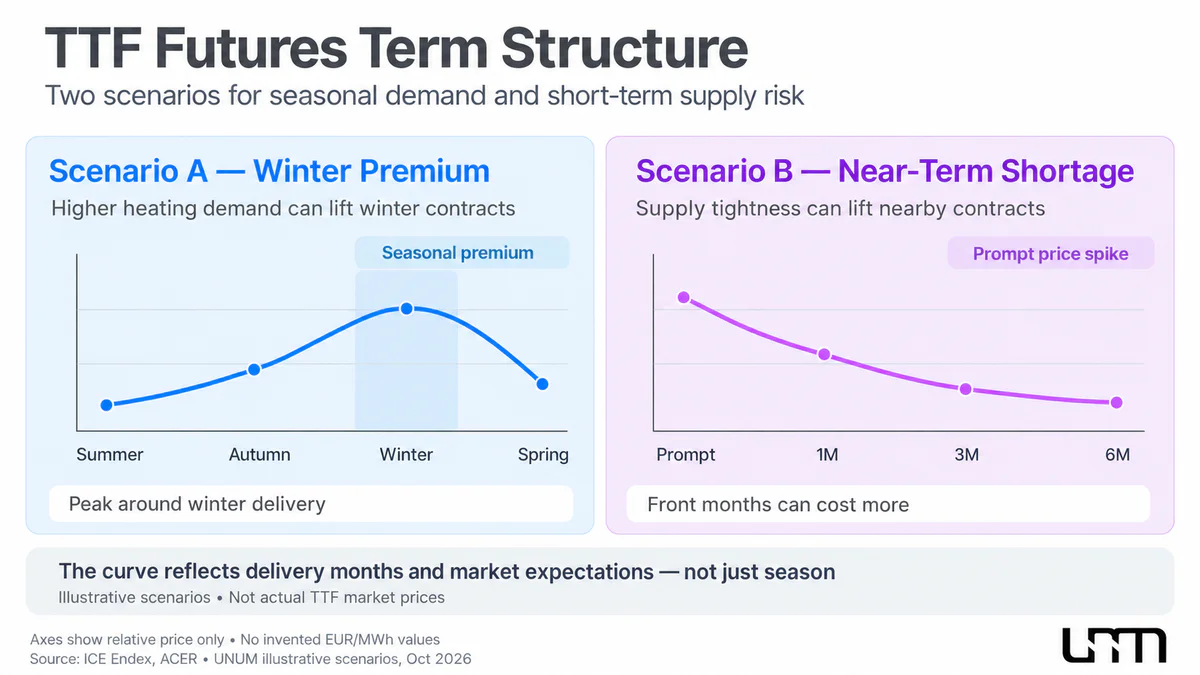
At the same time, quotes for different months can vary significantly. During periods of expected high winter demand, contracts for the heating season may trade higher than summer ones, although the actual shape of the price curve depends on market conditions.
What Influences the TTF Natural Gas Price
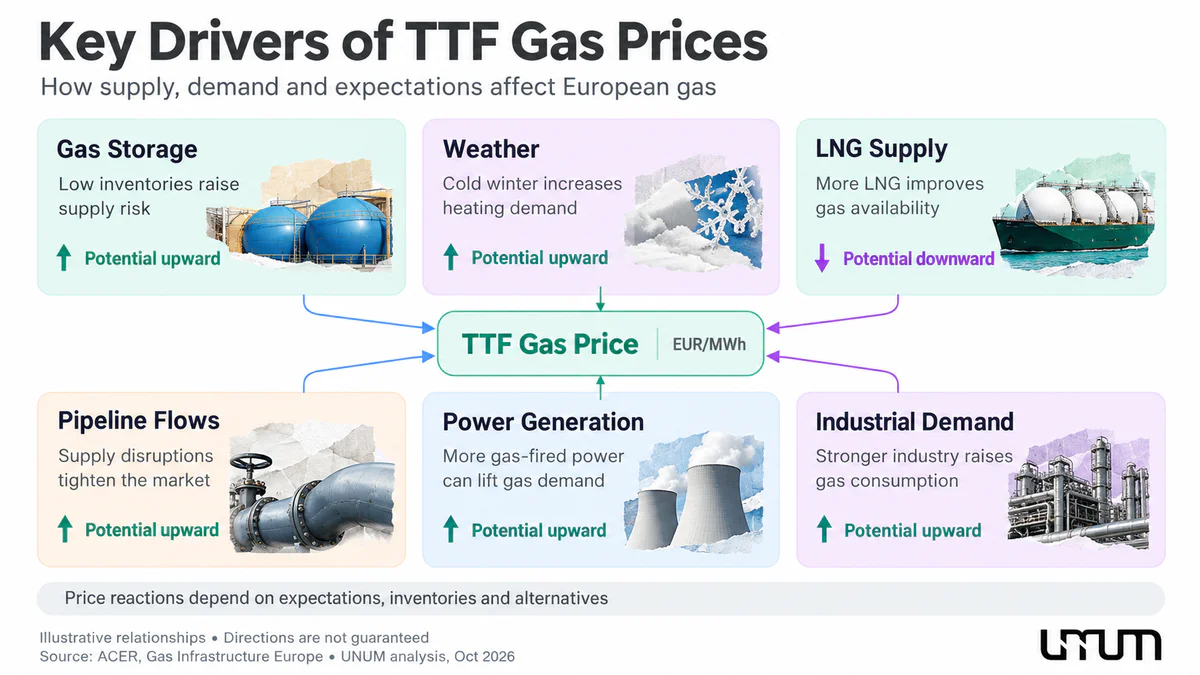
The European gas market is sensitive to seasonality, international LNG trade, the state of pipeline infrastructure, and changes in energy consumption. The significance of individual factors depends on the ratio of available supplies, reserves, and expected consumption.
Gas Reserves in European Storage
Underground gas storage facilities (UGS) allow for accumulating fuel during periods of relatively low consumption and using it in winter when heating demand increases.
The level of storage fill is one of the most important indicators for analyzing TTF quotes. High reserves can reduce concerns about fuel shortages, while low reserves increase the need for additional purchases.
However, one percent of fill does not provide a complete picture. It is important to consider the absolute volume of gas, expected temperatures, withdrawal and injection rates, available storage capacity, and forecasted supplies.
For example, the same level of storage is evaluated differently by market participants at the beginning of autumn and at the end of winter. In autumn, inventories are considered with the upcoming heating season in mind, while in spring, they are viewed in terms of the need to replenish them for the next winter.
Weather Conditions and Seasonality
Weather directly affects the demand for natural gas, primarily through the heating of residential and commercial buildings.
A cold winter increases fuel consumption and accelerates the withdrawal of gas from storage. If supply issues arise simultaneously, the TTF price can rise particularly quickly.
A mild winter, on the other hand, can reduce consumption and allow for a larger volume of gas to be retained in storage by the beginning of spring.
In the summer months, heating demand usually falls, but gas continues to be injected into storage in preparation for the next heating season. Therefore, the need for imports remains even with relatively low current consumption.
For traders, changes in weather forecasts relative to previously formed expectations are especially important. If the market already anticipates a cold winter, confirmation of the forecast does not necessarily lead to additional price increases.
LNG Imports
Liquefied natural gas (LNG) plays a crucial role in Europe's supply. It is obtained by cooling natural gas to a liquid state, allowing the fuel to be transported by sea over long distances.
After delivery, LNG is sent to terminals where it undergoes regasification and is directed into the gas transmission network.
The growing importance of LNG has strengthened the connection between the European market and international gas trade. European buyers compete for available cargoes with importers from Asia and other regions.
One of the price benchmarks for the Asian LNG market is JKM (Japan Korea Marker). Comparing JKM and TTF quotes helps assess competition between European and Asian buyers; however, to determine the attractiveness of supplies, transportation costs and other deal conditions must be considered.
The difference between European and Asian prices creates opportunities for LNG geographical arbitrage, where suppliers direct flexible volumes to the market with a more attractive price after accounting for logistics costs.
If prices in the Asian market rise, some flexible LNG supplies may be redirected there, where deliveries provide higher revenue after accounting for transportation and other costs. In such a situation, European buyers may need to offer a higher price to attract additional volumes.
The reverse process is also possible: an increase in global LNG production or a decrease in demand in Asia can improve gas availability in Europe.
Pipeline Supplies and Geopolitics
Despite the development of the LNG market, pipeline gas remains an important component of Europe's energy supply.
Import volumes depend on the available production and export capacities of suppliers, pipeline throughput, the technical condition of infrastructure, and international agreements.
Accidents, transit restrictions, sanctions, and geopolitical conflicts can change the availability of gas and supply routes. Their impact is especially noticeable when buyers have few options to quickly replace missing volumes.
To assess such events, it is important to consider not only the announced size of supply reductions but also the possibilities of compensation through LNG, other pipelines, and storage inventories.
Electricity Generation
Natural gas is used in power plants, so its consumption dynamics are linked to the state of the European electricity market.
When the output of wind and solar power plants decreases, gas-fired plants may increase production to meet the energy system's needs. This raises fuel demand.
When renewable energy generation increases, the need for gas-fired generation may decrease, all else being equal.
However, the actual impact depends on the energy system's structure, the availability of nuclear and hydroelectric power, electricity prices, and carbon emissions.
Industrial Demand
Gas is used in the chemical industry, metallurgy, fertilizer production, glass manufacturing, and other energy-intensive sectors.
An increase in industrial production can raise fuel consumption, while an economic downturn and high energy costs can reduce it.
With prolonged price increases, some enterprises reduce production, improve energy efficiency, or switch to alternative energy sources if technically feasible.
Therefore, high gas prices can gradually limit demand on their own, although the speed of such adaptation varies between industries.
European Gas Market and the Role of TTF
TTF is used as a price benchmark in physical deliveries and financial contracts for natural gas. Its significance for the European market is linked to high liquidity and the ability to make deals for various delivery terms.
However, Europe does not represent a single market with an absolutely uniform price. Individual countries and trading zones have their own gas hubs, and delivery costs may vary due to infrastructure constraints, tariffs, and local supply-demand balances.
In addition to TTF, other price benchmarks are used in the European gas market, including the UK NBP (National Balancing Point). The difference between their quotes can reflect regional infrastructure constraints and demand characteristics.
The reduction of Russian pipeline supplies has changed the structure of European imports and increased the significance of LNG. This has heightened the dependency of European prices on global competition for gas cargoes.
For traders, this means the need to monitor not only European indicators but also changes in global LNG supply, its cost in Asia, and the availability of maritime transport.
How TTF differs from Henry Hub
TTF and Henry Hub are among the most important natural gas price benchmarks, but they reflect the conditions of different regional markets.
TTF is formed in the European trading system, where imports, gas storage, and international competition for LNG play a significant role.
Henry Hub is a physical gas hub in the U.S. state of Louisiana. Its quotes serve as the main benchmark for the U.S. natural gas market, which relies on large domestic production.
| Characteristic | TTF | Henry Hub |
| Regional Market | Europe | USA |
| Type of Hub | Virtual gas transfer point | Physical gas hub |
| Typical Price Unit | EUR/MWh | USD/MMBtu |
| Main Factors | LNG imports, pipeline supplies, European storage and demand | U.S. production, domestic storage, weather, LNG exports |
| Role | European price benchmark | American price benchmark |
The difference between TTF and Henry Hub prices changes over time. For an accurate comparison, quotes must be converted to a common currency and energy unit.
One million British thermal units (MMBtu) is approximately equal to 0.2931 MWh, so direct comparison of numerical values in EUR/MWh and USD/MMBtu is incorrect.
The difference between the two benchmarks can serve as one of the indicators of the economic attractiveness of U.S. LNG supplies to Europe, but it is not equal to the exporter's profit: the entire cost chain and contract conditions must be considered.
How to trade TTF natural gas
TTF gas trading is available through various financial instruments, the conditions of which vary significantly. Professional participants in the physical market make deals for gas delivery, while financial traders can use exchange-traded and over-the-counter derivative contracts.
TTF gas futures
TTF futures allow deals to be made with prices linked to the cost of natural gas on the European market for a specific future period. They are used for both hedging price risks and speculative trading.
One of the main platforms is ICE Endex, where Dutch TTF Natural Gas Futures contracts are traded.
The standard Dutch TTF Natural Gas Futures contract on ICE Endex is deliverable: execution occurs through the transfer of rights to gas at the TTF virtual trading point.
One lot of a standard futures contract corresponds to a capacity of 1 MW for each hour of the delivery period. The total energy volume depends on the number of hours in this period.
For example, for a hypothetical month lasting 30 days without transitioning to daylight saving or standard time, the volume of one lot is 720 MWh. At a price of €40/MWh, its nominal value is €28,800.
The minimum size of a standard electronic deal on ICE Endex is five lots. For the example considered, this corresponds to 3,600 MWh and a nominal value of €144,000. A price change of €1/MWh will change the position value by €3,600 before trading costs are accounted for.
For certain transaction mechanisms, including EFP, EFS, and block trades, different minimum size requirements apply. The actual number of delivery hours may also differ during transitions to daylight saving or standard time.
Futures trading involves posting margin, which may be less than the nominal value of the position. This creates a leverage effect: relatively small price changes can lead to significant profit or loss relative to the capital invested.
When choosing a contract, it is necessary to consider the delivery month, liquidity, exchange fees, margin requirements, and execution procedure. For financial traders, it is especially important to monitor the expiration dates of deliverable futures.
Futures curve and seasonality
The TTF futures curve shows the prices of contracts with different delivery periods. It helps assess how market participants distribute expectations regarding gas costs for the near and more distant months.
When the prices of successive futures contracts rise as the delivery date extends, it is called contango; with the reverse structure, it is called backwardation. In the gas market, these terms should be used considering the pronounced seasonality of contracts.
Winter contracts may include a premium for increased heating demand, but this does not mean that the entire futures curve is constantly in contango.
In the event of a short-term deficit threat, the nearest deliveries may become more expensive than subsequent ones. Therefore, the shape of the curve depends on a combination of seasonal factors, stock availability, expected supplies, and the current market state.
For analysis, it is useful to consider not only the price of the nearest contract but also the difference between summer and winter futures, as well as changes in these ratios over time.
CFD on TTF natural gas
CFDs (contracts for difference) are over-the-counter derivative instruments that allow trading on the price changes of TTF gas without physical delivery of the fuel.
The financial result is determined by the difference between the opening and closing position prices, taking into account the spread, commissions, and other costs. CFDs allow opening long positions in anticipation of price increases and short positions in anticipation of price decreases.
Many brokers offer leveraged CFD trading. It allows opening a position whose nominal value exceeds the deposited margin, but significantly increases the risk of losses relative to the initial margin.
Consider a hypothetical CFD, the size of which is equivalent to 100 MWh of gas, with the underlying instrument price at €40/MWh. The nominal value of the position is €4,000. If the broker's conditions allow for a leverage of 1:5, the initial margin will be €800.
With a price change of €4/MWh, the financial result of the position will be €400 before accounting for the spread, commissions, and holding costs. This is equivalent to 50% of the initial margin. The actual parameters of a CFD, including contract size, margin, and available leverage, are determined by the broker's specifications and regulatory requirements.
When trading CFDs, it is necessary to consider possible commissions, rollover costs, and the risk of forced position closure due to insufficient funds. Since CFDs are over-the-counter instruments, the conditions for order execution and quote formation depend on the broker.
Some brokers may offer CFDs on the TTF price or derivative instruments based on corresponding futures. Before trading, it is necessary to check which underlying asset is being used: European TTF or American Henry Hub.
The availability of CFDs, leverage restrictions, and client protection measures vary depending on the jurisdiction and investor category.
Other Instruments
Certain exchange-traded investment products provide access to the dynamics of European gas futures. Their results may differ from changes in the nearest TTF quote due to costs, the mechanism of contract rollovers, and product structure.
Shares of energy companies may have an indirect dependence on the European gas market. However, their stock prices depend not only on TTF quotes but also on production costs, corporate strategy, debt load, and other factors.
Therefore, shares of gas companies cannot be considered a direct equivalent of investments in TTF natural gas.
How to Analyze TTF Charts and Quotes
For analyzing the European gas market, it is useful to combine the assessment of fundamental indicators with the study of quote dynamics and the structure of the futures market.
Fundamental Analysis
The main task of fundamental analysis is to assess how the balance of gas supply and demand in Europe might change.
Key indicators include:
- Fill levels of European underground storage.
- Daily injection and withdrawal rates.
- Temperature forecasts and the duration of the heating season.
- Pipeline supply volumes.
- LNG import volumes and regasification terminal load.
- LNG quotes on Asian markets.
- Industrial consumption and gas-fired generation.
- Price differences between near and distant futures.
One source of statistics on gas reserves is the AGSI+ platform, which publishes data from European storage operators. Information on LNG flows and gas transport infrastructure helps complete the supply picture.
When interpreting data, it is important to compare actual changes with market expectations. For example, a decrease in reserves during winter is not necessarily a negative signal if it aligns with seasonal forecasts and is offset by stable imports.
Technical Analysis
Technical analysis allows assessing trends, support and resistance levels, trading ranges, and changes in volatility.
TTF quotes can react sharply to unexpected changes in weather forecasts, inventory data, and gas supply reports.
When working with a futures chart, it is necessary to check the contract term and rollover dates. Price gaps on a continuous chart may occur due to the change of contract month, not an actual price jump within a single contract.
Trading volumes and open interest help assess the activity of futures market participants, but by themselves do not determine the direction of future price movement.
Main Risks of Trading TTF Natural Gas
The European gas market is sensitive to unexpected changes in supply, weather, and geopolitical conditions. These features create risks for participants in both the physical and financial markets.
High volatility. Quotes can change sharply following reports of accidents, supply disruptions, weather forecasts, or changes in international LNG trade.
Seasonal risk. The cost of gas depends on the time of year, storage conditions, and expectations regarding the upcoming heating season.
Geopolitical risk. International conflicts, transit restrictions, and sanctions can alter supply availability and increase uncertainty.
Liquidity risk. Liquidity varies between futures maturities and trading instruments. Spreads may widen during periods of market stress.
Leverage risk. Futures and CFDs allow opening positions whose value exceeds the deposited capital. Sharp price movements can lead to a rapid loss of margin and, depending on the instrument and legal regime, additional obligations.
Futures market structure risk. The result of long-term holding of futures positions depends not only on gas price movements but also on the price difference between closing and opening contracts when rolling over a position.
For risk management, it is important to consider position size, instrument specification, potential price gaps, and possible losses in the event of adverse price changes.
The Importance of TTF for Financial Markets
TTF plays a central role in shaping natural gas prices in Europe and influences industrial energy costs, electricity generation, and inflationary processes. For traders and investors, its quotes are influenced by regional demand, gas storage levels, international LNG supplies, and market expectations.
When analyzing TTF, it is important to consider not only the current price but also the structure of the futures curve, storage conditions, weather forecasts, and the global gas market situation. To compare European quotes with the American market, one can use Henry Hub natural gas, while other energy instruments are presented in the commodities quotes section of UNUM.
About commodities
Natural gas TTF is the main price benchmark for the European gas market. We analyze how TTF quotes are formed, why they are influenced by weather, storage levels, LNG supplies, and competition with Asia. We explain the features of gas futures and CFDs, the principles of price analysis, and the main risks for traders and investors.