
Google unveiled Project Suncatcher – the placement of AI chips in orbit powered by solar energy. The project was announced on November 4, 2025: groups of solar-powered satellites will deploy Google’s tensor processing units (TPUs) in low Earth orbit, turning space into a data center.
Google has partnered with Planet Labs to build two prototypes. Each satellite will enter a dawn-dusk solar-synchronous orbit, keeping it in almost constant light. According to Google, this provides up to 8 times the performance of solar panels compared to ground installations. The prototypes are set to launch by early 2027. Their task is to test TPUs in space: thermal regulation, radiation resistance, and optical inter-satellite communication lines. Planet Labs is responsible for assembly on the Owl satellite bus platform.
Radiation tests of the Trillium TPU showed resistance to doses over a five-year mission. The most vulnerable component was the High Bandwidth Memory, but the issue is manageable. Google predicts cost parity with ground expenses by the mid-2030s as launch costs drop below $200 per kg. CEO Sundar Pichai called the project a step towards orbital data centers.
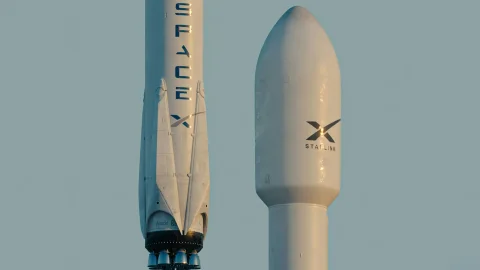
The test satellite will be launched on Falcon 9 as part of Transporter-18 on October 1. The chips will undergo overloads of 50–100 g, and in space – radiation. Each TPU will require about 1.3 square meters of radiator. Gartner analyst Bill Ray called the idea "the peak of madness." Orbital acknowledges dependence on reducing launch costs from ~$7000 to $10 per kg. SpaceXAI plans its systems by the end of next year – potentially up to 1 million satellites.
Related articles