


Technologies and financial markets are increasingly linked through corporate spending, trading infrastructure, and digital transactions. However, technological changes do not always immediately reflect in asset prices. Initially, they may impact company costs, financial organization operations, and competitive structure, and then, as they are commercially implemented, affect revenue and profits.
The new technologies of 2026 allow us to track this process in several directions. Perpetual futures on stocks are entering the regulated U.S. market, autonomous AI agents are receiving additional protection mechanisms, and banks are testing round-the-clock transactions and preparing for post-quantum cryptography.
At the same time, the stages of technology development vary. Some are already generating measurable revenue for suppliers, while others are still at the level of initial launches, pilot projects, and technical updates. For investors, this is a crucial distinction, as even promising financial innovations do not guarantee commercial returns.
Perpetual Stock Futures Trading Begins in the U.S.
On November 3, 2026, the U.S. Commodity Futures Trading Commission (CFTC) announced the possibility of trading perpetual futures on individual stocks. Such contracts can be traded on CFTC-registered futures exchanges, additionally registered with the SEC in a notification procedure for trading futures on securities.
Today, perpetual futures contracts on individual equity securities can begin trading on CFTC-registered exchanges for the first time.
The practical launch has already taken place. The Kalshi platform introduced perpetual contracts on Qualcomm, McDonald's, Amgen, and Costco stocks. Thus, the technology, which gained popularity in the cryptocurrency market, began to be applied to individual instruments of the traditional U.S. stock market.
Unlike a regular future, a perpetual contract does not have a fixed expiration date. A trader can hold a position without regularly rolling over between contracts with different maturities, as long as margin requirements and trading platform conditions are met.
On crypto exchanges, the price link of a perpetual future to the underlying asset is often maintained using a periodic funding rate. However, the specific settlement mechanisms and holding costs of new stock contracts depend on their specifications and do not necessarily fully replicate the cryptocurrency model.
The main economic change is related to competition. Regulated platforms gain the ability to offer derivative instruments previously primarily associated with cryptocurrency trading. This potentially expands the derivatives market and creates additional sources of commission income for exchanges, brokers, and intermediaries.
However, the development of the new segment is already accompanied by legal disputes. On November 3, the Capital Markets Alliance, which includes Cboe Global Markets, Citadel Securities, and the Healthy Markets Association, initiated a legal challenge to the CFTC's decision. The alliance members believe that using the existing securities futures regulation regime for new contracts creates risks of circumventing securities law requirements.
For investors, this means that the further spread of perpetual futures will depend not only on demand but also on legal clarity. The number of available contracts is currently limited, and the scale of future liquidity is unknown.
Evaluating the development of the new market will be aided by trading volumes, open interest, the bid-ask spread, funding costs, and the expansion of the list of underlying stocks. These indicators will help determine whether the new products can compete with traditional futures and other instruments.
It is also necessary to consider leverage and the risk of forced liquidation. The absence of expiration does not make holding a position free or less risky, and insufficient liquidity can increase the actual costs for traders.
Learn more about the mechanics of new instruments and associated risks in UNUM's analysis of perpetual stock futures.
AI Agent Security Becomes a Separate Market
On November 3, CrowdStrike (NASDAQ: CRWD) introduced new solutions for AI system protection. One of the key products is the AI Kill Switch within the Falcon Guardian platform, allowing administrators to promptly restrict the operation of AI agents that exceed permitted behavior.
Autonomous AI agents differ from traditional chatbots in their ability to independently perform sequences of actions. They can access corporate databases, process documents, initiate software operations, and interact with external services.
Such capabilities expand the application of artificial intelligence but simultaneously increase the requirements for control. If an agent gains access to financial systems or confidential information, an error in its actions can lead to consequences beyond the initial task.
The AI Kill Switch is designed to limit such situations. In the first stage, the mechanism allows blocking the agent's access to AI models through the AI Gateway. In the future, CrowdStrike plans to expand capabilities for directly terminating processes on endpoint devices and preventing their relaunch.
Simultaneously, the company has entered into agreements to acquire Fiddler AI and Dreadnode. Fiddler specializes in monitoring the behavior of autonomous systems and explaining their actions, while Dreadnode develops tools for automated AI security testing. Both deals are yet to be finalized.
These events reflect a change in the structure of corporate spending on artificial intelligence. While initial investments were primarily directed towards model development, computing power, and applications, the widespread adoption of autonomous systems is creating additional demand for access control, monitoring, and auditing.
For banks, AI cybersecurity is especially important, as autonomous AI agents with the appropriate permissions can interact with payment systems, client data, and internal operations.
The economic effect is distributed between suppliers and customers. Developers of protective solutions have the opportunity to expand software sales, while corporate clients increase security spending to reduce operational risks.
However, the emergence of a new category of products does not guarantee high profitability for its participants. Some protective functions may become part of standard cloud platform packages, and increased competition may limit the cost of individual solutions.
It is important for investors to monitor the commercial implementation of new products, the dynamics of regular revenue ARR, the expenses of existing clients, and the impact of new directions on CrowdStrike's profitability.
Currently, the launch of the AI Kill Switch confirms the expansion of the company's product offerings but does not allow for determining the contribution new technologies will make to its future profits.
AI infrastructure increases demand for inter-chip connections
One of the most notable technological changes in the fall of 2026 is related to the semiconductor market. As computing clusters grow, the importance of components that ensure data transmission between processors, memory, and server systems increases.
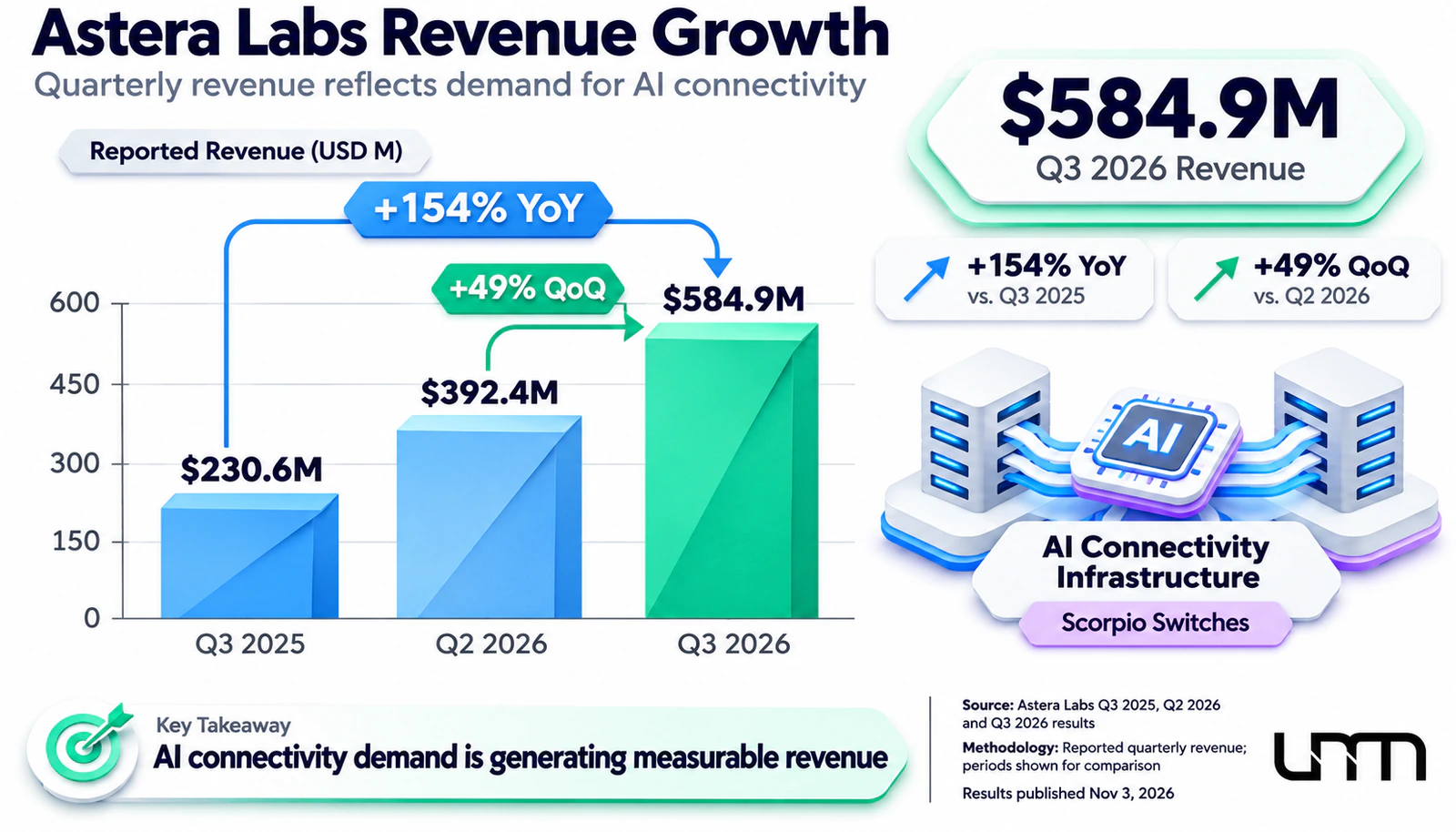
On November 3, Astera Labs (NASDAQ: ALAB) published its financial results for the third quarter of 2026. The company's revenue reached $584.9 million, increasing by 154% year-over-year and 49% compared to the previous quarter.
The GAAP gross margin was 72.3%, operating profit was $179.1 million, and the operating margin was 30.6%. The company's largest product line by revenue was the Scorpio family of network switches.
These figures confirm that demand for AI infrastructure brings measurable revenue not only to manufacturers of graphics accelerators but also to developers of interconnect components.
Modern computing systems use multiple processors that must quickly exchange information. If accelerators have high performance but data transmission between them is limited, part of the computing power is used inefficiently.
To solve this problem, specialized switches, retimers, and memory controllers are used. Retimers restore the quality of high-speed signals, while switches ensure data transmission between components of the computing system.
As the number of accelerators increases, inter-chip connections become one of the factors determining the overall performance of an AI cluster. Therefore, investments by cloud companies in data centers create demand not only for GPUs but also for equipment necessary for their joint operation.
For investors, three indicators are of particular importance: revenue and new order dynamics, gross and operating margins, and capital expenditures of major cloud companies. Comparing these helps determine how sustainable the demand for digital infrastructure is and whether sales growth is accompanied by increased profitability.
However, the results of Astera Labs reflect the position of a specific supplier, not the entire semiconductor industry. Competition between architectures, dependence on major customers, and potential slowdown in data center construction remain significant risks.
Moreover, even rapid profit growth does not guarantee an increase in stock value if investors have already priced high expectations into market multiples.
Changes in demand structure also affect related segments. Memory manufacturers are increasingly focusing on server equipment, and the rising cost of certain components may increase the cost of consumer electronics.
This mechanism is further explored in UNUM's materials on the impact of expensive memory on Apple's profit and on how artificial intelligence and energy are reshaping the global economy.
Tokenization brings banks closer to 24/7 settlements
On November 2, the Hong Kong Monetary Authority (HKMA) announced the expansion of the EnsembleTX pilot. Its infrastructure now supports 24/7 interbank settlements for operations with tokenized deposits using tokenized central bank money.
According to HKMA, the program involves 12 banks and 20 other industry participants, including financial and technology organizations. The project remains a pilot, but real monetary and digital asset operations are already being conducted in a controlled environment.
The tokenization of assets is gradually spreading to banking operations, allowing for the automation of certain stages of fund movements and settlements between financial organizations.
Traditional banking infrastructure often depends on the operating hours of payment systems and the availability of necessary participants. International operations additionally require interaction between organizations in different jurisdictions, conducting checks, and managing liquidity.
Tokenized settlements involve the use of digital representations of monetary claims and other assets. This allows for the automation of certain operations and potentially conducting them outside the standard banking schedule.
However, tokenized deposits, central bank digital money, and private stablecoins have different legal and financial characteristics.
A tokenized deposit represents a client's claim to a commercial bank and retains the associated credit risks. Central bank money is used as a settlement asset for relevant participants, whereas the reliability of private stablecoins depends on the issuer, the quality of collateral, and applicable regulation.
In the EnsembleTX pilot, tokenized central bank money ensures interbank settlements, while tokenized deposits are used in participant operations.
For international companies, a 24/7 mode potentially simplifies the management of cash balances and corporate liquidity. Banks, in turn, have the opportunity to create new services related to tokenized assets and automated payments.
However, the economic effect depends on the total costs of conducting operations, the availability of liquidity, and the number of system participants. The ability to settle 24/7 does not eliminate transaction checks, currency restrictions, and the need to comply with legislation.
Therefore, the main sign of commercial development will not be the mere fact of round-the-clock operation but the transition from pilot operations to sustainable volumes of regular settlements. Additional significance will be given to the expansion of participants and the reduction of operational costs.
The development of EnsembleTX is happening alongside other initiatives in the field of digital payments. For example, Mastercard, Visa, and Solana are exploring the use of the regulated Hong Kong stablecoin HKDAP, as UNUM reported in the analysis of international settlements.
Both directions are related to tokenization but use different forms of settlement means and should not be considered as a single payment system.
Stellar begins implementing post-quantum cryptography
The development of quantum computing is gradually affecting the security requirements of blockchains. Although sufficiently powerful quantum computers to break common digital signatures do not yet exist, developers are beginning to prepare infrastructure for potential threats.
One example is the Bell update, Protocol 30, introduced by the Stellar Development Foundation. It provides for the possibility of verifying ML-DSA digital signatures within Stellar smart contracts.
On November 3, 2026, the Bell update was activated in the test network. Validator voting for implementation in the main network is scheduled for November 23.
Modern blockchains use digital signatures to confirm the authority of address owners. Many common algorithms are based on mathematical problems considered difficult for classical computers but theoretically solvable by sufficiently powerful quantum systems.
ML-DSA belongs to post-quantum digital signature algorithms standardized by the National Institute of Standards and Technology (NIST) in the United States. It is designed to protect against known attack methods using quantum computing.
The Bell update adds the capability for Stellar smart contracts to verify ML-DSA signatures. This allows developers to create smart contract-based accounts with post-quantum authorization but does not replace the standard Ed25519 transaction signatures.
Thus, the Stellar update does not imply full protection of the network from future quantum attacks. Additional protocol changes and infrastructure upgrades will be required for that.
For financial institutions, quantum security of blockchain infrastructure represents a long-term interest. Custodians, payment services, and wallet developers will be able to explore new authorization methods before a direct threat to existing algorithms emerges.
However, practical implementation will require assessing compatibility, computational costs, and key storage features. Post-quantum signatures may be larger than usual, potentially increasing data transfer and processing requirements.
It is important for investors to distinguish between technological development and the dynamics of the XLM token. The introduction of a new cryptographic mechanism alone does not guarantee increased demand for the asset. Its economic significance will depend on the number of applications using the new features and the further development of the network.
Banks begin planning transition to post-quantum protection
Preparation for quantum threats is gradually extending beyond blockchain projects and becoming part of corporate IT budget planning.
On November 2, HKMA, together with the Hong Kong University of Science and Technology (HKUST), introduced the Post-Quantum Cryptography Toolkit — a toolset for assessing banks' readiness to transition to post-quantum information protection standards.
It includes accounting for the cryptographic algorithms and systems used, determining dependencies on suppliers, setting modernization priorities, and preparing transition schedules.
Simultaneously, HKMA published data from the Quantum Preparedness Index (QPI), designed to assess the readiness of Hong Kong's banking sector for quantum threats.
The initial index value was 2.3 out of 10, indicating an early stage of industry preparation. The regulator aims to raise the QPI score to 10 by 2030. This is a readiness benchmark according to HKMA's methodology, not a guarantee of complete technical invulnerability of banks.
For financial organizations, transitioning to new cryptography means more than just replacing one algorithm with another. Secure connections, electronic signature systems, key management, and individual elements of payment infrastructure may depend on different software products and suppliers.
Changing one component may require additional compatibility testing and updates to related systems. In large banks, such modernization can take years and involve significant organizational costs.
Therefore, post-quantum cryptography is gradually becoming a separate area of expenditure for information security. Potential recipients of new orders may include suppliers of key management systems, software libraries, digital identification tools, and specialized cybersecurity services.
However, the scale of the future market is still difficult to determine. Banks may implement new solutions gradually, use existing platforms, or defer certain expenses until more concrete regulatory requirements emerge.
For investors, real contracts, changes in IT budgets, and modernization results will be more indicative than just forecasts about the timeline for the emergence of quantum computers.
Technical risks for the cryptocurrency market are discussed in more detail in UNUM's material on quantum threats to Bitcoin.
Which financial markets might feel the changes first
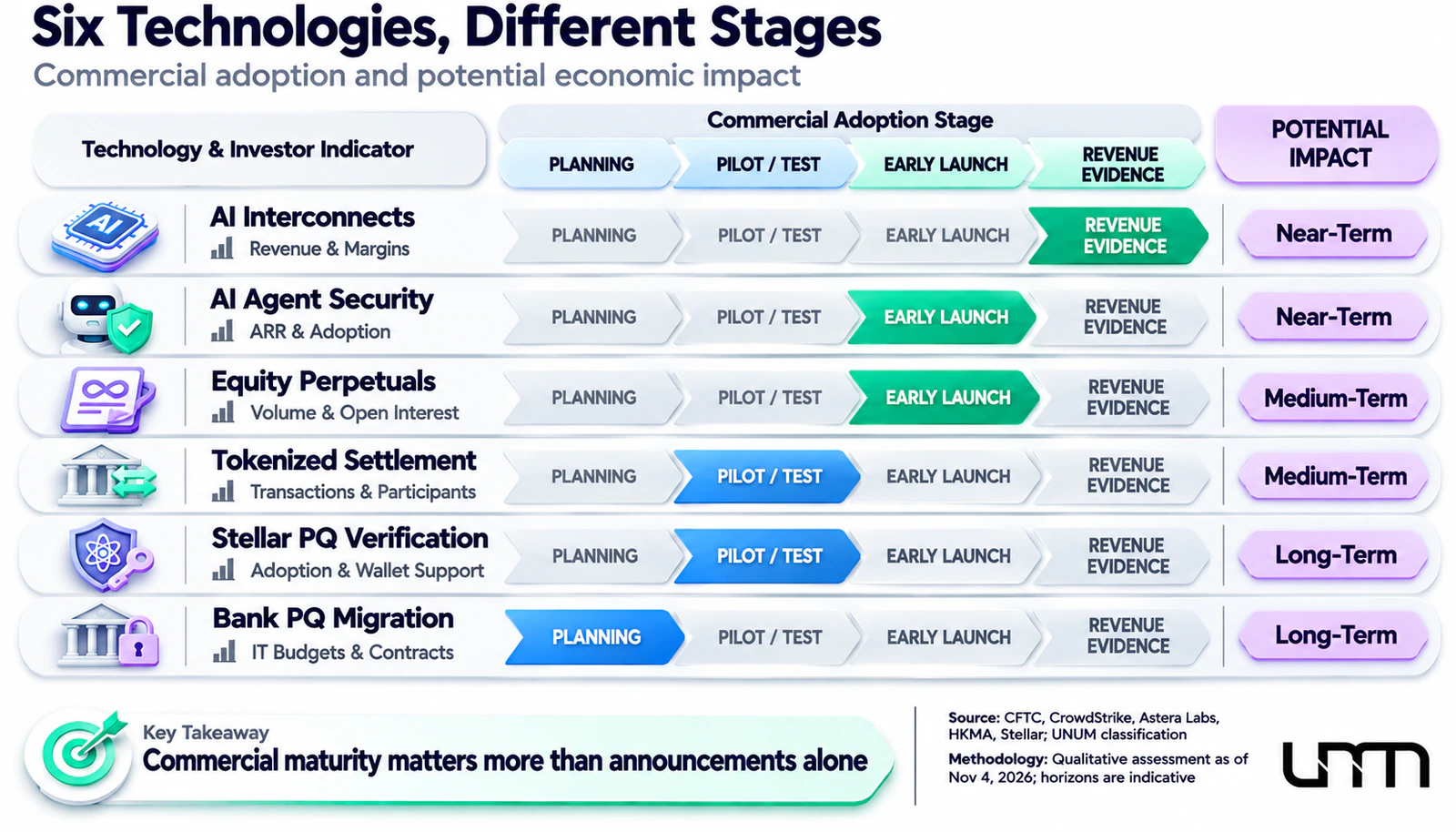
Six technological events share a common economic mechanism: new developments create opportunities for market expansion, changes in corporate spending, and redistribution of income among industry participants.
However, the speed of impact varies. In the semiconductor segment, there are already confirmed financial results, whereas tokenized banking settlements and post-quantum cryptography largely depend on future implementation.
For comparison, it is important to consider not only the potential of the technology but also its current stage of commercial development.
Direction | Current State | What Investors Should Monitor |
|---|---|---|
AI Infrastructure | Growth in equipment sales | Revenue, margin, orders, client capital expenditures |
AI Agent Security | New products and acquisition agreements | Solution sales, ARR, client expenses |
Perpetual Stock Futures | First contracts on Kalshi, legal dispute | Trading volumes, liquidity, legal status |
Tokenized Settlements | Expansion of banking pilot | Transaction volumes, participants, settlement costs |
Post-Quantum Blockchain Security | Stellar update in test network | Signature implementation and wallet support |
Post-Quantum Bank Security | Transition program development | IT contracts, budgets, modernization results |
Source: UNUM classification based on official publications from CFTC, CrowdStrike, Astera Labs, HKMA, and Stellar Development Foundation as of November 4, 2026.
In the coming quarters, the most notable financial results may continue to emerge from AI infrastructure providers. A commercial demand has already formed here, reflected in company reports. The next area to watch is AI agent cybersecurity, where new solutions are beginning to expand the existing corporate software market.
Over the next few years, regulated derivatives and tokenized settlements may gain greater significance. For these technologies, the key condition will be the transition from initial launches and pilots to regular operations with sufficient liquidity and clear economics.
In the long term, post-quantum cryptography may require a large-scale update of digital infrastructure. Initial modernization expenses may arise long before quantum computers pose a practical threat to existing algorithms.
How to Distinguish a Technological Trend from Market Expectation
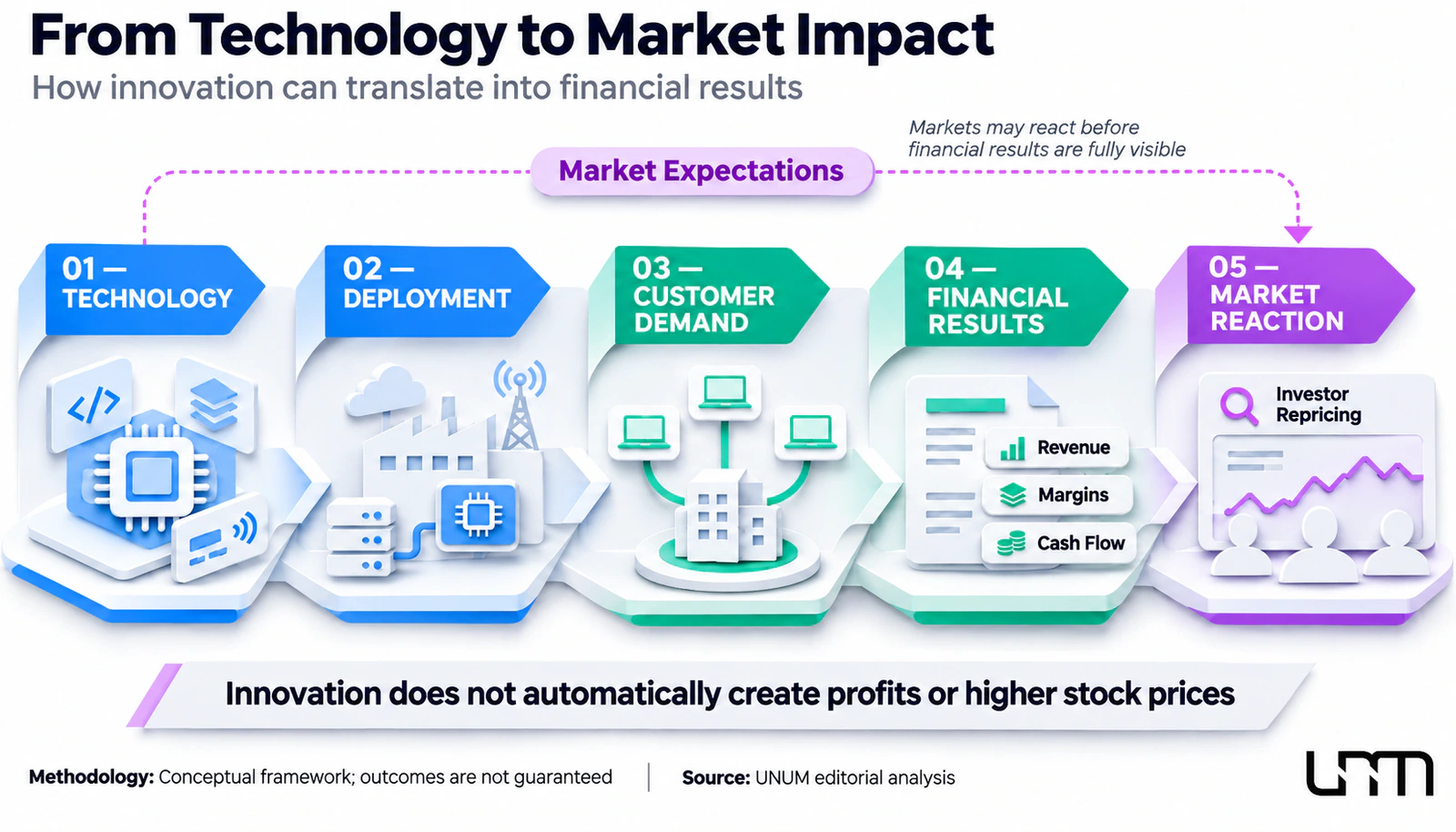
To assess new technologies, it is not enough to observe the number of announcements or the growing interest of investors. It is significantly more important to determine which stage of commercial development has already been passed.
Three levels can be distinguished:
Technological readiness. The company has presented a development, the regulator has permitted a new format of activity, or market participants have confirmed the technical feasibility of the solution.
Commercial implementation. Clients have started using the product, signing contracts, and incorporating the technology into regular operational processes.
Financial result. Revenue, profit, cash flows, or operational efficiency show a measurable impact of the technology on the business.
Not every technology goes through all these stages, and the timeframes for transitioning between them can vary significantly. Some developments remain experimental, while others become widely adopted but do not provide suppliers with attractive profitability.
For investors, company valuation is also important. Even a technology with sustainable demand does not necessarily make stocks attractive if future growth is already factored into market multiples.
Therefore, investments in technology should be evaluated considering financial results, competitive advantages, capital expenditures, and risks specific to the business.
What Technological Changes Mean for Investors
Technological trends of fall 2026 indicate that the impact of innovations on financial markets extends beyond individual AI developers or cryptocurrency projects.
New tools are gradually changing the organization of trading, digital infrastructure is becoming more important for AI performance, and banks are beginning to reassess their approaches to settlements and information security.
At the same time, the economic consequences are distributed unevenly. Some technologies are already generating measurable demand, while others require further investment, regulatory clarity, and time for commercial implementation.
For investors, financial performance of companies is crucial in assessing whether the implementation of new solutions has turned into a sustainable commercial outcome.
The main question is not which technology looks most promising, but when and how its development will begin to impact revenue, profit, and business competitiveness.