On October 28, 2026, DTCC's subsidiary, Depository Trust Company (DTC), launched the DTCC Tokenization Service (DTS). As previously reported by UNUM, access agreements were signed by 20 DTC participants, including JPMorgan, Bank of America, Citi, Morgan Stanley, and UBS. The launch marked an important step in integrating blockchain into the financial infrastructure, servicing assets worth over $114 trillion.
DTCC's tokenization differs from most RWA market projects in that digital securities are linked to the existing depository accounting system. For banks, this is an opportunity to manage assets more efficiently, and for blockchain infrastructure providers, a potential source of new revenue. However, the scale of the economic effect is still unknown.
How DTCC Securities Tokenization Works
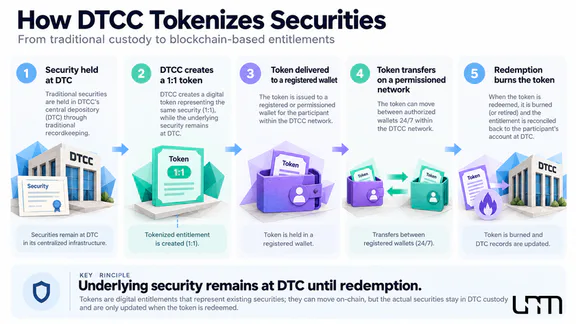
Tokenization of financial assets allows representing rights to existing stocks and bonds in digital form. When using DTS, a bank does not create a new security: it receives a token reflecting its rights to an asset, which continues to be held in DTC.
The mechanism is built on a 1:1 ratio. At the participant's request, DTC transfers the corresponding securities to a special consolidated account, the Digital Omnibus Account, in its centralized accounting system, after which it issues tokens to a registered digital wallet. These rights can be transferred to other participants, and upon reverse conversion, the tokens are redeemed, and the securities are returned to a regular depository account.
The legal ownership structure does not change. Cede & Co., the nominal holder of DTC, remains the registered owner of the underlying securities, while participants retain the provided economic interests and investor protection mechanisms. Thus, the token does not become an independent stock or bond existing separately from the depository. The detailed mechanism is described in the SEC document.
The service supports round-the-clock transfers between registered wallets within a single network. Smart contracts ensure compliance with established restrictions, and DTC monitors the movement of tokenized rights. This allows banks to move assets more flexibly within the existing legal framework.
How Tokenization Can Reduce Banks' Costs
The main economic goal of DTS is not just to speed up transfers but to increase capital efficiency. In traditional finance, a significant portion of liquid assets is involved in securing transactions, fulfilling settlement obligations, and managing risks. The longer these procedures last, the fewer opportunities there are to use capital for other operations.
Since May 2024, most US stock transactions have been settled under the T+1 standard, meaning the next business day after the transaction is concluded. Blockchain technology allows transferring tokenized rights outside regular trading hours, although this does not automatically shorten the entire settlement cycle. The SEC separately regulates the timing of securities transaction completion.
Suppose a bank needs additional treasury bonds to secure a transaction in the evening. A traditional transfer may depend on the working hours of depositories and intermediaries. If the parties use compatible infrastructure and agree to accept tokenized rights as collateral, the transfer can occur faster, potentially reducing the volume of liquid assets the bank must reserve to meet obligations.
For financial market participants, this opens up three opportunities:
Acceleration of collateral transfer. Banks can more quickly redistribute securities among counterparties and use them in new operations.
Increased liquidity management efficiency. Reducing operational delays potentially decreases the need for additional reserves.
Automation of settlement procedures. Smart contracts allow automating individual checks and actions with digital rights, reducing the volume of manual operations.
However, a quick token transfer is not equivalent to an instant deal completion. For delivery versus payment (DVP) settlements, which involve simultaneous asset and payment transfer, coordinated work of payment and depository systems is necessary.
The network fee size also does not reflect the full cost of the operation, which includes asset storage, regulatory compliance, and payment processing. UNUM previously analyzed a similar difference between blockchain costs and users' final expenses using the example of stablecoins.
On July 15, 2026, DTCC conducted a series of real operations in a production environment, including stock and treasury transactions, collateral transfers, and DVP settlements. This confirmed the technology's viability but does not yet prove significant capital savings with mass adoption.
Moreover, initial regulatory conditions stipulate that DTC does not assign tokenized rights a collateral or settlement value when calculating Net Debit Cap and Collateral Monitor metrics—mechanisms for limiting the depository's settlement risks. Therefore, the ability to use digital rights as collateral does not imply their automatic recognition in all risk management systems.
Why the $114 trillion market cannot be considered tokenized
The scale of the depository and the volume of tokenized assets need to be distinguished. Over $114 trillion is the total value of securities serviced by DTC. At the start of DTS, 34 securities are available for tokenization, accounting for about $30 trillion in serviced assets, according to DTCC data.
These $30 trillion represent the value of securities that can potentially be digitized, not the volume of tokens already issued. In the published materials about DTCC's launch, there are no figures on actually tokenized assets or statistics on regular DTS commercial operations.
A similar distinction needs to be made for participants. Twenty service access agreements do not mean that all connected banks have already transferred significant portfolios to the blockchain. Over 150 financial organizations participated in developing the infrastructure, but its usage scale will depend on economic feasibility and regulatory requirements.
In December 2025, the SEC's Division of Trading and Markets staff issued a no-action letter regarding DTC's limited pilot program. The regulator's position covers certain asset categories: stocks of companies from the Russell 1000 index, US treasury securities, and ETFs tracking major stock indices.
Thus, the tokenization of stocks and bonds is still developing within established frameworks. The letter provides a three-year term from the pilot program's launch and does not constitute a universal permission for issuing any digital securities.
DTCC President and CEO Frank La Salla described the launch as: “We are laying the foundation for responsible large-scale adoption in the institutional sector.”
It is the gradual expansion of commercial use, not the nominal value of available securities, that will show how successful the new infrastructure will be.
Which blockchains and companies can benefit from tokenization
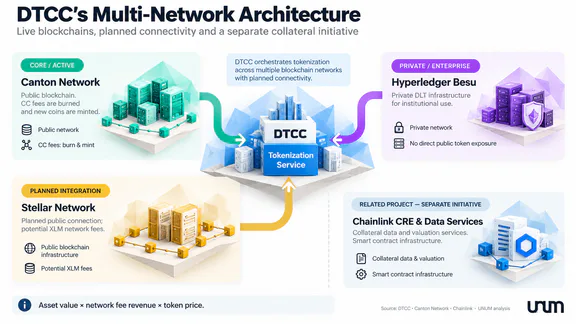
One feature of DTS is its multi-network infrastructure, allowing participants to work with multiple blockchains. At launch, the service is integrated with Canton Network and DTCC's private network based on Besu. In the first half of 2027, Stellar is planned to be connected.
This model reduces financial organizations' dependence on a single technology and allows them to choose infrastructure according to privacy, security, and operational cost requirements.
Blockchain | Integration Status | Potential Economic Impact |
|---|---|---|
Canton Network | Operational with DTS | Increased operations and fees paid in Canton Coin (CC) |
Private Besu Network | Operational with DTS | Demand for infrastructure services without direct link to public crypto asset |
Stellar | Connection planned for the first half of 2027 | Additional network activity and fees, but not guaranteed XLM growth |
For crypto investors, Canton Network is of greatest interest, as its public infrastructure uses the native token Canton Coin (CC).
According to the official description of the Canton model, fees for using the shared infrastructure are paid in CC and burned, while new coins are issued as rewards to network participants. This mechanism is called burn-and-mint: the supply volume depends on both burning and issuance. Therefore, an increase in the number of operations does not necessarily lead to a reduction in the number of tokens in circulation.
Integration with Stellar can also increase network activity, but the value of tokenized securities does not directly translate into demand for XLM. The number of operations, the size of fees, and the specifics of participant interaction with the blockchain are significant. Previously, UNUM examined the dynamics of liquidity and tokenized assets of Stellar.
Additional opportunities are available to technology solution providers. For example, DTCC collaborates with Chainlink in a separate project called Collateral AppChain, aimed at 24/7 collateral management. It is not a direct integration of Chainlink into DTS, but it shows that the financial market requires not only blockchains but also tools for data transfer, automation, and interaction between different systems.
Why the growth of the RWA market does not guarantee cryptocurrency appreciation
Investments in RWA and the purchase of native blockchain tokens used for tokenization imply different sources of returns and different risks. In the first case, the investor gains economic exposure to the underlying asset, such as bonds, while in the second case, to a cryptocurrency whose value depends on its own market and economic model.
When evaluating such projects, it is important not to mix three indicators: the value of placed assets, transaction turnover, and network income. There is no direct proportional relationship between them. For example, the transfer of tokenized bonds worth $1 billion may require only a few transactions with small fees, whereas regular movement of smaller assets can bring more income to the network.
Therefore, when analyzing the prospects of CC, XLM, and other cryptocurrencies, an investor needs to consider several factors:
What volume of operations actually passes through the public blockchain.
In which token fees are paid and who bears these costs.
What portion of the fees is burned or redistributed among participants.
How the token supply changes considering additional issuance.
It is especially important to distinguish between the economic benefits of the network operator and the interests of cryptocurrency holders. Private blockchain infrastructure can generate income for technology providers and reduce bank costs, while hardly creating demand for public tokens.
Thus, the expansion of the RWA market can support the development of the crypto industry, but to assess the investment attractiveness of a specific asset, it is not enough to know only the size of the securities placed in the network.
What risks may slow down the adoption of tokenization
Switching to blockchain does not automatically eliminate existing financial market problems. On the contrary, additional technological and operational requirements arise during the implementation phase.
One of the main risks is related to liquidity fragmentation. If banks use different blockchains, compatible mechanisms for accounting and conversion are necessary to transfer assets between them. Otherwise, liquidity will remain fragmented, and the economic effect of tokenization will be lower than expected.
Another limitation is the security of the digital infrastructure. Smart contract errors, key compromises, and software failures can create risks that require additional control mechanisms. While storing securities in a regulated depository reduces certain legal risks, it does not eliminate technological threats.
Market liquidity is no less important. The mere issuance of a token does not create buyers and sellers ready to conduct transactions at competitive prices. Effective trading requires market makers and mechanisms for quote formation. Previously, UNUM examined this issue in the context of tokenization and automated market makers.
As a result, the speed of DTS adoption will depend not only on the technical capabilities of the blockchain but also on the willingness of banks, regulators, and other financial market participants to agree on new processes.
What indicators investors should track in 2027
To assess the prospects of security tokenization, it is not enough to follow announcements of new partnerships. More important are the data showing the transition of technology to regular commercial use.
The main indicators will be:
Actual volume of tokenized assets. It will show what portion of available securities is actually used in digital form.
Number of active participants and operations. These indicators will help distinguish formal bank connections from real demand for the service.
Use of tokenized collateral. Growth in such operations along with reduced collateral transfer times will be evidence of the practical benefits of the technology.
Capital and operational cost savings. Results confirmed by financial organizations will allow for an assessment of DTS efficiency.
Network activity and cryptocurrency economy. For Canton, commission volumes, burning, and CC issuance are particularly important, while for Stellar, the number of additional operations after connection is crucial.
Development of settlement infrastructure. New solutions for monetary settlements and blockchain interoperability will show how ready the technology is for scaling.
Based on these indicators, three market development scenarios can be identified:
Accelerated adoption. Banks increase the volume of tokenized operations, expand the use of digital rights as collateral, and confirm capital savings. A sign of this scenario will be simultaneous growth in DTS turnover, the number of active participants, and the share of regular operations.
Gradual adoption. The service continues to expand, but the main activity remains within the institutional segment. The number of connections increases faster than actual turnover, and the impact on the value of public cryptocurrencies remains limited.
Slowed adoption. Technological and regulatory constraints hinder scaling, and banks do not achieve the expected savings. In this case, operation volumes will remain small relative to the value of assets available for tokenization.
Assigning specific probabilities to these scenarios is premature: there is insufficient public data on regular commercial DTS activity.
Who will ultimately profit from the tokenization of securities
The main beneficiaries in the initial stage may be banks, brokers, and depositories that manage to speed up asset transfers, improve liquidity management, and reduce operational costs. Providers of digital wallets, software, and blockchain infrastructure may also gain additional revenues as the number of operations increases.
For holders of CC, XLM, and other cryptocurrencies, the connection is less direct. The expansion of blockchain use creates potential demand for network services, but token value dynamics depend on commissions, issuance, revenue distribution, and market conditions.
The launch of DTCC is significant not because $114 trillion has already moved to the blockchain, but because tokenization has become part of the functioning regulated infrastructure of the US stock market. Its success will be determined by the volume of real operations, achieved capital savings, and the ability of new technologies to solve traditional financial tasks, not just the value of assets that can theoretically be digitized.