
On August 18, 2026, the SEC introduced Regulation Crypto Assets, and on August 21, the document was published in the Federal Register. The public comment period ended on October 20. The proposal is part of the revision of cryptocurrency regulation in the U.S. However, as of November 23, the new SEC rules remain under discussion and cannot be used by issuers as an operational regime.
The special exemptions potentially address a problem faced by the crypto industry: developers raise money before the network is completed by selling assets whose value may depend on the promised actions of the team. However, increasing the number of permissible offerings does not in itself guarantee either their economic efficiency or safety for investors.
Why Crypto Projects Find It Difficult to Raise Capital in the U.S.
For developers, issuing tokens and initial token offerings can simultaneously serve as a way to finance and distribute digital assets among future network participants. The buyer acquires a token before the full launch of the product and may expect that the fulfillment of promises by developers will increase the asset's value.
In such situations, the question arises about the application of the Howey Test. If the transaction essentially represents an investment contract, the offer and sale fall under federal securities laws. At the same time, the token itself is not always a security: the circumstances of the transaction, the issuer's promises, and the investor's dependence on the substantial actions of others are important.
Today, crypto companies can consider Regulation D, Regulation A, and Regulation Crowdfunding, but each mechanism has its own requirements for issuers, the circle of investors, permissible instruments, and reporting. For example, certain placement methods under Regulation D are aimed at accredited investors, while Regulation Crowdfunding requires the transaction to be conducted through a special intermediary.
SEC Chairman Paul S. Atkins described the application of established constructs to crypto assets as trying to "fit a square peg into a round hole." In his assessment, such a mismatch created obstacles to raising capital within the U.S.
What Funding Methods Does the SEC Propose
Regulation Crypto Assets includes the Startup exemption and Fundraising exemption. Both mechanisms are designed as exemptions from registration requirements for certain investment contracts related to crypto assets, rather than permission to issue any tokens without restrictions.
Startup Exemption for Early Projects
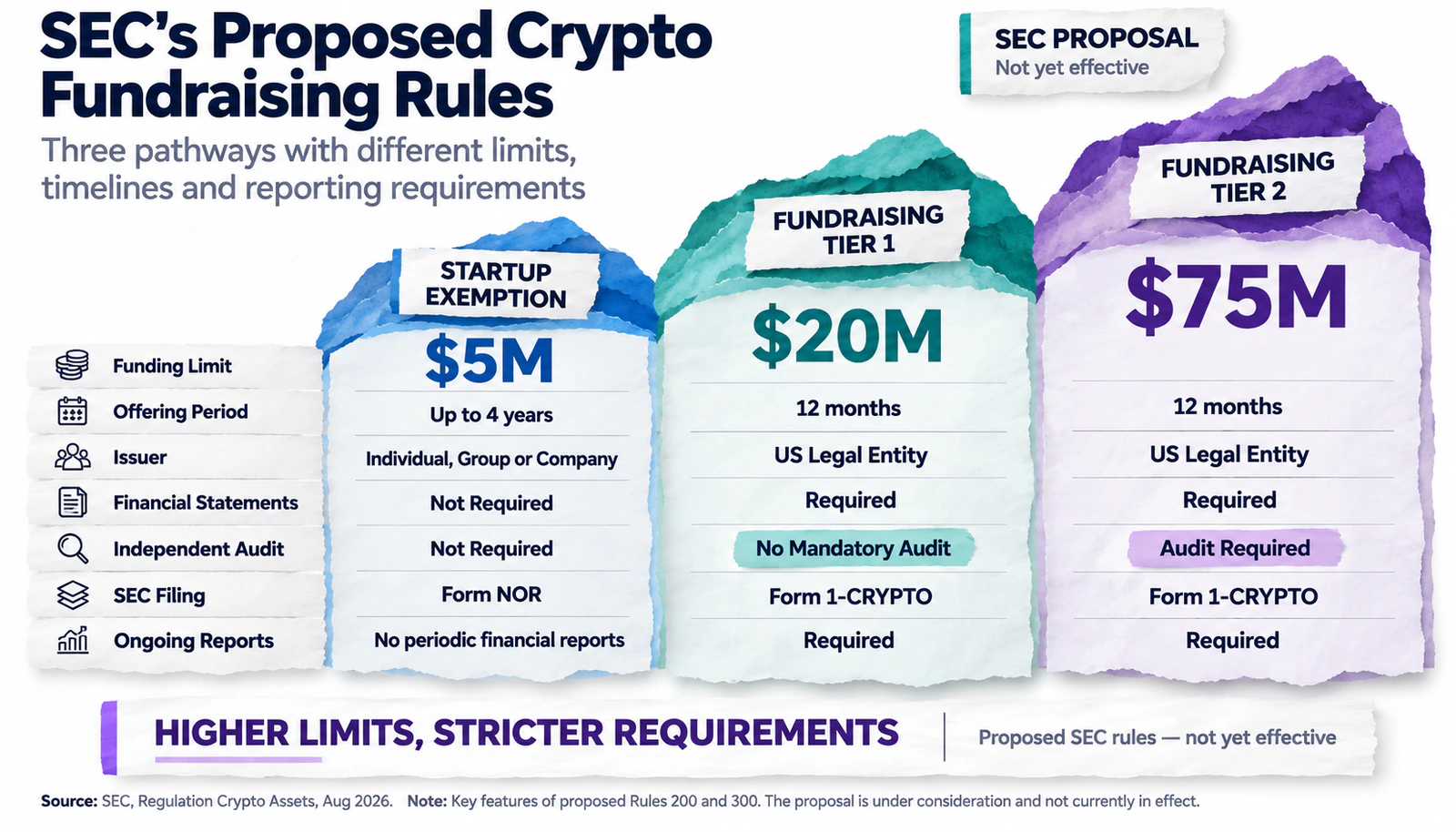
The proposed SEC Rule 200 allows offerings up to $5 million for a single period not exceeding four years. When submitting Form NOR, the issuer must confirm the intention to fulfill promised substantial managerial actions within four years. The exemption may be available to a company, individual, or group of individuals if the specified conditions are met.
The issuer and related parties can conduct several permissible operations within a single four-year period but cannot restart such a period for the same or substantially similar crypto asset. This restriction is intended to prevent circumventing the limit on amount and duration through renaming the asset or creating an affiliated structure.
Information about the token, developers, network, and risks must be freely available on the website no later than the submission of Form NOR. If by the end of the calendar year previously disclosed information has significantly changed, it must be updated within 30 calendar days after the end of that calendar year. The obligation remains until the end of the established period or the submission of Form TR.
During the allowed period, not only monetary sales but also certain operations of token distribution for services or actions related to network functioning may be considered. This is important for evaluating airdrops and network rewards; however, the applicability of the exemption to a specific operation is determined by the content of the rules and the nature of the investment contract.
Fundraising Exemption for Large Offerings
The proposed SEC Rule 300 includes Tier 1 with a limit of up to $20 million and Tier 2 with a limit of up to $75 million within 12 months. To apply both levels, the issuer must be a U.S. legal entity and meet additional criteria regarding management, assets, and business organization.
At both levels, the issuer must submit Form 1-CRYPTO and obtain qualification confirmation of the offering statement from the SEC before starting sales. In Tier 1, financial reporting is required, but mandatory independent confirmation is not provided. In Tier 2, financial reporting must be audited. However, for both levels, the project provides for ongoing and periodic reporting.
Parameter | Startup | Tier 1 | Tier 2 |
|---|---|---|---|
Placement Limit | $5 million | $20 million | $75 million |
Period | Up to 4 years | 12 months | 12 months |
Issuer | Individual, group or company | American legal entity | American legal entity |
Financial Reporting | Not required | Required | Required |
Independent Audit | Not required | Not mandatory | Mandatory |
For non-accredited individuals, the investment limit is 10% of the greater of annual income or net worth; for legal entities, it is 10% of the greater of revenue or net assets for the last fiscal year. These are restrictions for specific categories of buyers, not a general token value cap.
The annual limit for the Fundraising exemption may include sales by affiliated existing holders: up to $6 million in Tier 1 and up to $22.5 million in Tier 2. In the initial placement and subsequent placements qualified within a year after it, sales by existing holders may account for no more than 30% of the total amount of each placement.
How the SEC's Proposal Differs from Existing Rules
At first glance, the limits are already familiar to the market: Regulation Crowdfunding allows raising up to $5 million over 12 months, while Regulation A allows up to $20 million under Tier 1 and $75 million under Tier 2. However, the coincidence of maximum amounts does not imply the same applicability of mechanisms.
In the full text of the SEC project, it is indicated that the crypto investment contracts under consideration are not included in the list of securities permitted for placement under the current Regulation A. The new regime concerns the placement of crypto assets within certain investment contracts. This is not a universal registration of crypto assets and not full regulation of tokens.
The potential advantage lies in specially designed disclosures, rules for the distribution of digital assets, and the ability to legally designate the termination of the corresponding investment contract. Meanwhile, existing mechanisms for private and public financing remain if the structure of a particular deal meets their conditions.
What Information Issuers Must Disclose to Investors
Rule 103 provides for ten thematic categories of disclosure, covering placement conditions, information about developers, network structure, token features, and risks. Disclosure by issuers is one of the main tools for protecting crypto investors, although the completeness of documents does not eliminate investment risks.
Offering Conditions — number and price of tokens, participation restrictions, intended use of funds.
Team Commitments — promised substantial actions, development milestones, and information about related parties.
Tokenomics — issuance, distribution, lock-ups, unlocking schedule, and asset concentration.
Infrastructure — network or application characteristics, security, code availability, and governance features.
Risks — conflicts of interest, technical vulnerabilities, and potential impact of developer decisions on asset value.
Unlike a typical promotional white paper, information must be provided according to a set of categories established by the regulator. For Startup exemption, this is public disclosure on the website; for Fundraising exemption, it is a more formalized Form 1-CRYPTO package and subsequent reporting. However, the presence of documents does not guarantee roadmap execution or token liquidity.
How the safe harbor will work
One of the most significant elements of the SEC proposal is the investment contract safe harbor mechanism. It relates to situations where, at the initial offering, the buyer relies on promised substantial managerial actions by developers, but their role in executing the investment contract ceases thereafter.
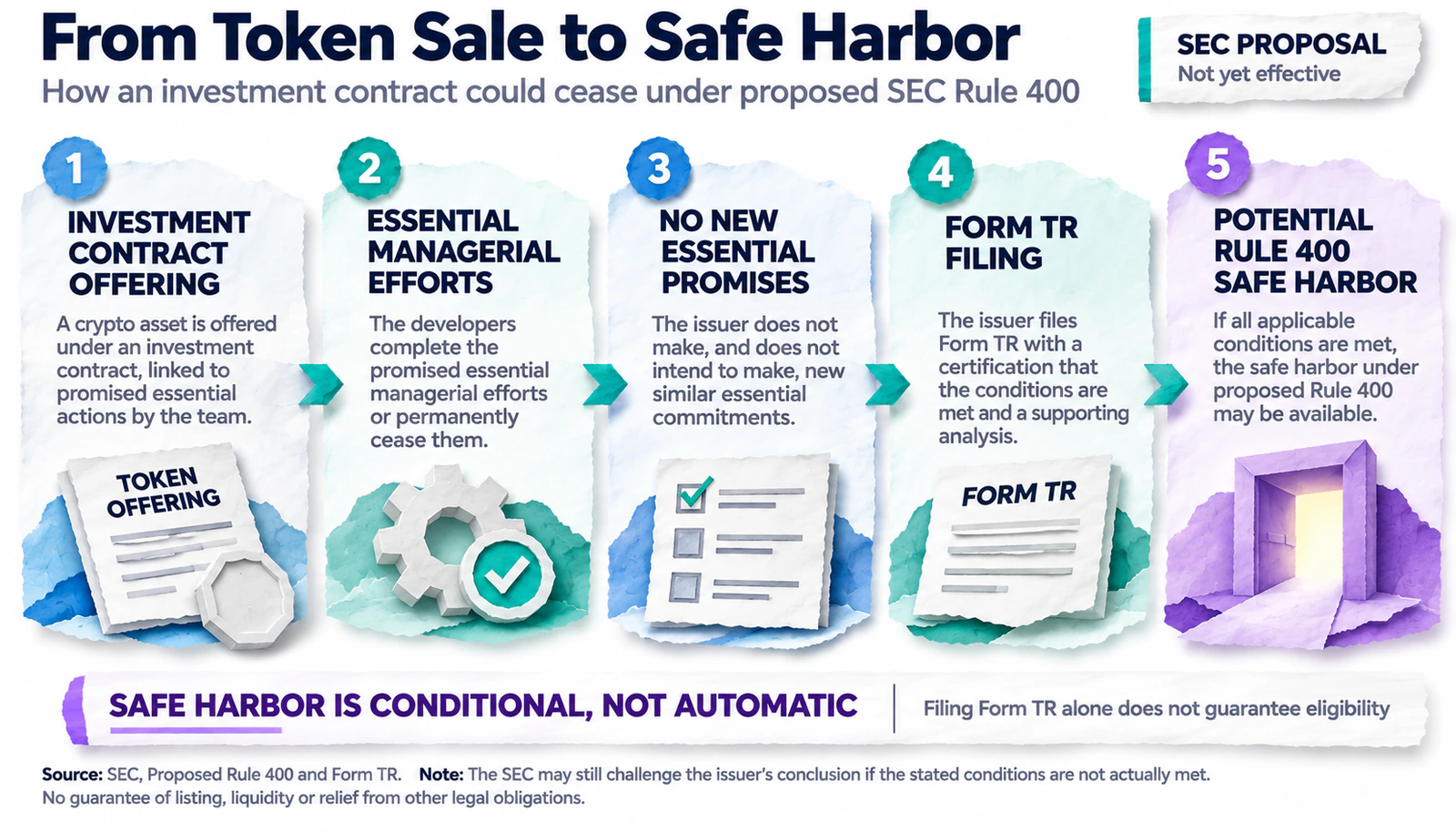
Safe harbor can be applied after the completion or final cessation of all promised substantial managerial actions, in the absence of new such promises, and upon filing Form TR. This is a conditional legal construct, not an automatic reclassification of the token. The SEC retains the ability to assess whether the issuer has indeed met the requirements.
Proposed sequence: investment contract offering → completion or final cessation of substantial commitments → absence of new similar promises → filing Form TR → possibility of applying Rule 400.
For trading, this potentially means a clearer point at which the crypto asset's connection to a specific investment contract ceases. However, safe harbor does not guarantee listing, liquidity, or the absence of other requirements. The proposal does not establish a full regulatory regime for crypto exchanges, brokers, custodial services, and ETF. Relevant issues are regulated separately.
How much token offerings might cost
Capital raising limits do not determine the final cost of raising investments. It is also influenced by reporting costs and legal risks of crypto projects. For a small team, even relatively moderate expenses for preparing materials can constitute a significant portion of funding.
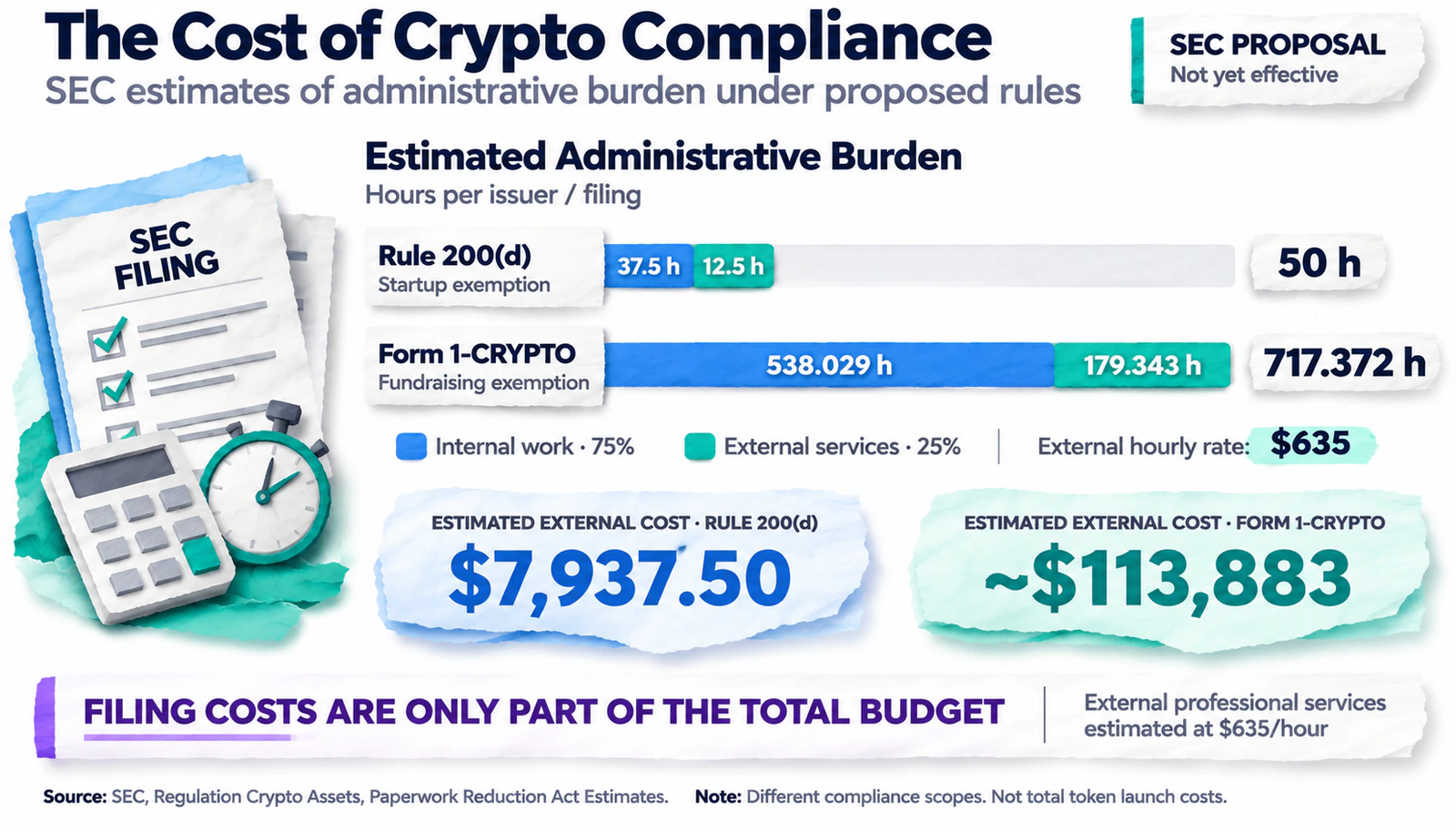
In the economic part of the project, the SEC estimates compliance with Rule 200(d) requirements at 50 hours per issuer: 37.5 hours of internal work and 12.5 hours of external specialists. At a calculated rate of $635 per hour, external work costs $7,937.50. This is an estimate of only a specific administrative duty, not the full token sale budget.
For Form 1-CRYPTO, the SEC estimates the workload at 717.372 hours, of which 179.343 hours are for external specialists. At a calculated rate of $635 per hour, their cost is about $113.9 thousand. These calculations do not include all possible expenses for legal support, audit, technical infrastructure, and marketing.
The SEC itself acknowledges that it is still difficult to determine whether the costs for Fundraising exemption will be significantly lower than expenses for comparable offerings under Regulation A. Therefore, it is premature to speak of confirmed savings: the real choice of regime depends on the amount of investment, the composition of buyers, disclosure requirements, and the development stage.
Which crypto projects might gain an advantage
Web3 startups may view the proposed exemptions as an alternative to some existing funding methods. This is especially true for infrastructure and application developers who raise money even before the full launch of the network.
In traditional venture financing, investors often acquire a stake in the company or receive other contractual rights. A token sale can use a different model: the buyer receives a digital asset whose economic value is linked to the future network. This does not make the token equivalent to a share, and the owner's rights need to be analyzed according to the specific deal terms.
For a hypothetical project needing $3 million, the Startup exemption might be of interest. An offering of $15 million could correspond to the Tier 1 limit, and $50 million to Tier 2 with an audit and more complex reporting. These are illustrative scenarios, not a statement that such projects automatically meet admission criteria.
The effect may also spread to networks where such operations take place: they may face increased transactional activity. Previously, UNUM wrote about Grayscale's forecast, according to which Ethereum, Solana, and BNB Chain could indirectly benefit from the development of regulated token sales. However, increased activity does not guarantee a rise in the price of ETH or SOL.
On this topic, you can also view UNUM's analysis “Crypto exchanges go beyond cryptocurrencies. How the Web3 market is changing”, dedicated to the development of digital asset infrastructure.
What risks remain for investors
Expanding access for crypto projects to capital increases the importance of requirements for protecting token buyers. Investments in cryptocurrencies through early token sales require a separate assessment of placement conditions, not just the potential profitability of the digital asset.
The proposed exemptions do not eliminate the effect of federal anti-fraud and market manipulation rules. Nevertheless, small projects may have less detailed financial information than large placements, and the risks of developers failing to deliver on promises, token concentration, and low secondary liquidity remain.
Before purchasing, it is important to study the legal structure of the deal, developers' obligations, token distribution and unlocking, use of raised funds, possible resale restrictions, and the network's dependence on the team. Even the publication of documents according to a formal standard does not guarantee a successful launch.
How market participants evaluate the SEC initiative
Blockchain Association suggests increasing limits
In comments from October 20, the Blockchain Association supported the creation of a special regime but proposed raising the Startup exemption limit to $10 million and the upper limit of the Fundraising exemption to $150 million. The organization links its position to the costs of developing infrastructure, security, and compliance requirements, and also calls for clarification of airdrop rules and the application of safe harbor. This is the position of the industry association, not a decision of the regulator.
Nasdaq advocates for a specialized approach
In a letter to the SEC dated October 21, Nasdaq supported the creation of a separate mechanism provided further clarification of its application to primary and secondary markets.
Overall, we support a specialized regulatory mechanism considering the comments outlined in this letter.
John Zecca, Executive Vice President and Chief Legal, Risk & Regulatory Officer at Nasdaq
Investor advocates warn of weakened control
Americans for Financial Reform Education Fund (AFREF) in a letter to the SEC dated October 20 questioned the sufficiency of disclosures and the mechanism for terminating investment contract status. According to the organization, the proposed approach may “increase rather than decrease risks and harm to investors.”
The difference in positions highlights a central dilemma. Developers are interested in more accessible ways to raise capital, traditional platforms in predictable rules for transactions and subsequent trading, while investor advocates fear a reduction in the level of disclosure and control.
A separate discussion concerns the alignment of rules for token sales and payment stablecoins. Previously, UNUM wrote that Circle is asking the SEC to align stablecoin regulations with the GENIUS Act. This is a related issue that the proposal on crypto investment contracts does not automatically resolve.
What scenarios are possible after the SEC decision
In a favorable scenario, the commission will adopt rules with clarifications that provide clear admission criteria. Then some crypto projects will be able to use a specialized financing procedure, and investors will receive more comparable disclosures.
In a more restrictive scenario, only issuers meeting established criteria will be able to use the new exemptions, and high reporting and compliance costs will maintain the competitiveness of traditional financing instruments.
If the decision is delayed or the final adoption of the project is refused, existing regimes will continue to apply, and the issues of adapting legislation to investment contracts with digital assets will remain the subject of legal disputes and new initiatives.
What the proposal means for investors and project founders
For founders, the significance will lie not only in the placement limit but also in the ability to meet the criteria for specific exemptions, prepare disclosures, withstand costs, and properly execute the completion of promised significant actions.
For investors, the potential outcome is more understandable documents on token sales, but not the elimination of market, technical, or legal risks. If the SEC adopts Regulation Crypto Assets, its main value may lie in creating a more predictable path from capital raising to a functioning network, rather than simply increasing the maximum allowable placement amount.