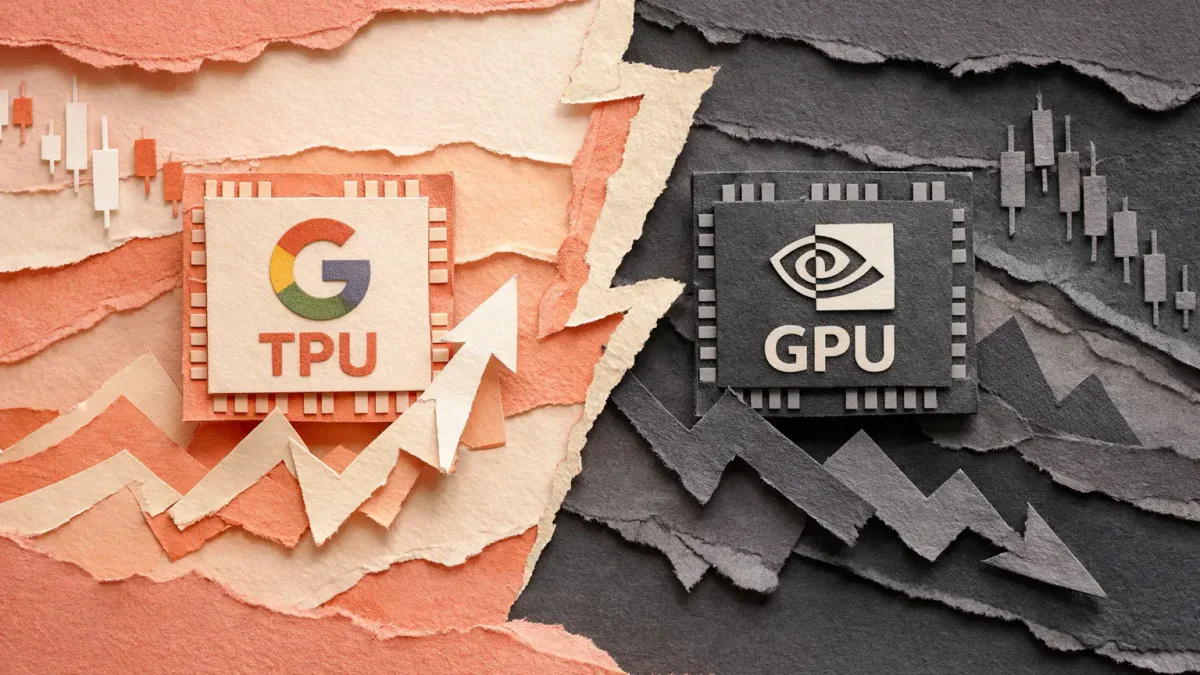
What Changed with the Release of Google's New TPUs
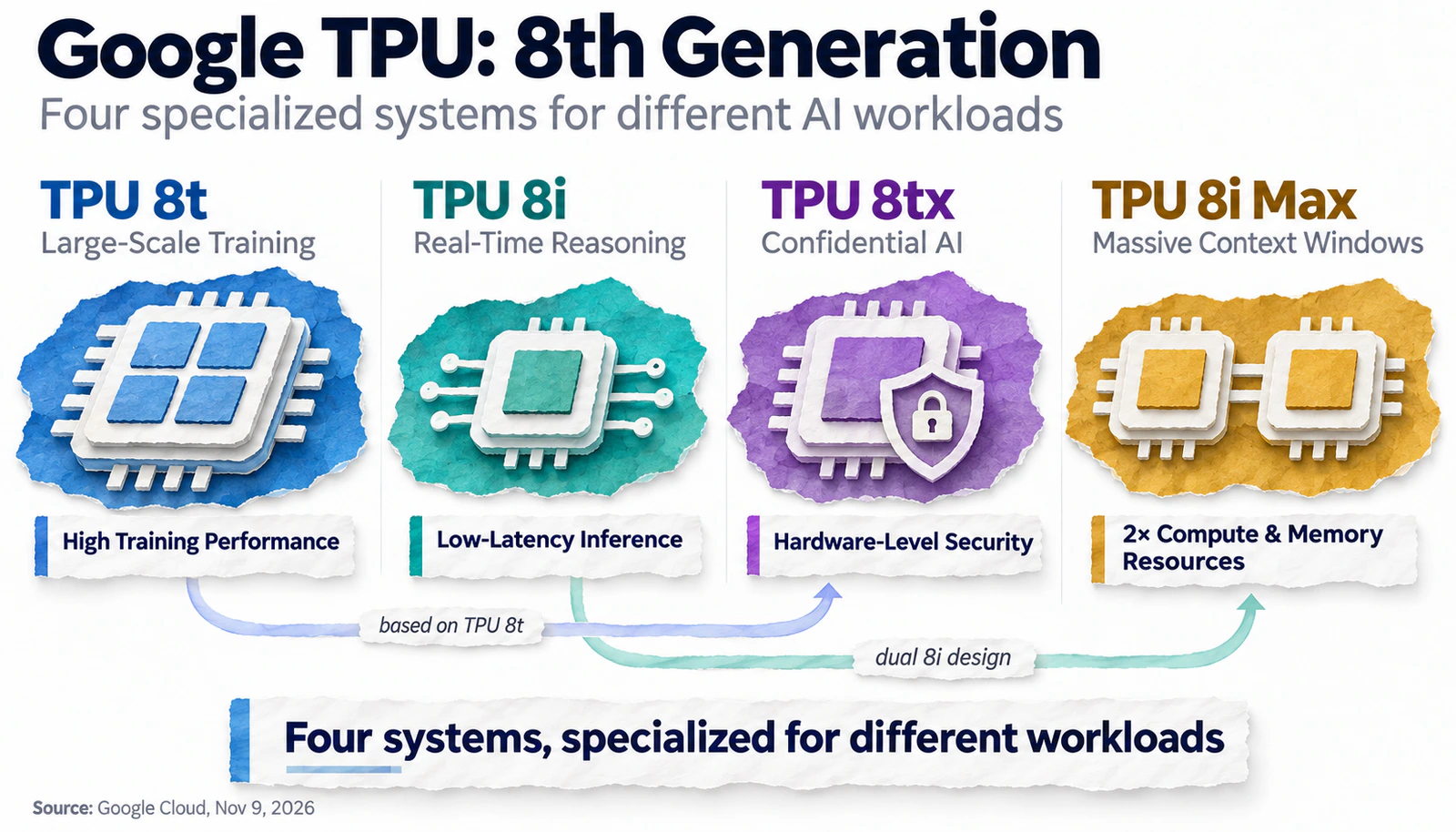
On November 9, 2026, Google introduced two new configurations of computing systems based on eighth-generation tensor processors (TPU) — 8tx and 8i Max. According to Reuters, the expansion of the lineup intensifies the competition between Google and Nvidia in the AI accelerator market. These are not fundamentally new chips but specialized systems adapted for specific computational tasks.
TPUs are accelerators for operations used in neural networks. Unlike graphics processing units (GPUs), which are suitable for a broader range of computations, TPU architecture is optimized primarily for machine learning tasks. This allows for more efficient use of equipment under certain loads, although it does not guarantee a universal advantage over GPUs.
The new systems are designed for different application scenarios:
TPU 8tx is focused on secure AI computations, including processing confidential information and operating corporate models. The system uses TPU 8t chips in conjunction with AMD EPYC fifth-generation central processors and provides hardware data protection during processing. According to Google, using the Boardfly network reduces latency by up to two times compared to TPU 8t.
TPU 8i Max is designed for AI agents and models processing large volumes of information. Combining two TPU 8i chips in one package has doubled the computing resources, the amount of built-in SRAM memory, and the memory bandwidth of HBM relative to the basic configuration.
This specialization reflects changing requirements for AI infrastructure. Instead of one universal solution, Google is developing systems for training neural networks, inference — processing requests with already trained models, secure computations, and working with large context windows. This allows the company to more accurately select equipment for the nature of the load and potentially reduce operational costs.
Why the Cost of AI Computations is Becoming the Main Field of Competition
Developing proprietary AI chips allows Google to control not only the characteristics of the equipment but also a significant portion of the costs of computing infrastructure. The company can adapt processors to its Gemini neural networks and cloud services, gradually reducing dependence on Nvidia for some tasks. However, the economic efficiency of this approach is determined not by the maximum speed of the processor but by the cost of performing a specific operation.
For example, an accelerator with high performance may be less advantageous if it consumes too much electricity, requires expensive cooling, or remains idle for a significant portion of the time. Therefore, the energy efficiency of TPUs should be evaluated based on the volume of useful computations per unit of consumed energy, not just the declared power of the equipment.
When comparing TPUs and GPUs, several indicators should be considered:
Cost of inference. Expenses for processing 1 million tokens with comparable response quality and generation speed.
Performance per watt. The volume of useful computations performed at a certain power consumption.
Total cost of ownership (TCO). Expenses for equipment, power supply, cooling, networks, and maintenance.
Equipment utilization. The share of computing power actually used for task execution, as idle time increases the cost of operations.
In April, Google announced that TPU 8t provides up to 2.7 times higher training performance, and TPU 8i improves the performance-to-price ratio of inference by 80% compared to the previous generation TPUs. These figures reflect a comparison of Google's own developments and do not prove a similar advantage over current Nvidia accelerators.
The competitiveness of TPUs and GPUs should be assessed based on testing results of the same AI models under comparable loads. If Google can provide similar quality and speed of request processing at lower costs, this will create conditions for increasing the profitability of Google Cloud or reducing rates for clients. It is the economic effect, not individual technical characteristics, that can become a significant factor in competition.
Google vs. Nvidia in the Battle for Developers
Despite the development of Google's specialized accelerators, Nvidia retains an important competitive advantage — the CUDA software ecosystem. It combines development tools, libraries, and optimization means that allow the use of Nvidia GPUs in existing software and cloud environments.
For corporate clients, switching to TPUs involves not only replacing equipment. Developers need to check model compatibility, adapt software tools, and ensure that the new system provides sufficient performance and stability. Additional implementation costs can reduce the savings from cheaper computations.
Google is attempting to reduce these barriers. In October, the company open-sourced TorchTPU, allowing the use of PyTorch models on tensor processors without extensive code rewriting. Additionally, support for popular inference tools vLLM and SGLang is being developed, simplifying the transfer of existing AI workloads to Google hardware.
However, competition does not exclude collaboration. Google continues to use Nvidia GPUs in its cloud infrastructure, and in September, the companies, together with Emerald AI, announced the creation of an alliance to improve the energy efficiency of data centers. More about this initiative can be read in the UNUM article on the collaboration between Google and Nvidia.
Thus, TPU should currently be seen as an expanding alternative to GPU, rather than a full replacement. For Nvidia, the main risk is that large cloud operators gain more options to independently choose equipment and gradually shift suitable computing tasks to their own processors.
How proprietary AI chips could impact Google Cloud's profits
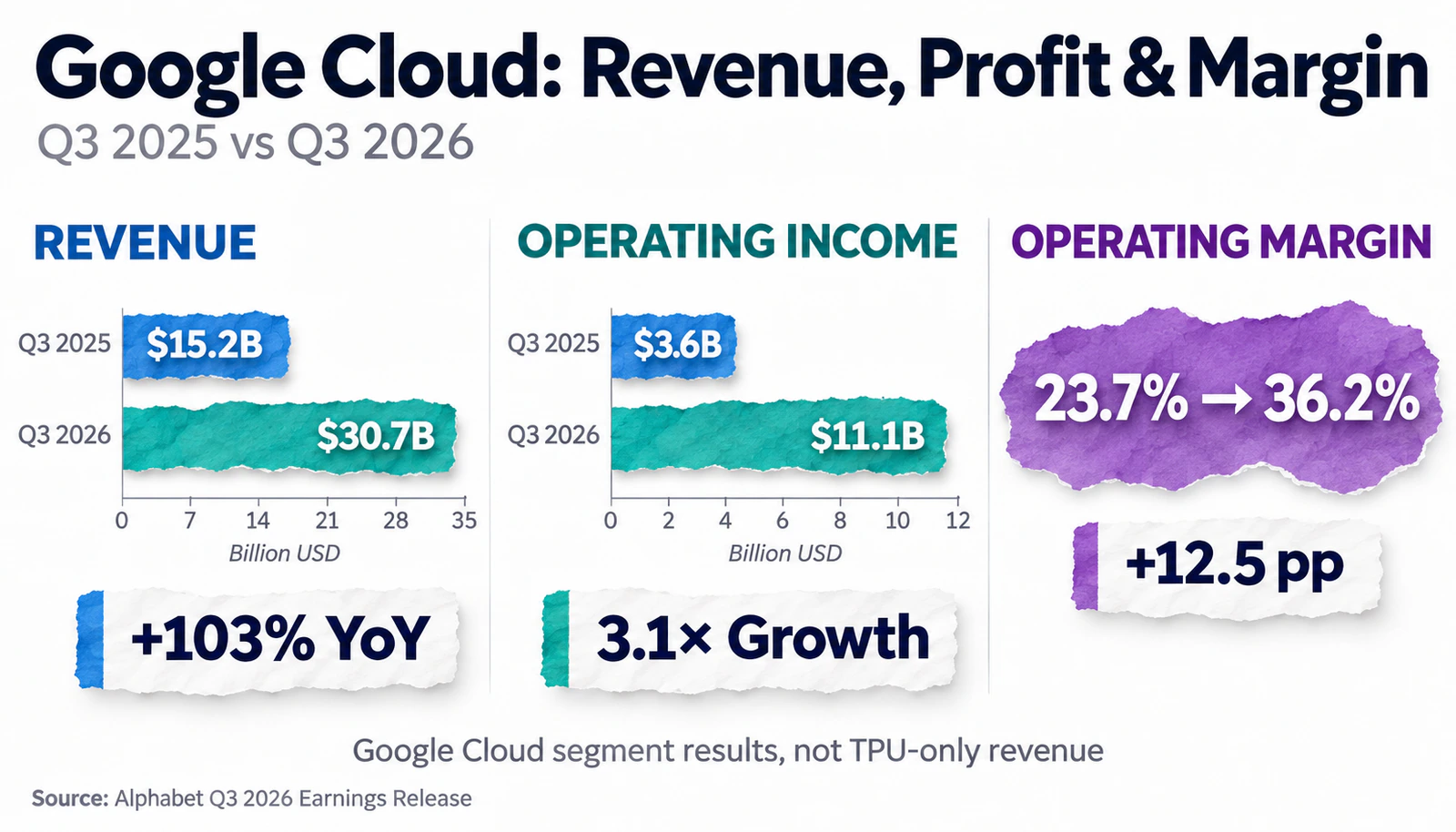
The development of TPU is particularly significant against the backdrop of Alphabet's rapidly growing cloud business. According to the third quarter 2026 report, Google Cloud's revenue increased by 103% year-on-year, reaching $30.7 billion. The division's operating profit was $11.1 billion compared to $3.6 billion a year earlier, and the operating margin rose to approximately 36.2%.
The growth is linked to increased demand for corporate cloud services, AI infrastructure, and artificial intelligence-based solutions. Alphabet specifically noted the significant contribution of TPU system sales to Google Cloud's revenue, although the exact share of this segment was not disclosed.
We are seeing high demand for our TPU systems from a wide range of customers.
For Google, proprietary AI chips create two potential sources of financial benefit. The first is related to optimizing computing costs for Gemini, search, and other services. The second involves providing TPU to customers through Google Cloud and selling ready-made systems for installation in third-party data centers. This model allows for expanding the commercial application of proprietary accelerators beyond the company's cloud infrastructure.
For Google Cloud, cloud computing can become more profitable as the cost of inference decreases while maintaining the quality and speed of request processing. However, this effect depends on equipment utilization, pricing for clients, and infrastructure creation costs.
In the third quarter, Alphabet's capital expenditures amounted to $51.4 billion, and free cash flow (FCF) was negative, reaching -$9.1 billion. Besides large investments in technical infrastructure, FCF was affected by inventory accumulation for TPU system sales and a $5.2 billion fine from the European Commission. The company maintained its capital expenditure forecast for the entire 2026 year in the range of $195–205 billion.
High capital expenditures, equipment depreciation, and data center energy consumption can pressure financial results, even if the cost of individual computing operations decreases. Moreover, Alphabet has not yet disclosed the profitability of TPU sales separately from other Google Cloud products.
Therefore, for Alphabet (GOOGL) shareholders, the profitability of the cloud business becomes one of the key criteria for evaluating the effectiveness of investments in artificial intelligence. It is important not only to increase revenue but also to turn the expansion of computing power into sustainable profit and positive cash flow.
How Google's strengthening threatens Nvidia's financial results
Currently, Nvidia's financial indicators do not indicate a weakening demand for its solutions. In the second quarter of the 2027 fiscal year, ending July 26, 2026, the company's revenue reached $96.2 billion, increasing by 106% year-on-year. The Data Center division brought in $89 billion, which is 117% more than the same period last year. Nvidia's gross margin by GAAP was 75%.
However, the rapid market growth does not exclude changes in the competitive environment. If Google and other large tech companies continue to shift some tasks to their own accelerators, it could affect future GPU purchases. Such a transition could be particularly noticeable in the inference segment, where the cost of processing user requests directly impacts service profitability.
Increased competition poses two potential risks for Nvidia. First, the emergence of alternatives allows cloud operators to reduce dependency on a single supplier and redistribute capital expenditures. Second, economically attractive specialized accelerators could intensify price pressure, limiting Nvidia's ability to maintain a high gross margin.
However, the reduction of Nvidia's share in specific computational tasks does not necessarily lead to a decrease in its overall revenue. The development of AI agents, the complexity of models, and the expansion of infrastructure can sustain high demand for both GPUs and specialized processors. Moreover, when choosing equipment, customers consider not only the price of accelerators but also software compatibility, system reliability, and total operating costs.
A separate issue is related to the payback of infrastructure. The more data centers technology companies build, the more important it is for them to maintain high equipment utilization and receive sufficient income from clients. UNUM previously examined this problem in detail in the analytical article “AI Boom on Borrowed Money.”.
Thus, the threat to Nvidia is not in the immediate displacement of its equipment but in the gradual change in the demand structure for AI accelerators. As long as the industry grows rapidly, both manufacturers can benefit from increasing computational needs. But as competition intensifies, investors will need to more carefully assess sales profitability, pricing policies, and order stability.
Key Metrics for Investors to Watch
The competition between Google and Nvidia affects not only equipment manufacturers but also shareholders of tech companies. To assess long-term prospects, it is necessary to compare financial results with the real economy of computing, rather than relying solely on statements about the performance of new processors.
Key metrics to watch:
Metric | What it indicates to investors |
|---|---|
Google Cloud Revenue | Growth in demand for cloud services and AI infrastructure |
Google Cloud Operating Margin | Ability to increase profit as the business expands |
Alphabet Capital Expenditures | Cost of infrastructure development and potential pressure on cash flow |
Nvidia Data Center Revenue | Stability of demand for accelerators and server systems |
Nvidia Gross Margin | Potential impact of competition and pricing policy on profitability |
Cost of TPU and GPU Inference | Economic efficiency of solutions under comparable loads |
Number of TPU Clients | Scale of commercial distribution of Google's proprietary accelerators |
However, Google Cloud and Nvidia Data Center revenues cannot be directly compared as indicators of the same market. Alphabet's cloud segment includes various services and infrastructure sales, while Nvidia reflects revenue from equipment and data center solutions.
The next important event for investors will be the publication of Nvidia's results for the third quarter of the 2027 fiscal year, scheduled for November 17, 2026. The company previously forecasted quarterly revenue of around $108 billion with a possible deviation of 2%. The new report will allow assessing the demand dynamics and business profitability amid the expansion of alternative AI accelerators.
You can follow the company's development and related publications on the Nvidia page on UNUM.
What Advantages Google Has That Don't Yet Guarantee Victory Over Nvidia
Google's proprietary processors are becoming a more serious competitive factor due to the combination of specialized architecture, cloud infrastructure, and software tools. The company not only optimizes TPUs for its tasks but also gradually turns them into a commercial product for external clients.
However, the technological advantages of individual systems do not yet prove that TPUs can fully replace Nvidia GPUs. Real changes in the market will depend on the cost of computing, ease of development, equipment availability, and Google's ability to scale production without compromising profitability.
For investors, the key question is whether Alphabet can turn TPU development into sustainable profit growth, and whether Nvidia can maintain high margins amid increasing competition. It is the financial results and economic efficiency of computing, rather than individual technical characteristics, that will show how serious a threat Google's proprietary AI chips become.