


Aluminum
ALI


Aluminum is a lightweight non-ferrous metal widely used in construction, transportation, energy, engineering, and packaging production. In financial markets, it is considered a major industrial metal, and its exchange price depends on global demand, energy costs, raw material availability, and production volumes. For traders and investors, aluminum quotes on the LME, China's manufacturing activity, warehouse inventories, and producers' energy costs are of particular importance.
What is aluminum and why is it important for financial markets
Aluminum (Al) is a chemical element with atomic number 13, characterized by low density, ductility, and corrosion resistance. Its density is about 2.7 g/cm³ compared to 7.8 g/cm³ for steel and 8.9 g/cm³ for copper, making aluminum approximately three times lighter than steel and more than three times lighter than copper for the same volume.
Unlike gold, a significant portion of the demand for which is related to investments, the jewelry industry, and reserve assets, aluminum is primarily consumed by industry. Its quotes are sensitive to manufacturing activity, construction, automotive production, and infrastructure investments.
An important feature of the aluminum market is the high energy intensity of primary production. Extracting the metal from alumina requires significant volumes of electricity, so energy costs affect production costs and output volumes. Thus, the cost of aluminum depends simultaneously on industrial demand and the energy supply conditions of producers.
Where aluminum is used
Aluminum is in demand due to its low mass, corrosion resistance, thermal conductivity, and recyclability. These properties ensure demand from several industries, the condition of which affects the global metal market.
| Industry | Main Application | Factors Affecting Demand |
| Transportation | Body parts, engines, aircraft structures | Automobile and aircraft production |
| Construction | Facades, windows, profiles, and roofing structures | Construction activity and investments |
| Energy | Power lines, cables, distribution equipment | Development of electrical networks |
| Packaging | Cans, foil, containers | Consumer demand and packaging production |
| Industry and Electronics | Cases, machinery, heat-dissipating components | Equipment and electronics production |
In the transportation industry, reducing the weight of structures can decrease energy consumption. In electrical engineering, aluminum is used as an alternative to copper in some types of conductors, especially in overhead power lines where weight and material cost are important.
The development of electric vehicles, energy infrastructure, and data centers may support long-term demand for aluminum. However, actual consumption depends on construction volumes, material choices, and technological changes.
How the price of aluminum is formed
The price of aluminum is determined by the balance of industrial demand and supply of primary and secondary metal. Quotes are also influenced by production costs, warehouse inventories, international trade, and financial market participants' expectations.
Aluminum is represented on the exchange by deliverable and cash-settled contracts with various conditions. The main international benchmark is the London Metal Exchange (LME) quotes.
Price of aluminum on the LME
The LME publishes several price benchmarks. In particular, the LME Official Settlement Price is used for the nearest delivery, while the three-month quote reflects the cost of metal with the corresponding execution period. When analyzing, it is necessary to consider which specific indicator is displayed on the chart.
The standard deliverable futures contract for aluminum on the LME has the code AH and corresponds to 25 metric tons of primary aluminum of established quality. The exchange allows the delivery of registered metal brands in approved forms, including ingots, T-bars, and lead blocks.
At a nominal price of $2,500 per ton, the nominal value of the contract is $62,500. A quote change of $100 per ton corresponds to a change in the position value by $2,500 before expenses.
The minimum price increment for standard Outright trades in LMEselect is $0.50 per ton, or $12.50 per contract. Parameters may differ for other trading mechanisms.
Other exchange contracts
On the COMEX exchange, part of the CME Group, a deliverable futures contract for aluminum with the code ALI is traded. Its size is also 25 metric tons, but the trading and execution rules differ from the LME.
Additionally, the LME offers a cash-settled LMEmini Aluminium (MA) contract sized five metric tons, which does not provide for physical delivery.
| Characteristic | LME Aluminium | COMEX Aluminum Futures |
| Code | AH | ALI |
| Contract Size | 25 metric tons | 25 metric tons |
| Quote Unit | USD/t | USD/t |
| Minimum Standard Electronic Trading Increment | $0.50/t | $0.25/t |
| Cost of Specified Increment | $12.50 | $6.25 |
| Execution | Physical delivery | Physical delivery |
Characteristics refer to standard contracts. Conditions of individual products and trading mechanisms may vary.
Price of aluminum per kilogram and ton
In international trade, the price of aluminum is usually quoted in dollars per metric ton. To convert the cost to a per kilogram basis, simply divide the price per ton by 1,000.
Price per kg = price per ton / 1,000.
For example, at a nominal quote of $2,500/t, the cost of one kilogram is $2.50. This calculation reflects the exchange price of the metal without considering processing, transportation, taxes, and other expenses.
Exchange price and regional premiums
The physical price of aluminum may differ from the LME quote due to regional premiums, transportation costs, quality, and delivery conditions.
For example, in North America, the Midwest Premium is used—a regional surcharge added to the base price of primary aluminum. Its fluctuation can reflect local metal availability, trade restrictions, and delivery costs.
Thus, when comparing global prices, it is necessary to consider not only the exchange benchmark but also the conditions of acquiring physical metal in a specific region.
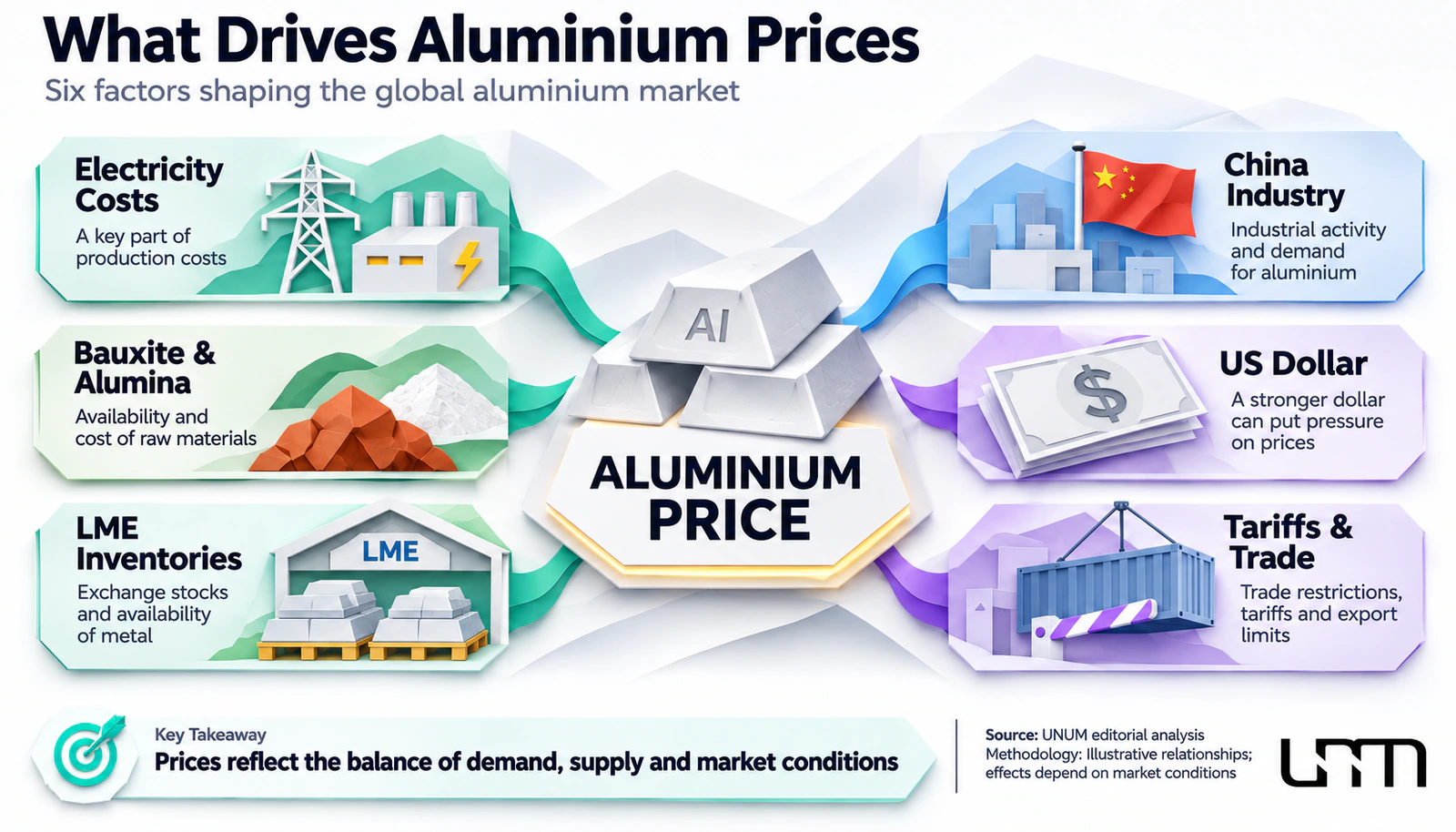
Factors Influencing Aluminum Prices
Energy Costs
The production of primary aluminum requires significant amounts of electricity, so energy costs substantially affect the cost of the metal. When tariffs rise, high-cost enterprises may reduce output, limiting supply. However, the impact depends on energy supply conditions: some producers use their own generation or long-term contracts.
The source of energy also affects the carbon footprint of primary aluminum. This can determine the competitiveness of suppliers, especially for buyers considering emissions in production chains.
Demand and Production in China
China is the world's largest producer and consumer of primary aluminum. Demand is driven by construction, automotive, electrical engineering, and infrastructure investments.
For analysis, it is important to compare China's industrial activity with production, processing, and foreign trade volumes. Even an increase in domestic demand does not necessarily lead to higher global quotes if supply grows faster.
Availability of Bauxite and Alumina
Bauxite serves as the raw material for obtaining alumina, from which primary aluminum is produced. Disruptions in ore mining, export, or processing can increase production costs.
Alumina has its own market and pricing system. Its price increase can reduce the profitability of aluminum plants, even if the quotes for the finished metal remain relatively stable.
Global Industrial Demand
Aluminum is widely used in construction, transportation, and equipment manufacturing, so its consumption depends on the economic cycle. Growth in industrial production and capital investments usually supports demand, while an economic slowdown can limit purchases.
Indices of business activity PMI, construction statistics, and indicators of car production and industrial output are used for assessment. The market reaction depends not only on the data itself but also on how it aligns with investor expectations.
International Trade and Tariffs
The aluminum market is linked to international supplies of raw materials, primary metal, and finished products. Import tariffs, sanctions, and supply restrictions can redistribute trade flows and change regional premiums.
When assessing such measures, it is important to consider which product categories they affect and how quickly buyers can find alternative suppliers.
Warehouse Stocks
LME stocks help assess the availability of aluminum for exchange delivery. In analysis, it is important to distinguish between live warrants—metal under active warehouse warrants, and canceled warrants—metal for which warrants have been canceled as part of the release procedure.
A decrease in exchange reserves does not always indicate a global deficit: the metal may be moved to off-exchange warehouses. Therefore, stock data should be compared with physical premiums and the state of trade flows.
US Dollar and Interest Rates
Since aluminum is primarily quoted in US dollars, a strengthening of the American currency can increase the cost of the metal for foreign buyers and, all else being equal, limit demand.
Interest rates affect the financing of industry, construction, and warehouse storage. However, their impact should be assessed along with the physical market balance.
How Aluminum is Produced
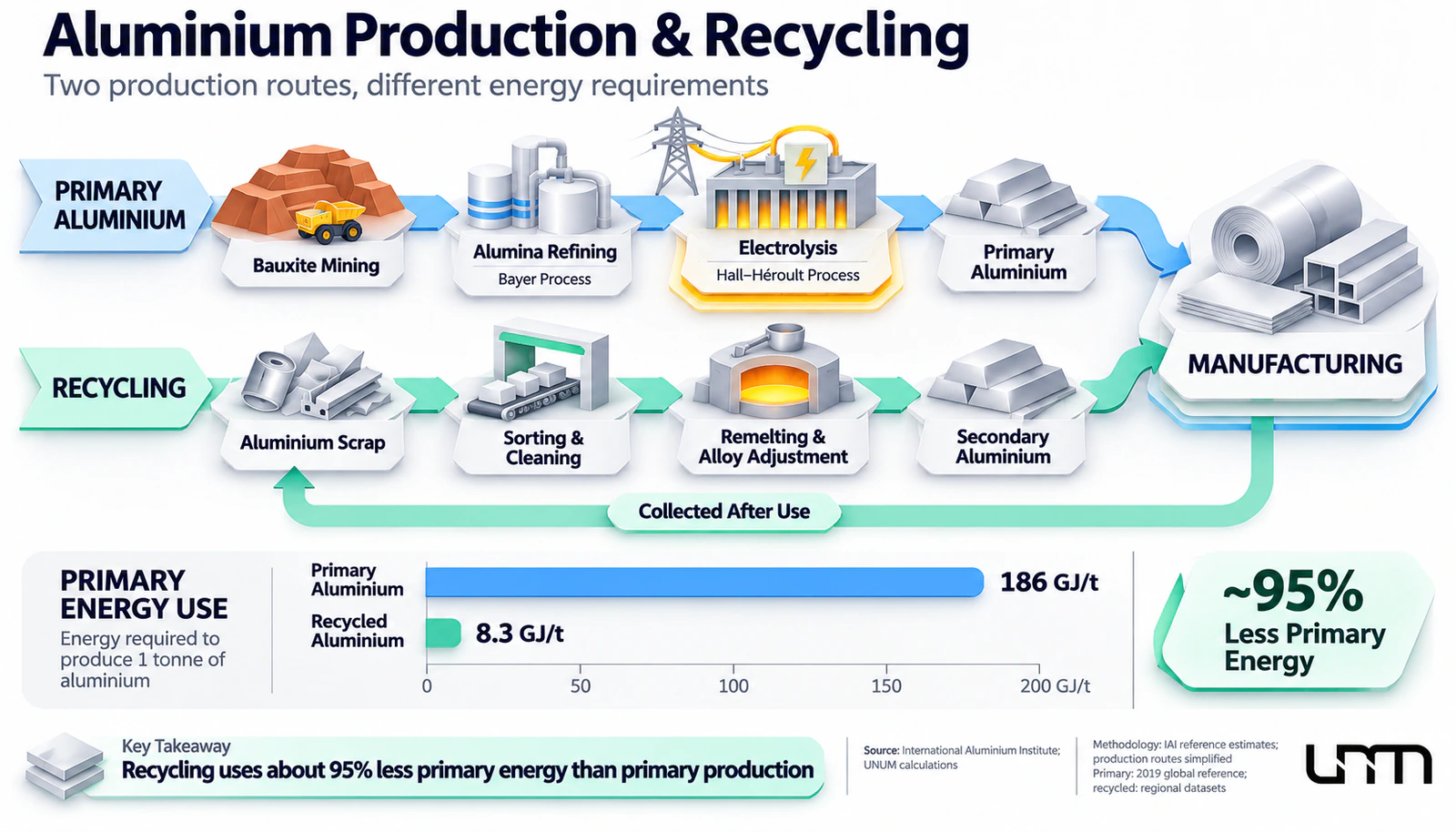
Primary aluminum is obtained from bauxite, which is processed into alumina (Al₂O₃) mainly using the Bayer method. Then, alumina undergoes electrolysis using the Hall-Héroult process, producing liquid metal for the production of ingots and billets.
The term "aluminum mining" is often used in everyday speech, but it is technically more correct to speak of bauxite mining and subsequent aluminum production.
Electrolysis requires a stable energy supply, and building new production facilities involves significant capital costs. Therefore, the supply of primary aluminum cannot quickly increase following a rise in demand. However, existing enterprises can ramp up capacity or resume previously halted operations.
Secondary aluminum is obtained by sorting, cleaning, and remelting scrap with necessary adjustments to alloy composition. According to the International Aluminum Institute, recycling can require about 95% less primary energy than producing metal from ore, when comparing respective production chains.
Recycling reduces the need for primary production but depends on the availability of scrap, the efficiency of its collection, and the composition of secondary raw materials.
How to Trade Aluminum on Financial Markets
Aluminum trading is available through futures, CFDs, and individual investment products. Indirect exposure to metal prices can be obtained through shares of producers.
The choice of instrument depends on the trading strategy, investment horizon, capital requirements, and acceptable risk.
Aluminum Futures
Futures allow for standardized exchange contracts with specific conditions. Producers and industrial consumers use them to hedge price risks, while traders use them to trade on price changes.
Standard delivery contracts for LME AH and COMEX ALI provide for 25 metric tons of aluminum each. Trading typically involves margin deposits, which may be less than the nominal value of the position.
This creates leverage and increases potential profits and losses relative to the invested capital. When choosing a contract, it is important to consider liquidity, fees, margin requirements, and physical delivery conditions.
Aluminum CFDs
CFDs (Contracts for Difference) are over-the-counter derivatives that allow trading on aluminum price changes without purchasing the physical metal. They allow positions to be opened on both rising and falling quotes.
Some brokers offer leveraged CFDs, where the nominal value of the position exceeds the margin deposit.
For example, a CFD nominal position of two metric tons at $2,500 per ton has a nominal value of $5,000. With a leverage of 1:10, the initial margin is $500.
A price change of 4%, or $100 per ton, will result in a profit or loss of $200 before expenses — this is 40% of the initial margin.
The actual sizes of CFDs, underlying quotes, and available leverage depend on the broker and jurisdiction. If the instrument is based on futures, rollovers, spreads, financing costs, and the risk of forced position closure must also be considered.
Producer Stocks and Exchange-Traded Products
Investing in the aluminum industry can be done through stocks of companies involved in metal production and processing. Their value depends not only on market quotes but also on production volumes, energy costs, debt load, and corporate decisions.
In some markets, exchange-traded products related to aluminum futures or producer stocks are also available. Their performance may differ from the dynamics of the physical metal due to asset structure, fees, and management features.
Comparison of Trading Methods
| Instrument | Features | Main Risks |
| LME and COMEX Futures | Exchange contracts for metal | Leverage, margin, physical delivery |
| CFD | Trading price changes through a broker | Leverage, spreads, rollover costs, counterparty risk |
| Producer Stocks | Stake in the aluminum business | Production and corporate risks |
| Exchange-Traded Products | Exposure depending on product structure | Fees, deviation from metal price |
How to Analyze Aluminum Quotes
An aluminum price chart allows you to study the dynamics of a selected market contract, assess volatility, and explore price trends. However, understanding the reasons for changes requires considering fundamental indicators.
Fundamental Analysis
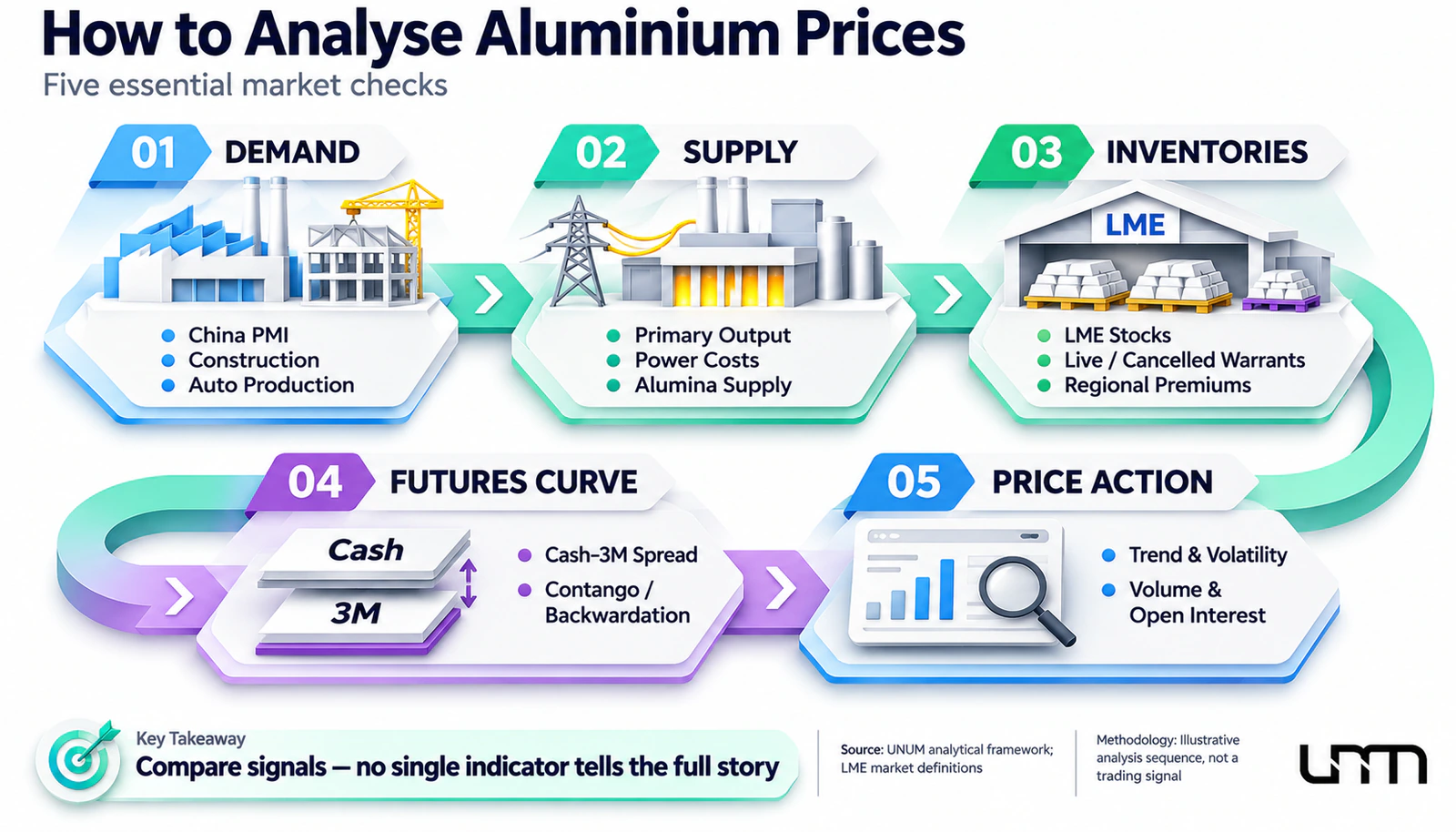
For practical analysis, it is convenient to use the following sequence:
- Assess industrial demand — production, construction, and economic activity in China.
- Check supply — primary aluminum production, alumina availability, and energy costs.
- Study inventories — LME data, warrant structure, and regional premiums.
- Analyze the forward market — the relationship between nearby and more distant quotes.
- Evaluate the chart — trend, volatility, and trading volumes.
In analysis, it is necessary to compare actual data with market expectations. For example, an increase in aluminum production does not necessarily lower quotes if investors expected an even more significant supply growth.
Futures Curve and Cash–3M Spread
Contracts with different delivery dates can trade at different prices. When more distant futures are more expensive than nearby ones, it is called contango; the reverse structure is called backwardation.
On the LME, an important indicator is the Cash–3M spread — the difference between the nearest delivery price and the three-month quote.
A positive Cash–3M means that the nearest price is higher than the three-month price and may indicate tightness in available supply. A negative spread corresponds to contango between these dates and may reflect storage and financing costs.
However, the spread itself is not a reliable price predictor. It must be compared with warehouse inventories and regional premiums.
Technical Analysis
Technical analysis involves studying trends, support and resistance levels, moving averages, trading volumes, and volatility.
When working with continuous futures charts, it is important to consider rollovers between contracts: they can create price gaps that do not reflect changes in the metal's value within a single contract.
Trading volume and open interest help assess market activity but do not guarantee forecast accuracy.
Main Risks of Investing in Aluminum
Aluminum is sensitive to the state of the industry, energy market, and global supply chains.
| Risk | Potential Impact |
| Slowdown in China's economy | Decrease in industrial demand |
| Increase in energy costs | Higher production costs and reduced output |
| Disruptions in alumina supply | Limitation of primary production |
| Increase in warehouse inventories | Potential pressure on quotes |
| International trade restrictions | Changes in supply and regional premiums |
| Strengthening of the dollar | Higher purchasing costs for buyers with other currencies |
| Production and environmental requirements | Additional costs for enterprises |
| High volatility and leverage | Significant losses relative to the margin contributed |
When trading futures and CFDs, adverse price movements can quickly lead to a loss of margin, and in some cases, additional obligations.
Long-term growth in industrial demand does not guarantee a constant increase in aluminum prices: production expansion, recycling development, and technological changes may offset consumption growth.
Frequently asked questions about Aluminum (ALI)
The main factors are industrial demand, especially in China, electricity costs, bauxite availability, production volumes, and inventories. Their impact depends on the current market balance and participants' expectations.
On the LME and in the standard COMEX ALI contract, the price of aluminum is expressed in US dollars per metric ton. To convert the price per ton to price per kilogram, divide the price per ton by 1,000.
Primary aluminum is obtained through electrolysis, which requires significant energy costs. Rising electricity prices can increase production costs and lead to a decrease in production volumes at plants with unfavorable energy supply conditions.
The standard LME aluminum futures contract has the code AH, while the COMEX aluminum futures contract is ALI. Market data providers may have different trading symbols.
Primary aluminum is obtained from bauxite through electrolysis. Secondary aluminum is produced by recycling aluminum waste. Recycling generally requires significantly less energy, but the characteristics of the finished metal depend on the raw material composition and processing technology.
if they are available in the relevant jurisdiction. Indirect participation in the aluminum market is also provided through shares of producing companies.
Both metals are widely used in industry, but their production and cost structures differ. For aluminum, the cost of electricity during electrolysis is particularly important, while for copper, it is ore extraction, concentrate availability, and electrical infrastructure development. Therefore, prices for these metals may respond differently to the same economic events.
If production cuts due to high energy costs, bauxite shortages, or supply disruptions are more significant than demand reductions, the price of aluminum may rise even during an economic downturn.
Cash–3M shows the difference between the nearest delivery price and the three-month aluminum price. A positive value indicates that the nearest price exceeds the three-month price, while a negative value indicates the opposite relationship. The spread helps analyze the state of the futures market but is not a standalone price forecast.