


Arabica Coffee
KC


Arabica Coffee is a type of coffee derived from the beans of the Coffea arabica plant. On the ICE Futures U.S. exchange, it is represented by the Coffee C (KC) futures contract for green, or unroasted, arabica that meets the exchange's delivery standards. The contract serves as one of the primary global price benchmarks for arabica and is used by producers, exporters, processors, and traders for trading and hedging price risks. Its quotes primarily depend on the harvest in Brazil, weather conditions, global demand, export deliveries, and available coffee stocks.
Factors Influencing KC Coffee Price
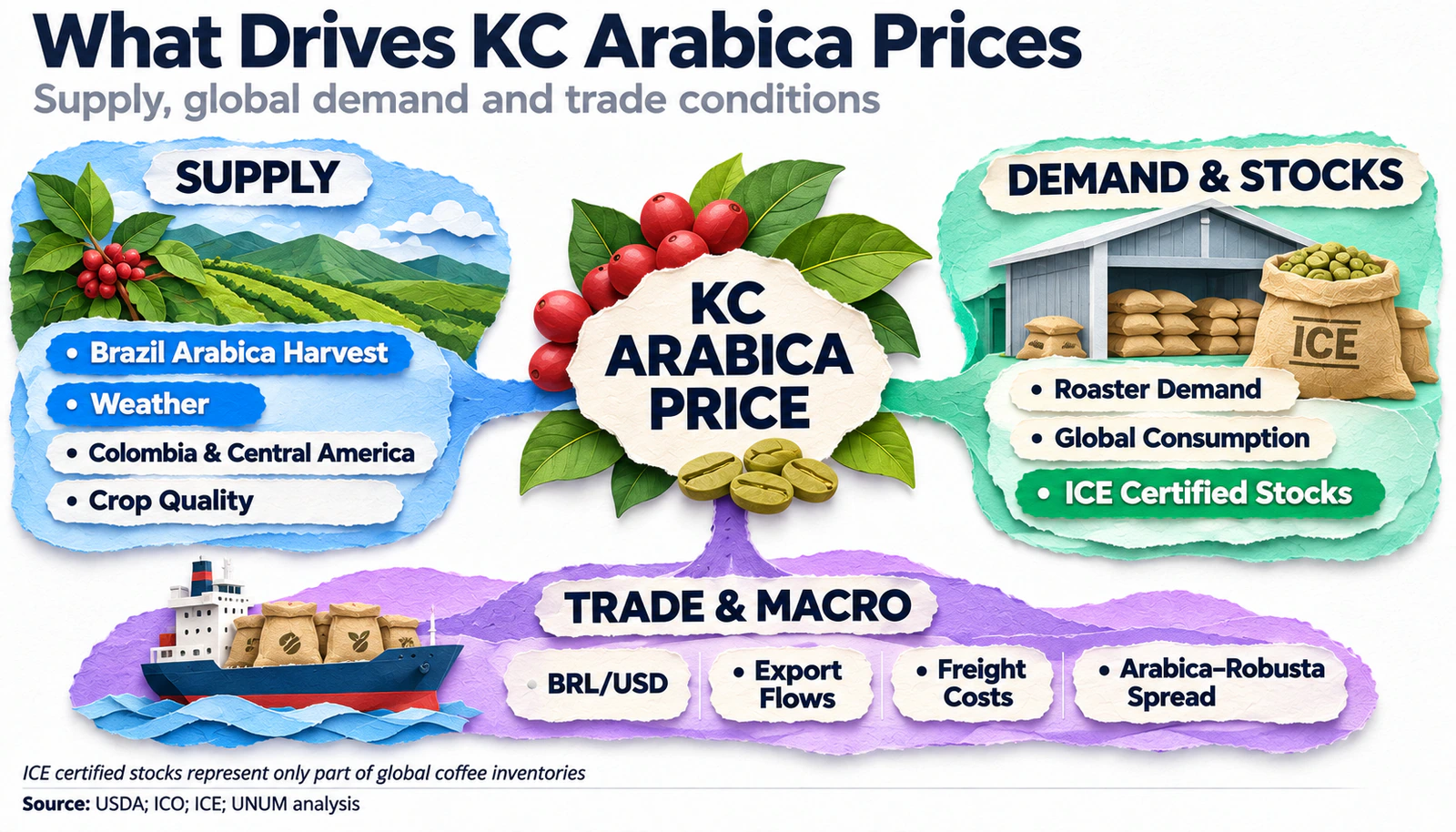
The price of KC coffee depends on the state of the global arabica market, and KC coffee quotes primarily react to changes in expected production, demand, and stocks. The following factors are particularly important for assessing the asset's value:
- Brazil's Harvest. Changes in arabica production volumes in the largest producing country affect global supply and market participants' expectations.
- Weather Conditions. Droughts, frosts, and excessive rainfall can reduce yields, damage coffee trees, and degrade bean quality.
- Production and Export. Shipments from Colombia, Central America, and other regions determine the availability of arabica on the international market.
- Global Stocks. A reduction in commercial reserves, including ICE-certified stocks, can increase the sensitivity of quotes to supply disruptions.
- Exchange Rates. Changes in the Brazilian real's exchange rate affect export revenue and producers' decisions to sell coffee.
The impact of each factor depends on the overall market balance and traders' expectations. Even a reduced harvest does not guarantee an increase in KC quotes if it is already priced in or offset by increased supply from other countries.
How the Global Arabica Coffee Market Works
The global coffee market brings together green bean producers, exporters, international traders, roasting companies, and end consumers. For analyzing the KC futures, the arabica market is particularly important, as this type of coffee underlies the Coffee C exchange contract. However, overall coffee market statistics also consider robusta, so it is necessary to separately highlight arabica data for KC assessment.
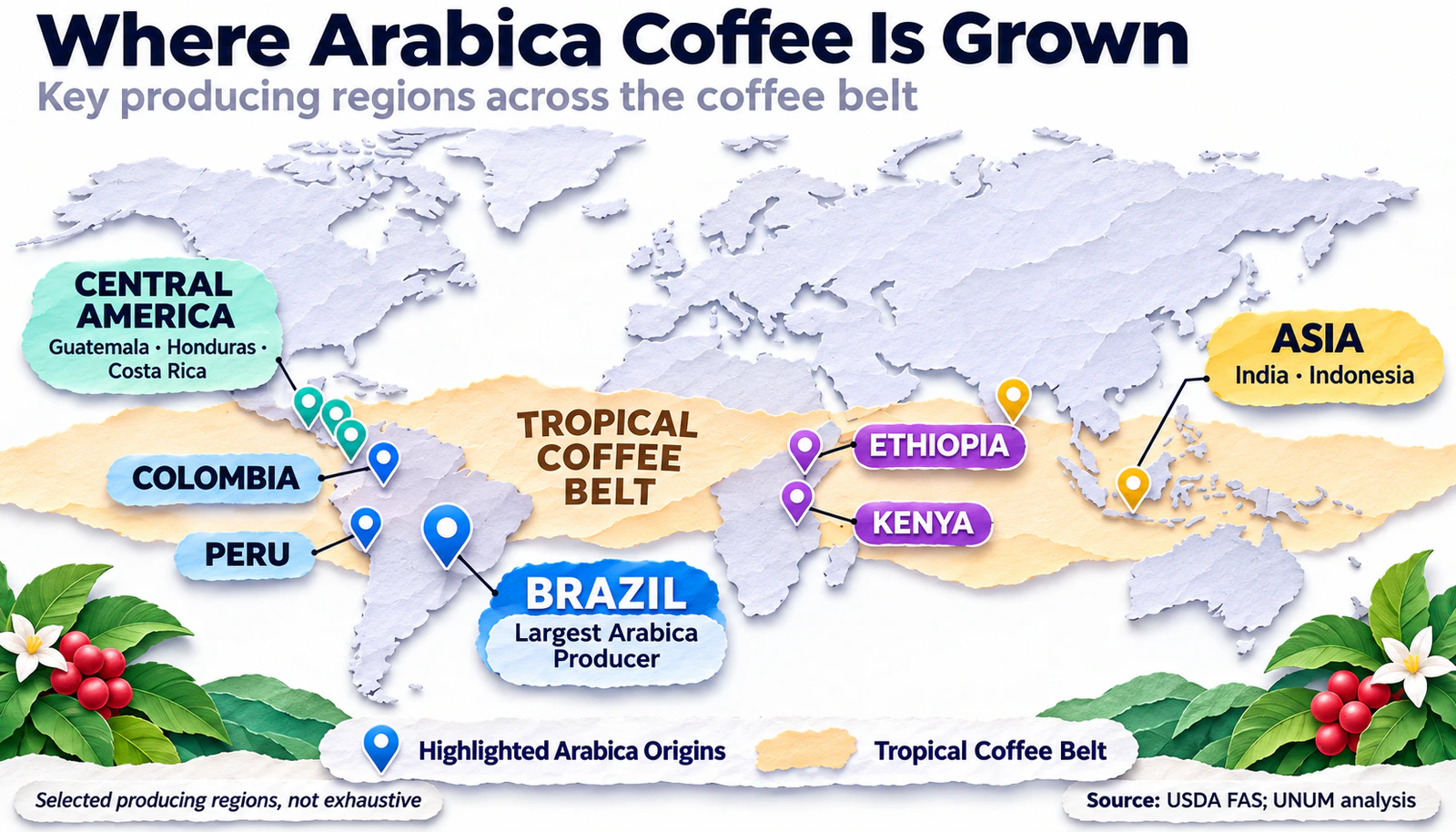
Arabica is primarily grown in tropical regions, often at significant altitudes, where the harvest depends on temperature, rainfall patterns, and the condition of coffee trees. Brazil holds the greatest significance for the international market, but Colombia, Central American countries, Ethiopia, and other producers also play substantial roles. Their harvest cycles vary, so coffee availability changes throughout the year.
For traders, it is important to distinguish the total production volume of arabica from the supply of beans that meet Coffee C requirements. Not all produced arabica is suitable for KC delivery: origin, quality, certification results, and the location of exchange-approved warehouses matter.
Brazil: The Main Source of Price Risks
Brazil is the largest arabica producer, so its harvest forecasts are crucial for the global Coffee C balance. To assess supply, market participants monitor the area of productive coffee plantations, forecasted yields, fruit development, and harvesting conditions.
A key source of statistics is the Brazilian state company CONAB, which publishes coffee production estimates. For the KC market, forecasts of arabica output separate from robusta are particularly important, as changes in Brazil's total harvest may conceal opposite trends in the two types of coffee.
Besides harvest volume, export rates and producer behavior are significant. Increased production does not necessarily lead to an immediate drop in quotes if farmers delay sales, logistical constraints arise, or the market had anticipated an even higher harvest.
Colombia and Other Arabica Producers
Colombia is known for producing high-quality arabica, including washed coffee, which plays a notable role in international trade. For analyzing its supply, it is important to consider rainfall, the condition of coffee trees, plantation renewal, production costs, and export activity.
Other significant arabica-growing regions include Honduras, Guatemala, Costa Rica, Peru, Ethiopia, and several neighboring countries. Their production conditions and harvest seasons differ, and bean quality and origin influence premiums or discounts relative to international price benchmarks.
A reduction in production in one country can be partially offset by increased supplies from other regions. However, the interchangeability of different coffee batches is limited by bean characteristics, roasters' requirements, and long-term contract conditions.
How Arabica Differs from Robusta and Why It Matters for KC
Arabica and robusta are different types of coffee used both independently and in blends. Arabica is usually grown in cooler conditions and at higher altitudes, while robusta is better suited to warmer climates. They also differ in caffeine content, flavor characteristics, plant resilience, and production geography.
The KC futures on ICE Futures U.S. reflect the market for deliverable arabica, whereas robusta has a separate contract, Robusta Coffee Futures, on ICE Futures Europe with the ticker RC. The contracts have different specifications and pricing methods: KC is quoted in U.S. cents per pound, while RC is in U.S. dollars per metric ton.
How the Arabica and Robusta Price Spread Affects Demand
Roasting companies may adjust the ratio of arabica to robusta in some coffee blends, considering raw material costs, technological requirements, and consumer preferences. If arabica becomes significantly more expensive relative to robusta, some buyers may increase the use of the cheaper type of coffee where permissible.
However, such substitution is limited by formulations, taste characteristics, and contractual obligations. Therefore, an increase in the price spread between Arabica and Robusta does not automatically mean a drop in demand for KC.
To compare the two markets, KC and RC quotes need to be converted to a common unit of mass and currency. After this, the change in price difference can be assessed, but it is not a direct indicator of the profitability of roasting enterprises.
Why grain quality affects the physical price
The quality of green coffee is determined by the size and uniformity of the beans, the presence of defects, moisture content, and the results of organoleptic evaluation. The ICE exchange uses certification standards, including grain quality checks and cup tests. The size of the premium or discount depends on the permitted origin and delivery point and is determined by the current ICE rules for a specific execution date.
The list of permissible countries of origin is not immutable. For example, starting with the May 2027 contract, ICE provides for the admission of Arabica from Vietnam with an established discount to the base price. This does not mean that any coffee from Vietnam automatically meets delivery requirements: the batch must undergo the necessary verification and certification procedures.
The actual cost of a specific batch of Arabica may differ from the KC quote. Specialized varieties, coffee from specific regions, and products with special quality characteristics are often sold under independent commercial conditions.
Seasonality of Arabica and main weather risks
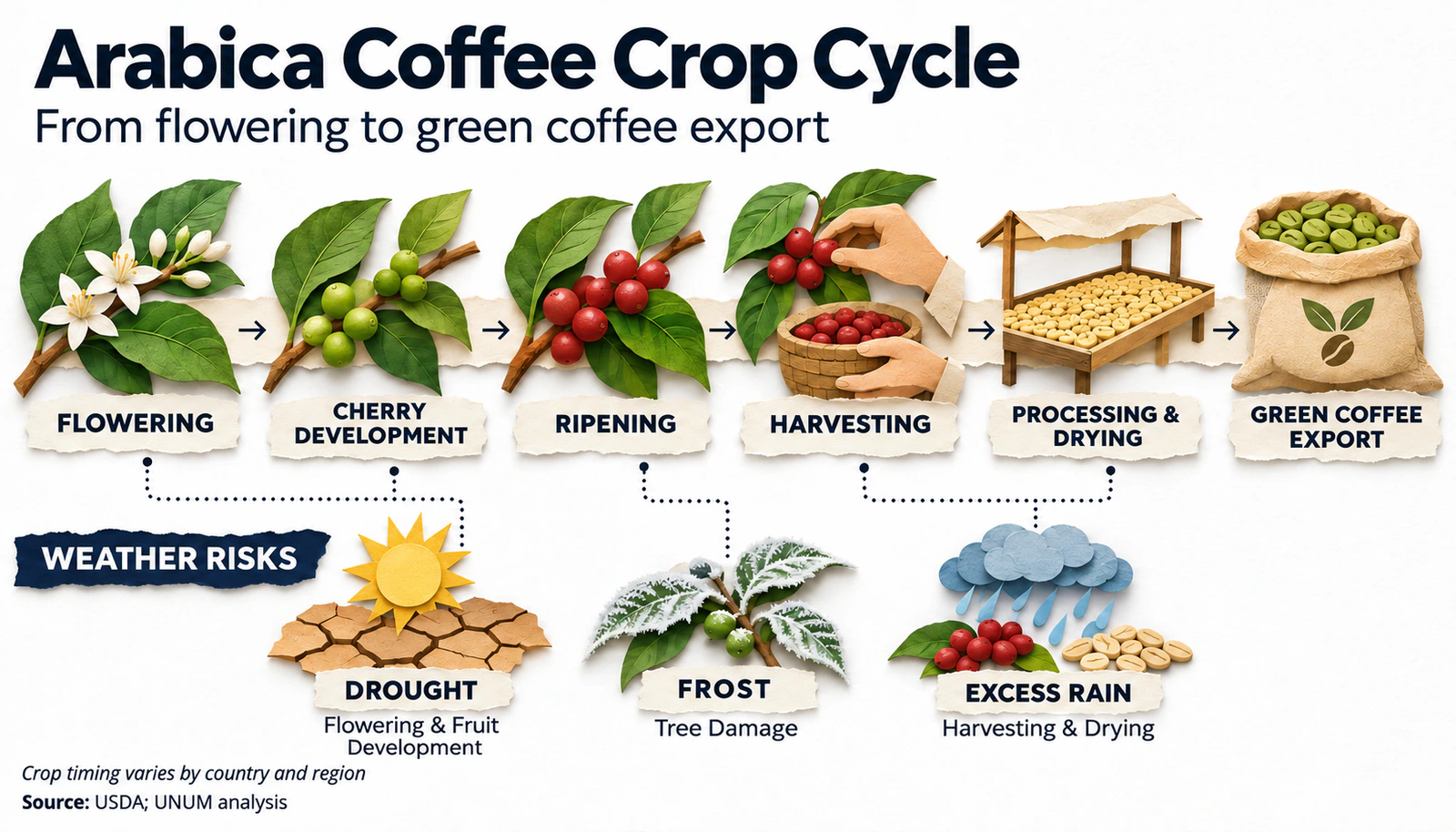
Coffee production is associated with the multi-year life cycle of coffee trees. Unlike annual agricultural crops, producers cannot quickly increase output by expanding plantation areas: new trees take time to start full fruiting. This limits the speed of supply response to changes in world prices.
Flowering, rainfall, and yield
For the formation of the future harvest, the conditions of coffee tree flowering, berry development, and fruit ripening are important. Prolonged drought can worsen the condition of plants, and lack of moisture during key periods can reduce the number of forming fruits. Excessive rainfall during harvesting and drying can complicate processing and degrade grain quality.
Frosts remain a separate risk for Brazilian Arabica. Severe cold can damage leaves, branches, and productive parts of trees, and the consequences of severe frosts can extend to several subsequent seasons.
To assess the impact of a weather event, it is necessary to consider the affected regions, the stage of plant development, and the share of damaged plantations. An unfavorable forecast for one region does not necessarily lead to a reduction in the entire Brazilian harvest.
Two-year production cycle of Arabica
Brazilian Arabica is characterized by a tendency to alternate higher and lower yields, known as the biennial cycle. After a period of intensive fruiting, trees may allocate more resources to recovery and vegetative growth, affecting the potential harvest volume in the next season.
However, this cycle is not a strict rule. Its expression depends on the condition of the plants, weather, agronomy, plantation renewal, and other factors. Therefore, the harvest forecast cannot be based solely on the alternation of calendar years: weather conditions and plantation conditions can disrupt this cycle.
How to account for different harvest seasons
In Brazil, the main coffee harvest is usually collected in the middle of the calendar year, although the timing varies by region and weather conditions. In Colombia and other countries, different production cycles are possible, including main and additional harvest periods.
For market analysis, it is important to compare production with the corresponding stage of the season and consider differences in marketing years. A decrease in exports in a particular month may reflect normal seasonality rather than a deterioration in global supply.
What influences the price of Arabica coffee KC
Coffee C quotes are formed under the influence of expectations of global production, consumption, and available stocks. Forecasts of Arabica harvests in Brazil are particularly important for the market, not just the total coffee production, which includes Robusta. Additionally, the price may react to changes in exports from other countries, currency fluctuations, logistics, and the financial positions of market participants.
Production and global coffee balance
The basis of fundamental analysis is the comparison of beginning stocks, harvest, consumption, and ending stocks. For the global market, the following dependency is used in a simplified form:
Ending stocks = beginning stocks + global production − global consumption.
When comparing different sources, it is necessary to consider the calculation methodology, marketing years, and the distinction between Arabica and Robusta. For an individual country, the balance additionally includes imports and exports, but at the global level, international trade mainly redistributes existing supply.
A reduction in forecasted ending stocks may increase the market's sensitivity to new supply disruptions. However, even a worsening balance does not guarantee an increase in KC if it has already been factored into the exchange price.
Global demand and the activities of roasting companies
Demand for coffee is formed by the consumption of households, restaurants, coffee shops, and ready-to-drink beverage manufacturers. Its dynamics depend on consumer incomes, retail prices, consumption habits, and the development of the coffee industry in different countries.
In the short term, consumption may change more slowly than harvest, so supply disruptions sometimes cause significant volatility. However, a prolonged increase in raw material costs can influence roasters' purchasing decisions, blend compositions, and inventory volumes.
It is also important to consider the differences between the growth in retail coffee prices and changes in KC. The price of the finished beverage includes roasting, packaging, transportation, rent, labor, and trading expenses, so it does not mirror the dynamics of exchange quotations.
Brazilian Real Exchange Rate and Export Economy
Coffee KC is quoted in US dollars, while a significant portion of Brazilian producers' costs are in reals. A weakening BRL against the USD, all else being equal, can increase exporters' revenue in local currency and stimulate sales.
However, the impact of the exchange rate depends on previously concluded contracts, hedging, fertilizer costs, transportation expenses, and current stocks. Therefore, the movement of BRL/USD should not be considered as an independent forecast of Coffee C quotations.
Stocks and Availability of Deliverable Coffee
To assess the short-term market condition, traders monitor commercial stocks, export flows, and ICE certified stocks. The latter reflects only coffee allowed in the exchange delivery system, not all physical Arabica stocks.
A reduction in certified stocks may indicate a decrease in available deliverable supply but does not necessarily mean a reduction in the entire global harvest. Certification, batch movements, and owners' decisions to place beans in warehouses also affect this indicator. Therefore, ICE stock dynamics should be evaluated alongside exports, commercial reserves, and production forecasts.
Which Data to Use for Fundamental Analysis of KC
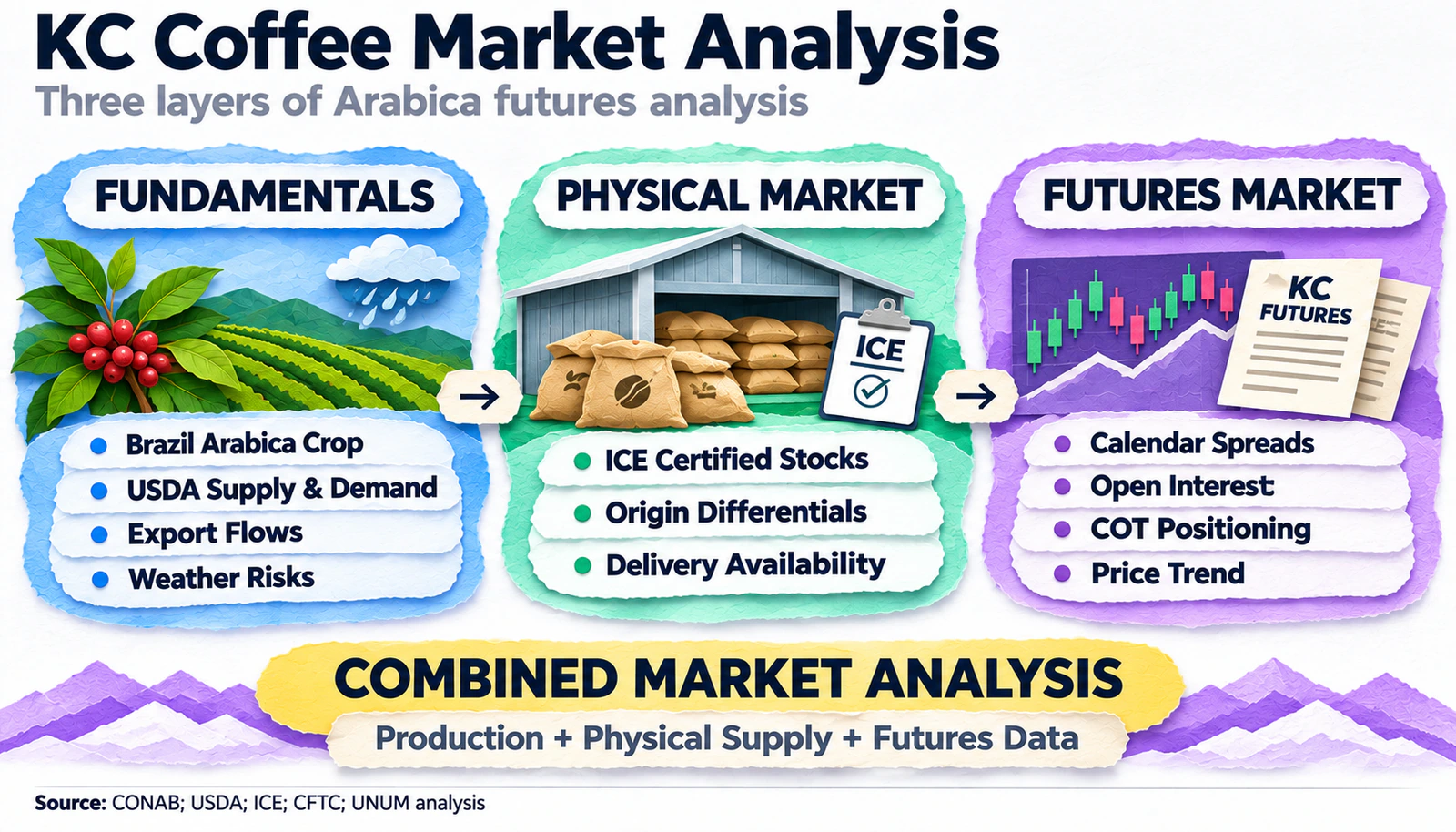
For Arabica analysis, it is necessary to combine agricultural production forecasts with data on global trade, stocks, and market participants' positioning. A single report rarely provides a complete picture: for example, a forecast of a high Brazilian harvest should be compared with actual exports, offerings from other countries, and buyers' expectations.
| Source | What to Analyze | Practical Application |
| CONAB | Arabica production in Brazil, coffee plantation area, production area, and yield | Assessment of potential supply |
| USDA Coffee: World Markets and Trade | Production, consumption, export, and ending stocks | Global balance analysis |
| ICO Coffee Market Report | Price indicators, export flows, and market trends | Comparison of coffee market segments |
| ICE | Certified stocks, quotations, volume, and open interest | Evaluation of the futures market and deliverable supply |
| CFTC COT | Positions of commercial participants and investment funds | Analysis of market position structure |
| BRL/USD | Brazilian real value relative to the dollar | Assessment of the export currency factor |
How to Read CONAB and USDA Forecasts
When assessing the Brazilian harvest, it is necessary to check how much the estimate of Arabica specifically has changed. An increase in overall coffee production may be accompanied by a reduction in Arabica output if Robusta shows the opposite trend.
In USDA publications, coffee volumes are often expressed in 60 kg bags, so when comparing with KC exchange quotations, it is necessary to convert the units of mass. It is also important to check whether the source uses the calendar, agricultural, or coffee marketing year.
To assess the impact of the publication on quotations, the new forecast should be compared not only with the previous report but also with market participants' expectations. Even an increase in production can be accompanied by a rise in KC if the actual forecast turned out to be below consensus.
What the ICO Report Shows
The International Coffee Organization (ICO) publishes price indicators for various coffee groups, international trade data, and market reviews. They help compare the dynamics of different categories of Arabica, Robusta, and overall export flows.
ICO indicators are calculated using a separate methodology and cover various coffee categories and price observations. Therefore, they do not necessarily coincide with a specific KC futures contract. Discrepancies between them are useful for analyzing the coffee market structure and do not necessarily indicate an error in ICE quotations.
How to Use the CFTC COT Report
The Commitments of Traders report shows the distribution of open positions among categories of major participants in the futures market. For Coffee C, traders can assess the dynamics of positions of producers and trading companies, funds, and other reportable categories.
An increase in the net long position of investment funds may indicate a strengthening of speculative demand for futures, but it does not guarantee further growth. For analysis, it is more important to compare the size of the position with its historical range, changes in open interest, and price dynamics.
CFTC COT reports typically reflect positions as of the end of Tuesday and are published on Friday, unless the regulator's calendar provides for a postponement. Therefore, they are suitable for studying market positioning rather than determining the current flow of orders.
Practical Algorithm for Analyzing Arabica KC
A fundamental assessment can be built sequentially by combining information on Arabica production, available stocks, and the state of the exchange market. The following order is convenient for this:
- Check the Brazilian harvest forecast, highlighting Arabica separately and assessing weather risks.
- Study production in other countries, primarily Colombia and Central American states.
- Compare the global balance, consumption, and carryover stocks according to USDA.
- Check exports and ICE certified stocks to assess available supply.
- Analyze BRL/USD, futures spreads, and COT, comparing fundamental data with the state of the exchange market.
The Arabica coffee price forecast is based on several scenarios considering Brazil's harvest, stocks, exports, and demand. For instance, a decrease in production may support prices, but an increase in supply from other countries or a weakening in consumption could partially offset its impact. No scenario guarantees a specific movement in KC.
How Coffee C Quotes Are Formed on ICE
On the exchange, Arabica coffee is represented by the Coffee C (KC) futures, which is used for trading and hedging price risks. The exchange contract provides for the physical delivery of green Arabica that meets ICE requirements, and quotes are expressed in US cents per pound.
An important feature of Coffee C is the system of premiums and discounts for the allowed origin of coffee and the location of the delivery warehouse. Therefore, KC serves as a price benchmark but does not set a single price for any type of Arabica from any country.
KC Futures Specification
A standard contract corresponds to 37,500 pounds of green coffee, or approximately 17.01 metric tons. The minimum price change is 0.05 cents per pound, which equals $18.75 per contract.
The main delivery months are March, May, July, September, and December. Physical delivery is made through licensed ICE warehouses in approved locations in the US and Europe. Delivered batches must meet the exchange's requirements for origin, quality, and certification.
The first notice day for delivery occurs seven business days before the first business day of the delivery month. The last trading day is one business day before the last notice day, which, in turn, is seven business days before the last business day of the delivery month. A client broker may set earlier deadlines for closing positions.
For a trader not planning physical delivery, these deadlines are practically significant: the position must be closed or rolled over considering the exchange and broker requirements.
How to Calculate the Cost of a Coffee Futures Contract
The nominal value of the contract is equal to the price per pound multiplied by 37,500. For example, with a hypothetical quote of 250 cents per pound, or $2.50: $2.50 × 37,500 = $93,750.
If the price changes by 1 cent per pound, the value of one contract will change by $375. The minimum increment of 0.05 cents corresponds to $18.75.
Opening a futures position usually requires margin rather than the full nominal value of the contract. However, profits and losses are calculated based on the full size of the position, making leverage a significant source of risk.
All calculations are hypothetical and do not reflect the current market price of KC or actual margin requirements.
How to Convert Coffee Price Per Pound to Price Per Ton
The price of coffee per pound on ICE is expressed in US cents. To convert to dollars per metric ton, first convert the quote to dollars, then multiply by 2,204.62.
Coffee price per metric ton (USD) = price per pound (USD) × 2,204.62.
For example, with a hypothetical quote of $2.50 per pound, the price is about $5,511.56 per metric ton.
In the physical coffee market, a 60 kg bag is also widely used. Its hypothetical cost at the same price, excluding quality premiums, logistics, and other expenses, would be about $330.69.
Conversion does not mean that any batch of Arabica will be sold at this price: real contracts take into account origin, quality, delivery times, and transport conditions.
Why the Physical Price of Arabica Differs from KC
In physical trading, the price of coffee is often determined with a differential relative to the futures benchmark, reflecting quality, origin, location, and other commercial conditions. Such a premium or discount depends on the characteristics of a specific batch and the situation in the relevant market segment.
Therefore, an increase in KC does not always lead to a similar change in the cost of each type of Arabica. For example, a shortage of a certain quality or origin may increase its premium even with a stable futures market.
How to Analyze the KC Chart and Futures Curve
The KC coffee price chart can display a single futures contract or a continuous series combining several delivery months. Before technical analysis, it is necessary to check the selected month, year, and method of forming historical quotes.
Contango and Backwardation
Contango occurs when a more distant futures contract is more expensive than the nearest one when comparing selected delivery months. This structure may reflect storage costs, financing, and expectations regarding future coffee supply.
Backwardation means the opposite relationship, where the nearest contract is more expensive than the more distant one. It may be associated with the higher cost of immediately available coffee or tension in the delivery market.
However, the shape of the futures curve does not provide a guaranteed forecast of the spot price. For proper interpretation, it is necessary to analyze stocks, seasonality, calendar spreads, and physical delivery conditions.
Trading Volume, Open Interest, and Volatility
Technical analysis of KC includes studying price trends, support and resistance levels, moving averages, volumes, and open interest. These indicators allow assessing participant activity and market liquidity.
An increase in open interest means an increase in the number of open contracts. Since each contract has a long and short side, the indicator itself does not reveal the direction of positions of individual participant categories. For a more detailed assessment, it should be compared with price, trading volume, and COT reports.
High volatility in Arabica may accompany revisions of Brazilian crop forecasts, news of frosts, or sharp changes in export expectations. In this case, a technical signal should be considered as part of the analysis, not as an independent confirmation of the future direction of quotes.
Tools for Trading Arabica Coffee KC
Trading coffee on the exchange is conducted through standardized futures and options, while CFDs are over-the-counter derivative instruments. Additionally, there are investment products with exposure to the coffee market. They differ in settlement rules, delivery, liquidity, costs, and capital requirements.
KC Futures
KC coffee futures allow opening positions based on the anticipated rise or fall in the price of Arabica, as well as hedging price risks of future deliveries. Producers, exporters, and roasting companies use such contracts to manage price uncertainty in purchases and sales.
Trading requires compliance with margin requirements, which may change with increased volatility. Before opening a position, it is necessary to check the contract size, chosen month, liquidity, and delivery notice periods.
Options on Coffee C
Options allow for various risk management strategies and exposure to the price of Arabica. The option buyer typically risks the paid premium, while the seller's obligations can create significantly higher risk depending on the position conditions.
The cost of an option depends on the price of the underlying future, expected volatility, time to expiration, and other characteristics. Therefore, even a correct forecast of the KC direction does not necessarily mean profit on a specific option.
CFD on Coffee
CFDs on coffee are over-the-counter derivative instruments that allow opening positions based on price changes without the physical purchase of coffee beans. The broker may use its own specification and price reference, so it is necessary to verify whether the CFD is indeed linked to Coffee C (KC).
For example, a hypothetical CFD position of 1,000 pounds at a price of $2.50 per pound has a nominal value of $2,500. If the broker's terms provide for a 1:10 leverage, the initial margin will be $250. A 4% price change will result in a profit or loss of $100 before expenses, corresponding to 40% of the initial margin.
The calculation illustrates the effect of leverage and does not reflect the conditions of a specific broker. Actual CFD sizes, spreads, commissions, leverage restrictions, and negative balance protection depend on the instrument, client category, and jurisdiction.
Investment Products and Company Stocks
Investments in coffee through exchange-traded products may differ from direct KC trading in terms of costs, portfolio structure, and the impact of rolling futures contracts. In certain jurisdictions, products linked to coffee futures or baskets of agricultural commodities are available.
Shares of roasting companies, beverage manufacturers, and coffee chains represent an indirect way to participate in the coffee industry but do not mirror Arabica quotes. The rise in raw material costs may increase expenses for such companies, but its impact on financial results depends on selling prices, contracts, and sales structure.
Key Risks of Trading Coffee KC
Arabica quotes are sensitive to weather conditions, crop forecasts, available stocks, and changes in international trade. Since expanding production takes time, short-term supply disruptions can cause significant price fluctuations.
To assess the consequences of these risks, it is necessary to consider how a market event might affect an open position, its margin requirements, and the possibility of closing the contract.
| Risk | Possible Impact |
| Drought and Frost | Crop reduction or damage to coffee trees |
| Weather issues during harvest | Delivery delays and reduced grain quality |
| Low ICE certified stocks | Increased sensitivity of the delivery market |
| Currency fluctuations | Changes in the export economy of producers |
| Quality and origin differences | Changes in physical premiums and discounts |
| High volatility | Sharp changes in the value of an open position |
| Leverage | Rapid increase in losses relative to margin |
| Physical delivery | Delivery obligations in case of untimely position closure |
For individual retail CFD accounts, mandatory negative balance protection may apply. For exchange-traded futures, additional margin requirements and losses beyond the initial margin are possible. Therefore, when managing a position, it is necessary to consider not only the expected price direction but also the available capital, execution terms, and broker conditions.
Frequently asked questions about Arabica Coffee (KC)
Total production includes arabica and robusta. If the increase in output is mainly due to robusta, the supply of arabica may remain limited. Quality of beans, stocks, and market expectations are also significant.
This coffee has undergone the exchange's verification procedures and is in the appropriate warehouse system. It does not reflect all global commercial stocks, so its dynamics should be analyzed separately from the overall USDA balance.
The BRL exchange rate is just one factor in the export economy. Currency hedging conditions, contract prices, available stocks, and weather risks can have a stronger influence on producers' decisions and quotes.
Their dynamics are linked through the coffee market and partial substitutability in blends, but production conditions and demand structure differ. Therefore, the price of RC is better used as an additional indicator rather than a direct forecast for KC.
Platforms may show different expiration months, continuous futures series with various methods of transitioning between contracts, or quotes with different delays. To make accurate comparisons, it is necessary to check the parameters of the displayed instrument.
An increase in open interest means more outstanding contracts. Since each contract has long and short sides, this indicator does not determine the market direction by itself. It should be compared with price, trading volume, and position distribution in the COT report.
Yes. Futures, options, individual CFDs, and available investment products are used for this purpose. Each option has its own trading conditions, costs, and risks.