
Why Analysts Are Changing Bitcoin Expectations
As of November 11, 2026, Bitcoin was trading around $73.7k. According to Yahoo Finance, at 05:38 UTC, the quote was approximately $73,725, although it fluctuated throughout the day. Earlier, on November 8, BTC fell to $73,708, marking a low for over two months. More details on the reasons for the decline, including outflows from exchange-traded funds and position liquidations, were discussed in UNUM's analytical material.
The current cryptocurrency price is significantly below most long-term targets, which banks and investment companies continue to publish. Some analysts expect a recovery to $100–150k over the next year, while others foresee Bitcoin's market capitalization reaching tens of trillions of dollars by the end of the decade.
Bitcoin's price forecast depends not only on perceptions of the future cryptocurrency market but also on specific methodologies. Short-term estimates usually consider cash flows, market cycles, and financial conditions, whereas long-term models are built around the assumed share of BTC in global investment portfolios, corporate reserves, and the store of value segment.
Therefore, a change in the target price does not necessarily prove that analysts have become more confident or cautious about Bitcoin. It is important to determine which indicator they revised, what timeframe they are considering, and what new data formed the basis of their calculations.
How Banks Revised Bitcoin Forecasts
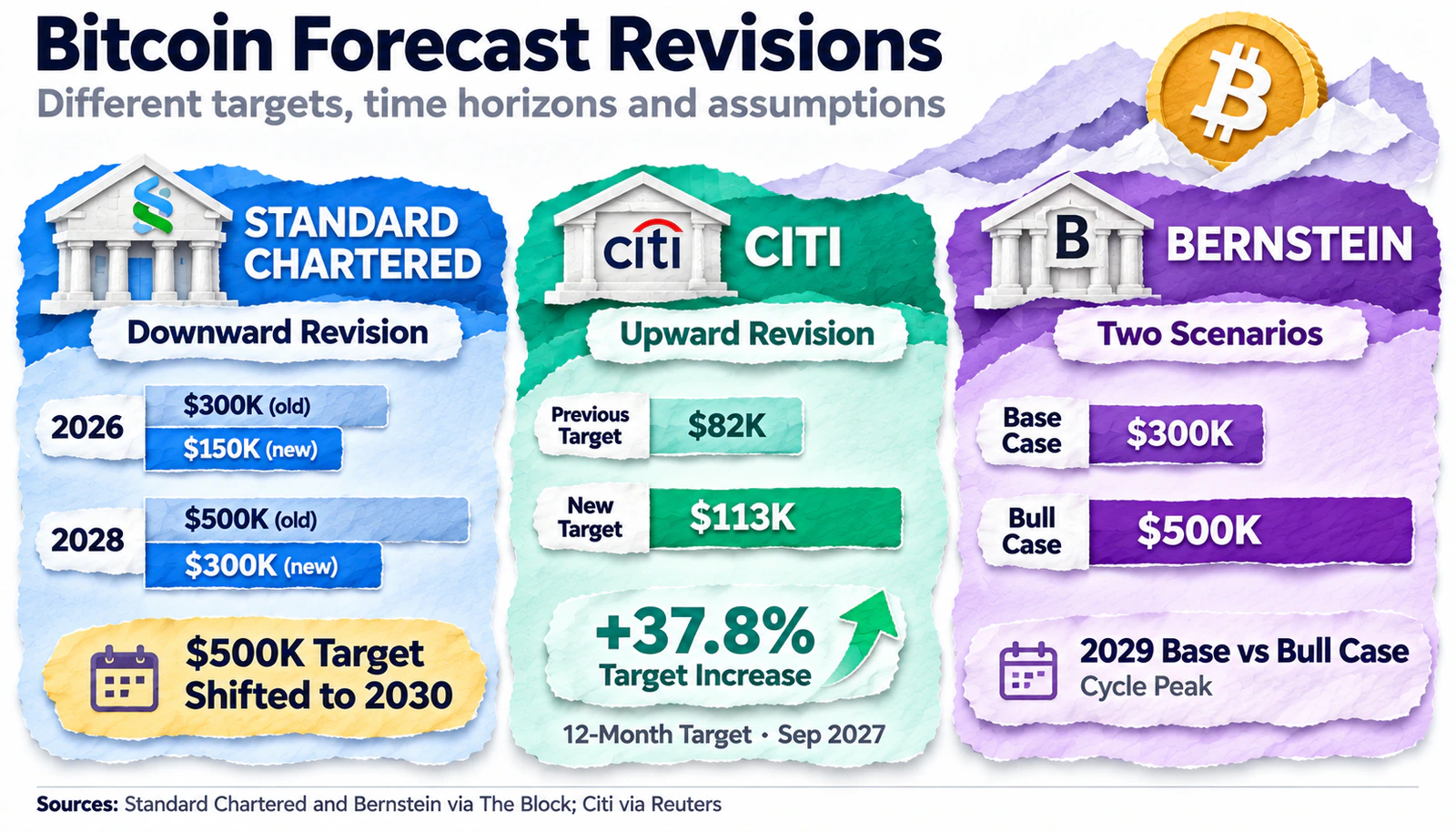
One of the most illustrative examples is Standard Chartered. In December 2025, the bank significantly lowered its price targets and postponed the expected timeline for Bitcoin reaching $500k from 2028 to 2030.
The bank's analyst, Geoffrey Kendrick, who heads digital asset research, explained the revision by changes in demand structure. Previously, the bank relied on a combination of purchases from spot Bitcoin ETFs and companies forming cryptocurrency reserves. However, by the end of 2025, Kendrick stopped factoring in further expansion of corporate purchases on the previous scale.
The new trajectory, published on December 9, 2025, projected $150k by the end of 2026 instead of the previous $300k, $225k in 2027 instead of $400k, and $300k in 2028 instead of $500k. The target for 2029 was reduced from $500k to $400k, and the $500k mark was postponed to 2030.
In a comment on the revision, Kendrick admitted: "Our previous short-term targets were incorrect."
The essence of this revision is not a rejection of long-term optimism but a change in the expected growth rate. The bank still anticipates Bitcoin reaching $500k but believes it will take more time.
Citi Raised 12-Month Target to $113k
Citigroup demonstrated a different approach. According to a Reuters report on October 1, 2026, the bank raised its 12-month BTC forecast from $82k to $113k, an increase of approximately 37.8%. Simultaneously, the Ethereum estimate was increased from $2,240 to $3,028.
Citi associates the revision with expectations of a recovery in capital inflows into cryptocurrency investment products, more favorable macroeconomic conditions, and a gradual increase in Bitcoin's share in the portfolios of financial advisors' clients.
Unlike Standard Chartered's long-term model, Citi's forecast pertains to around the end of September 2027. Therefore, it cannot be directly compared with price targets for the end of 2030. Additionally, the available confirmation is based on a Reuters client note summary rather than a publicly available original bank study.
Bernstein Expects $300k at Cycle Peak in 2029
In August 2026, Bernstein analysts led by Gautam Chhugani presented two scenarios for Bitcoin's further growth. The base scenario anticipated a recovery to approximately $125k by the end of 2026, $150k by mid-2027, and reaching around $300k at the market cycle peak in 2029.
With faster institutional adoption, Bernstein considered $200k by mid-2027 and around $500k in 2029. As a more distant benchmark, the company maintained an estimate of $1 million by the end of 2033.
The base scenario is based on a model comparing Bitcoin's market value with the marginal cost of its production. The optimistic variant assumes a higher price multiplier if investors increasingly use BTC as a limited-supply asset amid rising government debt and currency devaluation risks.
Thus, Bernstein's Bitcoin forecast for 2027 significantly differs from the highest expectations for 2029–2033 not only in price but also in implementation conditions. The $500k mark is considered an optimistic accelerated growth scenario, not a base forecast.
ARK Invest maintains high forecast but revises its foundation
Unlike banks that publish target prices for relatively short periods, ARK Invest builds its Bitcoin valuation for 2030 through the potential size of available markets. In a study dated April 24, 2025, analyst David Puell presented three scenarios:
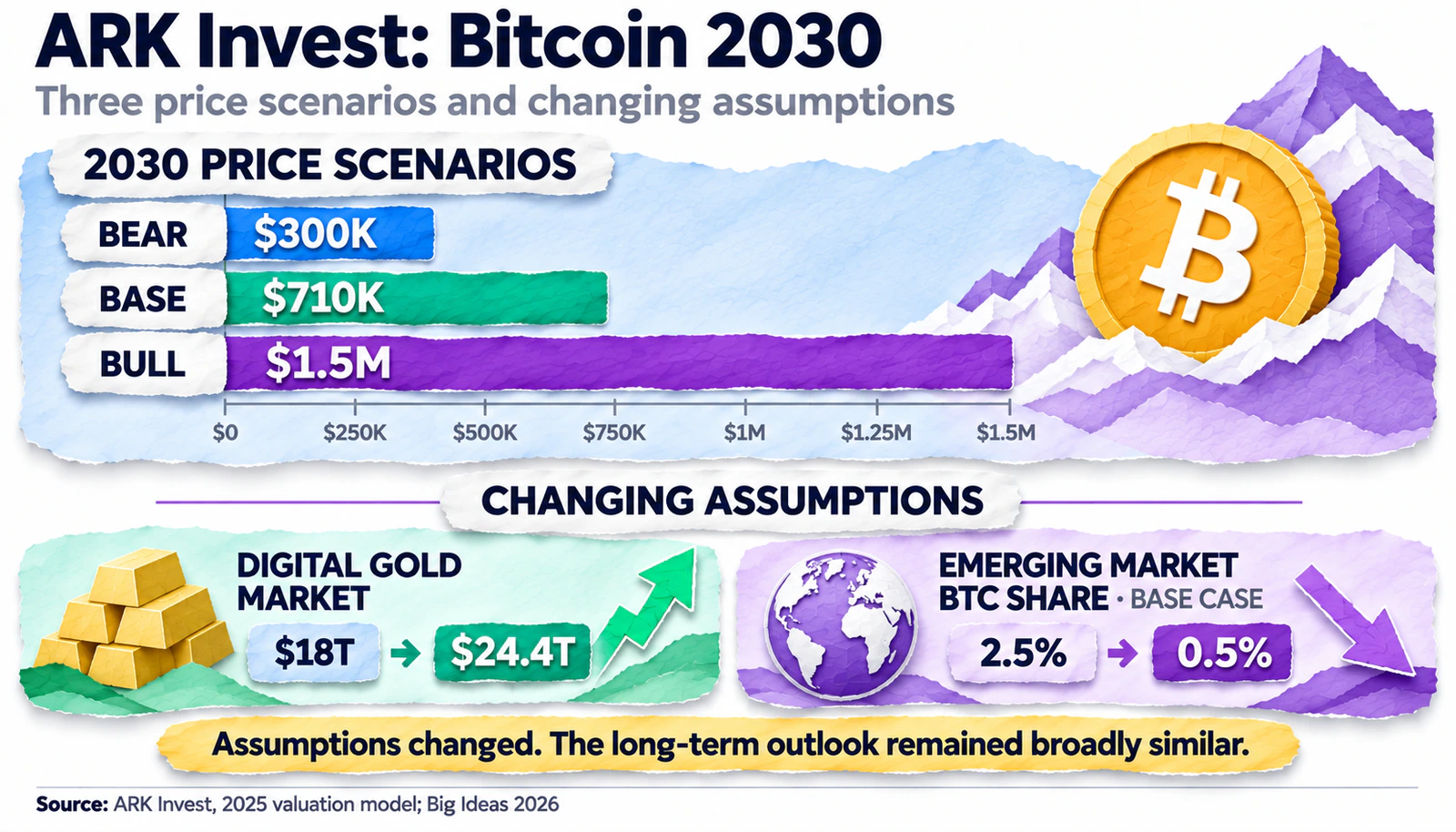
Pessimistic — around $300,000 per BTC by the end of 2030.
Base — around $710,000 with gradual institutional adoption.
Optimistic — around $1.5 million with a larger capital inflow into Bitcoin.
ARK's methodology considers six potential sources of demand: institutional investments, competition with gold, savings protection in developing countries, government and corporate reserves, as well as financial services based on the Bitcoin network. The most significant components of the model are global investment portfolios and the gold market.
In the base scenario, ARK assumes that Bitcoin can occupy 2.5% of the global investment portfolio excluding gold, which the company estimates at approximately $200 trillion by 2030. In the optimistic scenario, the corresponding share increases to 6.5%. These are calculated assumptions, not actual investments already made by institutional investors.
Why ARK changed assumptions in 2026
In the Big Ideas 2026 report, the company revised two key components of the model using data as of December 31, 2025.
The first change relates to Bitcoin's role as digital gold. ARK increased the estimated available market in this segment by approximately 37%, from $18 trillion to $24.4 trillion. The reason was the growth in gold capitalization in 2025, which the company estimated at 64.5%.
The second change was the opposite: the assumed shares of Bitcoin in the savings protection segment in developing markets were reduced by approximately 80%. For the base scenario, the figure decreased from 2.5% to 0.5%, and for the optimistic scenario — from 6% to 1.3%. ARK associates the revision with the rapid spread of stablecoins, which can satisfy part of the demand for alternative monetary instruments.
Thus, the two adjustments act in opposite directions. The expansion of the potential digital gold market increases the estimated value of BTC, while the reduction in demand expectations in developing countries decreases it.
Our assumptions about Bitcoin's growth have changed, but the forecast itself remains roughly the same.
In the same report, the company estimates Bitcoin's potential capitalization at approximately $16 trillion by 2030, implying an average annual capitalization growth of about 63% over the 2025–2030 horizon. With an expected supply of approximately 20.5 million BTC, this capitalization mathematically corresponds to a price of about $780,000 per coin. This is an Unum calculation based on ARK's model, not a newly officially announced target price of $780,000.
Separately, ARK considers the digital asset market valued at about $28 trillion by 2030 and suggests that Bitcoin could occupy about 70% of this segment. However, 70% of $28 trillion equals $19.6 trillion, not $16 trillion. Since the approximate figures within the report do not fully align with each other, it is more accurate to use the separately published forecast of its capitalization at $16 trillion for BTC valuation, rather than deriving an additional price from the 70% share.
ARK's revision shows why fundamental analysis of Bitcoin does not boil down to evaluating its limited supply. Even with an unchanged issuance schedule, the future value of the asset depends on how well assumptions about its competitiveness relative to gold, stablecoins, and traditional investment instruments hold up.
Bitwise raises long-term Bitcoin estimate to $1.6 million
On October 28, 2026, Bitwise presented an updated study Bitcoin Long-Term Capital Market Assumptions. The company increased its ten-year BTC forecast from $1.3 million by 2035 in the previous model to $1.6 million by 2036. Simultaneously, the expected average annual growth rate increased from 28.3% to 34.3%.
In the new study, Bitwise also forecasts Bitcoin's average annual volatility at 27.8% and correlation with U.S. stocks around 0.43. For institutional portfolios, the company considers scenarios of allocating 1% to 5% of capital in BTC. These figures relate to model expectations for the next decade, not the already achieved characteristics of the asset.
Bitwise's Chief Investment Officer Matt Hougan explains the revision by the expansion of markets where Bitcoin can potentially compete with existing financial instruments. Specifically, the estimated size of the global store of value market grew from $91 trillion to $110 trillion, and the institutional investment market estimate on a ten-year horizon increased from $216 trillion to $303 trillion.
We are raising our target price for Bitcoin to $1.6 million by 2036.
Hougan emphasizes that the company has maintained its previous assumptions about Bitcoin's share in specific market segments. The increase in the target price is primarily due to the estimated growth of these markets, rather than expectations of faster BTC penetration into each of them.
However, the $1.6 million forecast cannot be directly compared with ARK's targets for the end of 2030: Bitwise's horizon ends six years later. The company also warns that Bitcoin will remain a volatile asset and may experience significant downturns even if the long-term growth scenario is realized.
For investors, this model is primarily useful as a way to understand the scale of potential institutional demand. But its outcome depends on assumptions about the size of future markets and Bitcoin's ability to capture a portion of them. If these conditions are not met, the actual price may be significantly lower than the calculated one.
More about the company's updated model can be found in the UNUM news “Bitwise predicts Bitcoin at $1.6 million by 2036”.
Finder's collective forecasts have also changed significantly
Expert surveys allow for the assessment of not only the position of individual investment companies but also the range of expectations among cryptocurrency market specialists.
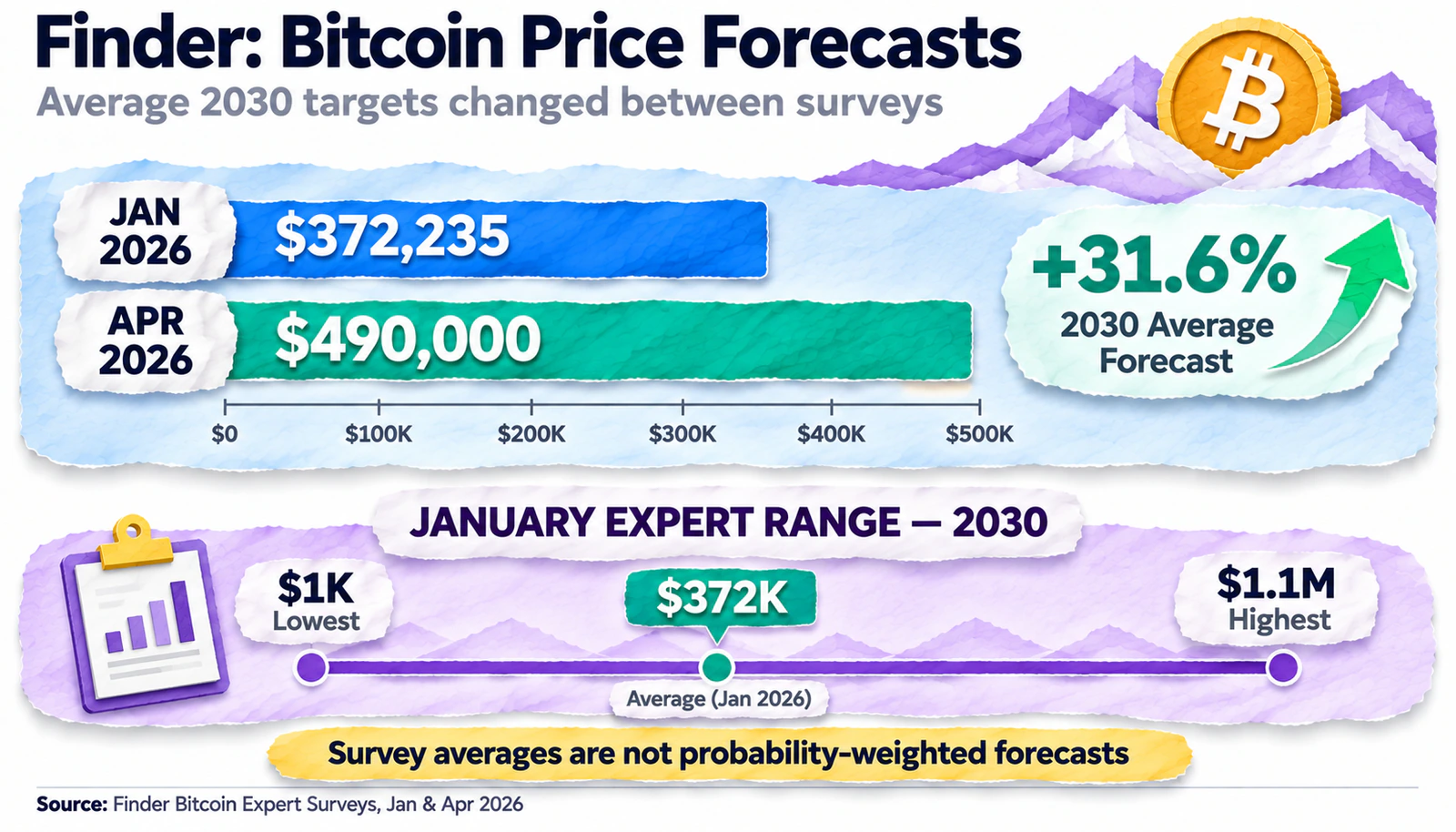
In Finder's January study, 21 experts participated. The average Bitcoin estimate was $133,688 by the end of 2026, $372,235 by the end of 2030, and $695,882 by the end of 2035. The previous survey had a forecast of $391,794 for 2030, so the January figure reflected a decrease in long-term expectations.
The April survey showed a different picture. The average estimate for the end of 2026 decreased to $127,000, but the forecast for 2030 increased to $490,000, and for 2035 to $825,625. Thus, the average price target for 2030 increased by approximately 31.6% compared to the January study.
This does not mean that every survey participant became more optimistic. The composition of the panel can change between studies, so it is correct to compare the average values of the two samples rather than attribute an individual reassessment to all experts.
The range of opinions within the January panel was even more significant: the minimum forecast for 2030 was $1,000, and the maximum was $1.1 million per BTC. This range shows that specialists are evaluating fundamentally different future scenarios for cryptocurrency — from losing investment appeal to Bitcoin becoming a major global reserve asset.
The arithmetic mean of these responses is not a probability-weighted forecast. It does not show how likely each scenario is and depends on the composition of a relatively small group of respondents. Therefore, Finder's surveys are reasonably used as an indicator of changing expert sentiment rather than as an independent model of BTC's fair value.
What prices are named by independent experts and well-known investors
Unlike institutional research, individual forecasts are often based on the author's vision of the future of the global financial system. Some experts use macroeconomic models and liquidity data, others link Bitcoin's growth to limited supply, and others suggest that large-scale financial crises will lead to accelerated capital inflow into cryptocurrencies.
When evaluating such forecasts, it is especially important to distinguish independent researchers from company executives whose financial results depend on the development of the cryptocurrency market.
Brian Armstrong lowered his long-term target
Coinbase CEO Brian Armstrong represents one of the most notable examples of changing an individual Bitcoin forecast for 2030.
On August 20, 2025, Armstrong publicly considered the possibility of BTC reaching $1 million by the end of the decade. He associated this scenario with the development of regulation in the US, institutional adoption of Bitcoin, the expansion of ETFs, and the emergence of a state cryptocurrency reserve.
A year later, his assessment became more cautious. In August 2026, Armstrong spoke of a range of $300,000–$400,000 by 2030, and on September 10, in an interview with CNBC, he confirmed that he considers the upper limit of this range a realistic target.
The short answer is yes, I really do think that's a realistic target by 2030.
Compared to the initial $1 million mark, the upper limit of the new range is 60% lower. However, this is Armstrong's personal assessment, not an official Coinbase forecast model, so it should be considered with appropriate caution.
This revision shows that even long-term Bitcoin development supporters can significantly lower price expectations without abandoning the core investment idea.
Tom Lee expects $250,000 already in 2026
Co-founder of Fundstrat Global Advisors, Tom Lee, holds a much more optimistic view of the near-term outlook. In an interview with The Master Investor Podcast on January 20, 2026, he confirmed a target of $250,000 for Bitcoin this year, although he simultaneously warned of possible sharp declines and uneven market recovery.
Lee explains his opinion by the gradual expansion of cryptocurrency and blockchain infrastructure use in traditional finance. He views Bitcoin as a digital analogue of gold, whose potential audience does not yet coincide with the circle of precious metal investors.
However, with a price of about $73,700 in November, to reach $250,000 by the end of 2026, Bitcoin would need to increase by approximately 239% in less than two months. Such dynamics are mathematically possible but would require an exceptionally large-scale change in demand and market conditions.
Lee's forecast period has not yet expired at the time of writing, so it is premature to call it erroneous. However, the gap between the current price and the target level allows us to assess how high the demands are for this scenario on the near-term BTC dynamics.
Arthur Hayes links Bitcoin growth to credit risks in the AI industry
BitMEX co-founder Arthur Hayes offers a different scenario in which Bitcoin may benefit not from sustainable economic growth but from large-scale problems in the credit market.
In an interview with Bankless on June 22, 2026, Hayes suggested that excessive investments in AI infrastructure could lead to credit losses. If major borrowers and financial institutions face difficulties, central banks, in his opinion, may respond with additional monetary support measures. Hayes associates such a turn of events with a potential increase in demand for Bitcoin up to $1 million.
One of the key thoughts of the expert is formulated as follows:
The Fed can't print Moore's Law.
Hayes means that additional monetary emission cannot stop the technological improvement of equipment, due to which previously built computing infrastructure may become obsolete faster and lose economic appeal.
In the October news, UNUM examined Hayes' scenario in detail with reaching $1 million by 2030. However, in the June interview, the specific timeframe for achieving such a price was not as clearly defined as the cause-and-effect hypothesis itself.
Therefore, Hayes' position is more accurately considered as a conditional macroeconomic scenario rather than an exact forecast for a specific date. Its implementation depends on the sequence of several events: a credit crisis, the monetary authorities' reaction, and the subsequent increase in demand for BTC.
Lyn Alden evaluates Bitcoin through global liquidity
Investment strategist Lyn Alden does not offer a universal target price for BTC in 2030 in the studies considered. Her approach is useful in that it allows assessing the likelihood of realizing others' forecasts through macroeconomic conditions.
In the study Bitcoin: A Global Liquidity Barometer, prepared by Sam Callahan commissioned and with advisory participation by Alden in September 2024, the author analyzed the relationship between Bitcoin and global liquidity. According to the study results, BTC moved in the same direction with changes in the selected global liquidity indicator in approximately 83% of the observed 12-month periods.
However, this is a historical result of a specific methodology. It does not mean that an increase in the money supply in the future will necessarily cause Bitcoin to appreciate, and the correlation itself remains under any conditions.
In a later author publication Why Most Cryptocurrencies Won't Accrue Value from December 2025, Alden maintained a long-term positive view on Bitcoin while simultaneously emphasizing its volatility, technological, and regulatory risks.
Her position complements the forecasts of ARK and Bitwise: even if the potential Bitcoin market is large, the speed of capital attraction will depend on global liquidity and the attractiveness of alternative assets.
Josh Fraser and John Hawkins present opposing assessments
In a January study by Finder, Origin Protocol co-founder Josh Fraser explained the possibility of Bitcoin reaching a price of about $500,000 through comparison with the capitalization of gold. According to his calculations, if the gold market is approximately $30 trillion, achieving BTC capitalization at the level of a third of this amount would correspond to a price of about $500,000 per coin.
Fraser also allows for Bitcoin to move towards $1 million by 2035, linking it to the spread of ETFs, corporate reserves, and regulated cryptocurrency storage. However, the $30 trillion gold market valuation is an assumption used by the expert at the time of the comment, not an immutable value.
An opposing position was expressed by John Hawkins, head of the School of Government at the University of Canberra: "BTC remains a speculative bubble."
Hawkins believes that Bitcoin has failed to achieve widespread adoption as a means of payment, which was envisioned in the early stages of the network's development. In his opinion, the growing interest in stablecoins and tokenized assets does not in itself prove the fundamental value of BTC.
Here lies an important distinction between two investment approaches. Bitcoin proponents view it as an asset with limited supply, whose value is driven by demand for capital preservation and transfer. Skeptics point to the lack of cash flows and the dependency of market price on investors' willingness to continue buying the asset.
Both approaches contain verifiable assumptions, but neither allows for a highly accurate prediction of Bitcoin's future price based solely on one characteristic.
Comparison of Bitcoin Forecasts by Timeframe and Methodology
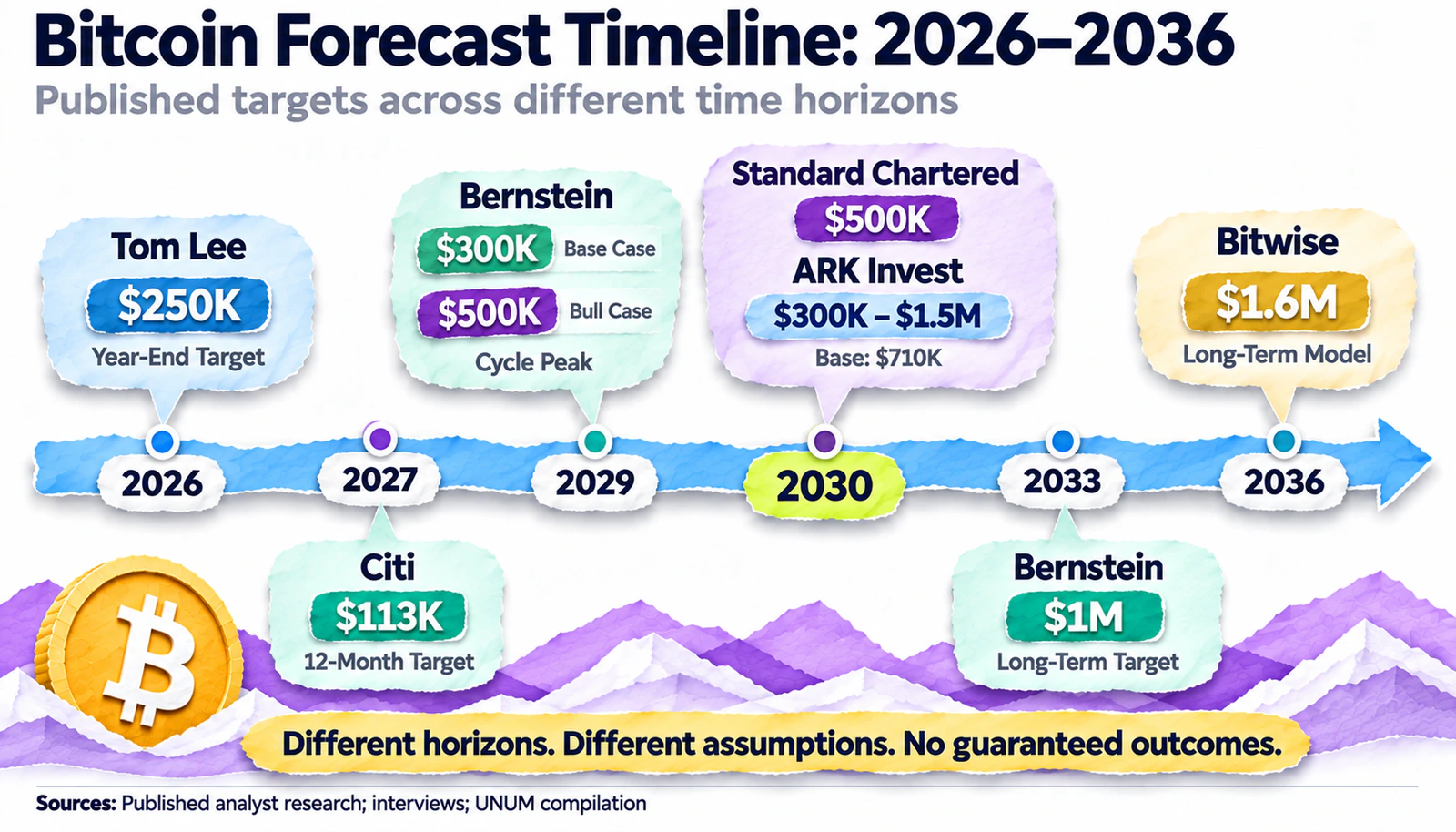
To avoid mixing assessments with different time horizons, let's consolidate the main published benchmarks into one table. It includes both direct target prices and collective or calculated estimates, but their types are indicated separately.
Author or Organization | Forecast | Horizon | Date and Type of Assessment |
|---|---|---|---|
Citi | $113k | 12 months | October 2026, raised bank target |
Bernstein | $150k | Mid 2027 | August 2026, base scenario |
Bernstein | $300k / $500k | Cycle peak 2029 | August 2026, base / optimistic scenarios |
Standard Chartered | $500k | 2030 | December 2025, deferred target |
ARK Invest | $300k / $710k / $1.5M | End of 2030 | April 2025, three scenarios |
ARK Invest | Capitalization around $16 trillion | 2030 | Big Ideas 2026, model assessment |
Finder | $490k | End of 2030 | April 2026, average of expert survey |
Brian Armstrong | $300–400k | 2030 | August–September 2026, personal assessment |
Tom Lee | $250k | End of 2026 | January 2026, individual forecast |
Arthur Hayes | Around $1M | End of decade, conditionally | June 2026, credit crisis scenario |
Josh Fraser | Around $500k given gold capitalization | Long-term | January 2026, conditional calculation |
Bitwise | $1.6M | 2036 | October 2026, ten-year model |
Sources: original research by ARK Invest, Bitwise, Finder, expert interviews, and reports from Reuters, The Block on closed bank studies. Scenarios are not comparable probabilistic forecasts.
The range of published expectations for the end of the decade remains exceptionally wide. However, the comparison confirms an important conclusion: the highest estimates often relate to optimistic scenarios or more distant dates, whereas near-term forecasts suggest a much lower value for BTC.
Which past Bitcoin forecasts did not come true
The history of individual forecasts shows why even confident statements by well-known investors need to be verified against actual results.
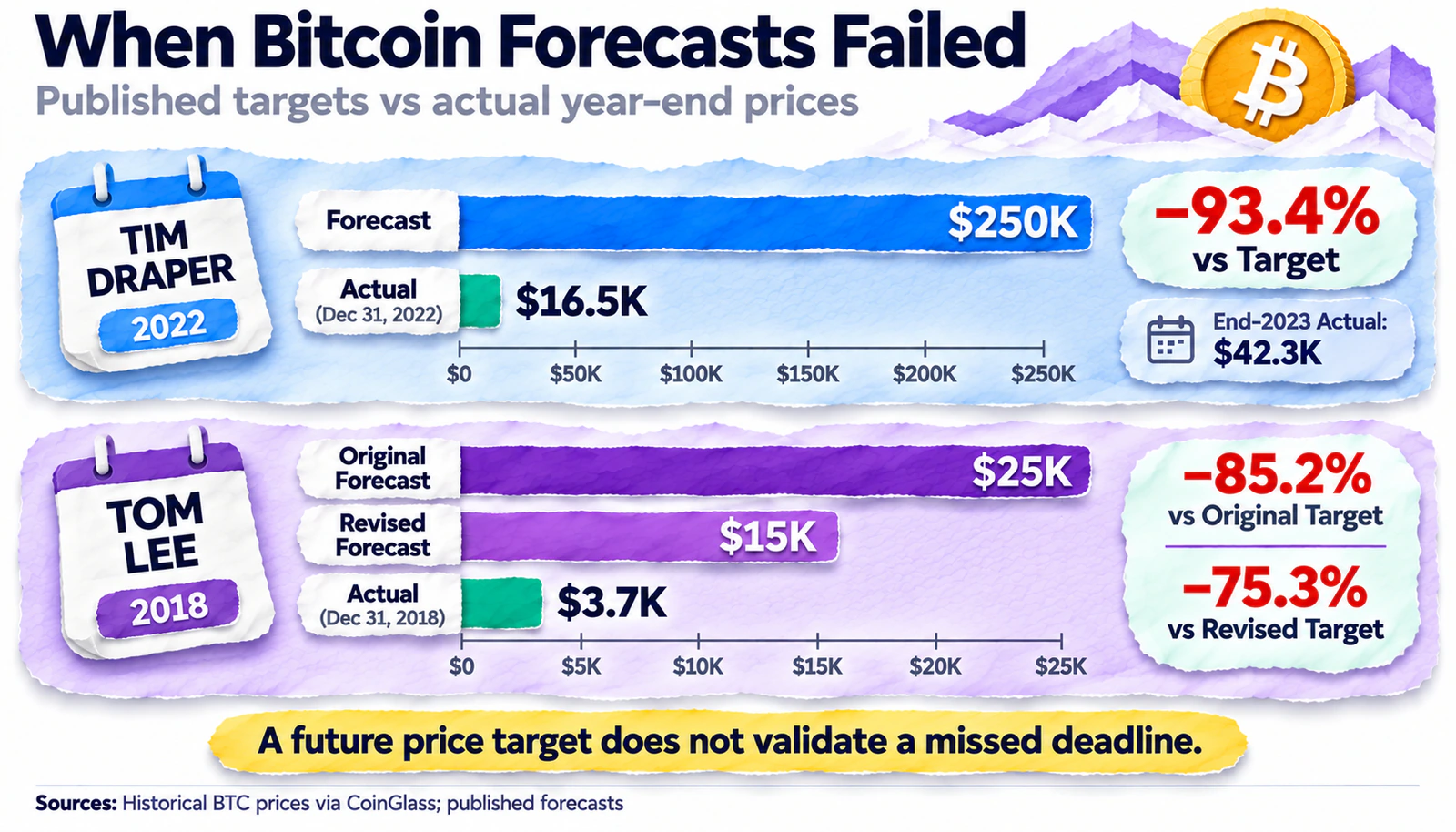
Tim Draper did not reach the $250K target within the specified timeframe
In 2018, venture investor Tim Draper predicted that Bitcoin would reach $250K by 2022. In an interview with Forbes, he explained the estimate by the expected growth in cryptocurrency usage, their gradual penetration into everyday payments, and the potential increase in Bitcoin's share of the global money market.
Later, in an interview, Draper clarified the timeframe as the end of 2022 or the beginning of 2023, but maintained the price target. After the initial period expired, he postponed expectations to the following years.
The actual BTC price at the close of December 31, 2022, was around $16,548, and by the end of 2023, it was about $42,265, according to historical data from CoinGlass. Thus, both benchmark values were significantly below $250K. By the end of 2025, the declared level was also not reached.
This example demonstrates the difference between an investor's belief in the long-term spread of an asset and the accuracy of a specific forecast. The possibility of reaching $250K in the future does not make the original estimate for 2022 correct in hindsight.
Tom Lee missed the forecast for the end of 2018
In May 2018, Tom Lee anticipated Bitcoin could rise to $25K by the end of the year. In November, after market conditions worsened, he lowered the target to $15K, but even this estimate was significantly higher than the actual BTC price.
According to CoinGlass, on December 31, 2018, Bitcoin closed at about $3,743. This is approximately 85% below Lee's initial forecast of $25K and about 75% below the revised estimate of $15K.
The example is particularly telling because the analyst revised the forecast during the year but failed to account for the full extent of the subsequent decline. The error does not mean that all his future estimates will necessarily be wrong. However, it shows how difficult it is to predict even a yearly Bitcoin price amid sharp changes in market liquidity.
To assess an expert's reliability, it's important to consider not a single successful prediction but the sequence of their forecasts, timelines, and the magnitude of deviations. If the target date has not yet arrived, it is more accurate to evaluate the scenario requirements rather than declare it realized or erroneous.
Why Bitcoin forecasts vary so much
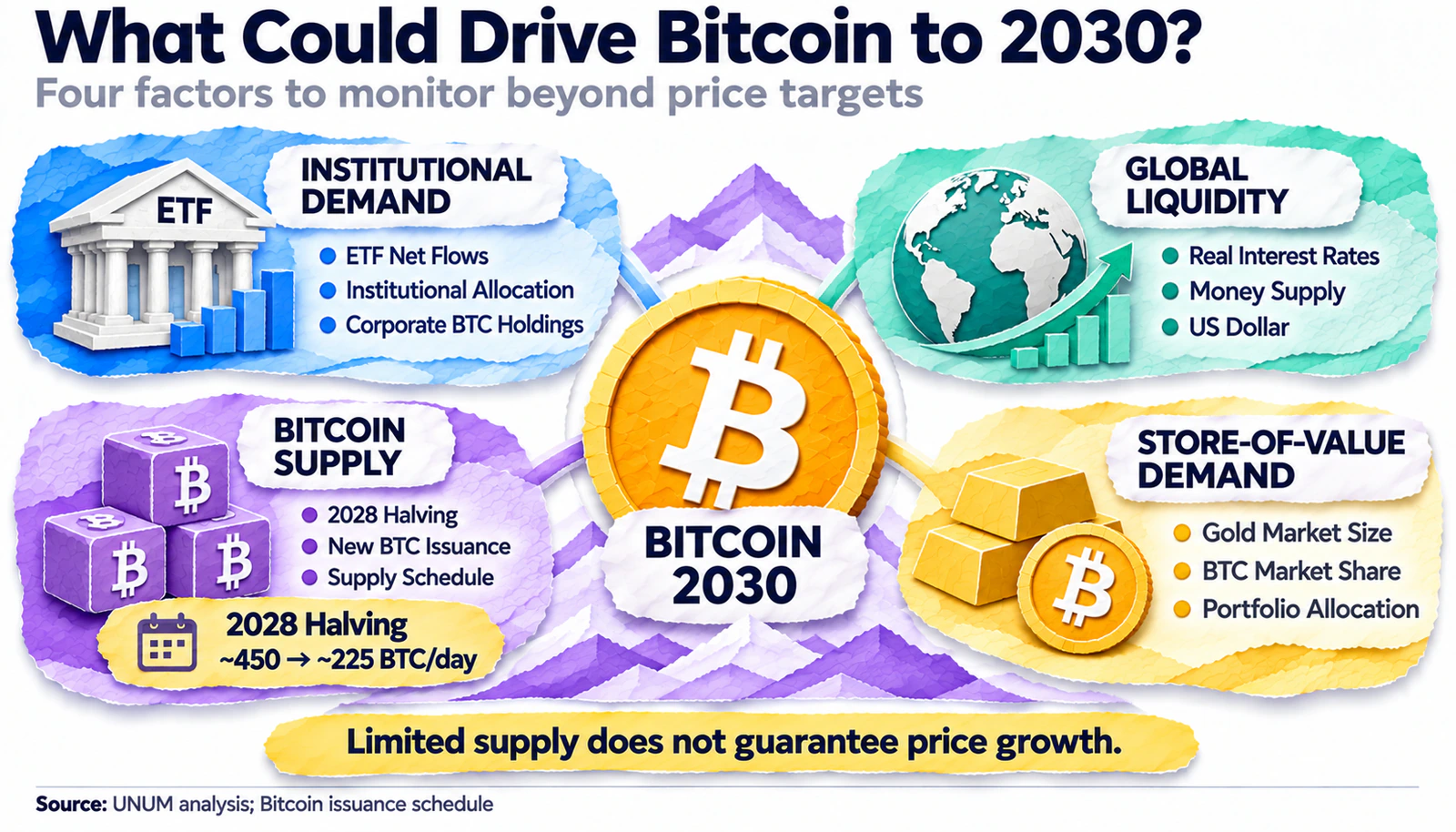
The main divergence among analysts is not about the BTC issuance schedule, which is known in advance, but about the assessment of future demand. For Bitcoin to reach $150K, $500K, or $1M, investors must be willing to buy coins at those prices, and the market must sustain such valuations over a prolonged period.
This is why fundamental analysis of Bitcoin differs from stock valuation. Cryptocurrency lacks corporate earnings or dividends that can be discounted to calculate value. Analysts use other approaches: comparisons with gold and investment capital markets, monetary liquidity, network effects, mining costs, and limited supply models.
Institutional demand and Bitcoin ETF
Spot Bitcoin ETFs in the US have made cryptocurrency more accessible through traditional investment infrastructure. However, the emergence of regulated funds does not guarantee a continuous capital inflow.
For example, according to Farside Investors, from November 2 to 6, 2026, US spot Bitcoin ETFs recorded a cumulative net outflow of about $1.28 billion. On November 4, the funds received $74.6 million, but on November 5 and 6, outflows amounted to $430.2 million and $411.9 million, respectively.
This dynamic shows that the institutional investment channel can amplify both demand and selling pressure. However, net ETF flows do not equal the total volume of Bitcoin purchases or sales on all cryptocurrency platforms and do not independently allow for determining the cause of a specific price movement.
For forecasts for 2030, the stability of capital distribution is more important. If large asset managers gradually increase the share of BTC in portfolios, demand could support its capitalization. If Bitcoin remains predominantly a high-risk instrument with a small share of institutional ownership, realizing the most optimistic scenarios will be more challenging.
In this context, it is necessary to evaluate not only fund flows but also corporate reserves. Public companies can increase demand for BTC, but cryptocurrency accumulation strategies are often associated with additional financial risks. For example, using borrowed funds and issuing new shares to acquire Bitcoin makes companies' results sensitive to its market price.
Therefore, even large corporate purchases should not automatically be considered a sustainable source of growth for decades to come.
Global Liquidity and Fed Interest Rates
The expected value of Bitcoin also depends on monetary policy and the state of the global financial market. When real interest rates remain high, bonds and cash instruments may become more attractive to investors who prefer relatively predictable returns.
Conversely, improved liquidity conditions can support interest in more volatile assets. However, this effect is not mechanical: Bitcoin can decline even amid an increase in the money supply if there are simultaneous large-scale sales or leverage issues in the cryptocurrency market.
Research by Sam Callahan, prepared with the participation of Lyn Alden, showed a high historical consistency of BTC movement directions and global liquidity over 12-month intervals. But the authors also note that short-term deviations arise due to internal market factors and changes in the asset's valuation.
Practical significance lies in the Fed's interest rates, real yields on U.S. government bonds, dollar dynamics, and lending conditions. These indicators need to be analyzed along with ETF flows and the state of the spot market.
An additional role is played by Bitcoin's connection with tech stocks. During the November 2026 sell-off, the decline in BTC was accompanied by a drop in Nasdaq. This indicates a possible influence of the general reduction in investors' willingness to take risks, although it does not prove a constant dependence between the two markets. This connection is further examined in UNUM's analysis "How Nasdaq's Decline Changes Bitcoin's Prospects".
Bitcoin's Competition with Gold
Comparison with gold occupies an important place in forecasts by ARK, Bitwise, and individual experts. Bitcoin has limited issuance, can be transferred between participants without physical movement, and can be divided into small units, making it a potential tool for preserving and transferring capital.
But these properties do not mean that BTC will automatically become an equivalent replacement for gold. The precious metal has a significantly longer history of use in reserves and investment portfolios, and its market behavior differs from cryptocurrency dynamics.
In ARK's updated model, the digital gold market is estimated at approximately $24.4 trillion. For negative, base, and optimistic scenarios, the company assumes that Bitcoin could capture a share equivalent to 20%, 40%, and 60% of gold's capitalization, respectively. These are model assumptions, not established market trends.
The important question is not whether BTC can theoretically reach a capitalization of several trillion dollars, but how sustainable demand for it can be given its high volatility.
The advantages and limitations of Bitcoin as digital gold are further explored in UNUM's article "Crypto Becomes Part of the Traditional Portfolio: What's Left of the Digital Gold Idea".
2028 Halving and Limited BTC Issuance
The maximum supply of Bitcoin is limited to 21 million coins. The next halving is expected around 2028, when the reward to miners for a new block will decrease from 3.125 to 1.5625 BTC.
With an average block creation time of about ten minutes, the daily issuance of new coins will decrease from approximately 450 to 225 BTC. The actual halving date is determined by reaching a set block height, so it may differ from calendar forecasts.
Limited BTC issuance remains one of the main arguments for long-term investments, but it does not guarantee price growth by itself. The issuance schedule is known in advance to market participants, so the impact of halving depends on how the reduction in new supply relates to actual demand.
The Stock-to-Flow model, popularized by analyst PlanB, uses the ratio of existing supply to annual new coin issuance. Its main limitation is that supply scarcity does not independently determine how much buyers will be willing to pay for the asset.
Therefore, to assess Bitcoin's price by 2030, the issuance schedule needs to be compared with institutional demand, liquidity, and the overall market environment.
What Market Capitalization is Needed for Bitcoin to Meet Forecasts
To estimate how much Bitcoin will be worth under various scenarios, it is necessary to link the target price with the projected number of coins in circulation.
ARK's model for the end of 2030 uses a supply of approximately 20.5 million BTC. Applying this assumption to several popular target levels, we get the following estimated market capitalizations:
$150,000 per BTC — about $3.08 trillion.
$300,000 — about $6.15 trillion.
$500,000 — about $10.25 trillion.
$1 million — about $20.5 trillion.
These are The Unum's calculations, not individual forecasts of future capitalization. They do not imply that increasing Bitcoin's market value by $1 trillion requires exactly $1 trillion in new funds.
Capitalization is determined by the product of market price and the number of coins, while the price itself is formed through buyer and seller transactions. Therefore, capitalization can change significantly more than the volume of net cash flows.
However, to maintain a high Bitcoin value, a steady demand capable of absorbing sales from existing holders is necessary. Otherwise, the price may quickly decline even after reaching a previously stated target.
What Growth Rates Are Required for BTC Until the End of 2030
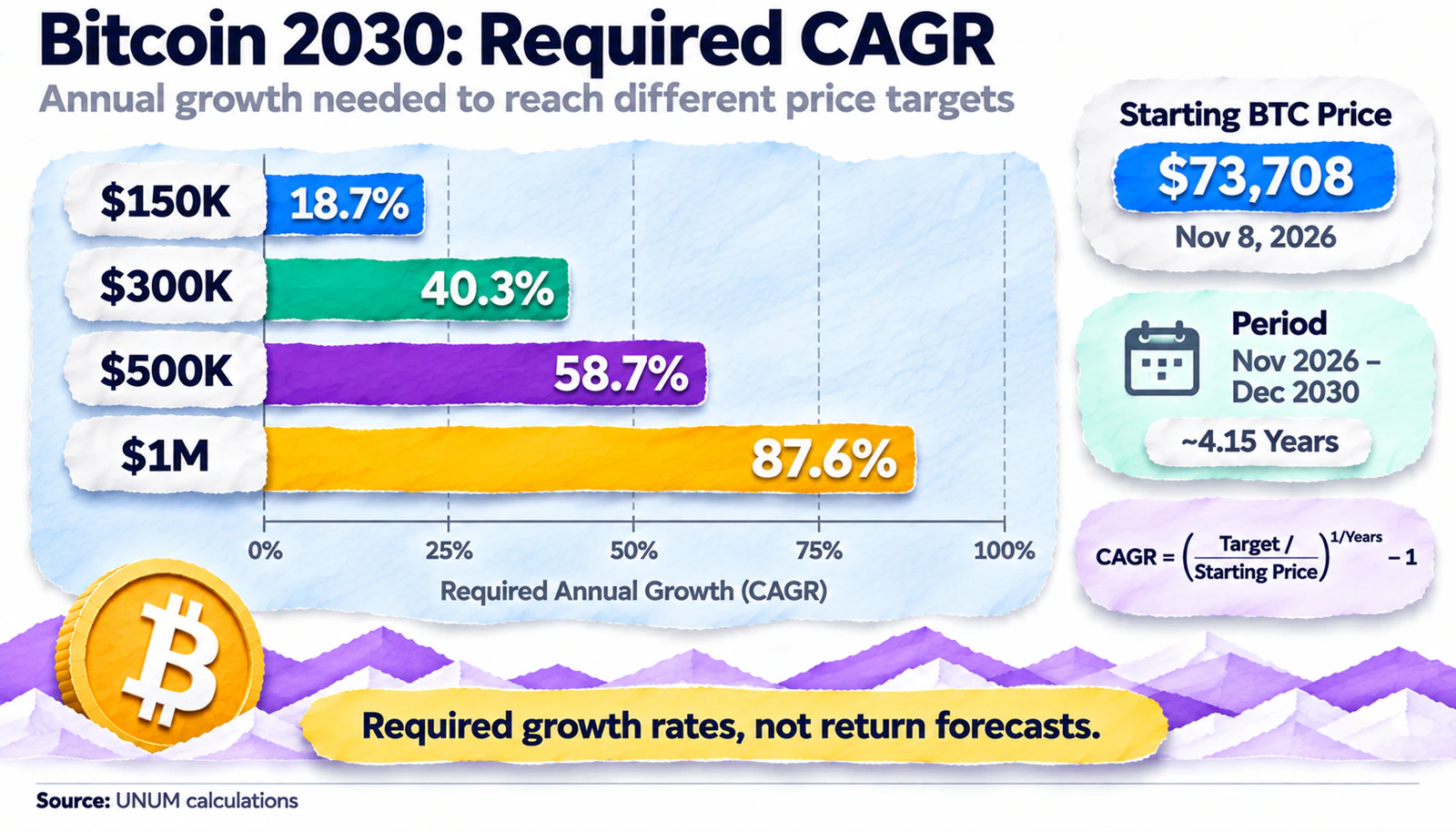
An additional check of forecasts is provided by the compound annual growth rate — CAGR.
For the calculation, we use the historical price of $73,708 from November 8, 2026, and the end date of December 31, 2030. Between these dates, there are approximately 4.15 years, not exactly four years. Therefore, the required growth rates are:
Target $150,000 — 18.7% per year
Target $300,000 — 40.3% per year
Target $500,000 — 58.7% per year
Target $1 million — 87.6% per year
Calculations by The Unum for the period from November 8, 2026, to December 31, 2030. Values are rounded to one decimal place.
Even the $150,000 scenario implies an average annual growth of nearly 19%. To reach $500,000, Bitcoin must appreciate by about 59% annually, while the $1 million target requires around 88% per year throughout the period considered.
These figures are not a forecast of returns. They show the mathematical conditions for achieving target prices, while the actual trajectory may include prolonged periods of decline and sharp recovery.
For comparison, it is useful to consider the more distant VanEck model. In January 2026, the company published a base scenario of Bitcoin at $2.9 million by 2050, implying an average annual growth of about 15% from the end of 2025 price. The forecast is based on the use of BTC in international settlements and central bank reserves. Although the final price is higher than many estimates for 2030, the implied growth rate is significantly lower due to the long horizon.
This once again shows why forecasts from different organizations cannot be compared solely by the maximum stated price. To assess realism, it is necessary to consider the time frame for achievement, initial cost, and economic conditions of the model.
What Investment Risks Could Hinder Bitcoin's Growth
High forecasts assume a gradual expansion of demand for BTC, but this process may be significantly slower than analysts expect or may stall at certain stages.
One of the key risks is associated with prolonged weakening of investment demand. If high real rates persist and global liquidity grows slowly, investors may prefer bonds and other instruments with more predictable yield characteristics.
Another risk is that Bitcoin ETFs and corporate reserves may not provide the expected volumes of new purchases. November outflows from U.S. spot funds already show that the availability of regulated investment products does not guarantee a constant increase in investments.
Technological threats are also of significant importance. Bitwise highlighted risks in its October study related to the development of quantum computing, AI-based mathematical methods, and potential regulatory tightening. At the same time, the company itself expects Bitcoin to continue experiencing significant downturns even amid long-term growth.
It is also necessary to consider the potential concentration of ownership. If a significant portion of the expected demand comes from a limited circle of corporate and institutional holders, changes in their financial position or strategy could significantly impact the market.
The interest of forecast authors should not be ignored. ARK Invest, Bitwise, VanEck, and other investment companies offer products or services related to digital assets. Executives at Coinbase and Strategy also work in companies whose financial results depend on the development of the cryptocurrency market.
Such interest does not automatically make the forecast incorrect but requires especially careful verification of calculations and assumptions.
For the current analysis of investment risks, it is useful to compare long-term models with the actual state of the market. For example, in the UNUM article “Bitcoin's Growth Relies on Futures: What's Next for BTC”, it is discussed how open interest, funding rates, and spot demand help assess the sustainability of price movements.
Which Bitcoin Scenarios Can Be Considered Justified by 2030
After comparing forecasts, it becomes clear that the market does not have a single reliable method for determining the future value of Bitcoin. Banks, investment companies, and independent analysts use different assumptions, and even detailed models from ARK and Bitwise depend on subjective assessments of potential demand.
Therefore, for practical analysis, it is more useful to highlight three groups of conditions that can lead to different outcomes.
A negative, or bearish, scenario assumes weak institutional demand, a prolonged period of tight financial conditions, and no significant expansion of Bitcoin's role in investment portfolios. In this case, BTC may significantly lag behind most optimistic estimates for 2030, even if the network continues to operate and the next halving occurs as scheduled.
The baseline scenario envisions gradual institutional adoption of Bitcoin without drastic changes in the structure of global finance. ETFs maintain a significant role, individual companies continue to accumulate BTC, and investor demand increases unevenly. In such a market development, the value of Bitcoin will depend on a combination of long-term adoption and cyclical liquidity fluctuations.
An optimistic, or bullish, scenario requires more substantial changes. Bitcoin must secure a stable share in global investment portfolios, strengthen its position as a store of value, and attract additional capital from major financial organizations. These are the prerequisites necessary for realizing the highest scenarios of ARK Invest and the long-term model of Bitwise.
However, the editorial assessment should not mechanically assign an exact probability to each scenario. Based on available research, it is impossible to reliably determine how likely it is to reach $300,000, $500,000, or $1 million by the end of 2030.
To assess movement toward any of the scenarios, investors need to monitor changes in real indicators: capital flows into ETFs, institutional allocations, global liquidity, corporate reserves, and spot demand.
Current Bitcoin quotes, market capitalization, price chart, and on-chain metrics can be tracked on the Bitcoin (BTC) page in UNUM.
What Analysts Ultimately Expect from Bitcoin by 2030
Bitcoin forecasts for 2030 still vary several times over. Standard Chartered has postponed reaching $500,000 to the end of the decade, Citi raised its 12-month target to $113,000, and Bernstein allows for growth to $300,000–500,000 at the peak of the cycle in 2029 under different conditions of institutional demand.
ARK Invest has maintained a relatively stable long-term model but revised its main assumptions. Bitwise, on the other hand, raised its ten-year estimate to $1.6 million by 2036 due to the increase in potential market sizes where Bitcoin can compete with traditional assets.
Among individual experts, disagreements are no less significant. Brian Armstrong lowered his own target for 2030, Tom Lee continues to expect a sharp rise in the near term, and Arthur Hayes associates the possible achievement of $1 million with large-scale changes in monetary policy. The experience of previous forecasts by Tim Draper and Tom Lee shows that even well-known investors can significantly err with timing.
The main factor determining Bitcoin's future is the asset's ability to attract sustainable investment demand with limited supply. Therefore, a high target price, the notoriety of the forecaster, or previous growth cycles alone are not sufficient grounds for an investment decision.
For evaluating long-term forecasts, it is more important to analyze their underlying assumptions, check the history of accuracy, and monitor changes in measurable market indicators. These will help understand whether Bitcoin is approaching the stated levels or if the market is developing according to a different scenario.